Published On:
February 3, 2026
Updated On:
February 3, 2026
Following a fatal accident involving a tech professional in Sector 150, the Noida Authority has issued a strict directive identifying 65 "black spots" across the city. Real estate developers must now secure not just their sites but the immediate surroundings with proper barricading, lighting, and signage or face severe penalties.
For years, the rapid urbanization of the National Capital Region (NCR) has been defined by the sound of jackhammers and the sight of rising skylines. However, a recent and heartbreaking tragedy in Noida’s Sector 150 has brought the construction frenzy to a screeching halt, forcing a hard look at the price of development. The loss of a young life—a software engineer whose vehicle plunged into an unguarded, water-filled pit on a foggy night—has exposed a lethal gap in our civic infrastructure: the "unmanaged periphery" of construction sites.
In response, the Noida Authority has moved from advisory to enforcement. The administration has issued a sweeping order to all real estate developers, mandating that the safety of the public is as much their responsibility as the safety of their workers. The message is clear: the project boundary does not end at the plot line; it extends to the road, the service lane, and the drains that surround it.
While construction accidents often involve workers within the site, this recent incident highlighted a different danger—the hazard posed to the common commuter. The accident occurred near a commercial plot where a deep excavation, intended for a basement, had been left exposed. Combined with the dense winter fog typical of North India and a lack of reflective signage or sturdy barricades, the site became a death trap.
This tragedy was not an isolated misfortune but a symptom of a larger malaise. Stalled projects, open basements filled with rainwater, and service roads cluttered with building materials have turned parts of Noida, particularly the developing sectors along the Expressway, into obstacle courses. The public outcry following the incident has pushed the authorities to identify 65 specific "black spots" or high-risk zones across the city that require immediate intervention.
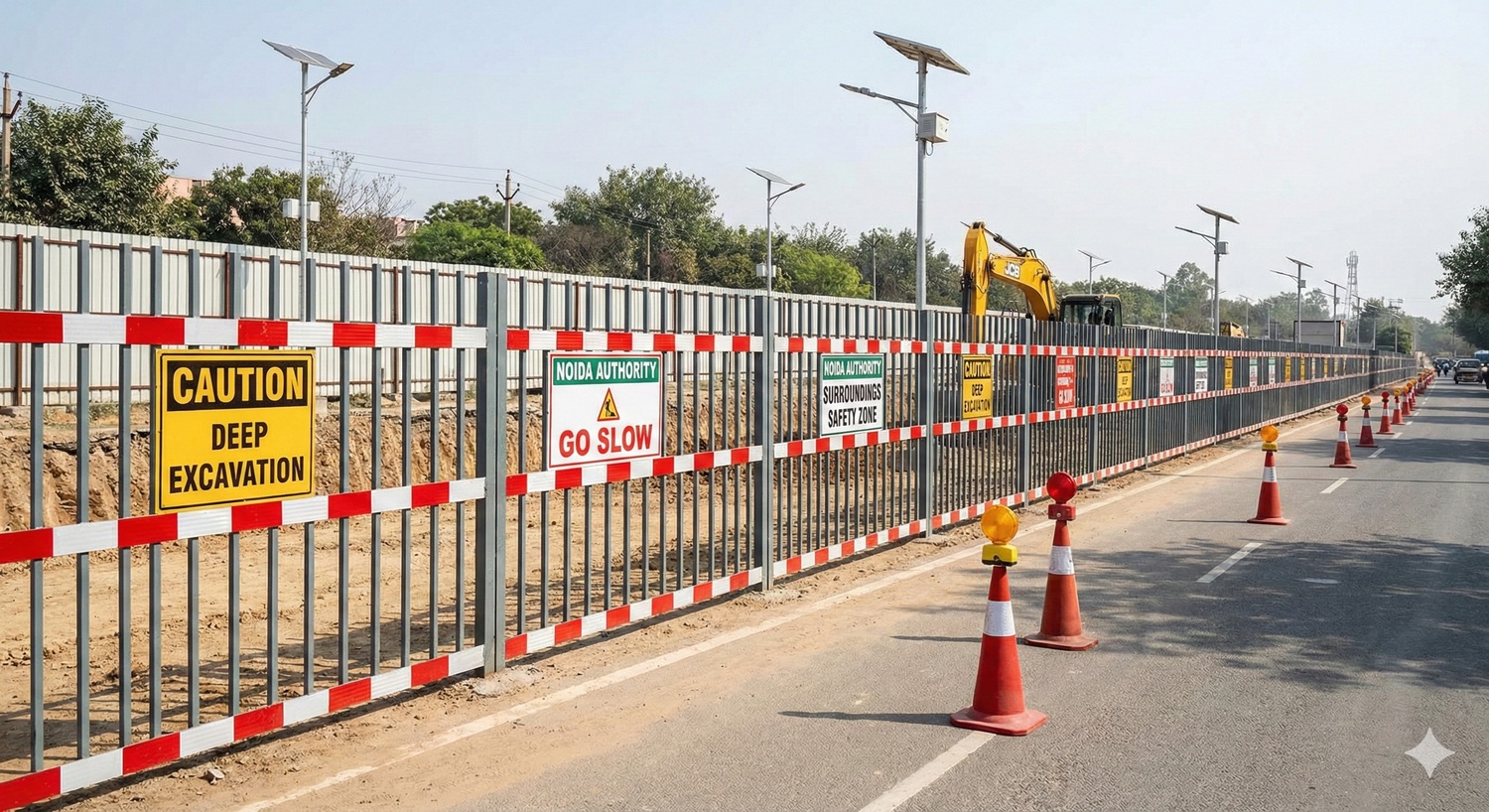
The Noida Authority’s latest directive fundamentally changes the compliance landscape for builders. It is no longer enough to simply fence off a plot with temporary blue tin sheets that often rust or fall over. The new guidelines demand a robust, "public-first" approach to site containment.
The era of flimsy taping is over. Developers are now required to install sturdy, structural barricades around any excavation site. These barriers must be capable of withstanding impact and must be anchored securely to prevent them from being displaced by wind or minor collisions.
A key failure in the recent accident was poor visibility. The new rules mandate the installation of high-intensity reflective tapes and blinkers on all barricades. These must be visible from a distance, cutting through fog and darkness to warn approaching motorists. Adequate street lighting around the project periphery is now the developer's burden, ensuring there are no dark spots where hazards can hide.
Perhaps the most significant shift is the definition of "project surroundings." Developers are now accountable for the condition of the roads immediately adjacent to their plots. If a service lane is riddled with potholes caused by heavy construction trucks, or if drainage is blocked by cement debris leading to waterlogging, the developer must rectify it. The practice of dumping sand or steel rods on public roads is now strictly prohibited and will attract immediate penalties.
A unique challenge in Noida is the prevalence of stalled or "ghost" projects—sites where construction stopped years ago due to insolvency or legal disputes, but the excavation remains. These abandoned pits, often hidden by overgrown vegetation, are ticking time bombs.
The authority’s survey revealed that many of the identified black spots belong to these dormant projects. The new order clarifies that the legal status of the project does not absolve the land-owning entity of safety obligations. Whether a project is active, stalled, or under litigation, the physical site must be secured. If the developer fails to do so due to financial inability, the Authority has signaled it will step in to secure the site and recover the costs as arrears of land revenue, a move that could lead to the attachment of assets.
The administration has set a tight deadline for compliance. Developers have been given until February 28 to rectify identified lapses. This includes:
Failure to meet this deadline will trigger a "Zero Tolerance" policy. The penalties are not limited to fines. The administration has indicated readiness to file FIRs for negligence against directors of non-compliant firms, a precedent already set by the arrest of a developer following the Sector 150 incident. Furthermore, occupancy certificates (OC) and completion certificates (CC) for other ongoing projects by the same developer could be withheld until safety norms are met.
For too long, the Indian real estate sector has viewed safety as a "box-ticking" exercise rather than a critical operational value. Construction zones in cities like London or Dubai are hermetically sealed from the public, with clear pedestrian walkways and rigorous traffic management plans. Noida’s new mandates aim to bring this level of discipline to the NCR.
This crackdown also empowers the residents. With the list of black spots being a matter of public record, Resident Welfare Associations (RWAs) and ordinary citizens are now acting as watchdogs, reporting unlit barricades or open drains via social media and official apps.
The tragedy that claimed a young life in Sector 150 was preventable. While no regulation can undo the loss, the swift and comprehensive reaction from the Noida Authority offers hope that such negligence will no longer be tolerated. By forcing realtors to look beyond their profit margins and secure the "surroundings" of their ambitions, Noida is taking a painful but necessary step toward becoming a safer, more responsible urban center. The message to the builders is simple: If you build in our city, you must ensure the city survives your construction.
