Published On:
March 12, 2026
Updated On:
March 12, 2026
The Uttar Pradesh cabinet has mandated that a seller's name must be officially recorded in the Khatauni (land records) before any property registration can proceed, effectively striking a massive blow to the state's land mafia and securing buyer investments.
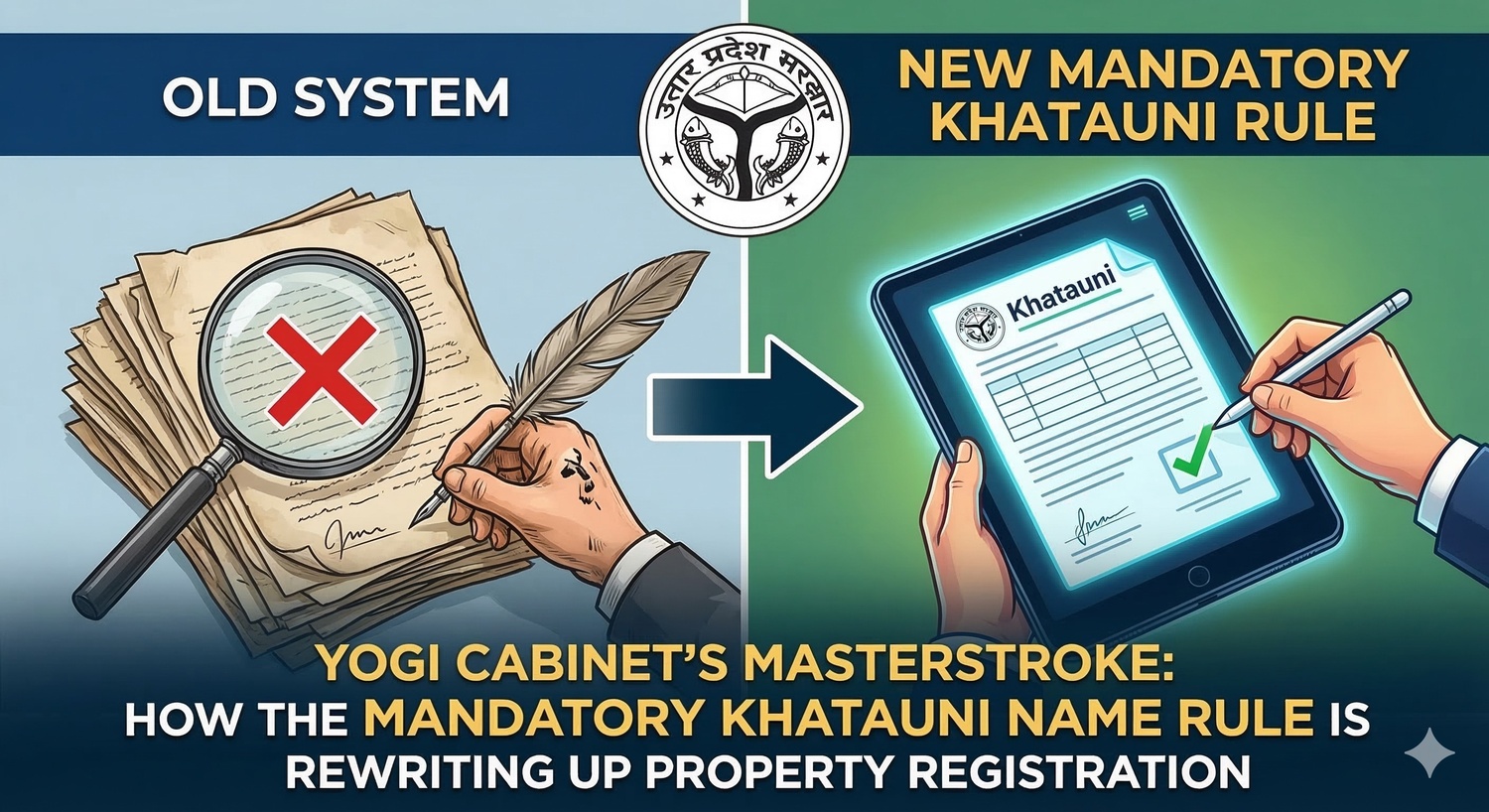
The real estate landscape in Uttar Pradesh is undergoing a massive and permanent recalibration. For decades, the property market, particularly in the rapidly expanding urban and peri-urban corridors, has been plagued by a severe lack of transactional transparency. Buyers frequently found themselves entangled in years of exhaustive litigation after discovering that the plot of land they purchased with their life savings was sold by someone who did not actually hold the legal title. To completely eradicate this systemic vulnerability, a recent Yogi cabinet decision approved a sweeping set of reforms targeting the very foundation of property transactions.
The objective is incredibly clear: to transform the state's real estate sector from a historically fragmented, speculative arena into a highly organized, end-user-driven economic powerhouse. By attacking the root cause of land disputes, the administration is restoring deep, institutional trust in the secondary resale market.
The absolute centerpiece of this legislative overhaul is the new, uncompromising UP property registration rule. In a landmark move, the state government has officially mandated that no piece of land can be registered or sold unless the seller's name is explicitly documented in the official revenue records. This makes the Khatauni name required protocol the ultimate gatekeeper for any real estate transaction moving forward.
Historically, the registration process across North India was alarmingly superficial. The sub-registrar’s primary responsibility was merely to verify the physical identity of the individuals executing the sale deed at the time of the appointment. If the buyer and seller presented valid, government-issued identification documents, such as an Aadhaar card or a Voter ID, the registry was typically processed without any further scrutiny into the actual ownership of the underlying asset. This massive procedural loophole allowed fraudulent individuals, impersonators, and the land mafia to illegally sell land they had no legal claim over. Under the new regime, mere physical identification is no longer sufficient to execute a sale.
To understand the immense gravity of this reform, one must first understand the specific anatomy of land records in Uttar Pradesh. The Khatauni is a highly detailed, official revenue document that acts as the ultimate ledger of land ownership and cultivation rights within a specific village, tehsil, or locality. It details the Khasra number (the unique survey number assigned to a specific plot), the total geographical area, the exact land revenue payable to the state, and, most crucially, the legally recognized names of the individuals who rightfully own the property.
When a property is legitimately sold, inherited, or transferred, a subsequent legal process known as mutation—locally referred to as 'Daakhil Kharij'—must be executed within the state's revenue department. Mutation officially removes the previous owner's name and legally inserts the new owner's name into the Khatauni. However, in many rural and semi-urban transactions over the past few decades, buyers would execute the sale deed at the local registrar's office but completely neglect the subsequent mutation process to avoid paying administrative fees or out of sheer legal ignorance.
This widespread negligence resulted in chaotic situations where the physical possession of the land belonged to one person, but the legal title in the government records still reflected the original owner or even a deceased ancestor. Fraudsters heavily exploited this massive disconnect. By legally mandating that the seller's name must strictly match the Khatauni records before a new sale deed can be executed, the government is forcing the entire market to proactively update and clean up their land records. If the name presented does not match the digitized revenue database, the transaction is immediately red-flagged, the registration process is completely halted, and the stamp and registration department initiates an active, thorough investigation into the discrepancy.
This policy shift is a monumental victory for the common homebuyer, the agricultural land investor, and large-scale developers. Real estate is highly capital-intensive, and the constant fear of falling victim to land sharks or forged registries has historically kept a significant amount of domestic and NRI capital sitting cautiously on the sidelines.
By shifting the heavy burden of title verification to the exact moment of registration, the state is acting as a proactive protective shield. Buyers no longer have to rely solely on expensive legal counsel or highly dubious local brokers to verify the authenticity of a property title. The government’s sub-registrars will now cross-reference the seller's details directly with the digitized Bhulekh portal—the state's online, real-time land record database. This instant validation entirely neutralizes the threat of impersonation and duplicate sales. It ensures that when a buyer parts with their hard-earned capital for a piece of land, they receive an absolute, undisputed legal title. Over time, this single legislative move is expected to drastically reduce the sheer volume of property-related civil suits currently clogging the district courts.
While the Khatauni mandate brilliantly secures the individual transaction, the cabinet also passed crucial financial amendments regarding how property taxes are utilized to fuel the state's explosive urban growth. Uttar Pradesh is urbanizing at a breakneck pace, and local municipal corporations require a steady, massive, and predictable flow of capital to build and maintain essential civic infrastructure like high-capacity sewage systems, wide arterial roads, and smart city power grids.
Previously, a highly complex and heavily bureaucratic system governed the distribution of circle rate fees and additional stamp duties. The state collected a one percent fee based on the prevailing circle rate and an additional two percent stamp duty earmarked specifically as a development fee for properties located strictly within municipal corporation limits. However, the actual transfer of these funds back to the local civic bodies was painfully slow. The capital was only released after the local authorities submitted exhaustive Utilization Certificates proving exactly how previous funds were spent, leading to massive delays and stalled infrastructure mega-projects.
The cabinet has completely streamlined this vital financial pipeline. Under the newly approved regulations, the state government will automatically release these accumulated development funds to the respective local bodies every six months, completely bypassing the archaic requirement of waiting for immediate usage certificates. By decentralizing this capital flow, municipal corporations in rapidly expanding economic hubs like Lucknow, Kanpur, Meerut, and Ghaziabad will now possess a highly predictable, biannual revenue stream. This deep financial liquidity allows city planners to aggressively execute long-term urban development projects, ensuring that the physical civic infrastructure keeps perfect pace with the booming residential and commercial real estate construction happening around it.
The real estate and economic masterplan of Uttar Pradesh extends far beyond the borders of its primary metropolitan cities. Recognizing that true, equitable economic mobility requires frictionless physical mobility, the cabinet also greenlit the highly anticipated CM Gram Transport Yojana 2026. This ambitious logistical project is purposefully designed to completely overhaul rural connectivity, seamlessly linking the state's massive, highly productive agricultural hinterlands with its burgeoning urban centers.
Uttar Pradesh comprises an astounding 59,163 individual gram sabhas. Despite significant, highly visible improvements in the national and state highway infrastructure over the past seven years, a staggering 12,200 of these villages remain entirely isolated, lacking any form of regular, reliable, and safe public transportation. The new rural transport scheme directly targets this massive logistical void. The state administration plans to rapidly deploy massive fleets of modern, 28-seater buses specifically designed to navigate deep rural road networks, bringing these historically disconnected populations directly into the primary economic fold.
To ensure the rapid, flawless deployment and massive scale of this initiative, the government is highly incentivizing aggressive private sector participation. Crucially, the buses operating under this specific rural scheme will be entirely tax-free, creating a highly lucrative, low-friction business model for private fleet operators, local entrepreneurs, and transport agencies. The operational logistics, including precise route mapping and standardized fare structures, will be strictly governed by a dedicated district-level committee headed by the local District Magistrate alongside Regional Transport Officers. This ensures fair pricing for the rural consumer and optimal, profitable coverage for the private operator.
The intersection of this massive transport scheme with the broader real estate and land market is profound. Land values are intrinsically tied to logistical accessibility. When a previously isolated, deep-pocket village is officially integrated into the regional transit grid, the fundamental economic dynamics of the surrounding land change almost overnight.
Farmers gain frictionless, daily access to larger urban wholesale markets, significantly boosting regional agricultural incomes. More importantly, the ambitious youth from these villages can now easily commute to nearby industrial hubs, corporate parks, and educational institutions without being permanently forced to migrate and rent expensive accommodations in the congested city centers. This daily, fluid movement of people and commerce naturally stimulates massive peripheral economic growth.
As physical connectivity improves, large-scale developers and institutional investors inevitably begin looking outward. They aggressively acquire large, consolidated land parcels in these newly accessible rural corridors to build specialized industrial logistics parks, vast cold storage facilities, and sprawling affordable housing townships. The transport scheme essentially expands the viable, investable real estate footprint of the entire state, turning distant agrarian land into highly productive, high-yielding economic assets.
When analyzed collectively, the 30 critical proposals approved during the high-powered cabinet meeting held in Lucknow’s Lok Bhawan represent a highly cohesive, highly strategic vision for the state's economic future. The current administration is aggressively dismantling the archaic, opaque, and highly exploitative systems that have historically stifled economic progress. In their place, they are systematically installing digitized, heavily regulated, and highly transparent frameworks that reward honest investment and severely penalize fraud.
The strict mandate requiring verified Khatauni records before executing any property registration is arguably one of the most critical legal and financial reforms in the state's modern history. By forcefully dragging all land transactions out of the shadows and demanding absolute documentary proof of legal ownership, the state is entirely dismantling the black market of property fraud at its very source. Buyers can now comfortably invest their life savings with absolute certainty, knowing beyond a shadow of a doubt that the institutional mechanisms of the state are actively working to protect their ownership rights.
Simultaneously, the highly strategic reallocation of stamp duty revenues ensures that the state's urban centers are exceptionally well-capitalized and fully prepared to support the massive influx of corporate commercial and luxury residential real estate projects. This guaranteed financial liquidity empowers local governments to deliver the world-class civic amenities—from uninterrupted power to flawless sanitation—that modern homebuyers and global multinational corporations absolutely demand before setting up operations.
The real estate sector acts as the ultimate, undeniable barometer for regional economic health, driving massive employment, generating heavy tax revenues, and fueling secondary industry growth across steel, cement, and logistics. For Uttar Pradesh to achieve its highly publicized, aggressive ambition of transforming into a trillion-dollar economy, its land and property markets must operate with the exact same level of institutional trust, speed, and efficiency as global financial markets.
The recent comprehensive cabinet decisions are a massive, perfectly calculated leap in that exact direction. By completely eradicating the fear of fraudulent land sales, guaranteeing consistent urban infrastructure funding, and physically connecting its massive rural population to the modern grid, Uttar Pradesh is sending a very clear, unambiguous message to the global financial community. The state has permanently shed its legacy of bureaucratic red tape and exhausting property disputes. It is now actively operating as a highly secure, aggressively expanding, and deeply transparent economic powerhouse, perfectly positioned to attract billions in investment and lead the next great wave of India's real estate boom.
