Published On:
June 10, 2026
Updated On:
June 10, 2026
YEIDA is launching a massive land acquisition drive to develop 10 brand-new sectors (Sectors 5 to 14) near the upcoming Noida International Airport in Jewar, utilizing a farmer-friendly land pooling policy. This expansion promises over 1 lakh jobs, premium residential zones, and industrial hubs, cementing the Yamuna Expressway as North India's fastest-growing real estate corridor.
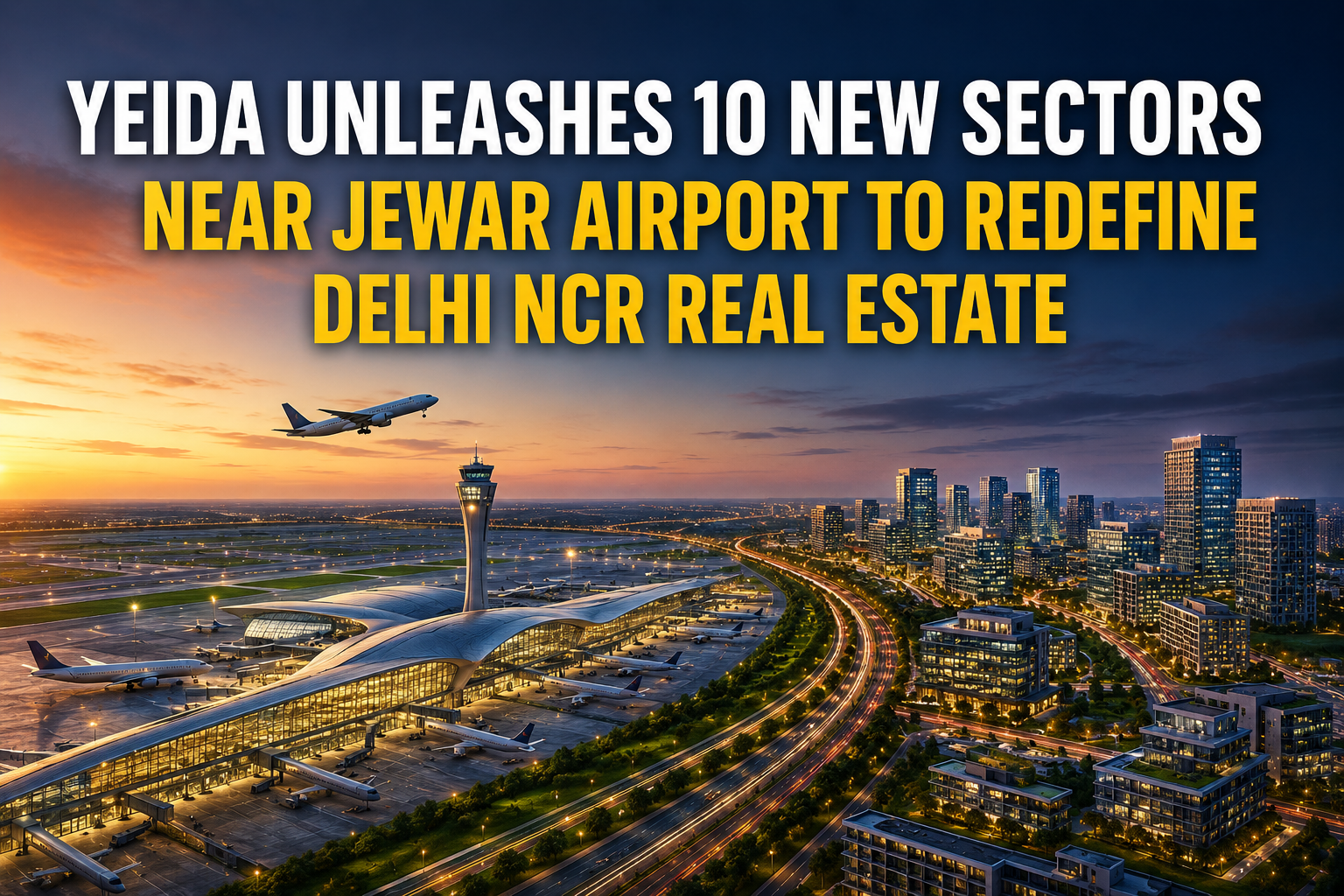
The landscape of the National Capital Region is undergoing a historic transformation. Driven by the rapid development of the Noida International Airport at Jewar, the Yamuna Expressway Industrial Development Authority has officially set in motion a mega land bank acquisition drive. This ambitious urban planning initiative will pave the way for 10 brand-new sectors within Yamuna City. Positioned strategically alongside the Yamuna Expressway in Gautam Buddha Nagar, these new sectors represent the most significant urban expansion in the region to date.
For years, real estate investors, large-scale developers, and prospective homebuyers have kept a close eye on the Yamuna Expressway corridor. Now, the transition from long-term vision to active execution is happening. The launch of Sectors 5 through 14 is not just about plotting land on a map; it is about building an entirely new, self-sustaining metropolis from the ground up. By blending smart residential communities, high-tech industrial parks, and world-class commercial zones right next to what will soon be India's largest aviation hub, the authority is shaping a walk-to-work lifestyle that promises to alleviate the heavy congestion plaguing the traditional hubs of Delhi and Gurgaon.
The master plan for Yamuna City has been carefully segmented to prevent haphazard growth and ensure balanced urban functionality. The 10 newly designated sectors are divided into highly specialised zones, each serving a distinct economic and lifestyle purpose.
The immediate demand generated by the airport operations will require massive housing infrastructure. Sectors 5, 6, 7, and 11 are strictly earmarked for residential development. Because of their sheer proximity to the airport transit lanes, Sectors 5 and 6 are already experiencing massive speculative interest. These zones will host a mix of high-rise group housing societies, premium independent plots, and affordable housing complexes. The urban design mandates wide arterial roads, extensive green belts, local parks, and smart city integrations to ensure a high standard of living.
Yamuna City is not just a bedroom community; it is designed to be an economic powerhouse. Sectors 8, 9, and 10 have been reserved exclusively for industrial setups, manufacturing units, electronic clusters, and specialised zones like Toy Parks and textile hubs. The strategic brilliance of these industrial sectors lies in their direct access to the upcoming airport cargo terminal. Businesses operating out of these sectors will enjoy unmatched logistical advantages, enabling rapid import and export capabilities that will attract both domestic conglomerates and foreign direct investment.
To support the residential and industrial populations, Sectors 12 and 13 are mapped out for heavy commercial and mixed-use development. This is where the skyline will feature luxury shopping malls, five-star hotel chains, high-street retail promenades, and massive corporate office complexes. Meanwhile, Sector 14 is firmly dedicated to institutional development. This zone will become the intellectual and healthcare backbone of the city, housing top-tier universities, research centres, and multi-speciality hospitals. This strategic zoning ensures that residents will have access to high-end careers, entertainment, and essential civic services within a short, walkable distance from their homes.
Acquiring thousands of hectares of land for urban development is traditionally a bottleneck plagued by legal disputes, protests, and prolonged delays. However, the authority is implementing a highly cooperative, mutual-consent approach to secure the required land bank without friction.
Instead of relying on forced acquisitions, the administration is aggressively promoting the Uttar Pradesh Land Pooling Policy. Under this progressive framework, the local farming community does not just walk away with a one-time cash settlement. Instead, farmers who voluntarily hand over their agricultural land receive a developed portion of commercial or residential land back in the newly established sectors. This fundamentally changes the dynamic, turning local villagers into long-term stakeholders and direct partners in the region's economic boom.
District administration teams are currently holding extensive meetings across the affected villages to explain these compensation packages transparently. The ultimate goal is to establish a massive, undisputed, and legally clear land bank by the end of the current financial year.
A critical element in smoothing the land acquisition process has been standardising the compensation rates. To bring parity across the massive airport-expressway growth belt, recent benchmark land rates for adjacent expansion areas like New Noida have been aligned with the authority’s rates, fixed at roughly ₹4,300 per square metre. This uniform valuation gives landowners a clear, reliable reference point for compensation discussions, reducing the rumor-based rate claims that often stall negotiations.
Furthermore, the authority has spent recent months clearing a backlog of legacy compensation issues to build immense trust with the local population. Recent payouts involving a 64.7 percent hike in original compensation for farmers who gave up land for the Yamuna Expressway a decade ago have sent a strong signal to the current landowners. This commitment to honouring financial agreements ensures that the new phase of acquisition for Sectors 5 to 14 will proceed with minimal resistance.
For investors and homebuyers, securing a property in these new sectors directly through government schemes represents a highly lucrative, yet highly competitive, opportunity. The financial dynamics of these allotments are distinctly different from buying land through private developers.
The baseline allotment rate for residential plots in current schemes hovers around ₹36,260 per square metre. This is highly attractive when compared to private developer projects along the same expressway corridor, which routinely demand upwards of ₹50,000 to ₹60,000 per square metre. However, the final payable amount is influenced by Preferential Location Charges. If an applicant is allotted a corner plot, a park-facing plot, or a plot situated on an arterial road measuring 18 metres or wider, a 5 percent premium is added for each attribute, capped at a maximum of 15 percent of the total premium.
It is crucial to understand that properties allotted by the authority operate on a leasehold model, typically granted for a period of 90 years from the date of the lease deed execution. Allottees are required to pay a one-time lease rent, usually calculated at 10 percent of the total plot cost, prior to the registry.
The authority also maintains strict rules regarding the transfer of these plots to curb immediate speculative flipping. In most cases, a newly allotted plot can only be sold in the secondary resale market after the formal lease deed registry is completed. Furthermore, to ensure actual urban development takes place, allottees are bound by construction clauses requiring them to build a minimum structure on the plot within three years of registry, adhering to strict Ground Coverage and Floor Area Ratio guidelines.
To protect the interests of the local farming community who made the development possible, standard residential plot schemes enforce strict reservations. Generally, 17.5 percent of the plots are reserved exclusively for farmers whose land was acquired for the airport or expressway, ensuring they have guaranteed residential space in the newly modernized city.
The real value of these 10 new sectors lies not just in the land itself, but in the massive infrastructural web being woven around them. Real estate appreciation is directly tied to connectivity, and Yamuna City is poised to become the most accessible hub in North India.
The Noida International Airport is naturally the primary catalyst. As the airport phases move towards commercial flight operations, an estimated workforce of over one lakh professionals—ranging from aviation staff and logistics managers to hospitality experts—will require permanent housing within a ten-kilometre radius.
Beyond the airport, the region is being integrated into a futuristic transit network. The proposed Pod Taxi system will provide seamless, automated connectivity directly from the airport terminals to the upcoming Film City and surrounding industrial sectors. Additionally, the planned expansion of the Rapid Rail Transit System will drastically cut down commute times between Yamuna City, Delhi, and other major NCR nodes. The construction of new barrier-free expressways and direct link roads ensures that residents of the new sectors will enjoy smooth, uncongested travel.
The announcement of Sectors 5 through 14 is a watershed moment for real estate investment in Uttar Pradesh. With land prices in traditional hubs like Gurgaon and Central Noida reaching historic, often unaffordable highs, the Yamuna Expressway offers the last remaining opportunity to acquire premium real estate at ground-floor prices.
The government-backed nature of these plots ensures clear legal titles, making them highly secure investments that are easily financed through major public sector banks. As the massive infrastructure projects transition from blueprints to reality over the next few years, property consultants widely estimate that early investors in these newly launched sectors will witness their capital appreciate significantly.
By aggressively acquiring land, partnering with local farmers through equitable pooling policies, and zoning the region for comprehensive socio-economic growth, the authority is not just expanding a city; it is building the future of India's aviation and industrial landscape. For anyone looking to secure long-term wealth, establish a business in a high-growth corridor, or build a home in a thoroughly modern, green city, Yamuna City’s new sectors offer an unmatched canvas for success.
