Published On:
February 27, 2026
Updated On:
February 27, 2026
The Yamuna Expressway Industrial Development Authority is advancing plans to establish globally recognized, ASCA-certified laboratories within its Sector 28 Medical Device Park, a strategic development poised to transform the region into a premier international healthcare manufacturing hub and elevate the local industrial real estate landscape.
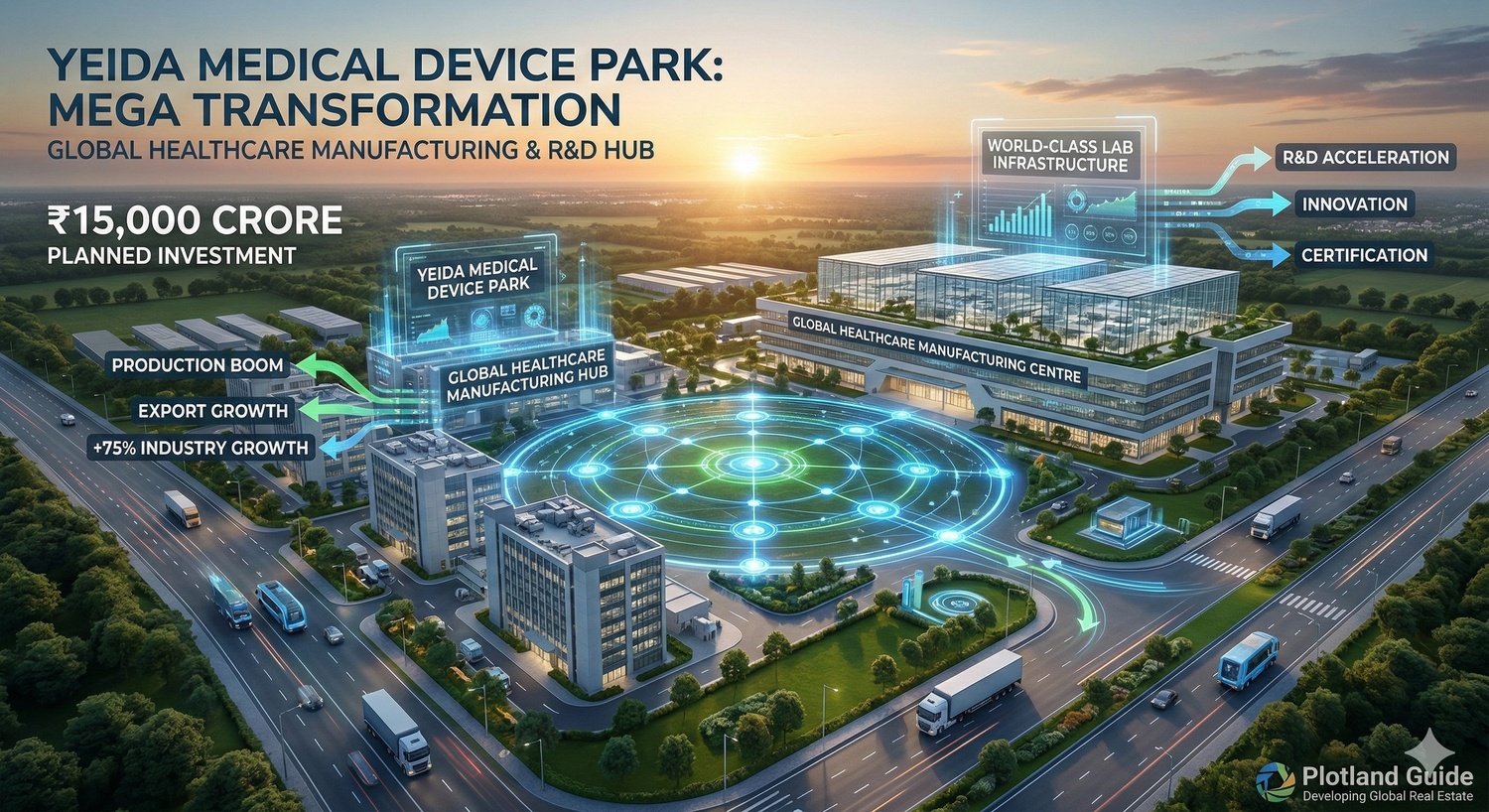
The landscape of industrial development along the Yamuna Expressway is undergoing a monumental shift. As India aggressively positions itself as a self-reliant powerhouse in various critical sectors, healthcare manufacturing has undeniably taken center stage. At the heart of this transformation is the highly anticipated Medical Device Park located in Sector 28 of the Yamuna Expressway Industrial Development Authority (YEIDA) region. In a move that promises to redefine the country’s medical technology capabilities, authorities have initiated advanced discussions with a premier, NABL-accredited contract research organization to establish world-class laboratory infrastructure within the park.
This strategic development is not merely a triumph for the medical technology sector; it represents a defining moment for the industrial real estate landscape of the entire Greater Noida and Yamuna Expressway corridor. By integrating internationally recognized testing facilities right at the source of manufacturing, the region is preparing to host a comprehensive, 360-degree ecosystem that caters seamlessly to the rigorous demands of global healthcare markets.
The genesis of this infrastructural leap traces back to high-level strategic discussions initiated during recent international summits in Dubai. The core objective has always been to bridge the gap between domestic manufacturing capabilities and stringent global compliance standards. Recognizing that top-tier manufacturing requires equally sophisticated testing and validation mechanisms, authorities engaged with an Ahmedabad-based testing agency renowned for its extensive pharmaceutical and medical device testing expertise.
Following the initial international dialogue, technical teams and senior delegations conducted comprehensive site visits and infrastructure audits at the Yamuna Authority. These walkthroughs were designed to ensure that the proposed laboratory designs could integrate flawlessly with the existing utility, engineering, and architectural frameworks of the Medical Device Park. During these briefings, consultants detailed the current status of the Common Scientific Facilities and the advanced equipment already slated for procurement. The focus is entirely on creating a synchronized environment where research, development, testing, and mass production operate in perfect harmony.
One of the most critical aspects of this upcoming laboratory infrastructure is the pursuit of the Accreditation Scheme for Conformity Assessment (ASCA). For the uninitiated, ASCA is a rigorous framework recognized by top-tier international regulatory bodies, including the USFDA. Securing ASCA certification for the laboratories within the Sector 28 park is a transformative step that will dictate the future trajectory of medical device exports from India.
When medical devices are manufactured, they must undergo exhaustive testing for biocompatibility, sterility, performance, and material safety before they can be sold in international markets. Historically, Indian manufacturers have often had to rely on overseas laboratories or face prolonged waiting periods to get their products validated against international benchmarks. By housing ASCA-certified labs directly within the Medical Device Park, manufacturers will have access to testing data that is universally accepted.
This proximity ensures that every diagnostic kit, surgical implant, or radiology machine produced in the park is tested to the highest global standards locally. Consequently, companies will experience drastically reduced turnaround times and significantly lowered costs for international market approvals. The ability to seamlessly export products to North American and European markets without redundant conformity testing gives companies operating in the YEIDA region a massive competitive advantage.
To ensure that the Medical Device Park reaches its peak operational capacity without unnecessary delays, a highly structured "Hybrid Investment Plan" is being formulated. This dual-phase execution strategy is designed to optimize existing resources while simultaneously expanding the park’s capabilities to cover entirely new technological frontiers.
The first phase involves a comprehensive Brownfield Upgrade. This focuses on taking the current Common Scientific Facilities already under construction or procurement within the park and enhancing them. The goal is to manage and upgrade these existing structures to ensure they meet the stringent requirements of ASCA and other international operational benchmarks. Upgrading these initial facilities allows the park to offer immediate, high-quality testing services to the first wave of companies setting up their manufacturing units.
The second phase is a visionary Greenfield Development. Recognizing that the medical technology sector is incredibly vast—spanning everything from basic surgical tools to advanced robotics and oncology equipment—the current infrastructure will eventually need supplementation. The greenfield approach involves designing and constructing entirely new, specialized testing modules from the ground up. These new facilities will cater to highly specialized sectors of medical technology that are not covered by the baseline infrastructure, ensuring that the park remains future-proof and adaptable to the evolving needs of the global healthcare industry.
Detailed technical feasibility studies are currently underway to outline the specific equipment requirements, spatial layouts, and comprehensive investment roadmaps needed to execute both the brownfield and greenfield phases flawlessly.
The Medical Device Park in Sector 28 is much more than a collection of factories; it is a meticulously planned, 350-acre industrial ecosystem designed to support end-to-end medical device production. The integration of world-class testing laboratories is the crowning jewel of a master plan that includes robust basic and scientific infrastructure.
Beyond the proposed ASCA labs, the park is actively developing multiple common laboratories focusing on the Internet of Medical Things (IoMT), artificial intelligence, machine learning, and biomaterial testing. Furthermore, specialized facilities such as gamma irradiation centers are being established for the crucial sterilization of medical equipment.
From an industrial real estate perspective, the meticulous planning of this park is driving unprecedented interest. Dozens of plots have already been allotted to various medical device companies, with many having executed lease deeds and secured building plan approvals. Companies setting up operations here are focusing on a diverse array of critical healthcare technologies, ranging from anesthesia equipment and in-vitro diagnostic products to complex orthopaedic and cardiac implants.
The infrastructure supporting these units is equally robust, featuring dedicated power backups, advanced water treatment plants, beautifully landscaped green spaces, and modern commercial amenities. For companies looking to establish a long-term footprint in India, the plug-and-play nature of this ecosystem offers an irresistible proposition, significantly reducing the friction traditionally associated with setting up heavy industrial manufacturing.
The strategic push to develop this lab infrastructure aligns perfectly with broader national goals of self-reliance and the 'Make in India' initiative. Currently, India imports a significant percentage of its high-end medical devices. The development of the YEIDA Medical Device Park is a direct countermeasure to this heavy import dependence.
By providing an environment where cutting-edge research can seamlessly transition into mass production, the park fosters deep domestic innovation. Local manufacturing of advanced medical technologies—such as CT scanners, MRI machines, respiratory care solutions, and robotic surgical systems—will not only reduce the national import bill but also improve the accessibility and affordability of critical healthcare solutions within the country.
The presence of advanced testing facilities ensures that this domestic production does not come at the cost of quality. Manufacturers will be held to international standards from day one, pushing the entire domestic industry toward greater excellence and reliability. This environment naturally encourages collaboration between industry players, academic researchers, and regulatory experts, creating a vibrant knowledge economy centered right in the Yamuna Expressway region.
The ripple effects of this mega-development extend far beyond the pharmaceutical and medical sectors. The establishment of world-class infrastructure in Sector 28 is acting as a massive catalyst for the local economy and the broader real estate market of the Greater Noida and YEIDA regions.
Industrial real estate in the vicinity is experiencing a surge in demand. As major healthcare manufacturers anchor themselves in the Medical Device Park, a secondary wave of ancillary industries—ranging from packaging and logistics to specialized raw material suppliers—is actively seeking industrial plots nearby. This clustering effect is a proven driver of sustainable industrial real estate growth, ensuring long-term appreciation of land values and sustained demand for commercial spaces.
Furthermore, a project of this magnitude translates to massive job creation. The park is projected to generate thousands of direct and indirect employment opportunities, ranging from highly specialized roles for scientists, lab technicians, and regulatory experts to administrative, logistical, and manufacturing jobs.
This influx of professionals will inevitably drive demand in the residential real estate sector. The surrounding sectors along the Yamuna Expressway are uniquely positioned to absorb this demand, leading to the accelerated development of housing societies, retail spaces, schools, and healthcare facilities. The synergy between the upcoming international airport in Jewar and the Medical Device Park further solidifies the region’s reputation as one of the most promising investment destinations in the country.
The ongoing efforts to integrate premier, globally accredited testing laboratories into the YEIDA Medical Device Park represent a masterclass in forward-thinking industrial planning. By anticipating the regulatory and logistical hurdles that manufacturers face and proactively building infrastructure to solve them, authorities are setting a new gold standard for industrial parks worldwide.
As the technical feasibility studies conclude and the hybrid investment plan transitions from paper to concrete reality, the Yamuna Expressway region is firmly on track to become a focal point of global healthcare innovation. The convergence of strategic location, world-class infrastructure, global compliance frameworks, and visionary planning ensures that Sector 28 will not just manufacture medical devices, but will actively shape the future of global healthcare delivery. For investors, manufacturers, and real estate stakeholders alike, the developments unfolding here signal the dawn of a highly lucrative and deeply impactful era of industrial growth.
