Published On:
November 30, 2025
Updated On:
February 4, 2026
The blog details the comprehensive and ambitious YEIDA Master Plan 2041, a long-term planning blueprint transforming the Yamuna Expressway Industrial Development Authority region into a globally competitive, sustainable, and smart urban corridor, fundamentally driven by the new Noida International Airport at Jewar.
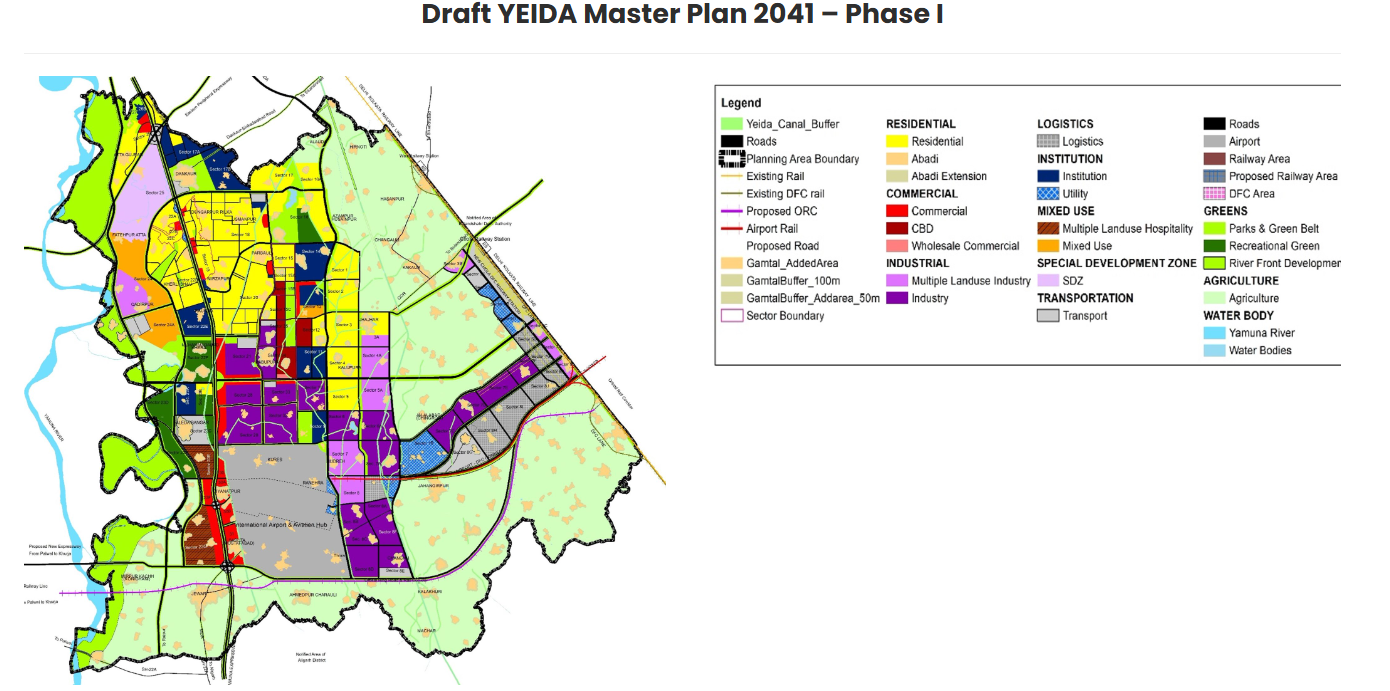
The Yamuna Expressway Industrial Development Authority (YEIDA) region is no longer just a stretch of asphalt connecting Greater Noida to Agra; it is the canvas for one of India's most ambitious urban experiments. With the notification and approval of the Master Plan 2041, the state government has effectively drawn the roadmap for the next two decades of growth in Western Uttar Pradesh. This is not merely a zoning document; it is a declaration of intent to shift the economic center of gravity of the National Capital Region (NCR) southwards, towards Jewar.
The Master Plan 2041 supersedes earlier perspective plans, bringing a sharper focus on sustainability, high-tech industrialization, and airport-centric urbanism. For investors, homebuyers, and urban planners, understanding this document is critical because it dictates where the jobs will be, where the greens will flourish, and ultimately, where the value will be created. This blog provides an in-depth analysis of the master plan, stripping away the bureaucratic jargon to reveal the future of this high-growth corridor.
The core philosophy of Master Plan 2041 is distinct from the planning of Noida or Greater Noida. While those cities were primarily designed as residential dormitories that later acquired industrial capabilities, the YEIDA region is conceptualized as an "Aerotropolis"—an airport city. The vision is to create a globally competitive hub where the airport is not just a utility but the primary economic engine.
The plan envisages a massive surge in population, projecting millions of residents by 2041. To support this human influx without repeating the chaotic sprawl of older cities, the plan emphasizes a "Smart City" framework. This means integrated utilities, intelligent traffic management, and a strict adherence to land-use norms. The region is divided into specific phases, with Phase-1 receiving immediate priority due to its proximity to the Noida International Airport and the established industrial sectors. This phasing ensures that infrastructure like roads and power lines precedes habitation, preventing the "infrastructure deficit" often seen in Indian urbanization.
At the heart of the Master Plan 2041 lies the Airport Influence Zone (AIZ). This is a specialized zone radiating from the Noida International Airport, subject to unique development controls and height restrictions to ensure flight safety and maximize economic spillover.
The AIZ is designed to be the commercial and hospitality heartbeat of the region. The master plan specifically allocates land here for an "Aerocity" model similar to Delhi or Hyderabad but on a larger scale. This zone will house large convention centers, international expo zones, and a dedicated hospitality belt featuring 5-star hotels and serviced apartments. The logic is simple: international business travelers landing in Jewar should not have to travel to Delhi for meetings or conferences; the ecosystem will exist right at the terminal's doorstep.
Furthermore, the AIZ includes provisions for high-value cargo and logistics support. With the airport positioning itself as a major cargo hub for North India, the land use in the influence zone prioritizes warehousing and freight-forwarding businesses that require runway access within minutes. For real estate investors, the AIZ represents the premium tier of the market, where commercial floor area ratios (FAR) will translate into high-rental yielding assets.
One of the most striking features of Master Plan 2041 is its deviation from the "housing-heavy" models of the past. The land use structure clearly prioritizes industrial and green spaces over pure residential utilization.
The Industrial MandateThe plan allocates a massive percentage share of the urbanizable area to industrial corridors. This is a strategic move to ensure that the city generates its own employment. Specific zones are earmarked for high-tech manufacturing, electronics (already visible with the mobile manufacturing clusters), and specialized sectors like Toy Parks and Apparel Parks. The master plan ensures that these industrial sectors are not isolated islands but are connected via wide arterial roads to the residential pockets, fostering a true "walk-to-work" culture.
The Green SpineSustainability is not an afterthought in this document. A significant portion of the land is legally locked as "Green and Recreational." This includes the preservation of river floodplains, the creation of urban forests, and a network of city parks that act as the lungs of the industrial city. The plan explicitly forbids construction in environmentally sensitive areas, particularly around the wetlands and canal networks that crisscross the region. For residents, this promises a quality of life significantly higher than the concrete-dense zones of Delhi or Ghaziabad.
Recognizing that the airport will drive the movement of goods as much as people, the Master Plan 2041 lays out a robust framework for logistics. A dedicated Multi-Modal Logistics Park (MMLH) is a key component, designed to integrate road, rail, and air cargo services seamlessly. This facility will allow manufacturers in the YEIDA region to ship goods directly to global markets without facing the bottlenecks of traditional supply chains.
Supporting this industrial activity is a planned network of Central Business Districts (CBDs). Unlike the scattered commercial complexes of Noida, the YEIDA CBDs are planned as concentrated clusters of high-rise offices, retail, and entertainment. These districts are strategically located at the intersection of major transport corridors to ensure high accessibility. The plan creates a hierarchy of commercial spaces—from local shopping centers serving daily needs in residential sectors to regional malls and corporate towers in the CBDs serving the global workforce.
No master plan can succeed without mobility, and the 2041 document places heavy emphasis on multi-modal connectivity. The existing Yamuna Expressway and the Eastern Peripheral Expressway serve as the spinal cords, but the plan details a finer network of capillaries to ensure smooth flow.
Rail and Metro IntegrationCrucially, the plan integrates the upcoming rail links. This includes the dedicated rapid rail connectivity to the airport and extensions of the metro line that will link the YEIDA sectors to the wider NCR network. A significant proposal is the rail link to Chola Railway Station in Bulandshahr, which will act as a major freight and passenger gateway, effectively connecting the airport to the main Indian Railways trunk lines.
Road HierarchyThe plan strictly defines a road hierarchy, ensuring that heavy industrial traffic does not mix with local residential traffic. Wide arterial roads (60 meters and above) form the grid, while smaller collector roads serve the internal sectors. This segregation is vital for safety and for maintaining the speed of logistics movement, which is the region's USP.
A city is more than just factories and roads; it is people. The Master Plan 2041 addresses the social needs of the projected millions through specific norms for social infrastructure.
Housing for AllThe plan outlines residential sectors with varying densities to cater to different income groups. From high-density affordable housing for the industrial workforce to low-density plotted developments and villas for the executive class, the allocation is balanced. Importantly, the plan respects the existing village settlements (Abadi areas). Instead of bulldozing them, it proposes integrating these villages into the urban fabric, ensuring that the original inhabitants benefit from the urbanization process.
Education and HealthDedicated land parcels are reserved for institutional use. The vision includes a "Knowledge City" component with universities and research centers that feed talent directly into the local industries. Similarly, the healthcare roadmap includes provisions for multi-specialty hospitals and local polyclinics, ensuring that world-class medical aid is available locally, reducing the dependency on Delhi hospitals.
To prevent the chaotic unauthorized construction that plagues many Indian cities, Master Plan 2041 introduces a stringent regulatory framework. The Development Control Regulations (DCR) are detailed and non-negotiable.
FAR and Height RestrictionsThe plan specifies the Floor Area Ratio (FAR) for every land use category, dictating the intensity of development. In the AIZ, height restrictions are strictly enforced to comply with aviation safety norms. These regulations ensure that the skyline remains uniform and that infrastructure capacity is not overwhelmed by excessive vertical growth.
Zoning ComplianceThe zoning regulations are designed to prevent "mixed-use chaos." An industrial plot cannot be quietly converted into a banquet hall, and a green belt cannot be turned into a parking lot. The plan empowers the authority to enforce these zones rigorously, ensuring that the long-term vision is not compromised by short-term commercial greed.
For the investor, Master Plan 2041 is the ultimate cheat sheet. It clearly identifies the high-growth zones versus the slow-burn areas.
The "Phase-1" AdvantageSectors falling under Phase-1 are the immediate beneficiaries. These areas will see the first wave of infrastructure spending—water supply, sewage lines, and electricity. Investing here offers the lowest risk and the fastest appreciation potential over the next 5-7 years.
The Commercial YieldWith the CBDs and logistics hubs clearly demarcated, commercial investors can now pinpoint exactly where the footfall will be. Owning land or retail space near the proposed logistics parks or the university zones offers a high rental yield potential that residential property simply cannot match.
The YEIDA Master Plan 2041 is a document of immense promise. It represents a shift from reactive planning (fixing problems as they arise) to proactive planning (building for the future). It envisions a region that is not just a satellite of Delhi but an economic powerhouse in its own right—a city built around the speed of flight and the efficiency of smart infrastructure.
For the stakeholders of this region, the message is clear: The blueprint is ready, the engines are revving, and the flight to 2041 has officially begun. The transformation of the Yamuna Expressway from a highway into a destination is no longer a dream; it is a notified plan.
