Published On:
January 27, 2026
Updated On:
February 7, 2026
YEIDA and JETRO are collaborating to develop a dedicated "Japanese City" and MSME park in Sector 5A, aimed at housing over 1,400 Japanese firms near the upcoming Noida International Airport.
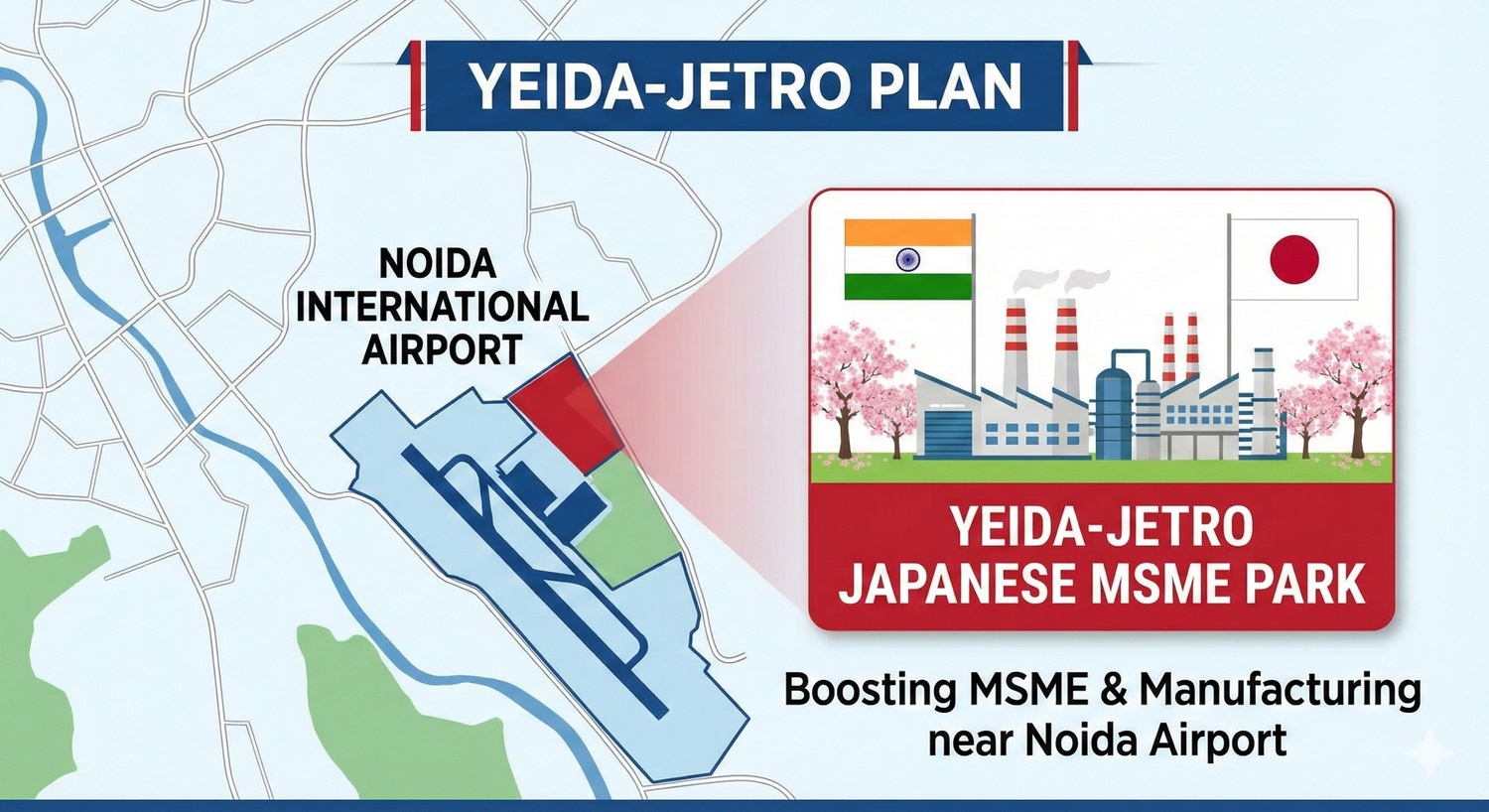
The industrial landscape of the Yamuna Expressway is on the verge of a massive transformation. Following the success of Japanese industrial zones in other parts of India, a new, ambitious chapter is being written right next to the upcoming Noida International Airport. The Yamuna Expressway Industrial Development Authority (YEIDA) and the Japan External Trade Organization (JETRO) have initiated high-level strategic discussions to establish a dedicated "Japanese City" and MSME park.
This development is not just another industrial cluster; it represents a targeted effort to create a self-sustaining ecosystem for Japanese innovation and manufacturing in one of India's most connected regions.
The core of the proposal centers on Sector 5A of Yamuna City, where approximately 395 hectares have been earmarked for this specialized hub. The concept goes beyond simple land allotment. The vision is to build a comprehensive "Japanese City" that offers a blend of industrial efficiency and lifestyle comfort.
Discussions indicate a shift toward mixed-use planning. Unlike traditional industrial areas that often lack social infrastructure, this proposed hub is expected to include residential facilities, schools, and recreational centers tailored to the needs of Japanese expatriates and workers. The goal is to create a "home away from home" environment that mirrors the successful model seen in Neemrana, Rajasthan, but on a grander scale with superior connectivity.
While global giants often grab the headlines, the backbone of Japan’s economy lies in its Micro, Small, and Medium Enterprises (MSMEs). Currently, there are roughly 1,400 Japanese MSMEs registered with JETRO that are actively scouting for manufacturing bases in India. This proposed park is designed specifically to cater to this segment.
Small and medium-sized enterprises often face hurdles regarding land acquisition and setting up initial infrastructure. To address this, the proposed park plans to feature "plug-and-play" industrial infrastructure. This means pre-built factory sheds and ready-to-use utilities that allow companies to start operations almost immediately, bypassing the long gestation periods usually associated with greenfield projects.
The primary driver behind this renewed Japanese interest is the location. The site’s proximity to the Noida International Airport (NIA) at Jewar changes the logistics equation entirely. For high-tech Japanese sectors—such as medical devices, semiconductors, AI, and precision electronics—speed to market is critical.
The multimodal connectivity offered by the region is unmatched. Beyond the airport, the area is linked to the Delhi-Mumbai Industrial Corridor (DMIC) and dedicated freight corridors. This ensures that products manufactured in the Yamuna Expressway belt can be shipped globally or transported to India’s ports with minimal friction. This logistics advantage is a key selling point that YEIDA is leveraging to attract high-value manufacturing.
The establishment of a Japanese MSME park will likely trigger a significant economic ripple effect across the region. A cluster of high-tech manufacturers requires a robust supply chain, service providers, and a skilled workforce, all of which translates to job creation and increased demand for local real estate.
We are already seeing a surge in interest for residential and commercial real estate in the sectors adjacent to the airport. As these industrial plans crystallize into signed Memorandums of Understanding (MoUs), the demand for housing—both for the workforce and the management—is expected to climb, further cementing the Yamuna Expressway as a premier investment destination.
This partnership signals that the region is no longer just a speculative real estate play but a rapidly maturing economic powerhouse backed by global trust and hard infrastructure.
