Published On:
November 17, 2025
Updated On:
April 2, 2026
YEIDA allots 7% Farmer Quota Plots to farmers whose land was acquired for development along the Yamuna Expressway. Here's a complete ground-level breakdown of how they work, what they cost, and what to check before buying.
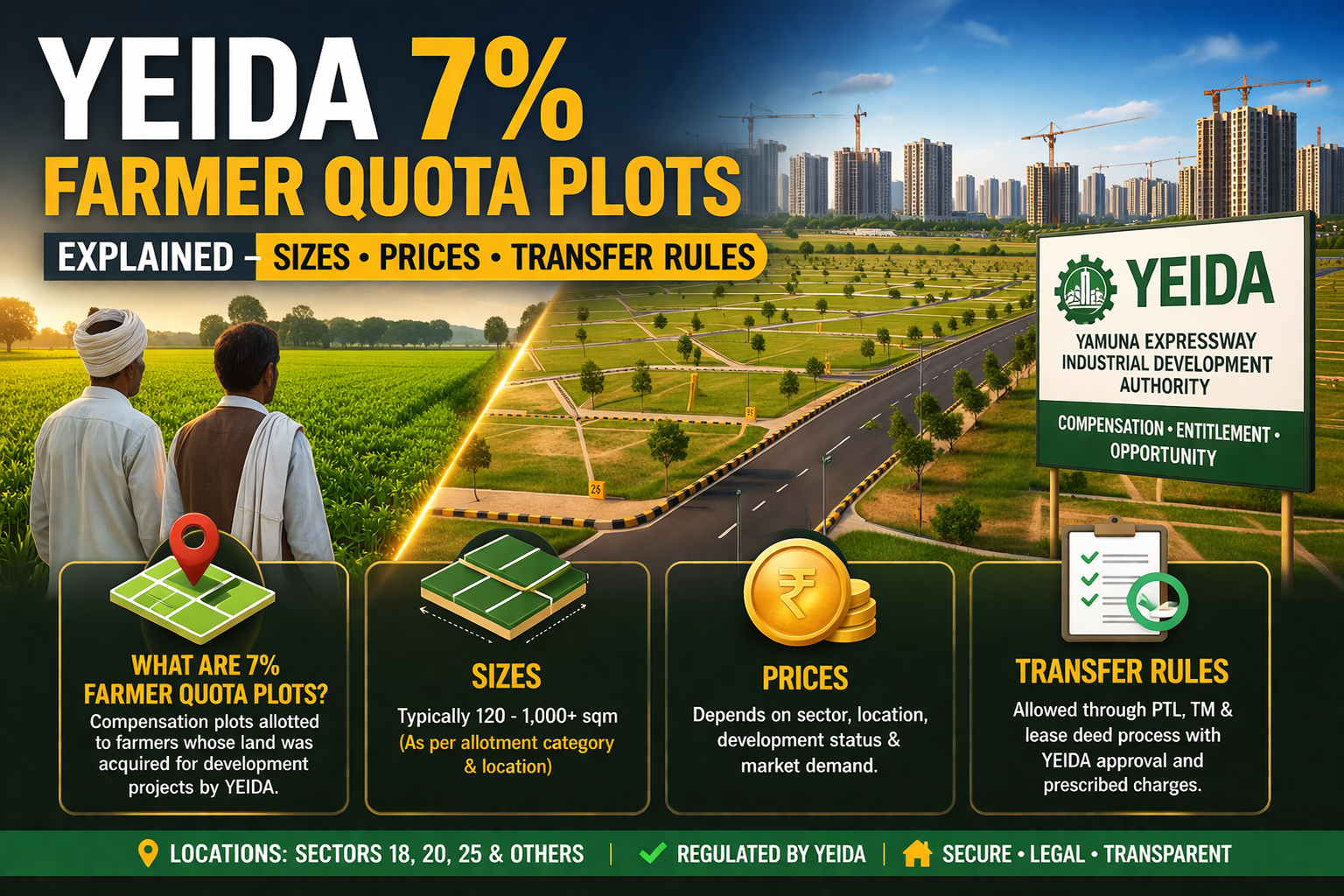
YEIDA allots 7% Farmer Quota Plots to landowners whose agricultural land has been acquired for development along the Yamuna Expressway. This is the latest version of a well-established compensation model — Noida did it at 5%, Greater Noida at 6%, and YEIDA follows at 7%.
The idea is straightforward: instead of only giving farmers a cash payout for their land, the authority returns a portion of the acquired area back to them as a developed residential plot — located near their original village, with full sector-level infrastructure. These are not village plots. They sit inside formally planned YEIDA sectors.
This segment is one of the most actively traded categories along the Yamuna Expressway right now, especially with Jewar Airport pushing demand across the entire corridor. But it's also one of the most misunderstood. Most buyers come in with incomplete information — on pricing, on transfer rules, on documentation, and on what distinguishes a safe deal from a risky one.
This blog covers all of it.
When YEIDA acquires a farmer's land, 7% of the total acquired area is carved out and returned to that farmer as a developed plot. The plot is located near the farmer's original village, within a notified YEIDA sector.
The percentage has increased over time as farmer bargaining power has grown. Noida started at 5%, Greater Noida moved to 6%, and YEIDA set it at 7%. Each increase reflects both better negotiated terms and the state's recognition that a one-time cash payment isn't enough compensation for permanent land loss.
These plots come with the same infrastructure YEIDA provides in its general residential sectors:
They are not self-developed village-level plots. They are authority-built, sector-integrated residential plots — and that distinction matters a great deal when comparing them to abadi land.
The 7% Farmer Quota plots are concentrated in Sector 18, Sector 20, and Sector 25, near the following villages:
All of these are established villages within the YEIDA notified boundary. The plots are allotted nearest to the farmer's own village — so the cluster in Sector 18 and 20 mostly comes from land acquired from Mirzapur, Acheja Buzurg, Parsaul, and surrounding habitations.
Infrastructure status as of mid-2025: Development work in Sectors 18 and 20 was over 70% complete. Underground wiring, drainage, and sewage work was actively underway. YEIDA had also released tenders for outstanding development work in the remaining areas. A loop road connecting the Yamuna Expressway with the Eastern Peripheral Expressway had been tendered as well, which will further improve overall connectivity for these sectors.
Sectors 18 and 20 are currently among the most active for resale transactions in the entire YEIDA zone.
Sizes vary significantly — from 120 sq yards to 1,000 sq yards — and that variation is structural, not random.
Each farmer's quota plot is 7% of the land acquired from them. Since land holdings differed across farmers — some gave up one bigha, some gave up ten — the resulting quota plots differ in size proportionately. There is no standardisation, and none is expected.
This creates a useful range of entry points:
Unlike YEIDA's own scheme plots — which come in fixed standardised sizes — the farmer quota segment is genuinely varied. That flexibility is part of what keeps demand active across different buyer profiles.
These plots are classified as residential, but YEIDA permits limited commercial use on them.
Up to 50% of the built-up area can be used for the following permitted categories:
Full commercial use is not permitted without a separate formal conversion process — which requires an application and payment of conversion charges to YEIDA.
The 50% allowance is meaningful in practice. A buyer can legitimately run a guest house or clinic alongside their residence on the same plot. In sectors like 18 and 20, which are seeing growing footfall from workers, contractors, and visitors connected to Jewar Airport development, this is a genuine income option — not just a theoretical one.
Most 7% quota plots front 12-meter internal roads, consistent with standard YEIDA residential sector layouts. These are not the wide arterial roads that run along sector boundaries — those typically run 24 to 45 meters — but the 12-meter internal grid is fully adequate for residential-scale use and is consistent across the sector planning.
There are three price points that matter in this segment, and confusing them leads to bad decisions.
Circle Rate (effective from 1 April 2025) Rs 18,000 per sq meter This is the government's official minimum valuation for stamp duty purposes. No registered transaction can be valued below this floor.
Unregistered Resale Prices Rs 20,000 – Rs 40,000 per sq meter These are plots where the farmer holds an allotment letter but registry has not yet happened. The wide band within this range reflects real differences — sector location, pocket within the sector, road facing, corner vs non-corner position, and proximity to main roads or sector entry points all move the needle significantly.
Registered Resale Prices Rs 45,000 – Rs 55,000 per sq meter These are plots where registry is complete and the title can transfer cleanly through a standard sale deed. The premium over unregistered plots reflects three things: clean transferable legal title, eligibility for bank finance (loans are only available on registered plots), and no ongoing dependency on the farmer's future cooperation.
The gap between unregistered and registered pricing is the market's way of pricing legal risk and documentation uncertainty. As Jewar Airport's commissioning timeline has become clearer, that gap has widened — buyers with capital are increasingly choosing the certainty of a registered plot rather than taking on interim documentation exposure in a rising market.
This is the part most buyers don't fully understand going in, and it's where the most confusion happens.
Transfer does not happen at the time of purchase. Typical timelines from allotment to registry run 2 to 3 years. The sequence works like this:
Many farmers across the Yamuna Expressway currently hold allotment letters only. Sector maps for several clusters are still awaited. Until those maps are officially published, registry cannot proceed — regardless of how willing both parties are to complete the transaction.
This means a large portion of the farmer quota plots available in the resale market today are unregistered. The farmer has the letter, possession may or may not be formally granted, but the clean legal title that makes a plot transferable doesn't yet exist.
Because most plots aren't registered yet, resale happens through a set of standard interim documents. This is not a grey-market workaround — it is the accepted and widely used transaction structure for pre-registry farmer quota plots across the Yamuna Expressway.
The four documents involved are:
Together, these four create equitable rights for the buyer. They do not create legal title. The plot technically remains in the farmer's name until registry and formal transfer are completed in YEIDA's records.
What this risk looks like in practice: Until registry happens, the buyer depends on the farmer's continued cooperation and the integrity of the original transaction. Instances of the same plot being sold to multiple buyers do exist in this segment. Due diligence before payment is not optional — it is the difference between a sound investment and a dispute.
Before transacting on any unregistered farmer quota plot:
Banks do not lend against unregistered farmer quota plots. Without a registered title, there is nothing for the lender to hold as security. Loan eligibility applies only after the plot is registered in the allottee's name.
For buyers who need financing, this means one of two paths:
This distinction affects a large share of the buyer pool and is one of the most practically important differences between the two price categories.
All YEIDA-allotted plots — including Farmer Quota plots — are leasehold. This is not a quirk of the farmer quota category; it is the standard model for every plot allotted by Noida Authority, Greater Noida Authority, and YEIDA.
Leasehold means the underlying land is owned by YEIDA. The allottee holds a long-term lease — typically 90 years — over it. Within that lease, the holder can build, sell, gift, or mortgage the plot subject to YEIDA's rules.
For day-to-day purposes, the difference from freehold is minimal. You can build on it, live in it, rent it out, and resell it. Brokers who position freehold as inherently superior are making a comparison that doesn't hold up when you look at actual usability and governance.
After physical possession is formally granted, construction must be completed within 3 years.
This applies to all Farmer Quota plots without exception. YEIDA monitors compliance. Failure to complete within the mandated period attracts penalties, and persistent non-compliance can complicate future transfer or regularisation.
For buyers who intend to build and occupy — this is manageable. Three years from possession is a reasonable construction window.
For buyers treating this purely as land banking with no build intention — this clause needs to be part of the planning. The clock starts from the date of possession, not from the date of purchase. Factor that in before committing.
These two categories get mixed up constantly. They are not the same thing.
Farmer Quota Plots (7% Category)
Abadi Plots
A farmer quota plot in Sector 18 comes with infrastructure that YEIDA is legally obligated to build and maintain. An abadi plot in the same village may or may not have a paved road in front of it — and if it doesn't, there is no authority to hold accountable for fixing that.
Abadi plots are cheaper and freehold. They suit buyers who are comfortable with village-level real estate, want immediate access, and are less focused on future resale liquidity.
Farmer quota plots cost more and are leasehold. They suit buyers who want authority-backed infrastructure, a clean and traceable legal chain, and better long-term liquidity in the secondary market.
Neither is categorically better. But they are genuinely different products serving different buyer needs — and treating them as interchangeable is one of the most common mistakes in this segment.
Demand for farmer quota plots — particularly in Sectors 18 and 20 — has been directly shaped by the Noida International Airport at Jewar. Since construction began in 2021, land prices across the YEIDA corridor have moved steadily upward, and these sectors sit well within that demand radius.
The airport effect on this specific segment has been twofold. First, resale prices — both unregistered and registered — have risen substantially as the airport's timeline has come into clearer focus. Second, the premium between unregistered and registered plots has widened, because buyers deploying serious capital are increasingly opting for registered title certainty rather than taking on interim documentation risk in a market that's already risen.
With infrastructure in Sectors 18 and 20 now over 70% complete, the investment case here isn't just about airport proximity on a map — it's backed by roads, drainage, and utilities that are visibly in place. That tangibility matters to buyers who've been cautious about paper-only assets elsewhere in the NCR.
The 7% Farmer Quota segment is a legitimate, authority-backed land category with a well-defined legal framework. It is not a shortcut and it is not a grey-market product. But it does require more groundwork from a buyer than a standard YEIDA scheme plot. Know your documents, verify before you pay, and be clear on where any specific plot sits on the registered-to-unregistered spectrum. Everything else follows from getting those basics right.
