Published On:
September 18, 2026
Updated On:
September 18, 2026
As the newly operational Noida International Airport at Jewar transforms regional connectivity, the proposed revival of Formula 1 racing and motorsports at the Buddh International Circuit is poised to inject a powerful new wave of economic growth, luxury hospitality, and real estate demand along the Yamuna Expressway corridor.
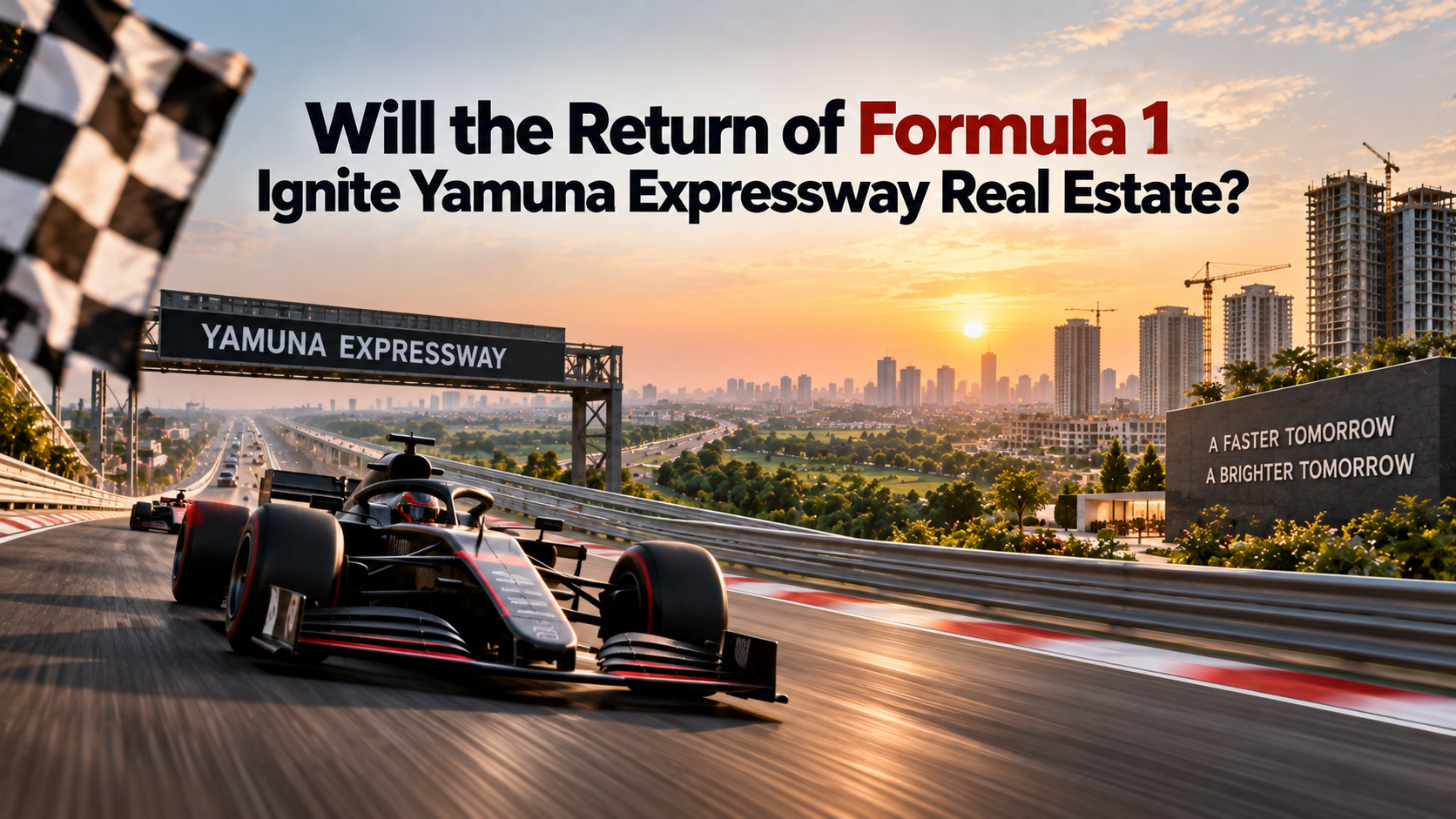
The narrative of real estate development in India is rarely defined by a single factor, but certain micro-markets experience generational shifts when massive catalysts align. For years, the Yamuna Expressway corridor was viewed as a distant, speculative stretch connecting Greater Noida to Agra. Today, that perception has been completely dismantled. Following the landmark operationalization of the Noida International Airport at Jewar, the region has transitioned into one of the most dynamic and sought-after investment destinations in the National Capital Region.
Just as developers, homebuyers, and commercial investors adjust to the massive economic uplift brought by the new aviation hub, a fresh conversation is sweeping the property market. Rumours and policy discussions surrounding the revival of Formula 1 racing and international motorsports at the Buddh International Circuit are gaining serious momentum. With a government task force actively evaluating the feasibility of bringing premier racing back to Indian soil, stakeholders are left wondering if the return of roaring engines could be the next major catalyst to supercharge the Yamuna Expressway real estate ecosystem.
To truly understand the weight of this potential revival, it helps to look back at how the landscape evolved. When the Buddh International Circuit hosted its inaugural Formula 1 Grand Prix in 2011, it placed India firmly on the global sporting map. The state-of-the-art track, designed by renowned architect Hermann Tilke, drew international acclaim from drivers and team principals alike. For a brief, electrifying window, the Yamuna Expressway was the center of the global sporting universe.
However, regulatory bottlenecks, complex tax disputes, and financial complications brought the high-speed action to a sudden halt after 2013. While the circuit occasionally hosted other motorsport events—such as a thrilling MotoGP round—the absence of recurring, premier global events left the massive infrastructure underutilized for years.
During that period of silence, the surrounding real estate market faced its own share of trials, navigating court cases, farmer agitations, and delayed project deliveries. Yet, the fundamental strengths of the corridor—its expansive land banks, wide master-planned avenues, and strategic alignment—ensured it survived the lull. Now, with the political and economic willpower shifting toward resolving past hurdles, the prospect of the circuit roaring back to life is no longer a distant pipe dream.
The potential return of Formula 1 does not happen in a vacuum; it arrives at a time when the Yamuna Expressway is already experiencing an unprecedented infrastructural renaissance. The opening of the Noida International Airport has completely transformed the region's accessibility, bridging the gap between national and international travellers and the southeastern edge of the NCR.
When evaluating the impact of a revived global sporting event, infrastructure is everything. International racing teams, global media crews, thousands of overseas tourists, and corporate sponsors require seamless logistical support. The proximity of a world-class international airport situated just a short drive away from the Buddh International Circuit solves the single biggest logistical hurdle that plagued early racing events in the region.
This powerful combination creates a dual-engine growth model. The airport guarantees steady, year-round commercial, industrial, and residential demand, while high-profile sporting and entertainment events inject periodic bursts of global visibility, high-end tourism, and immense economic activity. Together, they elevate the Yamuna Expressway from a standard suburban extension into a thriving, multi-modal global node.
If the government’s efforts to reclassify and revive motorsports successfully bring international racing back to the circuit, the immediate and most visible impact will be felt across the hospitality and commercial real estate sectors. Hosting a global event of this magnitude requires a massive ecosystem of support infrastructure that simply cannot be sustained by periodic visitors alone.
Real estate experts anticipate a massive rush of institutional interest in developing high-end hotels, serviced apartments, luxury resorts, and sprawling food and beverage avenues along the expressway. During peak racing weekends, thousands of high-net-worth individuals, team personnel, and international fans flood the venue, creating an acute demand for premium short-term accommodation that local inventory currently struggles to absorb.
Beyond hospitality, the commercial landscape stands to gain tremendously. Industry leaders note that the true financial opportunity lies in leveraging the circuit as a year-round destination. Rather than letting the sprawling facility sit idle between rare racing weekends, forward-thinking planners are eyeing its potential for automotive and Electric Vehicle (EV) testing, brand experience centers, product launches, and massive corporate MICE (Meetings, Incentives, Conferences, and Exhibitions) events. This continuous stream of corporate activity will drive sustained demand for Grade-A office spaces, event-led commercial complexes, and allied business parks along the corridor.
While commercial and hospitality assets will capture the immediate spotlight, the residential housing market along the Yamuna Expressway is poised to reap long-term benefits from this enhanced global positioning. The corridor has already witnessed a massive influx of top-tier developers acquiring large land parcels to build integrated townships, gated villa communities, and high-rise residential complexes.
The return of Formula 1 acts as a powerful branding tool for residential projects in the vicinity. Properties located within a short radius of a world-class entertainment and sporting landmark naturally command a unique market identity. Buyers looking for lifestyle upgrades are increasingly drawn to micro-markets that offer more than just four walls—they want vibrancy, recreational avenues, and long-term capital appreciation driven by iconic infrastructure.
Furthermore, the data from recent years highlights a fundamental shift in buyer behavior. The percentage of end-users purchasing homes along the expressway for self-use has risen dramatically, supported by the rollout of local schools, universities, hospitals, and retail hubs. When a region successfully transitions from an isolated highway stretch into a vibrant entertainment, aviation, and business capital, residential property values naturally stabilize and appreciate, rewarding long-term investors who backed the corridor early.
While the prospect of Formula 1’s return is undeniably thrilling, industry veterans emphasize the need for a structured, sustainable approach. The downfall of the initial racing era was rooted in complex tax structures, uncoordinated event management, and regulatory friction. For a revival to succeed, the ongoing discussions between government authorities, policy makers, and international sports management firms must establish a crystal-clear, long-term roadmap.
The formation of specialized task forces to evaluate Public-Private Partnership (PPP) models, streamline tax classifications, and modernize operational requirements indicates that current policymakers are taking a measured, strategic approach. If these institutional frameworks are successfully ironed out, they will provide the legal and financial predictability that global sports promoters and corporate sponsors demand.
For the real estate sector, this means that growth will be built on a foundation of sound policy rather than speculative hype. Developers and investors are already factoring these positive regulatory shifts into their long-term master plans, ensuring that the next wave of construction is aligned with actual economic utility and evolving consumer demands.
The story of the Yamuna Expressway is rapidly becoming one of the most compelling chapters in modern Indian real estate history. What began as a concrete ribbon cutting through agricultural land is maturing into a futuristic aerotropolis powered by aviation, industrial manufacturing, digital infrastructure, and world-class entertainment.
The potential revival of Formula 1 at the Buddh International Circuit serves as the ultimate punctuation mark on this transformation. While the Noida International Airport provides the wings that allow the region to take flight, global events like F1 supply the high-octane visibility that puts the corridor on the international map. For homebuyers, commercial tenants, and forward-thinking investors, the convergence of aviation, infrastructure, and leisure makes the Yamuna Expressway a market of unmatched potential. As the engines prepare to roar once more, the region is ready to race into a remarkably prosperous future.
