Published On:
March 30, 2026
Updated On:
March 30, 2026
The newly opened Dwarka Expressway tunnel, designed to eliminate Delhi-Gurugram traffic woes, has ironically become a major choke point, turning a five-minute underground stretch into a daily 40-minute ordeal. Flawed lane merging, the closure of alternative surface routes, and massive evening vehicular volumes are dampening the infrastructural triumph and raising concerns among daily commuters and real estate investors alike.
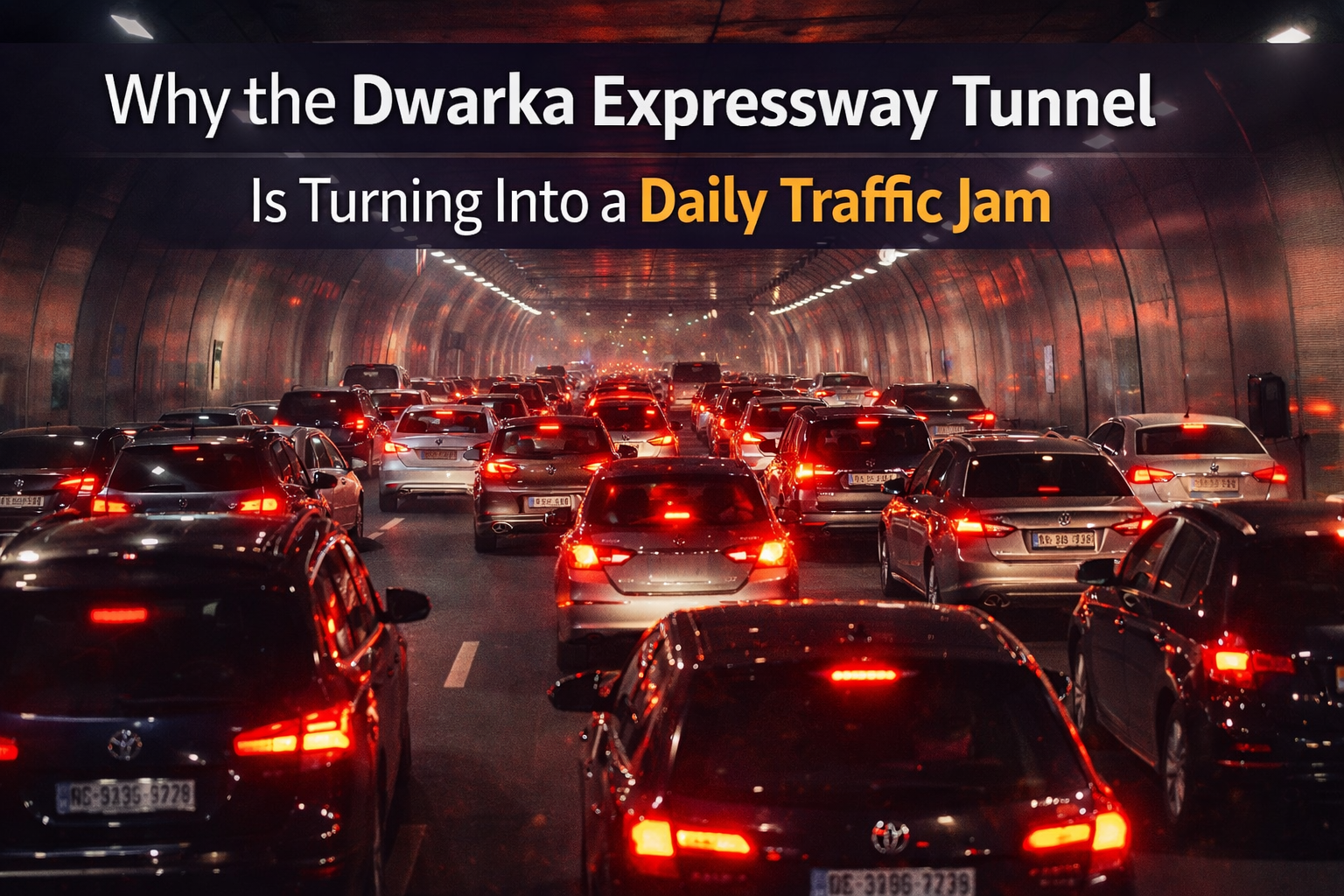
For years, the daily commute between Delhi and Gurugram has been synonymous with gridlock, frustration, and lost productivity. The National Capital Region has long struggled with vehicular congestion, with the primary Delhi-Jaipur Highway (NH-48) bearing the brunt of a rapidly expanding urban population. When the blueprint for the Dwarka Expressway was unveiled, it was heralded as the ultimate panacea for these deep-rooted urban mobility issues. The crown jewel of this massive infrastructure project was the underground tunnel connecting Mahipalpur in Delhi to the border of Gurugram, promising to bypass the notorious surface-level bottlenecks entirely.
The anticipation leading up to its opening was palpable. It was pitched as a futuristic, signal-free corridor that would redefine inter-city travel, slashing commute times and offering a seamless driving experience. However, fast forward to today, and the reality on the ground—or rather, under it—paints a starkly different picture. The latest Delhi-Gurugram news is dominated by reports of severe congestion, bringing the ambitious project under intense scrutiny. The much-celebrated engineering marvel has paradoxically transformed into a daily choke point, leaving thousands of commuters trapped in a subterranean nightmare where a simple five-minute drive now stretches into an agonizing 40-minute ordeal.
To understand the magnitude of the current disappointment, one must first look at the sheer scale and ambition of the original design. The Dwarka Expressway tunnel is not just a standard underpass; it is one of India’s most significant urban infrastructure undertakings. Spanning a total length of 5.1 kilometers, the structure is divided into a massive 3.6-kilometer, eight-lane main tunnel and a 1.5-kilometer connecting segment. It was meticulously engineered to provide direct, uninterrupted connectivity between the sprawling residential sectors of Dwarka, the corporate hubs of Gurugram, and the Indira Gandhi International Airport (IGI Airport).
The mathematical projections were highly optimistic. By entirely avoiding the chaotic intersections of Mahipalpur, the congested airport approach roads, and the perennial traffic jams at the Sirhaul border, travel time was expected to plummet. A journey that traditionally took anywhere from 60 to 90 minutes during peak hours was slated to be reduced to a breezy 20 to 25 minutes. Equipped with advanced ventilation systems, emergency fire suppression mechanisms, and state-of-the-art surveillance, the tunnel was built to handle high-capacity traffic volumes efficiently. It was supposed to be a masterclass in modern urban mobility, proving that smart infrastructure could conquer the chaos of one of the world's most densely populated metropolitan regions.
Despite the world-class engineering of the tunnel itself, the surrounding traffic ecosystem has failed to support it, leading to the severe Dwarka Expressway tunnel traffic jam we see today. The root of the problem does not lie in the underground carriageway, but rather in the entry and exit dynamics that govern the flow of vehicles. Urban mobility experts and frustrated daily drivers point to a series of compounding factors that have essentially turned the eight-lane tunnel into a massive funnel with a restricted spout.
A primary trigger for the recent surge in congestion is the sudden closure of vital surface-level diversions. Previously, a significant portion of the traffic heading towards Kapashera and surrounding border areas would take a surface cut, naturally distributing the vehicular load. With this alternative route closed, an overwhelming volume of traffic from the Delhi-Jaipur highway is now being forced directly into the tunnel. The infrastructure is suddenly bearing a load it was meant to share with parallel surface roads.
Furthermore, the design of the exit points is creating severe friction. As vehicles speed through the wide, eight-lane underground expanse, they are abruptly met with a harsh reality upon exiting. Near the Sector-21 roundabout, the road network unexpectedly narrows. This sudden reduction in lane capacity forces a massive volume of fast-moving vehicles to brake sharply and merge aggressively. It creates a classic bottleneck effect; traffic slows to a crawl, and within minutes, the back-up extends deep into the tunnel itself. The seamless integration of the Urban Extension Road-2 (UER-2) is also facing teething problems, with confusing lane designs and sudden merging points exacerbating the daily chaos.
The infrastructural snags translate into a grueling human experience, particularly during the evening rush hours. From 5:00 PM onwards, as corporate offices empty out and the workforce begins its mass exodus from Gurugram towards Delhi and the Dwarka sub-city, the tunnel transforms into a sprawling parking lot.
Commuters returning to the densely populated residential clusters along the expressway—specifically those residing in premium high-rises across Sectors 102, 103, and 104—are bearing the heaviest toll. For these residents, a stretch of merely four kilometers, which should ideally take less than ten minutes to cover, is now stretching beyond the half-hour mark. The psychological toll of this specific type of traffic jam is profound. Unlike a surface-level jam where drivers can occasionally seek alternative routes or pull over, the tunnel offers zero escape. Once a vehicle descends into the underground corridor, the driver is entirely committed.
Being trapped in a confined, subterranean space surrounded by hundreds of idling engines creates a palpable sense of claustrophobia. While the ventilation systems are robust, the sheer concentration of exhaust fumes from slow-moving or stationary vehicles over extended periods is a cause for concern. Additionally, the situation is incredibly sensitive to external variables. A minor fender-bender, occasional VIP movements that trigger impromptu barricading, or a brief spell of heavy rain waterlogging the exit ramps can instantly paralyze the entire corridor. In such instances, commuters have reported being stuck for nearly an hour, staring endlessly at a sea of red brake lights, questioning if the old, chaotic surface roads were somehow preferable to this modern trap.
The implications of this infrastructural bottleneck extend far beyond daily annoyance; they are actively sending ripples through the region's booming real estate market. Over the past few years, the entire Dwarka Expressway corridor has experienced an unprecedented property boom. Developers marketed the region aggressively on a singular, powerful promise: luxury living combined with zero-traffic, high-speed connectivity to both Delhi and the international airport.
Based on this promise, property prices in the new sectors of Gurugram skyrocketed. Homebuyers and investors poured capital into the region, anticipating a seamless, elevated lifestyle. However, the current reality of the Dwarka Expressway tunnel is prompting a wave of reassessment. While the long-term outlook for the corridor remains undeniably strong due to the massive capital injected by the National Highways Authority of India (NHAI), the immediate traffic snarls are a bitter pill to swallow for those who paid a premium for convenience.
Potential buyers conducting site visits during peak evening hours are experiencing the gridlock firsthand, leading to hesitations. Real estate experts are now advising clients to look beyond the glossy brochures and physically test the commute before making significant financial commitments. If the traffic management issues persist, it could temporarily cool the aggressive price appreciation in the immediate micro-markets, as the core selling point of "expressway living" is heavily compromised by the daily traffic snarls.
The current situation is unsustainable, and resolving it requires immediate intervention from traffic planning authorities, coupled with adaptive strategies from the commuters themselves. The infrastructure is fundamentally sound; it is the traffic management framework that requires a massive overhaul.
From an administrative standpoint, the most pressing need is to fix the exit dynamics. Authorities must urgently re-evaluate the closure of surface-level cuts like the Kapashera exit. Reopening these vital pressure-release valves would immediately divert a chunk of local traffic away from the tunnel. Furthermore, the bottleneck at the Sector-21 roundabout requires structural widening or, at the very least, the permanent deployment of trained traffic personnel during peak hours to manually enforce smooth lane merging.
Technology must also be leveraged to prevent the tunnel from becoming over-saturated. Dynamic digital signage should be installed well ahead of the tunnel entry points on both the Delhi and Gurugram sides. These smart boards should display real-time transit times through the tunnel versus surface roads. If the tunnel is choked, drivers should be warned in advance, allowing them to make an informed decision to stay on the surface service lanes of NH-48, effectively distributing the vehicular load.
For the daily commuter, survival currently hinges on strategic timing and route knowledge. Those who have the flexibility are adjusting their work hours, either leaving the office before the 5:00 PM rush or staying back late to avoid the peak congestion window altogether. Others are reverting to older routes, utilizing the surface service roads and the older underpasses which, ironically, are sometimes moving faster than the new multi-million dollar tunnel. Carpooling is also being actively discussed among residents of specific sectors to reduce the sheer number of cars entering the bottleneck.
The Dwarka Expressway tunnel serves as a powerful case study in modern urban mobility. It starkly highlights that building a colossal piece of infrastructure is only half the battle; integrating it seamlessly into the existing urban fabric is where the true challenge lies. An eight-lane highway is rendered useless if it forces traffic into a four-lane exit.
The ambition to create a world-class, signal-free corridor between Delhi and Gurugram remains a noble and necessary pursuit. The tunnel itself is a testament to India's growing engineering prowess. However, to transform this daily nightmare back into the dream commute it was envisioned to be, authorities must adopt a holistic approach to traffic management. Until the entry restrictions are refined, the exit bottlenecks are cleared, and alternative surface routes are effectively utilized, the Dwarka Expressway tunnel will continue to be a glaring reminder that in the complex world of city planning, the devil is always in the details.
