Published On:
July 19, 2026
Updated On:
July 19, 2026
A recent consumer forum ruling in Noida held a Resident Welfare Association liable for a "deficiency in service" after a child was attacked by stray dogs, establishing a major legal precedent that collecting maintenance charges creates a binding obligation to ensure resident safety.
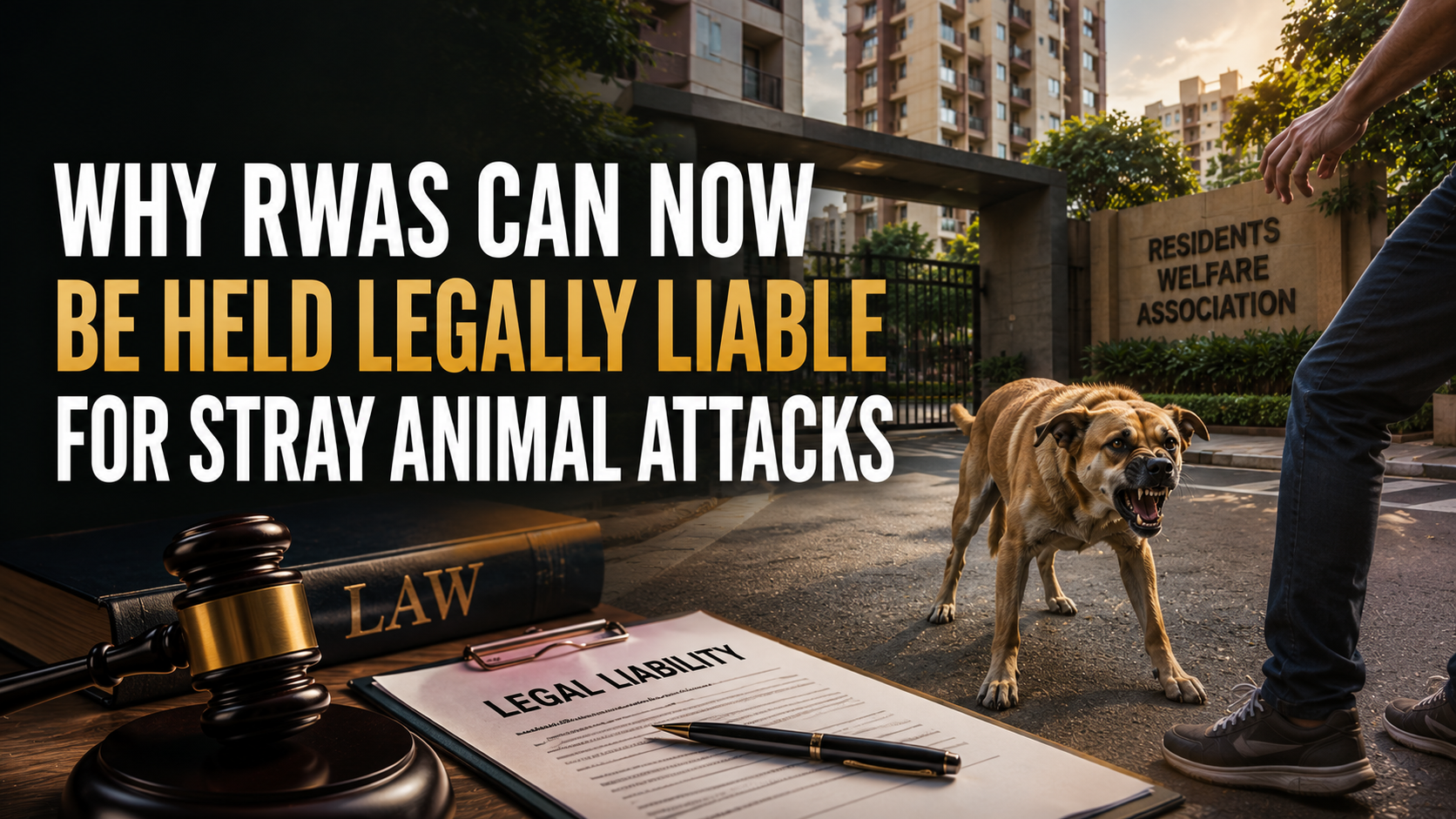
Urban living in India has undergone a massive transformation over the last two decades. The traditional model of independent houses has rapidly given way to sprawling gated communities and towering high-rises. For a homebuyer, investing in a gated residential society is not just about acquiring physical square footage; it is fundamentally about buying into a promise of enhanced security, well-maintained amenities, and a perfectly safe environment for their families. People willingly pay substantial monthly maintenance charges with the implicit understanding that the property management will shield them from external hazards. However, a growing urban crisis is fiercely challenging this expectation: the escalating conflict between human residents and stray animals within private residential complexes.
A recent and highly significant order by the District Consumer Disputes Redressal Commission in Noida has sent shockwaves through residential management committees across the country. By officially categorizing a stray dog attack inside a housing society as a direct deficiency in service on the part of the Resident Welfare Association, the judiciary has completely redrawn the boundaries of accountability. This ruling forces us to take a hard look at the legal responsibilities of apartment owners' associations, the consumer rights of the residents who fund them, and the incredibly complex legal tightrope of managing animal welfare alongside public safety.
To fully grasp the magnitude of this legal precedent, it is essential to examine the specific incident that triggered the consumer court's intervention. The case revolves around a deeply distressing event that occurred in late June 2022 within the confines of Kendriya Vihar-II, a well-known residential society located in Sector 82, Noida. On what seemed like a regular evening, a four-year-old child was playing in a green park situated directly behind the association's management office. Suddenly, she was subjected to an unprovoked attack by a pack of stray dogs roaming freely within the gated premises.
The severity of the attack was alarming. The young child suffered a Category III dog bite on her back and had to be rescued by a quick-thinking passerby. For the parents, the physical trauma inflicted upon their daughter was compounded by a deep sense of systemic betrayal. They argued that this was not an isolated, unforeseeable freak accident. Residents of the society had reportedly raised multiple red flags, constantly alerting the management committee about the rapidly growing stray dog menace and highlighting previous instances of aggressive canine behaviour.
Frustrated by the perceived inaction, the father of the victim took a legally innovative route. Instead of merely filing a standard police complaint, he approached the consumer forum. His core argument was brilliantly simple yet legally profound: having paid regular maintenance and security charges to the society since 2005, he was legally a consumer of their services. The failure of the management to provide a safe living environment, therefore, constituted a direct breach of his consumer rights.
The most groundbreaking aspect of the consumer commission's ruling is its interpretation of what constitutes a service obligation within a residential real estate context. The commission decisively ruled in favour of the resident, ordering the managing committee to pay a substantial compensation of one lakh rupees for the mental agony, physical injuries, and harassment suffered by the child, along with additional litigation costs. Furthermore, the order stipulated strict timelines for the payment, complete with penalty interest rates for any delays.
By categorizing the incident as a deficiency in service under the Consumer Protection Act, the legal forum established a very clear, transactional relationship between residents and their elected management bodies. When a housing society collects mandatory maintenance fees, a significant portion of those funds is explicitly earmarked for security services. The consumer forum's logic dictates that security is not just about deploying guards at the main gate to monitor visitor entry; it comprehensively includes safeguarding the residents from known, physical threats within the common areas, including aggressive stray animals.
The ruling firmly dismantles the long-held defense used by many management committees that their responsibilities are strictly limited to infrastructure upkeep, such as fixing broken elevators or cleaning common lobbies. It establishes a powerful legal precedent that accepting maintenance funds creates a binding, non-negotiable duty of care. If a known threat is ignored and it results in harm to a resident, the managing body cannot simply throw its hands up and claim helplessness.
One of the most fascinating legal subplots of this case was the shifting of the blame between the local civic authorities and the private residential management. In the initial complaint, the local development authority of Noida was also named as a party, operating under the assumption that managing stray animal populations is inherently a municipal responsibility.
However, the local authority fiercely defended itself by pointing out the distinct difference between public municipal land and private gated properties. Their argument was that while municipal bodies are responsible for public streets and open city sectors, a gated housing society is a private, restricted-access ecosystem. Since the residential association independently collects funds to maintain and secure its internal premises, the primary jurisdiction and responsibility for internal safety naturally fall upon the association, not the city's municipal corporation.
The consumer commission agreed with this separation of jurisdictions, ultimately dismissing the complaint against the civic authority. This dismissal is a massive wake-up call for real estate management bodies. It clarifies that once a builder hands over a project to a residential association, that association becomes the ultimate governing body for internal affairs. They cannot permanently outsource the liability of internal safety hazards to external municipal corporations while simultaneously collecting security fees from the homeowners.
While the ruling provides a massive victory for consumer rights and resident safety, it places the elected members of housing societies in an incredibly difficult, almost paradoxical legal position. Managing committees find themselves caught in a vicious crossfire between the strict mandates of consumer protection laws and the equally stringent regulations governing animal welfare in India.
When defending their position, the management of the Noida society highlighted this exact paralysis. They pointed out that stray dogs are heavily protected under national legislation, primarily the Prevention of Cruelty to Animals Act, alongside comprehensive Animal Birth Control Rules. According to the established legal framework and repeated guidelines from the highest courts of the country, stray dogs cannot be arbitrarily relocated, beaten, or driven out of their natural territories. Relocating a stray dog from its established territory is explicitly deemed illegal and cruel.
Therefore, the management argued that their hands were legally tied. They claimed they had done everything within their legal limits, which included issuing safety advisories to the residents and sending written requests to the municipal authorities to handle the situation. For the individuals running these associations—often volunteering their free time—the situation seems like a lose-lose scenario. If they aggressively remove the dogs, they face criminal charges from animal rights activists and statutory bodies. If they do nothing and a resident gets bitten, they now face heavy financial penalties from consumer courts.
To understand the gravity of the Noida ruling, it is important to recognize that this is not an isolated legal anomaly. It represents a steadily solidifying judicial trend aimed at enforcing strict accountability in community living.
A few years prior, a similar landmark judgement emerged from a district consumer forum in Gurugram. In that instance, the conflict involved a pet dog rather than a stray. A young girl was severely bitten by a resident's pet within the society premises. The consumer court in that case held both the housing management and the hired private security agency liable for a massive deficiency in service, awarding an unprecedented compensation that neared four lakh rupees. In its observation, the forum noted that while the financial penalty seemed steep, it was mathematically equivalent to just a few months of the total maintenance revenue collected by the society, emphasizing that societies possess the financial muscle to enforce better safety protocols.
When viewed together, the Gurugram pet dog case and the recent Noida stray dog case paint a very clear picture of the future of real estate management. The judiciary is consistently signalling that the physical safety of common areas—be it the clubhouse, the basement parking, or the green parks—is the absolute legal liability of the entity collecting the maintenance cheques. For smaller housing societies with limited reserve funds, a few such compensation payouts could easily push the association into financial bankruptcy, making proactive risk management an existential necessity.
If relocating stray dogs is illegal and allowing them to roam unmanaged invites consumer lawsuits, how can residential societies navigate this legal minefield? The solution lies in abandoning the extremes of total eradication or total negligence, and instead adopting highly structured, legally compliant community management strategies.
First and foremost, societies must actively engage with the Animal Birth Control rules rather than hiding behind them. The most effective, legally sanctioned method to manage stray populations and reduce canine aggression is a systematic sterilization and vaccination drive. Housing societies must allocate a portion of their maintenance budgets to collaborate with verified animal welfare NGOs. By proactively ensuring that every stray dog within the compound is neutered and vaccinated against rabies, the management drastically reduces territorial aggression and eliminates the risk of fatal disease transmission, effectively fulfilling their duty of care to the residents.
Secondly, the management of feeding practices is critical. Much of the conflict in gated communities arises because animal lovers feed strays near building entrances, children's play areas, or basement walkways. This inadvertently trains the animals to congregate in high-traffic human zones, creating perfect conditions for accidental conflicts. Housing societies must establish heavily regulated, designated feeding zones situated in the most secluded, low-footfall areas of the complex. Strict community guidelines must be enforced to ensure that feeding only occurs in these designated spots, thereby naturally drawing the animals away from the main residential corridors.
Furthermore, infrastructural audits are necessary. Many strays enter gated communities because of compromised boundary walls or entirely porous basement entry points. By investing in better perimeter fencing and installing physical barriers at critical access points, security agencies can monitor and manage the influx of new, unverified animals into the complex.
Finally, transparency and communication are paramount. Management committees must maintain meticulous records of their actions. If they have engaged an NGO for sterilization, set up feeding zones, and fortified the perimeter, these actions must be heavily documented. In the unfortunate event of an incident, this documentation serves as vital legal proof that the association took all reasonable, legally permissible measures to ensure safety, thereby fighting off the accusation of a "deficiency in service."
The recent consumer forum order emanating from Noida is far more than just a local news story about a tragic animal attack. It is a definitive legal milestone that permanently alters the operational dynamics of urban real estate. It firmly establishes that the collection of maintenance charges is not a mere administrative tax; it is a binding contract for safety, security, and peace of mind.
As our cities continue to grow denser and our residential complexes become larger, the friction between urban development, human safety, and animal welfare will only intensify. The era of passive property management is officially over. Resident welfare associations can no longer afford to be reactive entities that simply balance the financial books and change the hallway lightbulbs. They must evolve into proactive, legally savvy governing bodies capable of mediating complex community disputes, implementing sustainable animal management programs, and rigorously defending the fundamental consumer rights of the families they serve. For the modern homebuyer, this ruling provides a powerful reassurance that when they pay for a safe haven, the law will aggressively ensure they receive one.
