Published On:
July 26, 2026
Updated On:
July 26, 2026
India's residential real estate market is experiencing a profound structural shift, with premium and luxury housing driving record sales volumes while affordable flats face a steep decline. Modern homebuyers are prioritizing lifestyle upgrades, spacious configurations, and world-class amenities over budget constraints.
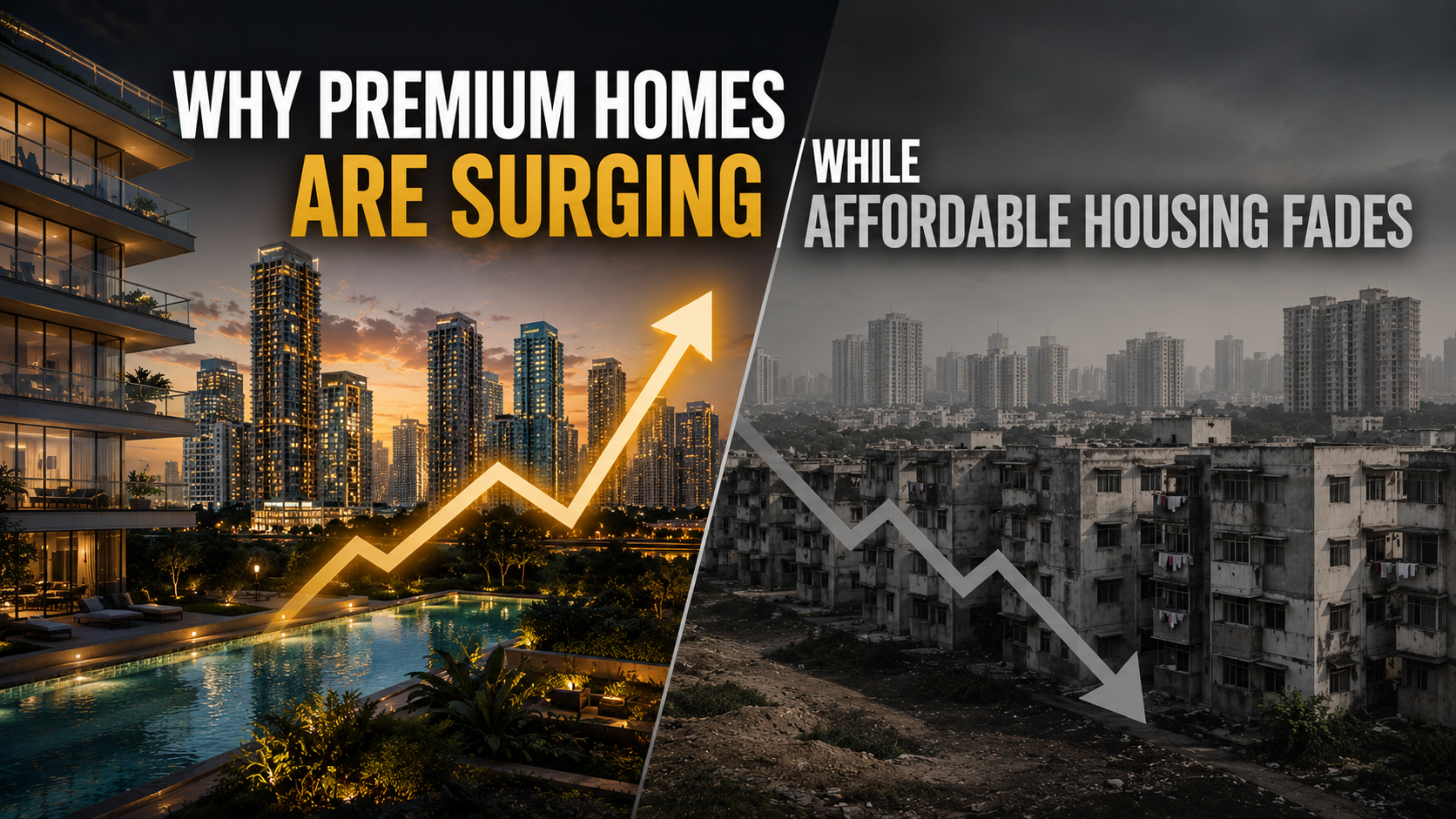
The Indian residential real estate market is undergoing one of the most remarkable transformations in its modern history. For decades, the foundational bedrock of the country's housing sector was volume-driven, anchored firmly by affordable housing projects catering to first-time buyers seeking compact apartments. Builders raced to launch thousands of budget-friendly flats, and marketing campaigns heavily focused on low entry costs and basic shelter.
Today, that traditional script has been rewritten. A sweeping structural shift is reshaping the urban skyline, characterized by an unprecedented surge in demand for premium housing, mid-income luxury, and ultra-high-end properties, running parallel to a sharp, sustained decline in the sales of affordable flats.
Recent mid-year market data tracking India's top residential hubs reveals a clear evolution in buyer mindset. While total housing sales remain stable, the underlying composition of those sales has flipped dramatically. Modern homebuyers are no longer merely looking for four walls and a roof; they are investing aggressively in upgraded lifestyles, smart architectural layouts, secure gated communities, and lifestyle-oriented amenities. Understanding this massive market divergence is essential for anyone looking to navigate property investments or interpret the future trajectory of urban development.
To comprehend the scale of this market realignment, one must analyze the hard transaction data emerging from major metropolitan hubs. Market assessments covering the first half of the year indicate that residential sales across India's top seven cities reached over 138,000 units, reflecting a modest year-on-year growth in overall transactional volume. However, breaking down those numbers by price brackets exposes a stark contrast in consumer behavior.
Properties priced above the one-crore-rupee mark have completely taken over the market landscape. High-value homes now account for an overwhelming majority of all residential transactions nationwide. The absolute star performer of this growth cycle is the 1.5 crore to 3 crore rupee bracket, which has registered staggering year-on-year sales spikes, positioning itself as the undisputed engine of modern real estate expansion.
Conversely, the affordable housing segment—traditionally defined as homes priced below 50 lakh rupees—has witnessed a dramatic, double-digit contraction. Properties falling in the sub-one-crore category have seen their overall market share shrink rapidly as developers pivot their land banks and capital toward larger, more lucrative residential configurations. This shift is not a temporary blip caused by seasonal fluctuations; it is a permanent structural migration of purchasing power toward the upper-middle and luxury segments.
The sharp decline in affordable flat sales is driven by a convergence of economic and behavioral pressures that have fundamentally altered the entry-level buyer's reality.
Following years of post-pandemic inflation, construction material costs—including cement, steel, and labor—have risen steadily. Developers operating in the affordable housing space have absorbed or passed on these cost increases, pushing entry-level apartment prices upward and eroding the core value proposition that once made budget housing attractive. At the same time, young urban professionals and nuclear families entering the market have seen their disposable incomes grow significantly, particularly within high-paying sectors like technology, global capability centers, and financial services.
Furthermore, the post-pandemic era permanently elevated expectations around living spaces. Families confined to small, compact apartments during lockdowns realized the heavy psychological and functional toll of cramped quarters. Buyers seeking their second or third home—as well as financially empowered first-time buyers—are now willing to stretch their budgets, utilize higher home loan eligibility limits, and prioritize long-term comfort over immediate cost-cutting. Consequently, a home priced under 50 lakh rupees often fails to match the spatial efficiency, ventilation, and community infrastructure that modern buyers demand.
As affordable housing retreats, the mid-income and luxury segments are experiencing a golden age. Properties ranging from 1 crore to 3 crore rupees are no longer viewed as elite, unreachable assets; they have become the mainstream benchmark for urban middle-class and upper-middle-class families looking to upgrade their standard of living.
This demand surge is heavily concentrated in economic powerhouses and tech corridors. Cities like Bengaluru, Pune, Mumbai, and the National Capital Region continue to capture the vast majority of total residential absorption. Bengaluru, fueled by robust employment generation and a massive influx of corporate professionals, has consistently led both sales volume and new project launches. Similarly, emerging corridors in Delhi-NCR and Chennai have recorded stellar growth, driven by massive infrastructure upgrades, expanding metro networks, and new expressway linkages.
Developers have responded swiftly to this demand curve. Across the country, fresh inventory launches heavily lean toward three-bedroom and larger configurations. Builders are actively recalibrating their master plans, reducing the supply of compact studio or single-bedroom apartments, and replacing them with spacious multi-room layouts designed to accommodate hybrid work setups, dedicated study rooms, and expansive family living areas.
The mass migration toward premium housing has fundamentally changed how real estate developers design, market, and execute their projects. In a market dominated by value-conscious buyers purchasing higher-ticket properties, compromises on construction quality or architectural design are no longer tolerated.
Large, listed developers with strong balance sheets have seized control of market share, squeezing out unorganized players who struggle to deliver large-scale luxury projects on time. These leading developers are investing heavily in institutional-grade construction practices, superior waterproofing, advanced acoustic insulation, and aesthetically pleasing high-rise facades.
Moreover, the definition of a premium project has evolved far beyond the apartment walls. Today's buyers evaluate the entire ecosystem of a residential society. Amenities that were once considered extravagant extras—such as temperature-controlled swimming pools, massive co-working lounges within clubhouses, multi-tier security systems, EV charging infrastructure, and expansive landscaped podiums—are now treated as non-negotiable baseline requirements. Developers who fail to integrate these lifestyle features find their inventories moving slowly, even in prime locations.
Despite facing periodic macroeconomic ripples, including geopolitical tensions affecting global supply chains and shifts in the technology job market, the premium housing sector has demonstrated remarkable price resilience. Rather than slashing base prices to clear unsold stock, established developers are holding their ground, absorbing minor sales slowdowns through flexible payment plans, structured construction-linked schedules, or occasional minor value additions.
This pricing stability stems from the financial maturity of top-tier real estate firms and the strong capital backing of domestic and foreign institutional investors. Real estate private equity inflows into Indian housing have surged, reflecting long-term confidence in the market's fundamental health. Institutional investors recognize that premium residential assets tied to strong infrastructure corridors offer stable, inflation-hedged appreciation and healthy rental yields.
As the market progresses through the second half of the decade, the trajectory is unmistakably clear. The era of volume-driven, low-cost housing dominance has given way to a quality-driven, aspiration-led market cycle.
For prospective homebuyers, this shift means that while entering the property market requires a higher financial commitment, the long-term asset value, community infrastructure, and quality of life delivered by modern residential projects are exponentially higher than ever before. Real estate is no longer just about securing physical shelter to check off a life milestone; it is a deliberate lifestyle choice.
For developers and investors, the message is equally straightforward. Success in the modern Indian real estate landscape belongs to those who can accurately read the aspirations of a financially empowered, globally exposed buyer demographic. By delivering spacious homes, immaculate execution, and holistic community living, the real estate sector is cementing its position as a primary pillar of modern economic growth.
