Published On:
March 16, 2026
Updated On:
March 16, 2026
According to Knight Frank’s Asia-Pacific Fit-Out Cost Guide 2026, India remains the most cost-effective hub for corporate expansion in the region, with mid-spec office interiors in cities like Bengaluru, Mumbai, and Delhi-NCR averaging just US$449 per square meter. Driven by a mature domestic supply chain and a highly skilled workforce, India offers multinational firms and Global Capability Centres unmatched value, successfully balancing world-class workplace quality with strict cost discipline.
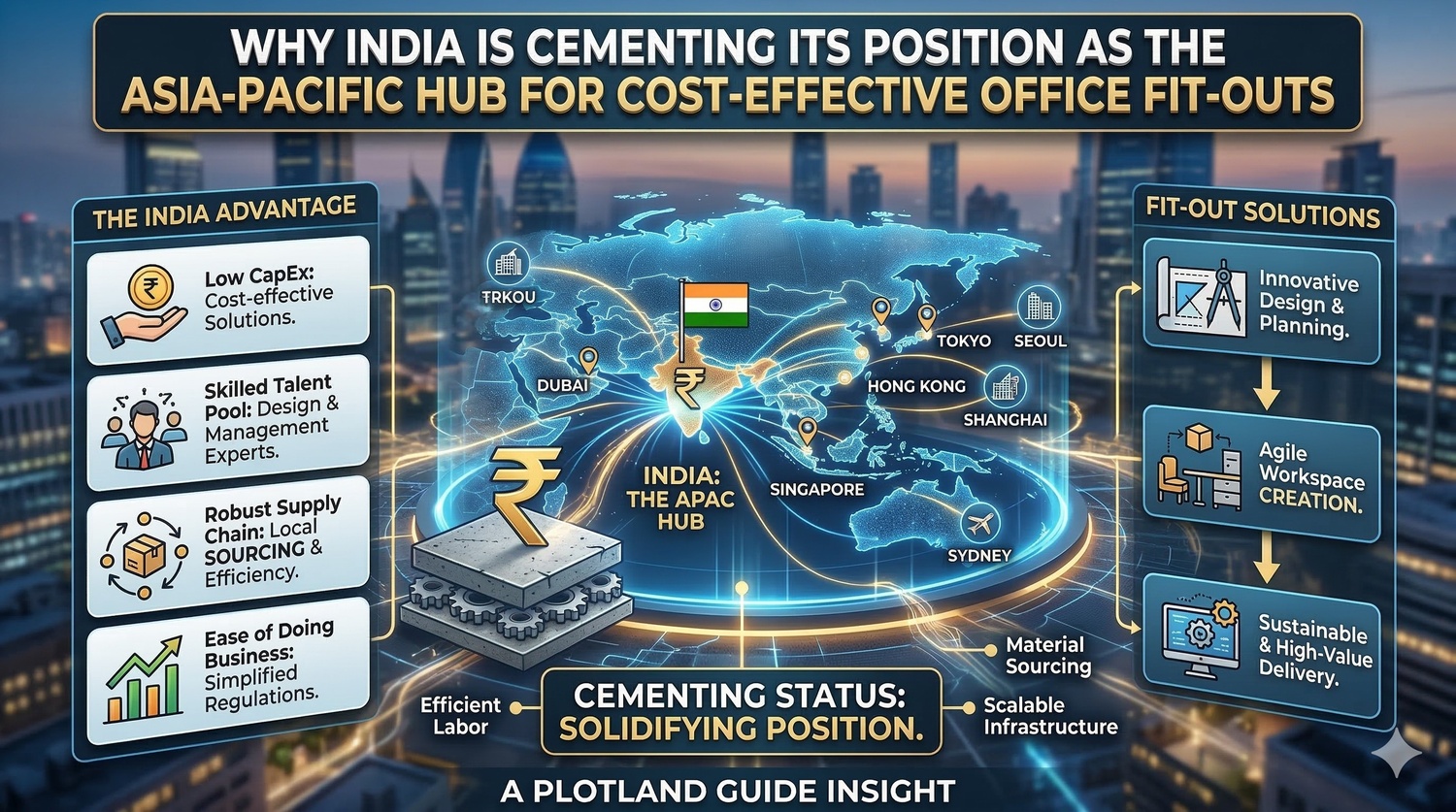
The global corporate landscape is undergoing a massive recalibration. As multinational corporations navigate an increasingly complex economic environment characterized by rising operational costs, shifting supply chains, and demanding sustainability mandates, the search for value has never been more intense. Amidst this regional reshuffling, India has emerged not just as a viable option, but as the undisputed leader for cost-effective corporate expansion in the Asia-Pacific region.
Recent data from the highly anticipated Asia-Pacific Fit-Out Cost Guide 2026, a comprehensive benchmark report evaluating 23 major cities across Australasia, East Asia, and Southeast Asia, paints a definitive picture of India’s competitive advantage. Major Indian commercial hubs, specifically Bengaluru, Mumbai, and the expansive Delhi-NCR region, are consistently offering multinational tenants an unparalleled blend of world-class quality and exceptional cost discipline.
As companies increasingly focus on creating employee-centric, highly flexible, and technologically advanced workspaces, understanding the dynamics of India's office fit-out market is essential for any business planning a regional expansion or looking to establish a Global Capability Centre.
The primary driver behind India's rising prominence as a corporate destination is its undeniable cost advantage, a factor that becomes strikingly apparent when compared to other regional financial centers.
Currently, the average cost for mid-spec office interiors across leading Indian cities sits at a highly competitive US$449 per square meter. Even for organizations looking to establish high-spec, premium office environments featuring the latest in smart-office technology and luxury finishes, the average cost remains around US$838 per square meter. To put this into perspective, these premium Indian fit-outs represent only a fraction of the capital expenditure required in cities like Singapore, which currently holds the title of the most expensive city for office fit-outs in the region, with costs routinely exceeding US$2,000 per square meter.
This massive disparity is not indicative of lower quality in India, but rather a reflection of fundamentally different market ecosystems. Singapore's soaring costs are largely driven by exceptionally stringent local sustainability regulations, high labor costs, and significant limitations on contractor capacity. In contrast, India offers a unique environment where scale and domestic capability converge to drive down costs without compromising on the final product.
Furthermore, India offers multinational tenants a distinct advantage when it comes to flexibility. The reinstatement costs—the financial burden associated with returning a leased commercial space to its original, bare-shell condition at the end of a tenancy—remain remarkably low in India, averaging just US$30 per square meter. This low exit barrier provides corporate occupiers with superior agility, allowing them to adapt their real estate footprints to changing business needs without facing exorbitant penalties.
The secret behind India's ability to deliver high-quality office fit-outs at such competitive price points lies in the rapid maturation of its domestic supply chain and contractor ecosystem.
Historically, developing a premium office space in India often required importing a significant portion of the necessary materials, from specialized carpeting and acoustic paneling to ergonomic modular furniture. This reliance on imports naturally inflated project costs and extended delivery timelines. However, the landscape has completely transformed over the last decade.
Today, India boasts a robust, deeply integrated domestic manufacturing sector specifically catering to commercial interiors. Many leading international brands have established manufacturing facilities directly within India or in neighboring Asian countries, drastically reducing shipping costs and bypassing complex international logistics bottlenecks. This localized production ensures that corporate occupiers have immediate access to world-class office furniture, advanced lighting systems, and high-end interior finishes at a fraction of the historical cost.
Complementing this localized manufacturing is a vast, highly competitive pool of skilled labor. From specialized architects and interior designers to master carpenters and technology integrators, India's workforce is capable of executing complex, bespoke office designs that meet rigorous global standards. The combination of competitive wages and a deep talent pool allows contractors to maintain high margins of efficiency throughout the project lifecycle.
India's unique value proposition is acting as a massive catalyst for the influx of Global Capability Centres. Multinational firms across sectors—ranging from global finance and advanced technology to pharmaceuticals and retail—are rapidly expanding their operational footprints in cities like Bengaluru, Hyderabad, and Pune.
These Global Capability Centres are no longer just back-office support functions; they are critical engines of innovation and strategic growth for their parent companies. Consequently, the expectations for these workspaces have evolved dramatically. Multinational firms are no longer willing to settle for basic, utilitarian office environments. They demand sophisticated, employee-centric designs that foster collaboration, enhance productivity, and reflect their global brand identity.
The Indian real estate and construction sectors have successfully risen to this challenge. Workplace solutions in India today routinely match, and often exceed, the quality standards found in traditional Western markets like the United States or the United Kingdom. By successfully combining massive operational scale with strict cost discipline, India allows these corporations to deliver exceptional workplaces that attract top-tier talent without breaking their regional real estate budgets.
Despite the clear advantages, executing a commercial fit-out project in the current global climate is not without its hurdles. The broader economic environment across the Asia-Pacific region is currently characterized by significant volatility. Occupiers and project managers are constantly navigating a complex web of challenges, including fluctuating currency exchange rates, the looming threat of new international trade tariffs, and localized labor constraints.
To combat this volatility and mitigate financial risk, the Indian market is witnessing a massive structural shift toward the "Design & Build" delivery model. Traditionally, commercial fit-outs followed a fragmented approach, where a company would first hire an architect to design the space, and then separately tender the project out to various construction contractors. This traditional method often led to communication breakdowns, delayed timelines, and significant cost overruns.
The Design & Build model revolutionizes this process by consolidating both the design and construction phases under a single, unified contract. A single entity takes full responsibility for the entire project lifecycle, from initial conceptualization and space planning to final execution and handover.
Industry analysis indicates that this streamlined approach is proving incredibly effective. By eliminating the friction between separate design and construction teams, firms are managing to reduce overall project timelines by up to 30%. Furthermore, this unified approach provides much greater cost certainty from day one, allowing corporate occupiers to lock in material prices early and significantly reduce the risk of unexpected budget blowouts.
Another major factor reshaping the office fit-out landscape in India and the broader Asia-Pacific region is the rapid escalation of Environmental, Social, and Governance (ESG) requirements.
Just a few years ago, integrating green building principles and advanced smart-office technology was viewed as an optional, premium upgrade. Today, it has transitioned into a mandatory baseline expectation. Driven by corporate sustainability pledges, evolving government regulations, and the demands of an environmentally conscious workforce, green building certifications such as LEED and WELL are now standard requirements for premium office spaces.
This shift naturally impacts project budgets. Implementing advanced HVAC systems for superior indoor air quality, utilizing sustainably sourced building materials, and integrating comprehensive IoT sensor networks for energy optimization all require upfront capital investment. However, experts note that the cost dynamics are highly nuanced. While these ESG requirements are undeniably raising the baseline cost of a competitive fit-out, the long-term operational savings in energy efficiency and improved employee retention often far outweigh the initial expenditure.
For companies expanding in India, the challenge lies in balancing these essential sustainability mandates with overall cost discipline. The mature local supply chain plays a vital role here as well, providing cost-effective, locally sourced green materials that help keep overall project budgets in check.
As the true cost of doing business in the Asia-Pacific region becomes increasingly complex, strategic foresight is paramount. While headline numbers firmly establish India as the most cost-effective destination for office fit-outs, corporate occupiers must recognize that the landscape is dynamic.
Global trade dynamics, particularly the potential ripple effects of new tariffs on essential construction materials, introduce an element of uncertainty that must be proactively managed. Furthermore, as demand for high-quality, sustainable workspaces continues to surge, even historically affordable markets will experience gradual upward pressure on labor and material costs.
To successfully navigate this environment, industry experts emphasize the critical importance of early engagement. Companies planning expansions or relocations must initiate the planning phase well in advance, taking the time to clearly define the project scope and required sustainability standards before any procurement begins. Building flexibility into supply chain strategies, locking in material prices early, and leveraging the efficiency of Design & Build models are essential strategies for mitigating both cost and delivery risks.
Ultimately, India's position as the premier destination for office fit-outs is secure for the foreseeable future. The nation's unique ability to seamlessly blend world-class workplace quality with unmatched cost efficiency, backed by a deeply integrated domestic supply chain, provides a compelling proposition for any multinational corporation. As businesses continue to prioritize resilient, employee-centric, and sustainable workspaces, India stands ready to define the next generation of the corporate office environment.
