Published On:
September 6, 2026
Updated On:
September 6, 2026
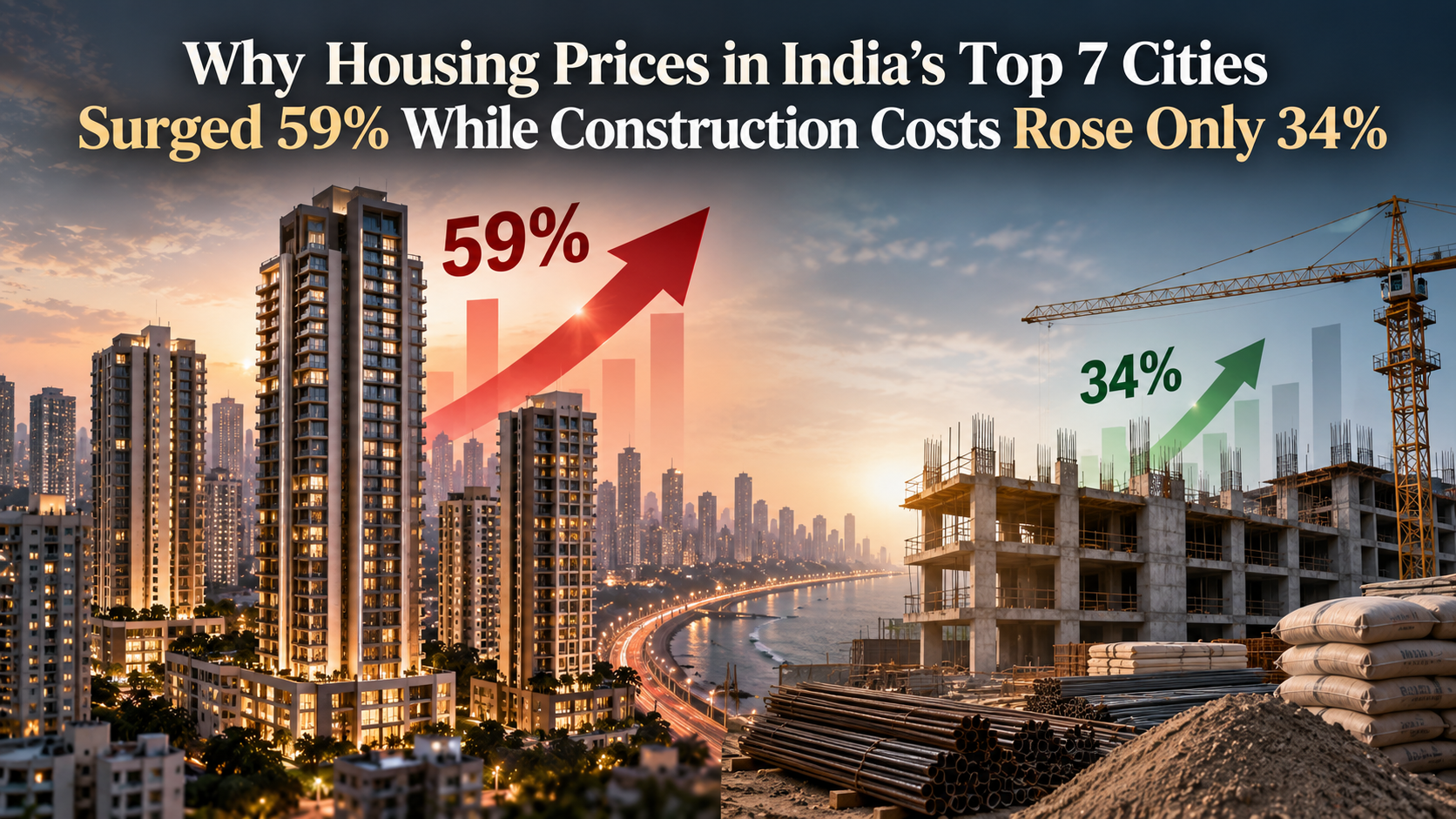
A recent industry report reveals a stark 25% divergence in the Indian real estate market, where average housing prices in top cities surged by 59% over the last five years, significantly outpacing a 34% rise in actual construction expenses. This growing gap is primarily driven by skyrocketing land acquisition costs, global supply chain disruptions, and intense demand-supply dynamics that are reshaping home affordability.
Anyone attempting to buy a home in a major Indian metropolitan area recently has likely felt the sharp pinch of escalating property prices. The Indian real estate market has experienced an unprecedented bull run over the past half-decade. However, beneath the surface of record-breaking sales numbers and massive project launches lies a complex mathematical reality that is fundamentally altering the housing industry.
Recent industry analysis focusing on the top seven Indian cities has uncovered a massive divergence between what it physically costs to build a residential tower and the final price tag handed to the homebuyer. Over the last five years, specifically between 2021 and 2025, the average cost to construct a standard-plus residential project increased by 34%. Yet, during the exact same timeframe, the average residential capital values—the actual housing prices paid by consumers—skyrocketed by a staggering 59%.
This creates a massive 25% gap that warrants a deeper investigation. When home prices outpace construction costs at almost double the rate, it signals a major structural shift in how real estate is valued, developed, and sold in India. For prospective buyers, this trend highlights a rapidly approaching affordability wall. For builders and developers, it presents a very delicate balancing act between maintaining project profitability and keeping homes within the financial reach of their target audience.
To truly grasp the magnitude of this market shift, it helps to look closely at the numbers behind the physical construction process versus the retail property market.
In 2021, the average physical cost to construct a standard-plus residential project in India's leading urban centers stood at roughly ₹2,681 per square foot. Fast forward to 2025, and that baseline construction cost climbed to ₹3,604 per square foot. This represents a compound annual growth rate of approximately 6.9%. In a rapidly developing economy dealing with inflation, a 34% jump over five years in physical building expenses is significant, but it follows a somewhat predictable economic curve.
However, the retail side of the property market tells a wildly different story. In 2021, the average residential capital value in these top seven cities was around ₹5,826 per square foot. By 2025, that average asking price leaped to ₹9,260 per square foot, registering a massive 59% overall increase and a compound annual growth rate of 12%.
This clear, widening disconnect proves that the physical bricks, mortar, and steel are no longer the primary drivers of property price hikes. In fact, industry data indicates that while 66% of the recent property price hikes can be linked directly to rising construction expenses, the remaining 34% of the price surge is being fueled entirely by external market pressures.
If building materials only account for a portion of the price hike, where is the rest of the money going? The most significant factor driving up housing prices is the aggressive surge in land values. Unlike cement, steel, and manual labour, the cost of raw land is inherently finite and highly competitive.
Over the past five years, land prices across major Indian cities have risen sharply, driven by a combination of rapid urbanization, shifting demand-supply dynamics, and heavy infrastructure-led appreciation. When a new metro line is announced, a massive highway corridor is planned, or a new international airport gets the green light, the surrounding land values multiply rapidly long before the first brick of a residential project is even laid.
The data reflects this reality intensely. Between 2021 and the first half of 2026, land values in the top seven cities recorded massive hikes ranging between 50% and 120%. The National Capital Region and Bengaluru have experienced the most aggressive spikes. In the NCR, land price hikes soared between 70% and 130%, while Bengaluru witnessed land appreciation between 60% and 120%.
These higher land acquisition costs severely complicate project feasibility. When developers are forced to pay exorbitant premiums simply to acquire a land parcel in an established or upcoming corridor, that massive initial capital expenditure is inevitably baked into the final per-square-foot cost passed down to the homebuyer. The physical cost of building the apartment remains the same, but the dirt it sits on has doubled in value, dragging the overall property prices upward.
While local land prices form a massive chunk of the rising costs, international events are directly impacting the daily expenses on Indian construction sites. The modern real estate supply chain is highly globalised. Developers rely heavily on imported materials, international shipping routes, and global commodities pricing to finish their projects.
The ongoing geopolitical tensions in the Middle East have triggered a severe ripple effect across the Indian construction sector. These conflicts have caused sharp disruptions in fuel-linked logistics, driving up the cost of transporting heavy construction materials across the country. More importantly, the tensions have heavily impacted the pricing of steel and imported finishing materials.
The Mechanical, Electrical, and Plumbing (MEP) sectors of construction are also feeling the heat. Because of global supply constraints and rising international commodity rates, copper and aluminium prices have surged. This has pushed overall MEP costs up by an estimated 9% to 13%.
When you factor in the increased logistics costs, the high price of steel, and the premium on imported finishing materials, global tensions have added an unexpected 8% to 10% to the overall physical construction costs for developers in India.
Beyond the international pressures, domestic inputs also play a major role in the 34% rise in construction costs. Analyzing the individual components of a building project reveals where developers are feeling the tightest squeeze.
Finishing materials, which include items like high-quality floor tiles, exterior glass facades, and architectural hardware, have become notably more expensive. These elements, which give premium and standard-plus housing their modern aesthetic, are now roughly 8% to 12% costlier to procure than they were a few years ago.
Interestingly, the largest single cost component in any Indian real estate project is manual labour. Employing skilled and unskilled workers typically accounts for a massive 25% to 30% of the total project budget. Despite the high inflation seen in other sectors, labour costs have seen a relatively moderate increase of just 5% to 6% over the last five years. Similarly, domestic cement prices have remained fairly contained, showing only a modest 4% to 5% increase during the same period.
This specific breakdown shows that the core skeleton of a building—the concrete and the workers pouring it—has remained relatively stable in price. The real financial inflation is happening in the specialized metals, the high-end finishing touches, and the transportation required to get materials to the site.
On the surface, a 59% increase in housing prices might look like a massive windfall for real estate developers. However, the ground reality of project financing paints a much more stressful picture. An 8% to 10% unexpected increase in raw construction costs can materially disrupt the project-level profitability of a development firm.
The impact heavily depends on the specific lifecycle stage of a given project. For residential towers that have already been launched, heavily marketed, and largely sold out to early buyers, the developer is locked into the agreed-upon sale price. They cannot legally or practically go back to a homebuyer two years after the initial booking and demand more money simply because the price of imported glass or steel has gone up. Consequently, the developer is forced to absorb these rising construction costs directly, resulting in severely compressed profit margins.
For upcoming or newly launched projects, developers have much more flexibility. They can recalculate their entire financial model based on the prevailing high construction and land acquisition costs and set a higher launch price. However, this strategy is entirely dependent on the local market's competitive environment and the actual purchasing power of the target demographic. If they push the launch price too high, they risk alienating buyers and stalling their sales momentum, leading to heavy unsold inventory.
The most alarming aspect of this 25% divergence between building costs and final property prices is the urgent affordability crisis it creates for the everyday homebuyer.
The luxury and ultra-premium housing segments operate under a different set of economic rules. High-net-worth individuals purchasing sprawling penthouses or premium villas are generally less price-sensitive. They have the financial bandwidth to absorb higher costs without abandoning their purchase plans. This is why the premium segment has continued to perform exceptionally well despite the rapid price hikes.
However, the situation is completely different for the affordable and mid-income housing sectors. Buyers in these brackets rely heavily on home loans, strict monthly budgets, and calculated down payments. When average residential capital values jump by 59% in just five years, wage growth rarely keeps pace.
As a result, millions of working professionals find themselves entirely priced out of established urban corridors. A mid-income buyer who could afford a spacious three-bedroom apartment in a prime location five years ago is now forced to settle for a smaller two-bedroom unit or look for properties in distant, underdeveloped peripheral suburbs where land costs are slightly lower. This dynamic severely threatens the long-term volume of housing demand in the mid-tier segment.
To survive this high-cost, high-price environment without crashing the market demand, real estate developers are being forced to adapt their business strategies rapidly. The days of aggressively launching massive, sprawling townships with fixed, low introductory prices are fading.
Moving forward, the market will likely see highly calibrated and calculated price increases. Instead of hiking prices across the board, builders are introducing micro-increases tailored to specific project phases or premium inventory units.
Furthermore, there is a distinct shift happening in project specifications and product mixes. To protect their margins without raising the final price tag beyond the buyer's reach, some developers are optimizing their floor plans, reducing the overall carpet area slightly, or choosing more cost-effective domestic finishing materials over expensive imports.
There is also a noticeable trend toward slower, phased launch timelines. Rather than flooding the market with thousands of units at once, developers are releasing smaller blocks of inventory. This allows them to test the market's pricing power, gauge the target clientele's affordability threshold, and adjust their financial models in real-time as construction costs fluctuate.
The Indian real estate market has structurally changed from where it was half a decade ago. The sheer 59% surge in housing prices, driven heavily by skyrocketing land values and international supply chain pressures, has permanently altered the barrier to entry for homeownership in top cities. While construction costs have certainly grown by a substantial 34%, they are no longer the single dominating factor in determining what a home is worth.
As land in prime urban and newly connected infrastructure corridors becomes increasingly scarce and expensive, this divergence is likely to persist. Buyers must now navigate a highly complex market where location premiums dictate the budget far more than the physical walls of the home itself. For developers, the future relies entirely on their ability to source materials efficiently, manage their land acquisition strategies prudently, and deliver quality homes without breaching the delicate threshold of consumer affordability.
