Published On:
September 18, 2026
Updated On:
September 18, 2026
Fueled by changing lifestyle aspirations and robust infrastructure upgrades, real estate buyers in Gurugram are increasingly shifting toward larger properties, making 3BHK and larger configurations the most sought-after housing choice. Recent market data highlights that nearly 68% of purchasers are buying for self-use, prioritizing spacious layouts, premium community amenities, and long-term value across prime growth corridors like the Dwarka Expressway and Southern Peripheral Road.
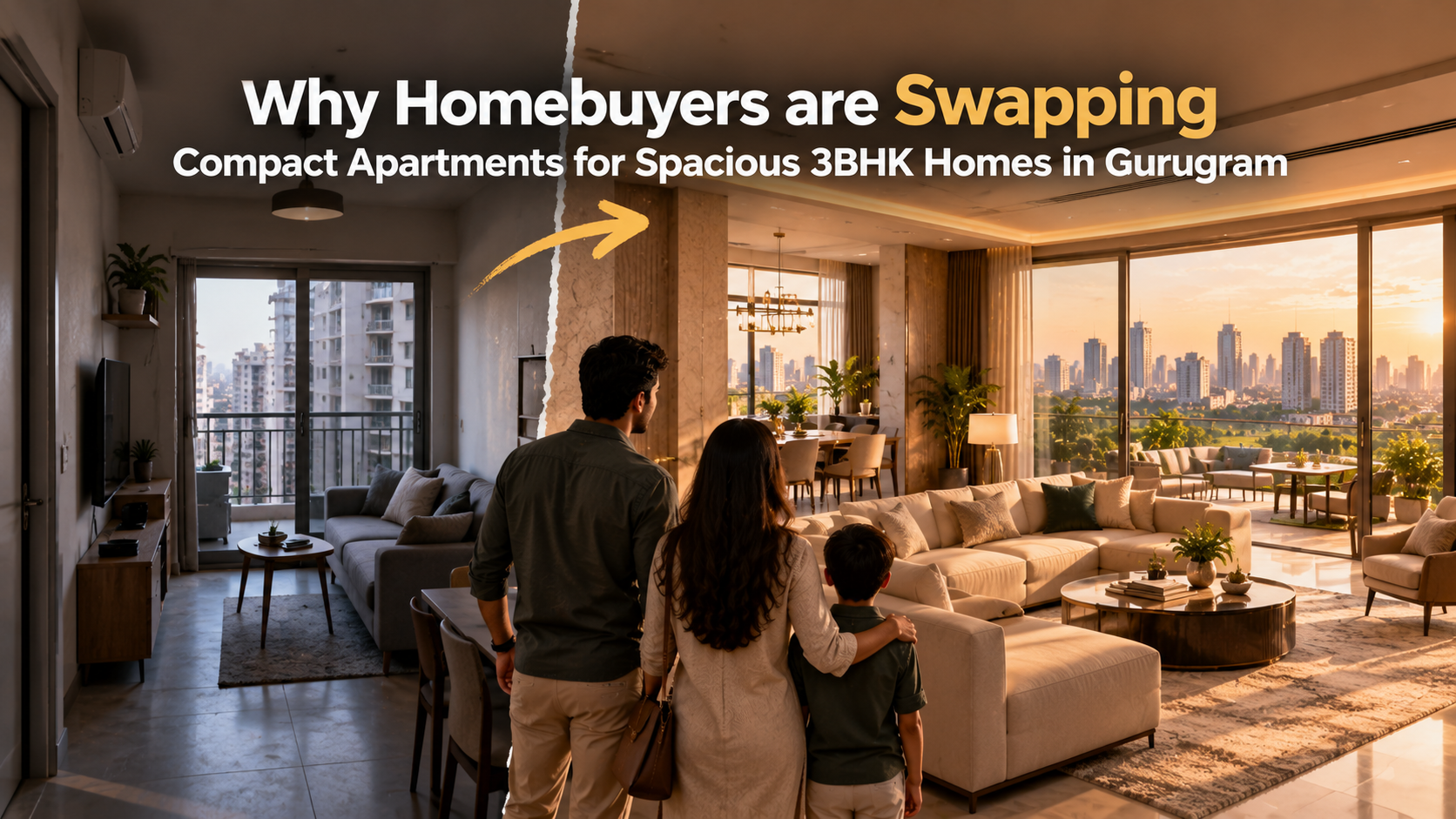
The urban residential landscape in the National Capital Region is experiencing a profound psychological and structural evolution. For many years, buying a home in a bustling corporate hub like Gurugram meant prioritizing proximity to office clusters above all else, often forcing buyers to settle for compact, multi-room apartments where square footage was at a premium. Families routinely managed their daily routines within tight floor plans, treating residential spaces merely as convenient crash pads close to corporate parks.
Today, that narrative has completely flipped. Driven by a collective desire for enhanced personal well-being, long-term flexibility, and a higher quality of everyday life, modern homebuyers are actively scaling up. Recent comprehensive market insights, including consumer sentiment metrics, reveal a striking surge in demand for larger configurations, with 3BHK apartments firmly establishing themselves as the undisputed kings of the residential market. As Gurugram’s expansive growth corridors witness massive infrastructural revamps, the city is transitioning into a haven for spacious, amenity-rich housing that caters to families looking to plant deep, comfortable roots.
To grasp the magnitude of this preference shift, one only has to look at the numbers. Industry-wide consumer sentiment surveys covering thousands of active homebuyers across major urban centers indicate that nearly 48 percent of all prospective purchasers now prefer 3BHK homes as their primary configuration of choice. In the Delhi-NCR market specifically, that preference climbs even higher, hitting an impressive 53 percent.
At the same time, interest in ultra-spacious residences—such as 4BHK units and expansive penthouse formats—has seen a steady upward tick, growing from around 3 percent in previous cycles to nearly 5 percent. While 2BHK units remain a viable second choice for younger buyers or initial-stage investors, the clear market momentum belongs to larger spaces.
This is not a superficial trend driven by temporary impulses. Real estate strategists and developers note that an overwhelming 68 percent of these property purchases are being made strictly for self-use rather than speculative investment. When a family is buying a home to live in for the next twenty or thirty years, their priorities change dramatically. They are no longer looking at raw square footage through a cold, investment-centric lens; instead, they are evaluating how well a home can adapt to their changing lifestyle requirements, accommodate hybrid work schedules, and provide a sanctuary away from the chaos of the city.
This massive appetite for spacious housing is not distributed uniformly across the entire city; it is heavily concentrated along Gurugram’s high-velocity growth corridors. Micro-markets such as the Dwarka Expressway, Southern Peripheral Road (SPR), Sohna Road, and New Gurugram are witnessing unprecedented real estate activity.
These emerging corridors share a common denominator: massive infrastructural enhancement. The rapid development of expressways, underpasses, and upcoming transit links has successfully bridged the gap between peripheral land banks and central commercial hubs. Because developers have access to larger land parcels along these expansive stretches, they are able to conceptualize master-planned communities that feature wide open green spaces, low-density zoning, and sprawling clubhouses—amenities that are virtually impossible to replicate in older, hyper-congested inner-city sectors.
For the modern homebuyer, purchasing a 3BHK or larger home along the Dwarka Expressway or Southern Peripheral Road means securing a lifestyle that balances connectivity with tranquility. They can commute efficiently to their workplaces while returning to a peaceful, well-planned environment characterized by wide internal roads, abundant parks, and sophisticated security architectures.
The modern Gurugram homebuyer is remarkably discerning. Simply adding extra square footage or tossing in an extra bedroom is no longer enough to win over families looking to invest their hard-earned capital. Developers are finding that today's consumers evaluate properties based on thoughtful layouts, intelligent spatial planning, and functional luxury.
The traditional boxy apartment design, where rooms were cut off and hallways wasted valuable space, has been replaced by fluid, open-plan architectural concepts. Modern 3BHK and 4BHK layouts prioritize seamless transitions between the living, dining, and kitchen areas, creating a sense of grand volume and abundant natural light.
Furthermore, the post-pandemic realization that homes must double as versatile spaces has permanently altered interior expectations. A standard 3BHK is no longer viewed merely as a master bedroom, a kids' room, and a guest room. Instead, families are utilizing that third room as a dedicated home office for hybrid working professionals, an online learning studio for children, a quiet reading library, or a personal wellness and yoga zone. Privacy, cross-ventilation, and optimal space utilization have become non-negotiable parameters for buyers who want their homes to effortlessly evolve alongside their changing life stages.
When buyers step into the market seeking larger homes, their expectations regarding community infrastructure scale up proportionally. The modern residential project in Gurugram is judged as much by its external amenities as it is by the interior dimensions of the apartment itself.
Developers are responding by curating holistic living environments that rival high-end wellness resorts. Pools for hydrotherapy, extensive jogging tracks, dedicated sports arenas, organic gardens, co-working lounges within clubhouses, and children's adventure zones have become standard expectations rather than luxury exceptions. For families investing in a 3BHK or larger unit, these shared community spaces act as an extension of their private living rooms, fostering a vibrant social fabric and offering children a safe, engaging environment to grow up in.
This wave of premiumisation is also evident in the way real estate brands are curating their portfolios. Leading developers who traditionally focused on standard configurations are aggressively pivoting toward luxury 3BHK and 4BHK developments. By incorporating international design standards, smart home automation, multi-tier security systems, and concierge services, these projects are successfully capturing the attention of affluent end-users and Non-Resident Indians (NRIs) looking for uncompromised comfort in their hometown.
A natural question arises in the midst of this boom: how are buyers reacting to escalating property values? The real estate market across the National Capital Region has seen significant price appreciation over recent years, driven by high demand, rising input costs, and the superior quality of new-age infrastructure.
Market surveys indicate that a majority of prospective buyers are indeed conscious of this price surge, with many expressing moderate concerns about rising property values. However, this financial awareness has not dampened the underlying desire for homeownership. Instead of retreating from the market entirely, buyers are adapting their strategies. Many are opting to explore emerging peripheral micro-markets where capital values offer better value per square foot, while others are carefully timing their purchases or leveraging new-launch inventories that offer structured payment plans.
The resilient intent to buy underscores a fundamental cultural and financial truth: real estate remains the ultimate asset class for long-term security in India. Buyers view paying for a larger, premium home not as an inflated expense, but as a future-proof investment in their family's health, happiness, and financial stability. The sweet spot for mid-to-high-tier housing investments has firmly settled into budgets that accommodate these larger, value-added properties, proving that quality will always supersede mere cost considerations.
As Gurugram continues to expand its physical boundaries and cement its status as a premier economic powerhouse, the residential preferences of its citizens will continue to set trends for the rest of the country. The era of settling for cramped, transactional housing is fading rapidly.
The widespread surge in demand for 3BHK and larger homes is a clear signal that the modern Indian homebuyer views living space as an essential component of personal wellness. By combining thoughtful interior architecture, sprawling community amenities, and strategic locations along high-growth corridors, Gurugram’s real estate ecosystem is successfully delivering what its residents desire most: a spacious, secure, and deeply satisfying place to call home. For anyone watching the urban transformation of the National Capital Region, one thing is certain—bigger is not just a trend; it is the new baseline for modern living.
