Published On:
March 10, 2026
Updated On:
March 10, 2026
Choosing a property in Noida is a highly strategic financial decision where a sector's specific infrastructure, proximity to commercial hubs, and master planning completely dictate the asset's lifestyle quality and long-term capital appreciation.
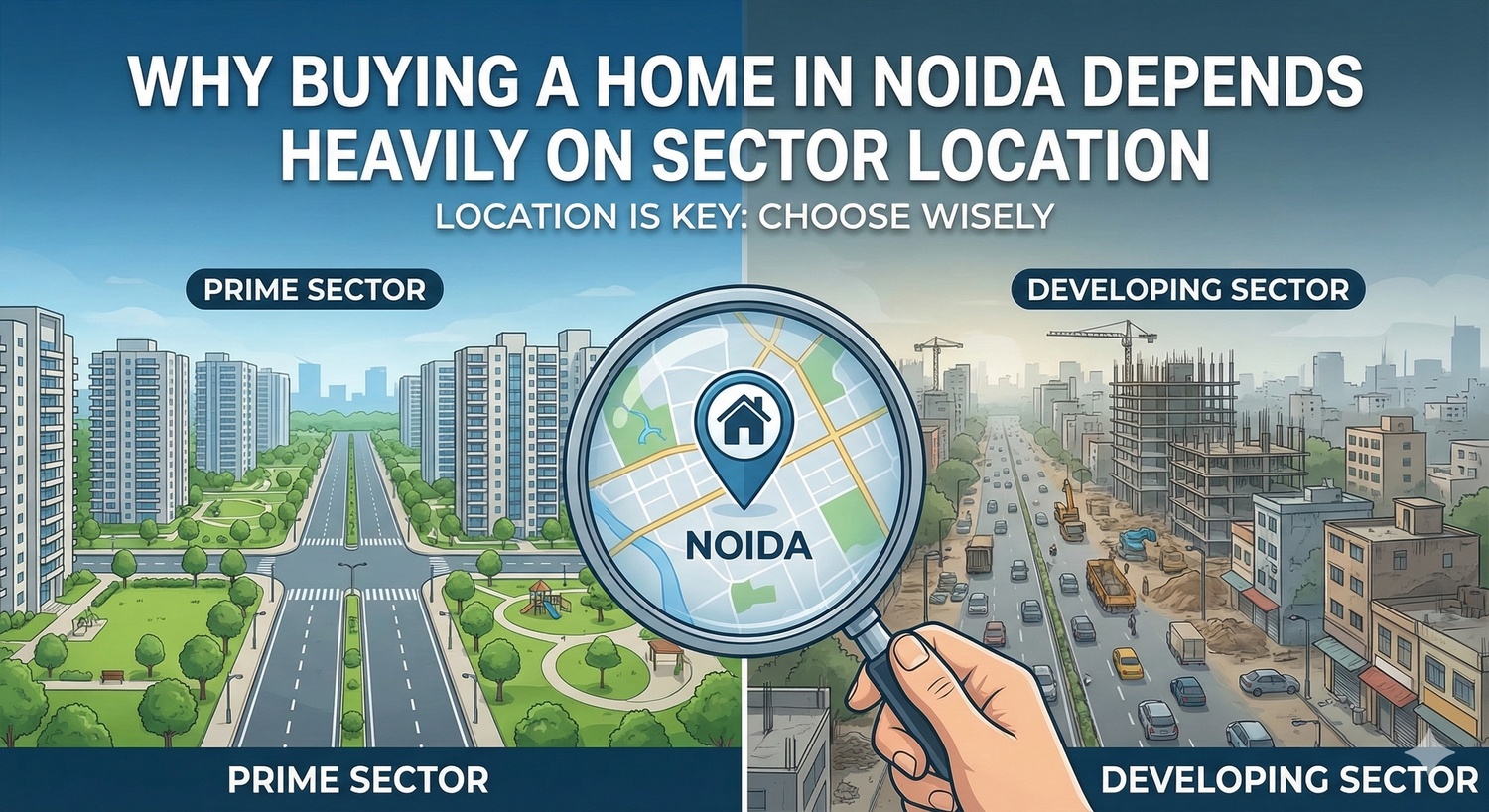
The real estate landscape of the National Capital Region has undergone a massive structural and psychological shift over the last decade. Gone are the days when simply owning a piece of property anywhere within the NCR guaranteed exponential, unchecked returns. The market has matured considerably, transitioning from a speculative, hype-driven frenzy into a highly calculated, execution-driven economic ecosystem. Nowhere is this evolution more visible and impactful than in Noida. As massive institutional capital pours into the region and multi-billion-dollar infrastructure projects move from paper announcements to ground reality, the city has cemented its position as one of North India’s most robust and reliable property markets.
However, the overarching narrative of a generalized "Noida real estate boom" can be dangerously misleading for the uninitiated homebuyer. The reality of the ground is that Noida is not a single, monolithic market. It is a highly complex, interconnected patchwork of distinct micro-markets, each driven by its own unique economic catalysts, demographic profiles, and infrastructural lifelines. Purchasing a home here is no longer just a standard transaction involving square footage, floor plans, and developer reputation. It is a strategic allocation of capital that depends entirely on geographic positioning. Whether your ultimate objective is securing a high-yielding rental asset, finding a peaceful family home in a mature neighborhood, or parking funds for aggressive long-term capital appreciation, your success hinges entirely on one critical variable: the sector location.
In the modern real estate equation, seamless connectivity is the ultimate currency. Noida’s sector valuations are directly and inextricably tied to their proximity to major transit arteries. While the city's original master plan was designed with a heavy emphasis on wide, grid-like road networks, the modern buyer's demands have evolved to prioritize multi-modal transport efficiency. Today, a property's intrinsic value is heavily influenced by its immediate distance from the Noida-Greater Noida Expressway, the DND Flyway, the Aqua Line, and the Blue Metro lines.
Consider the stark, often surprising price disparities that exist between residential sectors located just a few kilometers apart. Sectors situated directly along the expressway or within a short walking distance of an operational metro station command massive financial premiums. This is not merely a convenience tax; it is a direct reflection of the modern "walk-to-work" culture and the economic value of reducing daily commute times to central Delhi or local corporate IT parks. When daily travel friction is reduced, the livability index of the location skyrockets, taking property prices along with it.
Furthermore, the impending operationalization of the massive Noida International Airport at Jewar is fundamentally realigning property values across the entire southern corridor. Sectors that offer frictionless, signal-free access to the airport approach roads are currently witnessing aggressive price revaluations. These specific transit-oriented zones are frequently outpacing the broader city’s average appreciation rates by a significant margin. Conversely, if a sector remains geographically isolated or cut off from these primary transit routes, it risks long-term financial stagnation, regardless of how luxurious or heavily amenitized the individual apartment complexes within it might be.
To successfully navigate this vast market, an investor must deeply understand the specific economic DNA of Noida's key sectoral zones. The investment thesis and the expected lifestyle change dramatically the moment you cross sector dividing lines.
Sectors such as 94, 128, 135, and 150 represent the absolute pinnacle of Noida's luxury real estate ambition. This high-profile corridor is meticulously designed for high-net-worth individuals, top-tier corporate executives, and business owners seeking an elevated, exclusive lifestyle. Sector 150, in particular, has emerged as a massive focal point due to its strict low-density master planning, sprawling professional golf courses, and expansive, protected green covers. Properties in this belt are not just functional homes; they are definitive lifestyle statements.
Naturally, the capital entry barrier here is exceptionally high, with premium residential rates consistently crossing the ₹10,000 to ₹12,000 per square foot threshold, and ultra-luxury projects commanding even more. However, the return on investment is powerfully anchored by the proximity to the upcoming airport influence zone and the heavy presence of integrated luxury townships. For buyers looking for social status, massive capital appreciation over a ten-year horizon, and a relatively pollution-free environment, the expressway belt is the undisputed premier choice.
For the vast majority of end-users, growing families, and first-time investors, Central Noida remains the most practical and fiercely contested battleground. Sectors 74 through 79 represent highly established residential clusters that offer an optimal balance of housing affordability, ready-to-move-in inventory, and highly mature social infrastructure.
Unlike the emerging peripheral zones that are still under construction, these central sectors already possess fully functional, top-tier schools, massive retail malls, and multi-specialty healthcare facilities right around the corner. The strong presence of the Aqua Line metro provides seamless internal city connectivity, making these sectors incredibly popular among the salaried, working-class demographic. Because the neighborhood infrastructure is already mature and functioning, property prices here experience steady, highly predictable growth rather than volatile, speculative spikes. It is widely considered one of the safest, most defensive zones for capital preservation and highly reliable rental income.
Real estate demand does not exist in a vacuum; it relentlessly follows employment generation. Sectors 62, 137, 140A, and 143B serve as the heavy engines of Noida’s commercial and corporate growth. Packed with sprawling IT/ITeS parks, global capability centers, fintech startups, and massive new-age data hubs, these sectors are precisely where the city’s workforce goes to earn a living.
Buying a residential property directly within or immediately adjacent to these commercial sectors is a highly lucrative financial play for maximizing rental yields. Young technology professionals, consultants, and corporate migrants consistently seek housing within a tight five-kilometer radius of their office desks to avoid traffic fatigue. As a direct result, well-maintained apartments in these specific zones rarely suffer from prolonged vacancy periods. They offer landlords gross rental yields that comfortably and consistently outperform traditional residential market averages across the rest of the NCR.
To capture massive equity multipliers, many buyers are looking toward the growth corridors along the Yamuna Expressway and Greater Noida West (formerly Noida Extension). These regions remain the volume drivers for mid-segment housing and long-term land investments. Sectors here offer significantly larger floor plans and plot sizes at entry prices that are a fraction of central Noida’s rates.
However, the trade-off here is time and patience. Investors deploying capital into these emerging sectors must be willing to wait for the proposed metro extensions, local commercial hubs, and localized infrastructure to fully materialize. But the underlying data is incredibly strong. With massive industrial activation underway—including the allotment of thousands of industrial plots, the construction of major semiconductor manufacturing units, and the highly anticipated Film City project—these zones are transitioning from mere announcements into execution. As these mega-projects break ground and generate thousands of localized jobs, these specific peripheral sectors will inevitably experience the steepest appreciation curves in the entire region over the next five to seven years.
Perhaps the most common, and financially damaging, mistake homebuyers make in the Noida market is mismatching their personal financial goals with their chosen sector's specific economic profile.
If the primary objective is to generate immediate, high-yielding passive income, purchasing a sprawling, standalone villa in a developing, peripheral sector is a severe misallocation of capital. The tenant pool for luxury, isolated properties in under-developed areas is remarkably shallow. Instead, income-focused capital should be surgically deployed into compact, heavily amenitized apartments located directly in high-density commercial corridors like Sector 137 or Sector 62, where relentless corporate demand guarantees steady, uninterrupted cash flow.
Conversely, if the overarching goal is aggressive, long-term wealth creation and capital multiplication, buying into an already saturated, hyper-mature sector might yield highly disappointing results. The explosive, exponential growth phase in central sectors has largely passed; they have entered a phase of mature stabilization. To achieve high double-digit annual appreciation, buyers must adopt a value-investing mindset—identifying and investing in the high-potential growth corridors before the surrounding ecosystem fully matures and prices in the new infrastructure.
Ignoring the granular nuances of sector location can lead to severe financial stagnation and lifestyle frustrations. A stunning, luxury apartment built in a sector that fundamentally lacks basic civic amenities, proper road lighting, or reliable municipal water supply quickly transforms from a dream home into a depreciating liability. Despite the city's overall growth, there remain specific pockets within the broader region that suffer from historically stalled projects, unresolved land acquisition disputes, and poor spatial planning.
Furthermore, a sector's future trajectory is entirely dictated by the local development authority's zoning laws. A sector zoned primarily for heavy industrial or logistics use will never offer the serene, family-friendly environment of a designated residential green zone, regardless of how luxurious the individual apartment complex appears on a brochure. Buyers who fail to research the city's long-term master plan often find their property values permanently suppressed by the sudden, legally sanctioned construction of massive warehouses or noisy commercial setups right next door.
The micro-market environment dictates the absolute ceiling price of any property within it. An exceptionally built house in a poorly planned or poorly connected sector will always struggle to find eager buyers in the secondary resale market.
The narrative surrounding Noida's real estate market has moved far beyond the simplistic, outdated metric of tracking the average price per square foot. As the city rapidly evolves into a world-class urban center—driven by unprecedented infrastructural injections, stringent regulatory enforcement, and massive institutional capital—the financial divide between high-performing and stagnant micro-markets will only continue to widen.
Buying a home here requires the discipline and precision of a professional asset allocator. It demands a thorough, data-driven understanding of localized job creation, transit-oriented development models, and the long-term master plan of specific pin codes. By treating sector location as the absolute primary filter for any real estate decision, investors and homebuyers can secure assets that not only provide a superior, frictionless quality of life today but also act as powerful, highly resilient engines for wealth creation in the future.
