Published On:
March 10, 2026
Updated On:
March 10, 2026
As geopolitical tensions escalate across the Middle East, traditional safe havens are facing a severe stress test. Dubai's luxury real estate market is experiencing a rapid, historic correction, while Bitcoin demonstrates unprecedented resilience by absorbing the shock and rallying toward new highs.
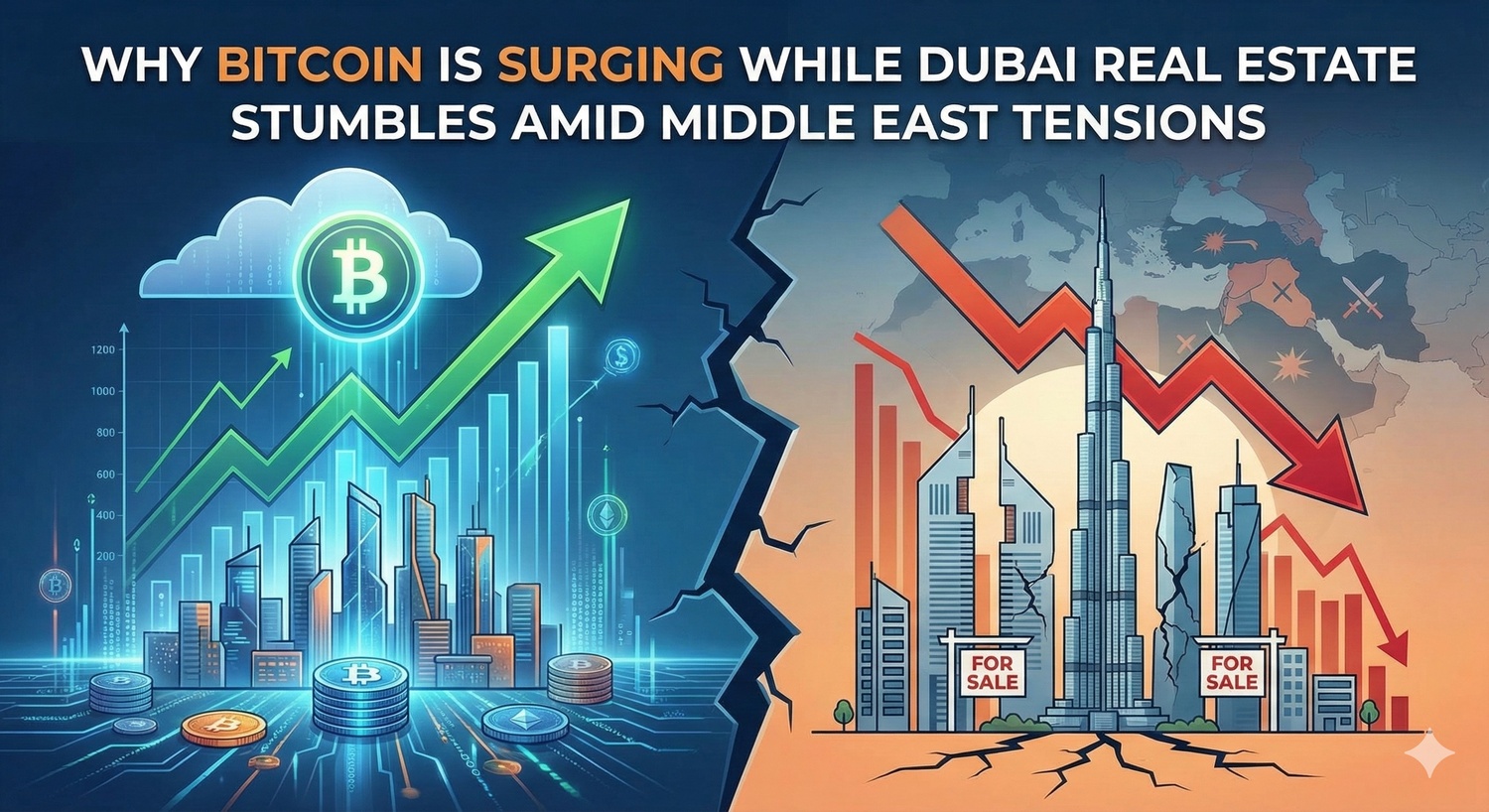
For generations, the global playbook for wealth preservation during times of conflict has remained remarkably consistent. When geopolitical stability fractures and missiles fly, capital inherently seeks out tangible security. Investors traditionally flock to physical gold, stable fiat currencies like the Swiss franc, and prime real estate located in historically neutral or heavily fortified territories. However, the sudden outbreak of regional warfare in early 2026 has completely upended this conventional wisdom.
We are currently witnessing a massive, real-time stress test of two vastly different asset classes: the highly tangible, luxurious physical property market of the United Arab Emirates and the entirely intangible, decentralized network of Bitcoin. The market behavior over the past few weeks has been nothing short of staggering, forcing institutional asset managers and retail investors alike to fundamentally rethink what it actually means to protect capital in the modern era. The traditional sanctuary of brick and mortar is showing severe structural cracks, while the digital ledger is proving to be an impregnable fortress.
To fully grasp the magnitude of the current capital flight, one must look at the sheer heights from which the local property market is falling. Dubai’s real estate sector has been the undisputed darling of global property investors for the better part of three years. Following a spectacular 2025—a year where sales reached historic highs across hundreds of thousands of transactions and vast amounts of foreign wealth poured into the city—the region had firmly established itself as a premier destination for long-term wealth preservation.
But the recent outbreak of warfare, marked by sudden airstrikes, drone activity, and severe airspace risks, shattered this carefully curated aura of invulnerability almost overnight. The raw market data paints a stark picture of a financial ecosystem in rapid, uncontrolled retreat. The local real estate index plummeted by over eighteen percent in a matter of days following the initial military engagements. To put the severity of that drop into perspective, this violent drawdown effectively wiped out every single fractional gain made since the start of the year. It has pushed valuations back to a precipice, threatening to erase the foundational growth achieved throughout late 2025 and leaving the market with a precariously thin cushion before prices revert entirely to 2024 levels.
The panic has not been confined merely to digital trading screens; it has manifested in frantic physical reality. As major airports faced temporary closures and the perceived risk to civilian infrastructure escalated, the demand for private aviation out of the city spiked by an estimated three hundred percent. Wealthy expatriates and corporate executives were reportedly paying massive six-figure premiums just to secure a flight out of the region. In a desperate attempt to stem the financial bleeding, local regulators were forced into highly defensive postures. Regional stock exchanges were shuttered entirely for multiple days to prevent blind, panic-driven selloffs, while strict daily pricing limits were heavily leaned upon to enforce a synthetic, artificial floor on plummeting asset prices.
While the geopolitical shock was the undeniable trigger for this crash, the explosive reaction of the property market has been severely compounded by pre-existing structural vulnerabilities. Long before the first sirens sounded across the region, professional analysts and credit rating agencies were quietly pointing to a looming, massive supply glut. The market was already bracing for an unprecedented influx of new residential inventory, with tens of thousands of newly constructed condominiums and luxury villas officially scheduled for handover in the latter half of the year.
When a property market is running hot on pure momentum, relentless marketing, and the universal fear of missing out, structural oversupply can often be temporarily ignored by overly optimistic buyers. But when sheer fear enters the equation, underlying economic fundamentals suddenly matter immensely. The war has rapidly transitioned the market from a frenzy of aggressive, no-contingency bidding into a frozen, highly cautious environment.
We are now witnessing the immediate, ground-level effects of this psychological shift. Mid-market buyers, suddenly armed with immense negotiating power, are demanding substantial, previously unthinkable discounts to close ongoing deals. Distressed property aggregators operating on the secondary market are flashing red, showing average price reductions hovering around five percent across the board. In more severe cases, panicked sellers are slashing their initial asking prices by over ten percent, desperate to liquidate their physical holdings before the market floor drops further.
There is a deep, underlying irony to the current wave of capital flight. Over the past few years, the city meticulously and successfully engineered its entire regulatory environment to become the ultimate global haven for the cryptocurrency and blockchain industry. By offering zero income taxes, incredibly friendly regulatory frameworks, and an unparalleled luxury lifestyle, the region attracted a massive, historic influx of digital wealth.
In the previous year alone, nearly ten thousand millionaires relocated to the area, bringing tens of billions of dollars in liquid capital with them. Major decentralized tech foundations, massive exchange behemoths, and high-profile crypto influencers all set up sprawling, expensive headquarters in the city's premium commercial districts.
However, the architects of this modern economic miracle are now learning a very harsh macroeconomic lesson regarding the nature of digital wealth: it is infinitely, frictionlessly mobile. The exact same highly liquid capital that flowed seamlessly into the city to purchase massive palm-shaped islands, branded penthouses, and sprawling office spaces is now reversing course at the absolute first sign of physical danger. A booming property market built heavily on the continuous influx of foreign, highly mobile capital is inherently fragile when the physical security of that capital is threatened. You simply cannot pack up a marble lobby, an infinity pool, or a luxury high-rise and take it with you when the local airspace closes.
This physical illiquidity stands in sharp, almost poetic contrast to the performance of Bitcoin during the exact same geopolitical crisis. Historically saddled with a mainstream reputation for wild, unpredictable volatility and speculative excess, the flagship cryptocurrency is currently acting as the most stable, reliable asset in the global financial room.
When the conflict initially escalated and the first strikes were confirmed, Bitcoin experienced a brief, reflexive dip—a standard, expected market reaction as highly leveraged algorithmic traders were instantly liquidated. But within a matter of hours, the financial narrative shifted entirely. While regional property indices were locked in a terrifying freefall and traditional fiat stock exchanges were actively halted by regulators, Bitcoin seamlessly absorbed the geopolitical shock and rapidly rallied. From the mid-sixties, it surged upward, adding over five percent to its value in the immediate aftermath of the strikes and confidently pushing back toward the pivotal seventy-thousand-dollar threshold.
This massive divergence in performance is largely due to the unique, underlying mechanics of the cryptocurrency market. Because digital asset exchanges operate twenty-four hours a day, seven days a week, they serve as the ultimate first responders to global macroeconomic shocks. When devastating news breaks over a weekend, traditional stock and property markets freeze, leaving investors utterly trapped in their depreciating positions until the opening bell rings days later. Bitcoin, conversely, allows for instant, borderless price discovery and immediate risk mitigation.
To truly comprehend why digital assets are vastly outperforming physical real estate in this specific moment, one must zoom out and analyze the broader macroeconomic chessboard. The regional conflict has not merely affected local housing dynamics; it has sent global energy markets into an absolute frenzy. Crude oil prices have surged violently past the one hundred and ten dollars per barrel mark, marking a massive monthly increase.
This historic spike in energy costs is currently rattling global equity markets to their core. Major Asian stock indices have plunged by seven to eight percent as the reality of soaring manufacturing and transportation costs sets in, reigniting dormant, terrifying fears of sticky global inflation and widespread stagflation.
In a hostile economic environment where rising inflation threatens to erode fiat purchasing power, and localized geopolitical instability actively threatens the physical destruction or seizure of physical assets, institutional capital is frantically searching for a very specific type of shelter. Gold has traditionally filled this exact role, but its physical custody, transport, and storage present massive logistical hurdles during times of active warfare. Real estate, as we are seeing, is highly illiquid, heavily localized, and currently carrying a massive, unavoidable geographic risk premium.
Bitcoin is perfectly filling this global void. Supported by steady, ongoing inflows into spot exchange-traded funds and a structurally tightening supply—with total mined coins recently crossing the historic twenty million mark—the asset is demonstrating an entirely new, sophisticated level of financial maturity. It is no longer trading like a highly speculative, risk-on technology stock; it is behaving exactly like an uncorrelated, sovereign-grade store of value.
What we are witnessing in the global financial markets today is a fundamental, permanent recalibration of how risk is assessed, priced, and managed. The deeply entrenched idea that a luxury apartment in a tax-free haven represents the ultimate, untouchable expression of financial security is being aggressively challenged by the cold, hard realities of kinetic warfare and regional instability.
Physical real estate will undoubtedly remain a vital, necessary component of long-term wealth generation, and regions with strong, established infrastructure will eventually recover once the geopolitical dust ultimately settles. The inherent tax efficiencies and regulatory clarity that successfully built the modern Middle Eastern economic hubs have not permanently vanished.
However, the sheer speed, severity, and suddenness of the recent market drawdown have permanently altered the psychology of the modern global investor. The stark realization that years of hard-earned property equity can be completely erased in a single week of localized conflict has highlighted the critical, non-negotiable importance of holding liquid, borderless assets. As capital continues to adapt to an increasingly unpredictable, multipolar world, the financial separation between physical and digital safe havens will only grow more pronounced. Investors are quickly learning that true financial security isn't just about where you park your money when times are peaceful; it is entirely about how easily you can move it when times turn bad. In the ultimate financial stress test of this decade, the decentralized ledger has proven to be infinitely more resilient than the marble facade.
