Published On:
July 19, 2026
Updated On:
July 19, 2026
The Karnataka High Court has ruled that children have a fundamental right to play in apartment common areas, striking down arbitrary bans by housing societies while simultaneously mandating the removal of hazardous aesthetic obstructions from shared corridors to ensure resident safety.
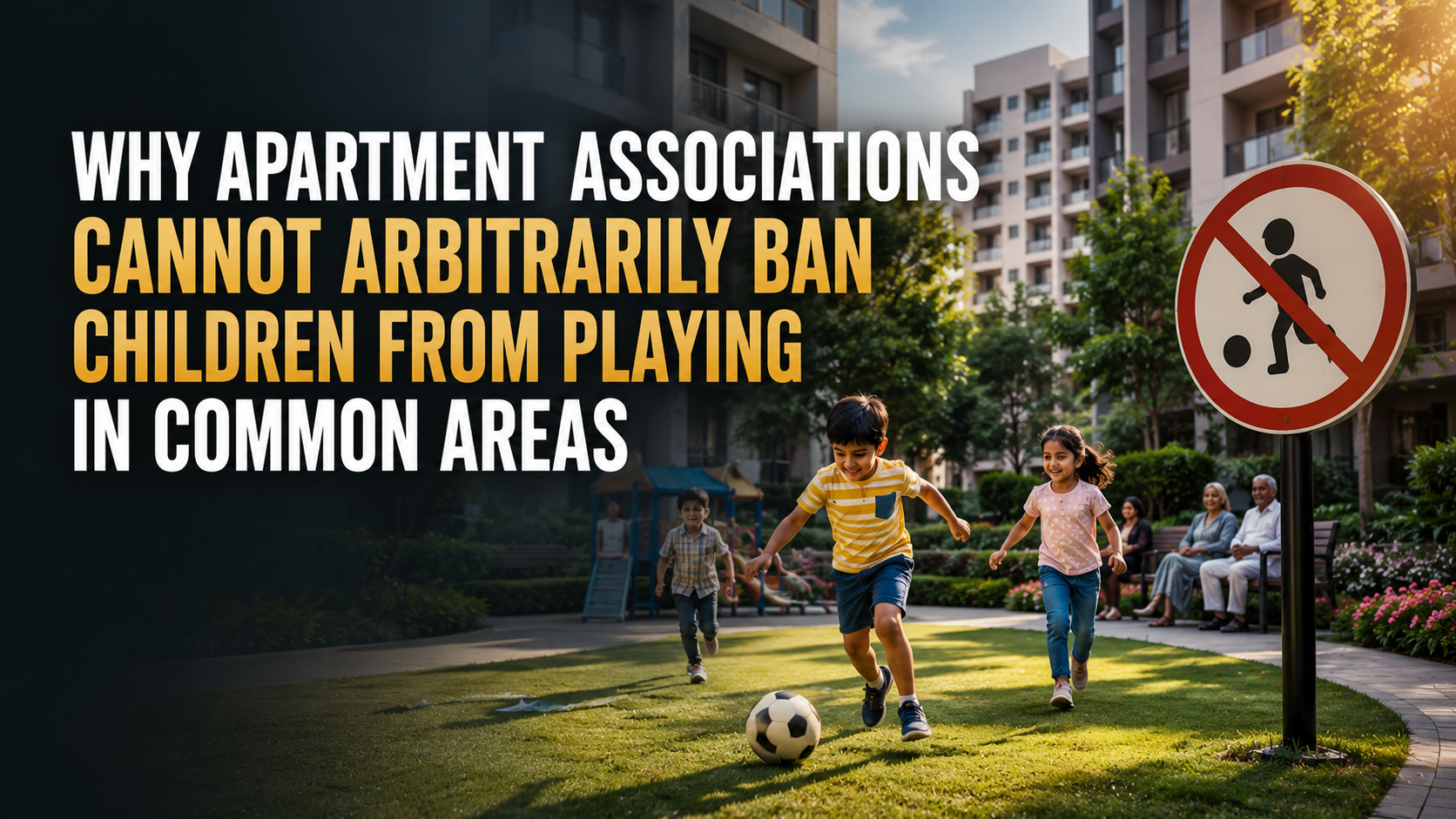
The rapid urbanization of our cities has completely transformed the way we live, bringing millions of people into high-rise apartments and expansive gated communities. While these residential complexes offer a heightened sense of security, modern lifestyle amenities, and the promise of community living, they also bring together individuals with vastly different routines, tolerances, and expectations. One of the most common and recurring friction points in any housing society revolves around the use of shared spaces, particularly when it comes to children playing outdoor games. The clash between residents seeking absolute peace and quiet and children needing adequate space for physical activity is an age-old urban dilemma.
Recently, this very issue reached the corridors of the Karnataka High Court, resulting in a landmark judicial observation that redefines the boundaries of authority held by apartment owners' associations. The judiciary has made it unequivocally clear that a housing society cannot impose a blanket ban on children playing physical games in designated common areas just because a few residents find it inconvenient. This ruling not only reinforces the fundamental rights of children but also sets a strong, nationwide precedent for how resident welfare associations must operate within the strict bounds of fairness, democratic consensus, and registered legal bye-laws.
Before delving into the complex legalities of community rules, it is essential to understand the broader context of modern childhood in urban landscapes. As cities expand vertically and real estate becomes increasingly expensive, open public grounds, expansive neighbourhood parks, and safe street-level play areas are becoming incredibly scarce. For a child growing up in a densely populated metropolitan area, the apartment complex playground or the designated common open area is often the only safe, accessible, and secure outdoor environment available for recreation.
Engaging in physical play is not merely a trivial pastime; it is a critical, irreplaceable component of a child's physical, cognitive, and social development. Participating in sports and high-energy games helps build vital teamwork skills, significantly improves cardiovascular health, and acts as a necessary psychological release for pent-up energy after long school hours. When housing societies restrict access to these essential spaces under the guise of maintaining strict community order, they are inadvertently stifling the overall well-being of the younger generation. The recent judicial intervention highlights exactly this deep concern, elevating the act of playing from a mere leisure activity to an essential developmental right that must be fiercely protected by the community.
The intense debate over playing rights was brought to the forefront by a legal battle initiated by a couple residing in a prominent Bengaluru apartment complex. These residents approached the judicial system to challenge two specific, highly restrictive actions taken by their apartment owners' association. The primary grievance was a sudden and vaguely defined prohibition on children playing football and other physical games in the society's designated playground.
The association attempted to justify this severe restriction by claiming they had received multiple complaints from certain residents regarding the noise levels and the potential nuisance caused by the playing children. They argued that their intention was simply to maintain a peaceful environment and ensure that only games deemed suitable for the play area were permitted. However, the aggrieved parents fiercely argued that this restriction was entirely arbitrary, completely devoid of any clear operational guidelines, and fundamentally detrimental to the mental and physical development of the children living in the complex.
When the matter was scrutinized by the higher judiciary, it was quickly determined that the association's defense lacked any real legal substance. The rules imposed did not clearly define which specific games were permitted and which were prohibited. Instead, the management had simply used vague, sweeping language to enforce a blanket restriction that effectively locked children out of their own playground. The court found this authoritarian approach to be legally and morally unsustainable in a cooperative housing environment.
In addressing the harsh restrictions imposed on the children, the judicial observation was both firm and enlightening. The ruling heavily emphasized that engaging in physical games is a fundamental right of children. Prohibiting them from accessing play areas under vague pretenses directly compromises their physical health and stunts their overall development.
The legal interpretation made it clear that while a resident association undeniably has the mandate to manage the premises, it absolutely does not possess the absolute power to deprive children of their recreational spaces. A handful of complaints regarding noise cannot serve as the sole, deciding basis for stripping away the rights of the younger residents. The court recognized that community living inherently requires a degree of mutual tolerance. The sounds of children playing are a natural, joyful part of a vibrant residential community, and expecting absolute, library-like silence in shared open spaces is both unreasonable and practically impossible.
Instead of outright striking down the association's power to regulate the premises, the court mandated a fair, democratic resolution. The management was directed to convene a general body meeting within a stipulated timeframe of three months. During this formal meeting, the residents are required to collectively decide, through a clear majority vote, which specific games can be safely accommodated in the play area. The directive was crystal clear: while certain high-impact games might require regulation for safety or property protection reasons, the association cannot use this as a convenient excuse to completely ban children from enjoying the playground. They must take the confidence of all members and create a specific, fair framework for recreational activities.
The conflict in the Bengaluru apartment complex was not limited exclusively to the playground. The second major issue brought before the court highlighted a severe safety hazard stemming from the arbitrary beautification of common transit areas. The residents had aggressively challenged the association's decision to place heavy flower pots along the common stairways and narrow corridors of the residential blocks.
According to the established bye-laws of almost all housing societies, common transit areas such as lobbies, staircases, and vestibules must be kept completely free of all physical obstructions. Residents and management alike are typically prohibited from leaving furniture, packages, or vehicles in these zones to ensure safe, rapid, and unhindered movement, especially during emergencies. Despite these standard, life-saving rules, the association had placed numerous potted plants on the stairways, arguing that this was done pursuant to a majority decision aimed at aesthetic enhancement of the building.
This seemingly harmless aesthetic choice quickly turned into a dangerous daily liability. The routine watering of these plants inevitably led to water percolating and flowing directly onto the stairway floors, creating consistently wet and highly slippery surfaces. This glaring negligence resulted in a tragic, entirely preventable accident where a resident slipped on the damp floor, suffered a severe leg fracture, and was forced to undergo multiple surgeries. Despite repeated, documented complaints raised at general body meetings regarding this exact hazard, the association had blatantly failed to take any corrective action.
The higher court took a remarkably stern view of this civic negligence. It firmly rejected the association's defense that the pots were placed through a majority consensus. The ruling powerfully underscored that a majority vote can never override fundamental safety protocols or infringe upon the basic civil rights of the residents to move freely and safely within their own building. The presence of the flower pots was deemed an illegal obstruction that directly caused the severe injuries suffered by the resident. Consequently, the court issued a permanent, strict injunction, ordering the immediate removal of all such pots and legally restraining the association from placing any similar aesthetic obstructions in the common transit areas in the future.
This comprehensive legal ruling serves as a vital, much-needed reality check for apartment owners' associations and resident welfare committees functioning across the entire country. These governing bodies undoubtedly play a crucial role in maintaining the physical infrastructure, ensuring perimeter security, and fostering a sense of community within massive residential complexes. However, this administrative authority is frequently, and dangerously, misunderstood as absolute, unchecked power.
Corporate legal experts and real estate practitioners consistently point out that an association's power is strictly bound and limited by its registered bye-laws and the overarching state apartment ownership acts. Any new rule, operational restriction, or financial penalty cannot be whimsically imposed by a few dominant office bearers. It must be formally proposed, openly debated, and officially approved through a prescribed democratic process, typically involving a formalized general body meeting where every single homeowner has a voice and a vote.
Furthermore, any rule implemented by an association must pass the strict legal test of reasonableness and non-discrimination. Creating rules that disproportionately target a specific demographic, such as young children, or imposing blanket bans without genuine, documented safety justifications, is highly likely to be struck down immediately if challenged in a court of law. The management committee acts merely as a custodian of the shared property and a facilitator of community living, not as an authoritarian regime policing the residents.
The friction between older residents who desire a tranquil living environment and younger families with highly energetic children is inevitable, but it absolutely does not have to end in bitter, drawn-out legal battles. Housing societies can adopt several proactive, intelligent strategies to find a harmonious middle ground that deeply respects the varied needs of all residents.
Establishing exceptionally clear, highly specific guidelines is the very first step toward effective conflict resolution. Instead of relying on vague statements about suitable games, associations should clearly document which exact activities are permissible in which specific zones. For instance, high-intensity sports like cricket played with hard leather balls might be strictly restricted to specific, heavily netted areas to prevent window damage, while softer games and light football could be freely allowed in the general playground.
Time management is another highly effective, easily implementable tool. Societies can implement designated active play hours that ensure children have ample, uninterrupted time for physical activities without disturbing the peace during early mornings, late evenings, or quiet afternoon resting hours. This predictable, daily schedule allows residents who are sensitive to noise to plan their rest periods or focused work hours accordingly.
Creating specialized, segregated zones can also significantly reduce daily friction. Larger residential complexes can greatly benefit from dividing their massive open spaces into active and passive zones. An active zone equipped with robust sports facilities can cater directly to children and energetic teenagers, while a completely separate passive zone featuring shaded seating areas, manicured gardens, and walking paths can be strictly reserved for senior citizens and those seeking quiet, undisturbed relaxation.
Regular, professional safety audits of all common areas are entirely non-negotiable. As the court ruling on the slippery flower pots explicitly demonstrated, aesthetic additions must never, under any circumstances, compromise structural safety or clear emergency transit pathways. Associations must conduct periodic checks to guarantee that stairways, fire exits, and narrow corridors remain completely free of all tripping hazards, slippery surfaces, and unauthorized personal storage.
When individuals or young families are looking to invest in a new apartment, their focus is almost entirely concentrated on the interior layout of the flat, the price per square foot, and the geographical location of the real estate project. Rarely do eager buyers pause to pay close attention to the fine print of the community bye-laws or aggressively research the historical track record of the existing welfare association. However, as this judicial episode perfectly illustrates, the rules governing the shared spaces can profoundly and permanently impact a family's daily life and overall happiness.
Prospective homebuyers must make it an absolute priority to request and thoroughly read the registered bye-laws of the housing society before finalizing any major real estate transaction. Understanding the official stance of the management on the usage of the clubhouse, the playground, and the transit corridors provides a highly accurate picture of the living environment. If an association has a known history of imposing abrupt bans, heavily penalizing residents for incredibly minor infractions, or completely failing to address significant safety hazards, it serves as a massive red flag indicating a poorly managed or overly authoritarian community environment.
Furthermore, engaging in casual conversations with current residents about exactly how disputes are handled internally can yield incredibly valuable insights. A community that values regular general body meetings, actively encourages open discussions, and relies heavily on democratic voting rather than the unilateral decisions of a few committee members is generally a vastly safer and more pleasant place to live. Homebuyers must realize that they are not just buying a set of concrete walls; they are buying their way into a complex micro-society. Ensuring that this specific society respects civil rights, rigorously prioritizes physical safety, and warmly accommodates the developmental needs of its youngest residents is just as crucial as verifying the legal property titles.
Ultimately, the true success of any residential community is measured not by the strictness or volume of its rulebook, but by the undeniable strength of its internal harmony. An apartment complex is a vibrant microcosm of the broader society, bringing together highly diverse age groups, varied professions, and vastly different lifestyles into close proximity. Expecting complete, uniform behaviour or demanding total, unbroken silence is a deeply flawed and unrealistic approach to modern community management.
Children laughing, running, and playing games is a universally recognized sign of a healthy, vibrant, and secure neighbourhood. While it is entirely valid and necessary to establish clear safety boundaries and enforce reasonable operating timings, attempting to artificially sanitize the living environment by completely banning play is a massive step in the wrong direction. Similarly, maintaining the aesthetic visual appeal of a building should never, for even a moment, take precedence over the fundamental physical safety of its occupants.
This powerful judicial intervention serves as a lasting reminder that deep empathy, basic common sense, and strict adherence to established legal frameworks are the true, unshakable pillars of effective community management. By prioritizing the holistic well-being of children and fiercely ensuring the daily safety of all residents, apartment associations can successfully transform themselves from rigid, frustrating enforcers into genuine, beloved facilitators of a thriving, highly inclusive urban lifestyle.
