Published On:
December 13, 2025
Updated On:
February 4, 2026
The Delhi Government is set to construct a 57-km expressway along the Najafgarh Drain, creating a vital high-speed link between Dwarka and the Western Peripheral Expressway (WPE).
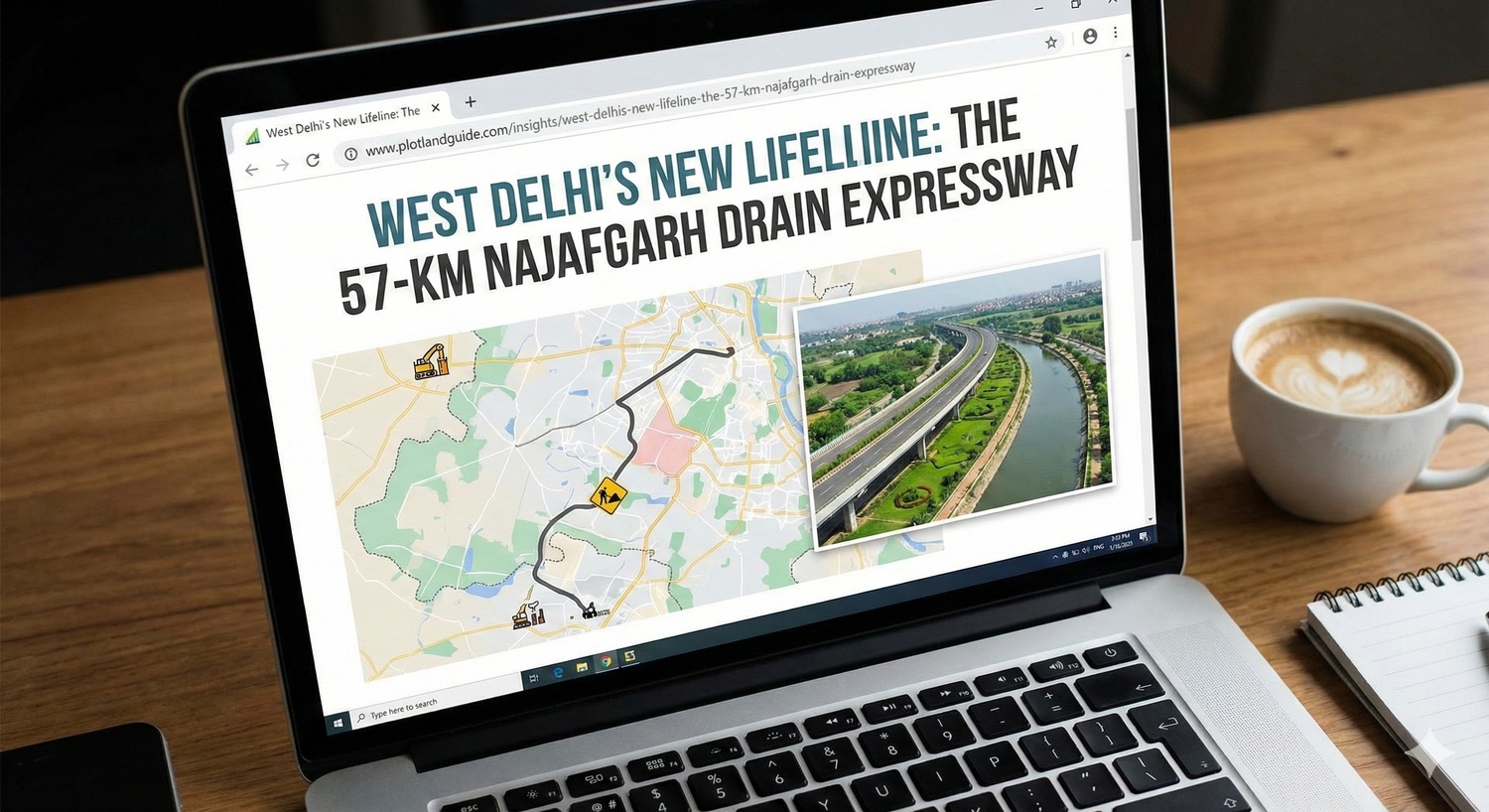
For decades, the Najafgarh Drain has been viewed through a singular, unflattering lens: a massive, sluggish channel of sewage cutting through the heart of West Delhi, synonymous with foul smells, monsoon overflow, and neglected urban backyards. It has been a barrier rather than a bridge, dividing neighborhoods like Dwarka, Vikaspuri, and Janakpuri from the rural expanses of Najafgarh and the Haryana border.
However, a monumental shift is underway. In what urban planners are calling the most significant infrastructure intervention for West Delhi since the arrival of the Blue Line Metro, the administration has officially set the wheels in motion for the "Najafgarh Drain Expressway." This project is not merely about paving a road; it is a fundamental reimagining of urban space. By utilizing the embankments of the city’s largest drain, the government aims to create a 57-kilometer mobility corridor that promises to unclog the arterial veins of the capital and unlock billions in economic value.
This blog delves deep into the anatomy of this mega-project, exploring the route, the engineering behind the rejuvenation, and why real estate investors are suddenly looking at West Delhi’s "Grey Corridor" with renewed interest.
The core proposition of the Najafgarh Drain Expressway is deceptively simple: utilize the unused land flanking the drain to build a road. However, the execution is a complex feat of engineering and urban planning. The project, recently approved by the Irrigation and Flood Control Board, involves constructing high-quality, rigid-pavement service roads on both banks of the drain.
The corridor is envisioned to span approximately 57 kilometers, effectively linking the central parts of West Delhi to the far-flung rural borders. The alignment is strategic, designed to act as a parallel artery to the chronically congested Ring Road and Outer Ring Road.
By creating this "bypass," the project aims to siphon off a significant chunk of traffic that currently clogs the Najafgarh Road and Rohtak Road. Commuters travelling from Dwarka or Vikaspuri to Gurgaon or Manesar will no longer need to navigate the maze of internal city traffic; they will have a direct, signal-free shot towards the periphery.
Unlike standard asphalt roads that often disintegrate under waterlogging conditions, the specifications for this project call for "rigid pavement" technology. Given the proximity to the drain and the history of flooding in the basin, concrete roads are a necessity. This ensures longevity and reduces the maintenance nightmares that plague other low-lying corridors in Delhi. Furthermore, the plan includes the construction of crash barriers along the central verge and the drain edge, ensuring that the high-speed movement does not compromise safety.
To understand the full scope of this project, one must acknowledge the history of the water body itself. The Najafgarh Drain is not an artificial canal; it is the remnant of the Sahibi River, a natural watercourse that once flowed freely. Over the years, urbanization turned it into a sewage carrier.
The current project is being touted not just as a road initiative but as a holistic rejuvenation of the Sahibi basin.
Desilting and Dredging:A critical component of the ₹450+ crore allocation is dedicated to the scientific desilting of the drain. Over 90 lakh cubic meters of legacy silt—accumulated over decades—is set to be removed. This is crucial because the road cannot survive if the drain overflows. By deepening the channel, the government is effectively increasing the flood-carrying capacity of the basin, directly addressing the waterlogging woes of colonies in Janakpuri and Vikaspuri.
The Green Corridor Concept:Beyond the tarmac, the vision includes developing green belts and cycle tracks along the embankments. The idea is to mimic the success of riverfront developments seen in other global cities. While it may take years to fully sanitize the water, creating a landscaped buffer zone between the road and the drain changes the "visual identity" of the corridor. It transforms a zone of neglect into a zone of utility and potential recreation.
The strategic brilliance of the Najafgarh Drain Expressway lies in its ability to connect "stranded" infrastructure. West Delhi has several high-capacity roads—the Urban Extension Road II (UER-II), the Dwarka Expressway, and the Ring Road—but they often lack efficient cross-connectivity.
1. The Dwarka Expressway Link:Residents of the new sectors along the Dwarka Expressway often struggle to enter core Delhi. This new corridor acts as a perpendicular feeder, allowing traffic from the expressway to zip into West Delhi without touching the choked NH-48 (Delhi-Gurgaon Expressway).
2. Relieving the Najafgarh Bottle-neck:For years, the town of Najafgarh has been a traffic nightmare. The Phirni Road, designed for a rural settlement, now carries the load of a bustling satellite city. The new corridor provides a bypass for through-traffic. Vehicles heading to Jhajjar or Badli can simply skirt the town, reducing travel times by upwards of 40 minutes during peak hours.
3. Industrial Logistics:The Basaidarapur and Mundka industrial belts suffer from poor access. Trucks often wait hours to enter or exit the city. A dedicated corridor linking directly to the KMP Expressway means that freight can move in and out of these industrial hubs without interfering with residential traffic. This is expected to lower logistics costs for businesses in West Delhi significantly.
In real estate, "connectivity" is the primary driver of capital appreciation. The announcement and subsequent foundation laying of the Najafgarh Drain Expressway is a signal for investors to recalibrate their portfolios. We are likely to see a "Corridor Effect," where property values within a 2-3 km radius of the alignment see an accelerated growth trajectory.
The stretch towards the Haryana border is prime real estate for warehousing and logistics parks. As e-commerce quick-commerce (10-minute delivery) models expand, the need for "in-city" warehousing is growing. The land flanking this new expressway is perfectly positioned to serve the consumption markets of West Delhi while remaining accessible to heavy trucks.
While the project is excellent on paper, seasoned observers of Delhi’s infrastructure landscape know that the path from "foundation stone" to "inauguration" is rarely smooth.
The NGT Factor:The National Green Tribunal (NGT) maintains a hawk-eyed vigil over the Najafgarh Jheel and its wetlands. Any construction that threatens the floodplain or the hydrological integrity of the wetland will face legal hurdles. The project proponents have emphasized that the road is built on the embankments and not inside the active floodplain, but environmental clearances will remain a fragile point. The boundary delineation of the wetland is a sensitive legal matter that could pause construction.
The "Silt" Challenge:Dredging 90 lakh cubic meters of sludge is a logistical nightmare. Where will this silt go? If not disposed of scientifically, it will simply wash back into the drain during the first monsoon. The success of the road depends entirely on the success of the drainage desilting. If the drain overflows, the "rigid pavement" will eventually succumb to water damage.
Encroachment Removal:The banks of the Najafgarh drain are heavily encroached upon in many urban sections. Relocating informal settlements and clearing the right-of-way (ROW) is a politically sensitive and administratively difficult task. The speed at which the administration handles these encroachments will dictate the project timeline.
If executed according to the timeline, the Najafgarh Drain Expressway could be operational within the next 3 to 4 years. By 2030, the mental map of West Delhi could look very different.
Imagine a commuter starting their day in Janakpuri. Instead of crawling through the Raja Garden red lights, they take a slip road onto the Drain Expressway. Driving past landscaped embankments, they bypass the clutter of Uttam Nagar and reach the Dwarka Expressway in 15 minutes, and are in Gurgaon in another 20. This is the vision being sold.
For the residents of West Delhi, this project is more than just a road; it is a validation of their long-standing demand for better infrastructure. It represents a shift from "adjusting" to the chaos to "overcoming" it.
The 57-km Najafgarh Drain Expressway is West Delhi’s "Big Dig." It is an ambitious attempt to reclaim urban space from neglect and repurpose it for mobility. While the challenges of ecology and execution loom large, the potential rewards—a decongested city, a revived water basin, and a booming real estate market—are too significant to ignore.
For homebuyers and investors, the window of opportunity is opening now. As the excavators begin their work on the embankments, the value of West Delhi is being rewritten, one kilometer at a time. The lifeline is no longer a pipe dream; it is becoming a concrete reality.
