Published On:
July 19, 2026
Updated On:
July 19, 2026
Uttar Pradesh is embarking on a massive ₹60,000 crore infrastructure expansion, targeting the construction of new four-lane highways to connect 33 district headquarters and city bypasses, setting the stage for statewide economic integration and a real estate boom.
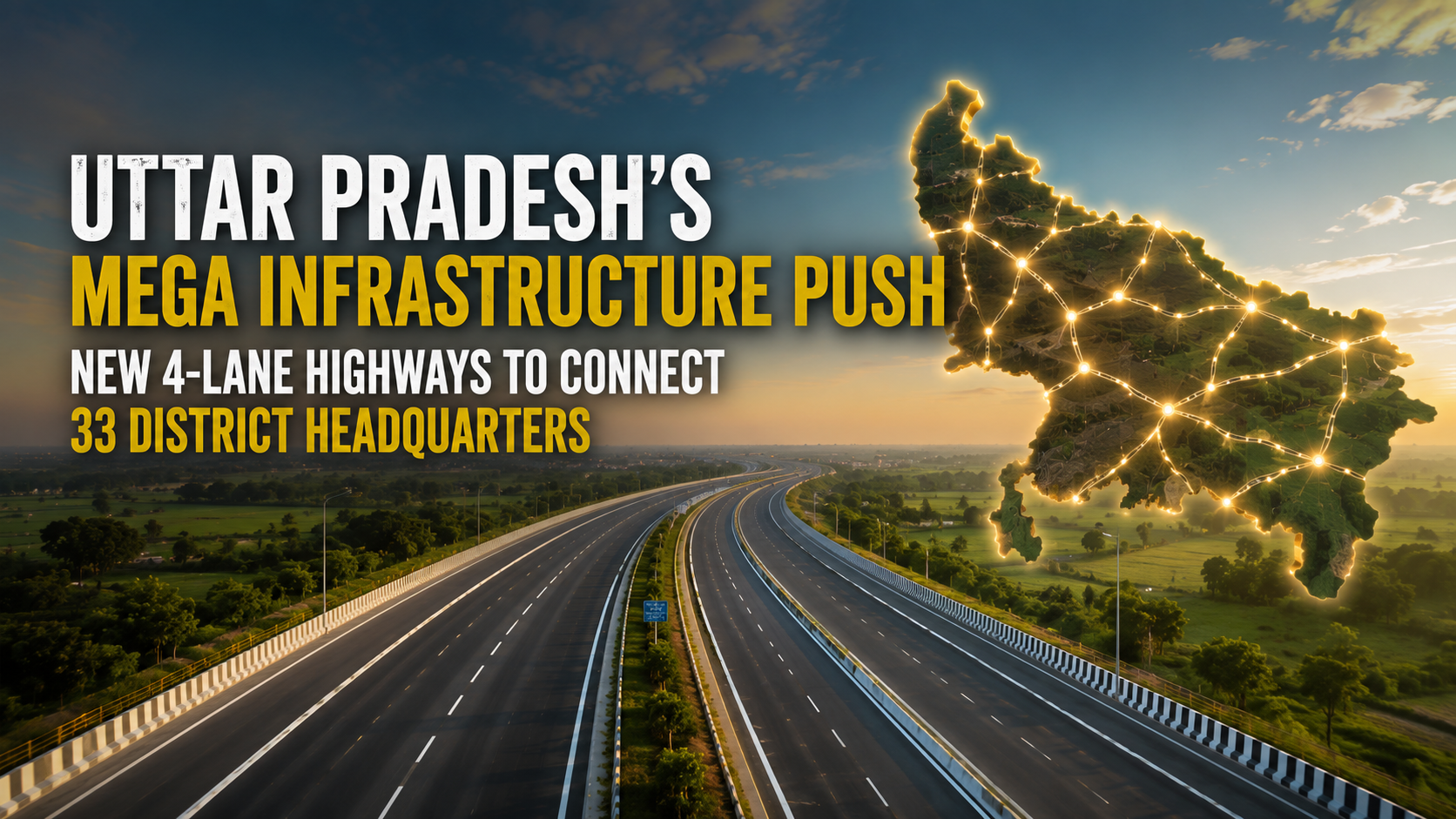
Uttar Pradesh is writing a brand-new, highly ambitious chapter in its infrastructure growth story. Over the past decade, the state has steadily built a solid reputation for its massive, state-of-the-art expressways that crisscross the landscape from east to west. However, the current development strategy is taking a much more targeted, hyper-local approach. The focus has decisively shifted beyond merely constructing mammoth greenfield expressways; the ultimate goal now is to ensure that the tangible benefits of rapid, high-speed connectivity reach deep into the state's administrative, agricultural, and commercial heartlands.
In a massive push to radically upgrade regional mobility, the state will soon witness the development of new four-lane highways specifically designed to link 33 district headquarters. This expansive road network is uniquely poised to bridge the critical gap between major metropolitan hubs and smaller, historically underserved districts. For years, many of these vital administrative districts have been forced to rely on aging, narrow two-lane roads that inevitably choke traffic and slow down everything from public transport buses and logistics trucks to emergency medical vehicles. By systematically widening and upgrading these critical arteries, the state aims to eliminate persistent bottlenecks, drastically reduce travel times, and spark a fresh wave of localized economic growth that touches the grassroots level.
This sweeping infrastructure overhaul is backed by an enormous financial commitment. Road projects worth approximately ₹60,000 crore have recently received the green light from the central government. During high-level strategic reviews involving top state officials and the Union Ministry of Road Transport and Highways, a comprehensive blueprint was laid out to completely redefine the state's transport geography. A primary feature of this master plan is the absolute commitment to providing seamless, unhindered four-lane connectivity to 33 district headquarters that currently lack such modern access.
Furthermore, the strategy incorporates a highly practical approach to solving urban congestion. The government has approved the rapid construction of dedicated bypasses for every single city in Uttar Pradesh with a population exceeding five lakh. Anyone who has navigated the bustling commercial towns of the state understands that city-center traffic is a massive hurdle for long-distance highway travel. By intelligently routing heavy transport and transit vehicles around these densely populated urban areas, these bypasses will significantly decongest city streets, lower urban pollution levels, and dramatically improve the average transit speed of highway traffic.
The seamless synergy between the central and state governments serves as a critical driver for these projects. To aggressively accelerate the pace of development, the state administration has committed to sharing the heavy costs associated with land acquisition. In an unprecedented move to facilitate construction, the state is also providing royalty-free soil for greenfield projects and offering government-owned land entirely free of charge wherever necessary. This proactive, business-friendly stance ensures that administrative hurdles are minimized and multi-crore projects move swiftly from the drawing board to on-the-ground execution. Crucial requirements like forest clearances and utility shifting are currently being handled on a strict priority basis by a dedicated task force managed by the Chief Secretary, ensuring that the momentum of construction remains completely uninterrupted.
While Uttar Pradesh has already established formidable east-west connectivity through landmark projects like the Purvanchal, Ganga, Bundelkhand, and Agra-Lucknow expressways, the current development emphasis is strongly leaning towards enhancing critical north-south links. The state leadership has recognized that achieving balanced, statewide regional development requires robust transport arteries running efficiently in all directions, not just horizontally.
One of the most highly anticipated infrastructural marvels discussed in recent reviews is the massive 742-kilometer access-controlled national highway planned between Shamli and Gorakhpur. This extensive corridor will cut diagonally across the state, linking the industrialized western Uttar Pradesh directly with the rapidly developing eastern regions, thereby acting as a powerful catalyst for statewide trade and industrial mobility.
In addition to this mega-corridor, a slew of other major projects are either currently underway or in the final stages of rigorous planning. The recently inaugurated 63-kilometer Lucknow-Kanpur six-lane greenfield expressway, built at an estimated cost of ₹4,200 crore, serves as a prime example of this aggressive push. It aims to significantly slash travel time between the state's two largest metropolitan centers, laying the essential groundwork for the proposed State Capital Region. Other critical corridors experiencing rapid development include the ₹13,980 crore Mathura-Bareilly-Sitarganj four-lane project, the Agra-Aligarh four-lane road, the comprehensive Kanpur Ring Road, and the Moradabad-Kashipur six-lane highway.
There are also highly significant developments occurring near the state borders. Projects like the Sonauli-Gorakhpur four-lane road and the Ghazipur-Ballia-Bihar border highway are set to dramatically improve cross-border trade logistics and streamline connectivity with neighboring states and the nation of Nepal.
Religious and cultural tourism is another massive focal point of this highway expansion initiative. Uttar Pradesh is proudly home to some of the country's most revered pilgrimage sites, and upgrading access to them is a top government priority. Infrastructure projects like the Ram Van Gaman Marg, the Ram Janaki Marg, and the 84 Kosi Parikrama Marg are being fast-tracked to provide seamless, world-class travel experiences to spiritual hubs such as Ayodhya, Chitrakoot, and Prayagraj. The proposed Ayodhya Ring Road, in particular, will play an incredibly crucial role in easing the massive, daily influx of devotees traveling to the Ram Temple and the newly operational Maharishi Valmiki International Airport. To further streamline regional transit, expansive ring roads are also being meticulously planned for cities including Moradabad, Aligarh, Jhansi, Mirzapur, and Saharanpur.
The underlying objective of this monumental road-building exercise extends far beyond merely laying fresh asphalt; it is fundamentally about engineering a deep-rooted economic resurgence. The state leadership has explicitly and repeatedly linked the expansion of the highway network to its highly publicized goal of transforming Uttar Pradesh into a one-trillion-dollar economy. Reliable, high-speed roads are viewed as the absolute, non-negotiable prerequisite for attracting heavy industrial investment, ensuring agricultural prosperity, and facilitating exponential tourism growth.
For the vital agricultural sector, the benefits of four-lane district highways are immediate and highly tangible. Farmers will finally be able to transport their perishable produce to regional mandis and food processing units much faster, significantly reducing post-harvest losses and ensuring they secure much better market prices. Traders and fleet logistics operators stand to save immense amounts of diesel fuel and transit time, deeply improving the overall profitability and efficiency of their supply chains. Even on a fundamental social level, better roads mean that rural students can commute to higher educational institutions with ease, and critical patients can reach advanced medical facilities in larger metropolitan cities without facing life-threatening delays on choked rural routes.
Since 2014, the state has witnessed an unprecedented, historical acceleration in highway development. Over 10,200 kilometers of national highway projects have been awarded, and more than 9,300 kilometers have already been successfully completed. The total financial investment injected into the state's national highway projects currently stands at a staggering ₹1.94 lakh crore. This sustained, massive influx of capital and infrastructure has effectively dismantled the state's old historical image of poor connectivity, firmly establishing it as a formidable, reliable growth engine for the broader Indian economy. The strategic integration of these new roads with rapidly expanding railway networks, modern metro systems, inland waterways, and new aviation hubs like the massive upcoming Noida International Airport at Jewar is creating a world-class multimodal logistics environment that is proving highly attractive to both domestic corporate giants and international investors.
There is a long-standing, proven axiom in real estate: where new roads go, massive development inevitably follows. In Uttar Pradesh, this has proven to be an undeniable, recurring fact. The official announcement and subsequent construction of new four-lane highways and strategic city bypasses are already triggering a massive, structural transformation in the local real estate markets across the state.
Historically, land prices situated near expressway entry points and major highway intersections in the state have witnessed aggressive, rapid appreciation, often jumping by thirty to forty percent within just a couple of years of a major project's announcement. As the newly proposed network of four-lane roads systematically connects the 33 district headquarters, this exact cycle of real estate wealth creation is preparing to repeat itself across multiple untouched regions.
The new city bypasses, in particular, are rapidly emerging as the hottest new property destinations for savvy investors. As traditional city centers become increasingly crowded, polluted, and expensive, the vast areas flanking these new bypasses become the new, highly desirable urban edge. Homebuyers and institutional investors are naturally drawn to these peripheral locations because they offer the incredibly rare dual advantage of easy, congestion-free highway access and property prices that remain relatively much lower than those in the saturated city core. Real estate developers are acutely aware of this shifting consumer preference. Consequently, there is a highly visible surge in the planning, zoning, and launching of massive integrated townships, premium plotted residential colonies, and bustling commercial complexes situated right alongside these proposed bypass routes.
The commercial and industrial real estate sectors are also bracing for a massive, unprecedented boom. District headquarters that gain fast four-lane access will immediately become highly viable, lucrative hubs for mega-warehousing and third-party logistics operations. E-commerce companies and FMCG brands require massive land parcels with flawlessly smooth transport access to set up their regional distribution centers, making these newly connected districts ideal, cost-effective candidates. Alongside the logistics boom, the highway hospitality and retail sectors will experience significant growth. These expansive highway corridors invariably attract large-scale dhabas, modern air-conditioned food courts, motels, and massive vehicle service stations, effectively creating thriving micro-economies of their own.
Furthermore, the rapid expansion of these road networks drives robust, sustained rental demand. As heavy construction begins and industries eventually set up their manufacturing shops along these corridors, there is an immediate, steady influx of industrial workers, logistics staff, and technical students who desperately require quality housing. This creates highly lucrative, long-term opportunities for retail investors looking to build rental housing units, hostels, or commercial leasing spaces close to the new highways. In historic cities slated for major religious corridor upgrades—such as Prayagraj, Chitrakoot, and Mirzapur—the real estate market is aggressively gearing up for a massive surge in demand for tourist accommodations, budget hotels, and luxury spiritual retreats. Local property broker data heavily indicates that land rates have already begun firming up in active anticipation of these infrastructure developments, signaling extremely high investor confidence in the state's vision.
The comprehensive, multi-billion rupee plan to seamlessly connect 33 district headquarters with robust four-lane highways and construct vital city bypasses is a masterstroke in modern urban and regional planning. It perfectly demonstrates a clear, evolved understanding by policymakers that true, sustainable economic development cannot be confined to a few sprawling, overcrowded metropolises; it must be distributed evenly and fairly across the state's vast and incredibly diverse geography.
By aggressively bridging the connectivity gap, Uttar Pradesh is not merely paving the way for faster vehicular travel; it is effectively unlocking the immense, largely untapped economic potential of its smaller district economies. From massively boosting agricultural trade and industrial logistics to triggering a statewide, decentralized real estate renaissance, this ₹60,000 crore infrastructure push is set to fundamentally reshape the future of the state. As these highways materialize from blueprints into reality over the coming years, they will undeniably serve as the vital, pulsing lifelines powering Uttar Pradesh's ambitious journey toward unprecedented, inclusive economic prosperity.
