Published On:
May 3, 2026
Updated On:
May 3, 2026
Uttar Pradesh is embarking on a massive infrastructure push following the inauguration of the 594-km Ganga Expressway, greenlighting 10 new high-speed expressways and link roads. This expansive network will seamlessly connect major hubs like Noida, Jewar, and Lucknow with remote regions like Chitrakoot and Vindhya, sparking an unprecedented boom in regional real estate, industrial logistics, and local agriculture.
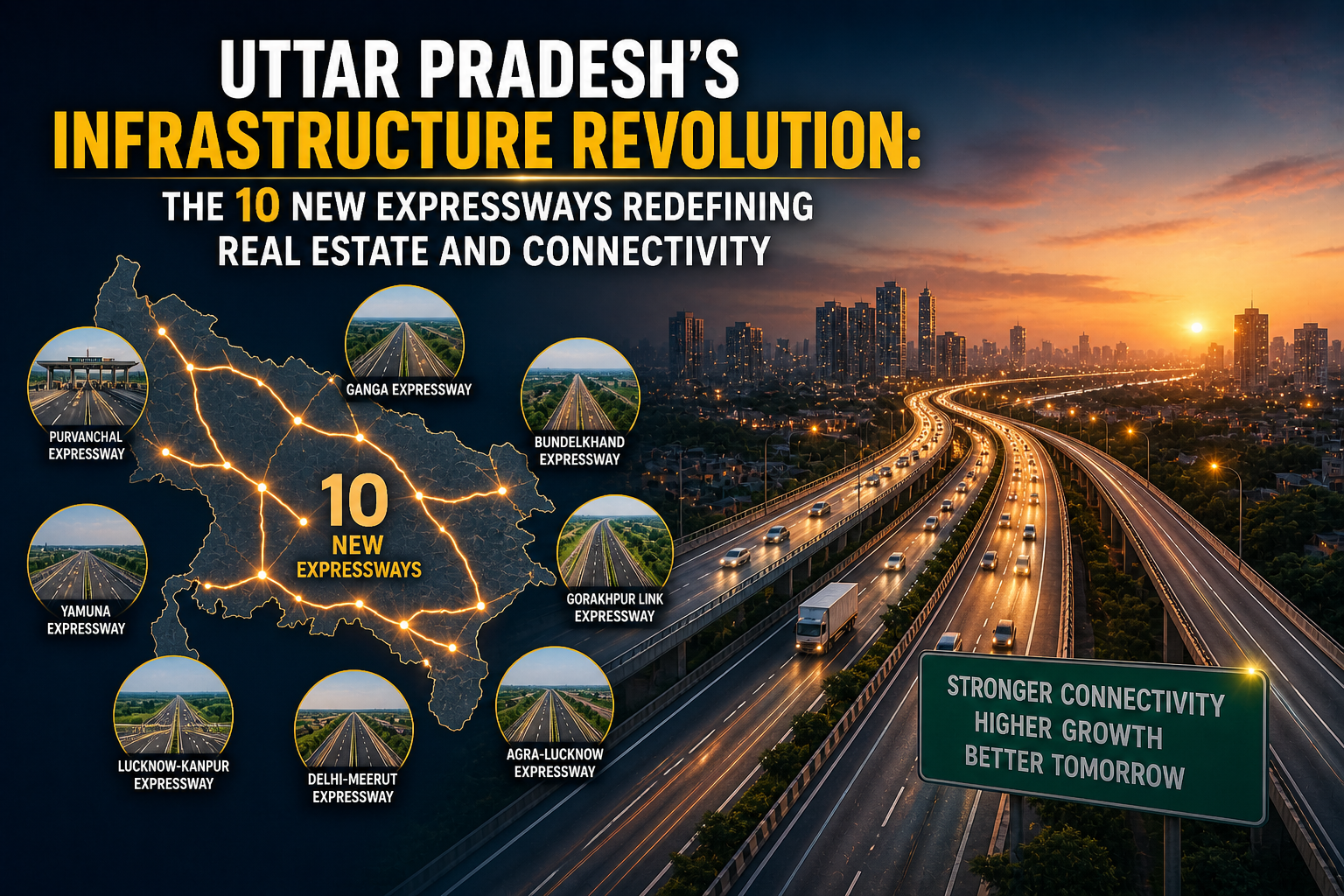
Uttar Pradesh is currently executing a monumental shift in its physical infrastructure, rapidly shedding its historical constraints to emerge as the undisputed logistics and connectivity capital of northern India. The state's transportation narrative has been completely rewritten in recent years, pivoting from congested state highways to a sprawling, high-speed grid of world-class motorways. While massive operational corridors like the Yamuna Expressway and the Purvanchal Expressway laid the foundational groundwork, the recent inauguration of the monumental Ganga Expressway has acted as the ultimate catalyst for an even grander vision.
Capitalizing on this massive momentum, the state government and regional development authorities have officially set into motion a highly aggressive plan to construct ten brand new expressways and critical link roads. This upcoming web of asphalt is not merely about moving vehicles from point A to point B; it is a highly calculated, strategic maneuver designed to decentralize economic growth. By physically linking massive urban centers like Noida, Lucknow, and Meerut with previously isolated rural belts, religious destinations, and emerging industrial zones, Uttar Pradesh is laying down the permanent physical framework required to sustain a trillion-dollar state economy. For real estate investors, large-scale developers, and logistics corporations, this aggressive expansion signals the opening of highly lucrative, untapped micro-markets across the entire state.
To fully comprehend the sheer scale and strategic necessity of these ten new projects, one must first look at the anchor of this new network: the Ganga Expressway. Stretching an impressive 594 kilometers, this massive six-lane greenfield corridor connects the bustling western hub of Meerut straight through the state's heartland to the historically and culturally significant eastern city of Prayagraj.
The immediate impact of this single highway is staggering, effectively halving the travel time between the National Capital Region and eastern Uttar Pradesh. By providing a frictionless, high-speed transit route that bypasses dozens of congested city centers—including Hapur, Bulandshahr, Amroha, Badaun, and Shahjahanpur—it has instantly elevated the commercial viability of these districts. However, state planners recognized a crucial geographical reality: a single primary artery, no matter how massive, requires a complex system of veins to truly nourish the broader state economy. The Ganga Expressway acts as the central spine, and the ten newly proposed expressways are the critical lateral branches designed to ensure that the economic prosperity generated by this central route permeates into the deepest, most remote corners of the state.
The blueprint for the state's next phase of infrastructure development is breathtaking in its scope, targeting highly specific geographical gaps in the current transit map. Executed primarily under the supervision of the state's dedicated expressway authority, these upcoming projects consist of massive standalone highways and vital, high-capacity link roads.
The expansion strategy includes the colossal 320-kilometer Vindhya Expressway, designed to completely open up the southeastern territories, supplemented closely by the 100-kilometer Vindhya-Purvanchal Link Expressway. Moving westward, the focus shifts toward bridging the gap between existing industrial hubs and religious tourism centers, highlighted by the 136-kilometer Meerut-Haridwar Link Expressway.
In the highly critical central and Bundelkhand regions, the authorities are rolling out the 118-kilometer Jhansi Link Expressway and the highly strategic 15.17-kilometer Chitrakoot Link Expressway. To ensure seamless movement between major urban metropolises, the 64-kilometer Lucknow-Kanpur Expressway and the 50-kilometer Lucknow Link Expressway are being aggressively fast-tracked. Further enhancing regional permeability, the 91-kilometer Farrukhabad Link Expressway will serve as a vital commercial conduit. Finally, focusing heavily on the aviation boom in the west, the state has prioritized the 74-kilometer Jewar-Ganga Link Expressway alongside a dedicated 50-kilometer Noida-Jewar Link Expressway.
Collectively, these ten projects represent an intricate, multi-billion-rupee master plan designed to completely eradicate geographical friction across Uttar Pradesh, transforming long, arduous inter-city commutes into smooth, highly predictable short drives.
From a commercial and real estate perspective, the most heavily scrutinized and highly anticipated projects on this new list are the corridors connecting to the upcoming Noida International Airport in Jewar. As this mega-airport prepares to become one of the largest aviation hubs in Asia, the surrounding land is experiencing a gold rush of unprecedented proportions. However, an airport is only as effective as the road network feeding into it.
The proposed 74-kilometer Jewar-Ganga Link Expressway is an absolute masterstroke of logistical planning. By directly connecting the new international airport to the massive Ganga Expressway, the state is effectively granting the agricultural heartlands and manufacturing centers of central and eastern UP direct, high-speed access to global air cargo routes. A manufacturer in Badaun or a large-scale agricultural exporter in Prayagraj will soon be able to load their goods onto a freight truck and have them arrive at an international departure terminal in a matter of hours, entirely bypassing the notoriously gridlocked borders of Delhi.
Simultaneously, the 50-kilometer Noida-Jewar Link Expressway will drastically alleviate the mounting traffic pressures on the existing Yamuna Expressway. As multinational corporations, major data centers, and advanced manufacturing units actively set up massive operational bases around the airport, this secondary, dedicated high-speed link ensures that corporate professionals and heavy freight can move between the established commercial hubs of Noida and the new aviation center with absolute ease. This hyper-connectivity is actively transforming the entire Yamuna Expressway Industrial Development region into the most lucrative, highly sought-after commercial real estate market in northern India.
While the western corridors cater heavily to aviation and corporate interests, the new expressways in the southern and eastern regions are designed to correct decades of historical underdevelopment. The Bundelkhand and Vindhya regions have traditionally suffered from severe infrastructural neglect, making them unattractive to private industrial investors and large-scale real estate developers.
The introduction of the massive 320-kilometer Vindhya Expressway, alongside the strategic Jhansi and Chitrakoot link roads, completely shatters this geographical isolation. By integrating these remote districts directly into the broader state highway grid, the government is making it highly viable for heavy industries, mining operations, and solar energy conglomerates to establish massive, cost-effective plants in these regions.
Furthermore, these specific highways act as a massive catalyst for the state's booming religious and cultural tourism sector. Uttar Pradesh is home to some of the most globally significant spiritual destinations, and the ability to travel comfortably is the primary driver of tourism economics. The Meerut-Haridwar Link Expressway will completely revolutionize the pilgrimage experience, cutting down the exhausting journey from the NCR to the holy ghats of Uttarakhand into a swift, highly managed drive. Similarly, connecting Chitrakoot and the broader Vindhya region with high-speed asphalt will drastically increase domestic tourist footfalls, triggering a massive, parallel demand for premium hospitality infrastructure, luxury resorts, and high-quality retail spaces in previously rural economies.
The ironclad rule of property economics dictates that where heavy infrastructure goes, intense real estate appreciation rapidly follows. The announcement of these ten new expressways is already sending massive, highly visible ripples through the regional property markets. We are witnessing a definitive shift in institutional investment strategies, actively moving away from the hyper-saturated, prohibitively expensive micro-markets of central Delhi and elite Gurugram sectors, and migrating rapidly toward these newly identified high-growth corridors.
For the residential sector, this infrastructure boom paves the way for the creation of massive, highly organized integrated townships. As travel times between tier-two cities and major employment hubs are slashed, the traditional concept of an acceptable daily commute is being radically redefined. Professionals will increasingly opt to purchase spacious, premium villas or high-end apartments in newly developed, less congested nodes along these link roads, rather than settling for cramped, overpriced flats in legacy city centers.
On the commercial front, the impact is even more aggressive. State development authorities have explicitly earmarked massive tracts of land along these upcoming routes specifically for the development of highly specialized industrial corridors. The modern e-commerce and quick-commerce sectors run entirely on the efficiency of their supply chains. Consequently, massive third-party logistics providers, multinational retailers, and heavy manufacturers are aggressively acquiring prime land parcels at the key interchange nodes of the proposed Lucknow-Kanpur Expressway and the Farrukhabad Link Expressway. The goal is to build massive, advanced Grade-A warehousing facilities and automated cold storage units that utilize the new high-speed roads for ultra-efficient, last-mile statewide distribution.
It is highly critical to recognize that this massive concrete expansion is not solely designed to benefit massive corporations and urban home buyers; the agricultural backbone of Uttar Pradesh stands to gain immense, generational wealth from this infrastructure push.
The primary, most immediate financial benefit arrives through the state's highly structured, transparent land acquisition processes. As the government secures the thousands of hectares required to build these greenfield projects, local farmers are receiving highly lucrative, market-aligned compensation packages. This massive injection of liquid capital into the rural economy frequently leads to rural families heavily reinvesting in advanced agricultural technology, vastly superior local housing, and children's higher education.
Beyond the immediate financial payouts, the long-term operational benefits for the farming community are staggering. Historically, a significant percentage of highly perishable agricultural outputs—such as dairy, specialized fruits, and fresh vegetables—spoiled during transit due to the excruciatingly slow, heavily potholed rural road networks. The new link expressways fundamentally solve this crisis. Farmers will now possess the physical capability to transport their fresh harvests from deep rural interiors directly to massive metropolitan consumer markets or specialized processing plants in a fraction of the time. This direct, frictionless access ensures significantly higher price realization, drastically minimizes post-harvest waste, and ultimately secures a much higher, highly stable standard of living for the state's agricultural workforce.
Transforming blueprints into operational, multi-lane highways across diverse, highly populated terrain is an incredibly complex logistical undertaking. It requires a flawless synchronization of land acquisition, environmental clearances, heavy financial mobilization, and massive civil engineering capabilities.
The state authorities have laid down a highly aggressive timeline, aiming to have the vast majority of this expansive network fully operational before the end of the current decade. To achieve this, the primary infrastructure development bodies are executing these projects through highly efficient, single-window clearance systems designed to completely bypass traditional bureaucratic paralysis. Furthermore, by heavily emphasizing greenfield alignments—meaning the roads are being built entirely from scratch on virgin land rather than attempting to widen highly encroached, existing highways—the state is drastically minimizing forced civilian displacement and structural demolition, allowing construction teams to operate at maximum velocity.
The focus extends far beyond merely laying down asphalt. These upcoming corridors are being designed as intelligent, highly sustainable highways. The blueprints heavily incorporate advanced, automated traffic management systems to strictly monitor vehicular speeds, massive, continuous green belts to actively offset carbon emissions, and dedicated, highly equipped emergency trauma response centers positioned strategically along the massive stretches to guarantee traveler safety.
The decision to aggressively pursue the construction of ten new expressways immediately following the monumental Ganga Expressway launch is a clear, undeniable declaration of Uttar Pradesh's economic ambitions. The state is actively transitioning from being merely the most populous region in the country into becoming its absolute logistical beating heart.
From the massive logistics parks rapidly expanding around the Jewar aviation hub to the newly empowered farmers in Bundelkhand shipping their produce at high speeds, the socio-economic benefits of this initiative are breathtakingly comprehensive. By permanently eradicating geographical friction and seamlessly linking its massive consumer bases with rapid industrial production centers, Uttar Pradesh is laying down the ultimate physical foundation for decades of continuous, highly structured prosperity. For investors, businesses, and residents alike, the upcoming web of super highways promises a highly connected, fiercely competitive, and incredibly lucrative future.
