Published On:
February 5, 2026
Updated On:
February 5, 2026
Uttar Pradesh’s new Urban Redevelopment Policy 2026 targets buildings aged 25 years or older for demolition and modern reconstruction, incentivizing private developers with higher Floor Area Ratios (FAR) and mixed-use permits. This initiative aims to revitalize decaying core city areas, improve urban density, and offer safe, modern housing without displacing residents to the outskirts.
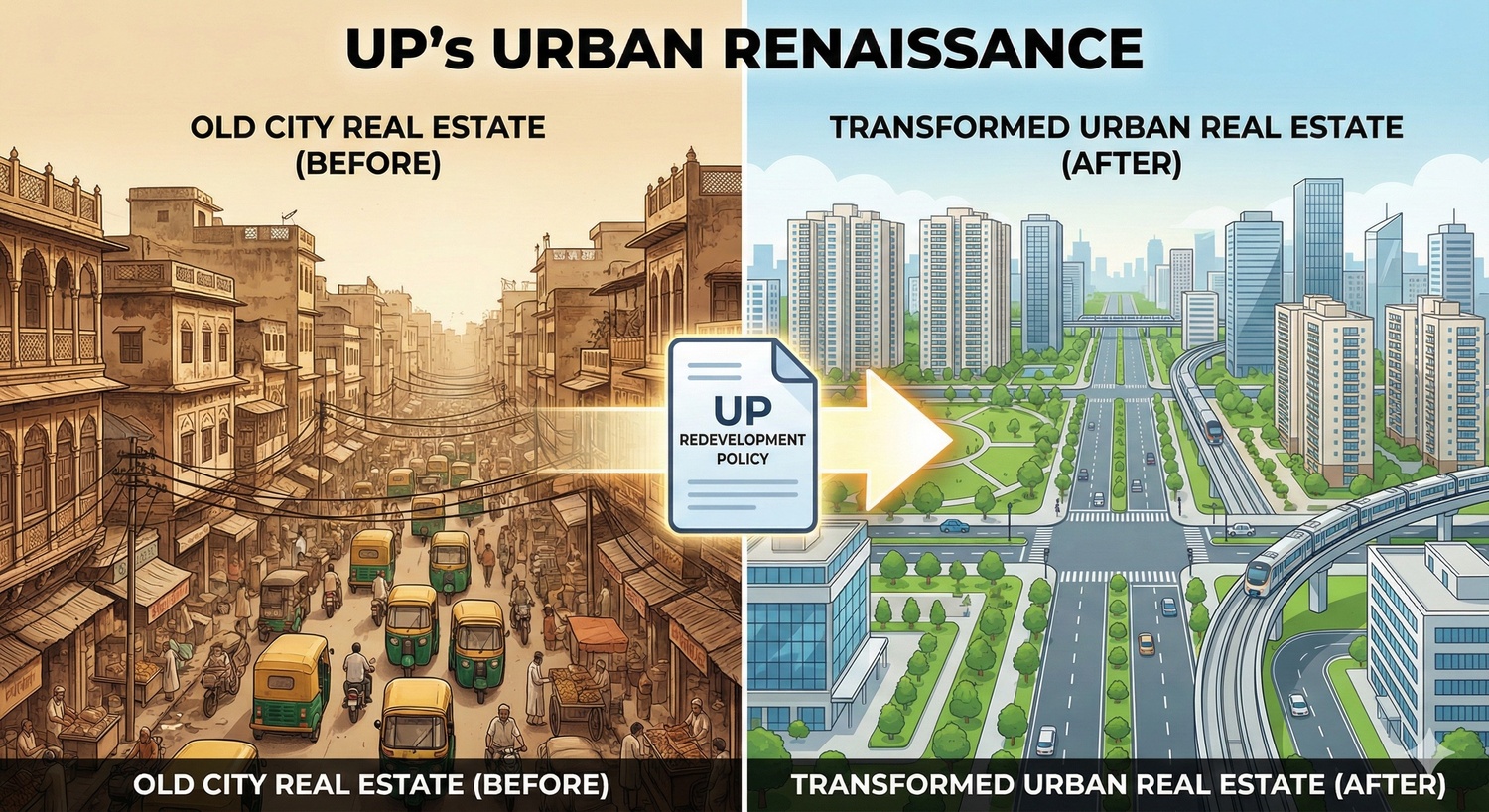
For decades, the heart of Uttar Pradesh’s historic cities—Lucknow, Kanpur, Varanasi, and Allahabad—has been frozen in time. While the outskirts gleam with glass-facade high-rises and wide expressways, the core city areas often struggle with crumbling infrastructure, unsafe dilated buildings, and severe congestion. These neighborhoods sit on some of the most valuable land in the state, yet their potential has remained locked behind legal hurdles and structural decay.
That narrative is about to change dramatically.
The Uttar Pradesh government has officially rolled out the Urban Redevelopment Policy 2026, a groundbreaking framework designed to breathe new life into these aging urban centers. By allowing the demolition and reconstruction of old, unsafe structures, the state is not just upgrading housing stock but actively reimagining the urban landscape. For property owners in these prime zones and real estate investors looking for the next big opportunity, this policy opens a door that has been shut for half a century.
This blog breaks down exactly how this policy works, the specific incentives driving it, and why it signals a massive shift for the real estate market in UP’s tier-1 and tier-2 cities.
At the heart of this policy is a clear eligibility criterion: Properties that are 25 years or older.
Previously, redeveloping older buildings was a bureaucratic nightmare involving multiple clearances and rigid zoning laws that made projects financially unviable. The new policy streamlines this by targeting residential and commercial structures that have outlived their structural utility. It creates a formal pathway for private developers to collaborate with existing owners and tenants to tear down these unsafe structures and build modern, high-density complexes in their place.
This is particularly crucial for the "Old City" areas. These zones are often characterized by low-rise, high-density clutter. The policy encourages vertical growth, allowing for more families to be accommodated in safer, cleaner, and more organized vertical townships without expanding the city's horizontal footprint.
Why would a developer take on the headache of redeveloping a congested old neighborhood? The government has answered this with two powerful incentives: Floor Area Ratio (FAR) and Mixed-Land Use.
To make these projects profitable, the government is offering a higher FAR for redevelopment projects compared to standard new construction.
The policy moves away from strict residential-only zoning. Redeveloped projects in these old areas can now integrate commercial zones—shops, offices, and cafes—within the residential complex. This aligns with the modern "Walk-to-Work" concept and significantly increases the project's commercial viability. A developer can now build a high-rise where the ground floors generate steady commercial rental income, subsidizing the cost of the residential units above.
To prevent haphazard construction on tiny plots, the policy sets a minimum land area requirement of 1500 square meters for redevelopment projects. This is a strategic decision to encourage "Clustering."
Instead of redeveloping a single house, the policy pushes for the amalgamation of smaller plots. Homeowners in older colonies can come together to pool their land, creating a sizable parcel that meets the 1500 sq meter threshold. This scale allows for proper planning of amenities like parking, green spaces, and fire safety access—features that are impossible to provide on small, individual plots.
A major concern with gentrification is the displacement of the original lower-income residents. The 2026 policy addresses this head-on with a mandatory inclusion clause.
Developers undertaking these projects are required to reserve a specific portion of the new inventory for Economically Weaker Sections (EWS) and Low-Income Groups (LIG). This ensures that the original fabric of the community is preserved. The families who lived in the dilapidated structures get to upgrade to safe, modern apartments in the same location, often at little to no extra cost, while the developer recovers their investment through the sale of the additional premium units allowed under the higher FAR.
Recognizing that cost overruns kill redevelopment projects, the administration has rationalized development charges.
The Uttar Pradesh Urban Redevelopment Policy 2026 is more than just a housing scheme; it is an urban renewal strategy.
For the Homeowner, it offers a way out of living in unsafe, crumbling houses with no capital to repair them. They get a modern asset with a higher market value.For the Developer, it unlocks prime land in the city center that was previously untouchable, offering high returns through commercial integration.For the City, it means wider roads, better drainage, and a modernized skyline without spending public money on construction.
As this policy takes effect, we can expect a construction boom in the core areas of Lucknow, Ghaziabad, and Kanpur. The skyline of Old UP is set to rise, blending its historic charm with the safety and convenience of modern living. The locks on the old city are finally broken; the renovation has begun.
