Published On:
July 12, 2026
Updated On:
July 12, 2026
The Uttar Pradesh government has initiated massive land acquisition for the Meerut-Haridwar, Vindhya, and Vindhya-Purvanchal expressways, a move set to transform regional connectivity and unlock immense real estate and industrial potential across the state.
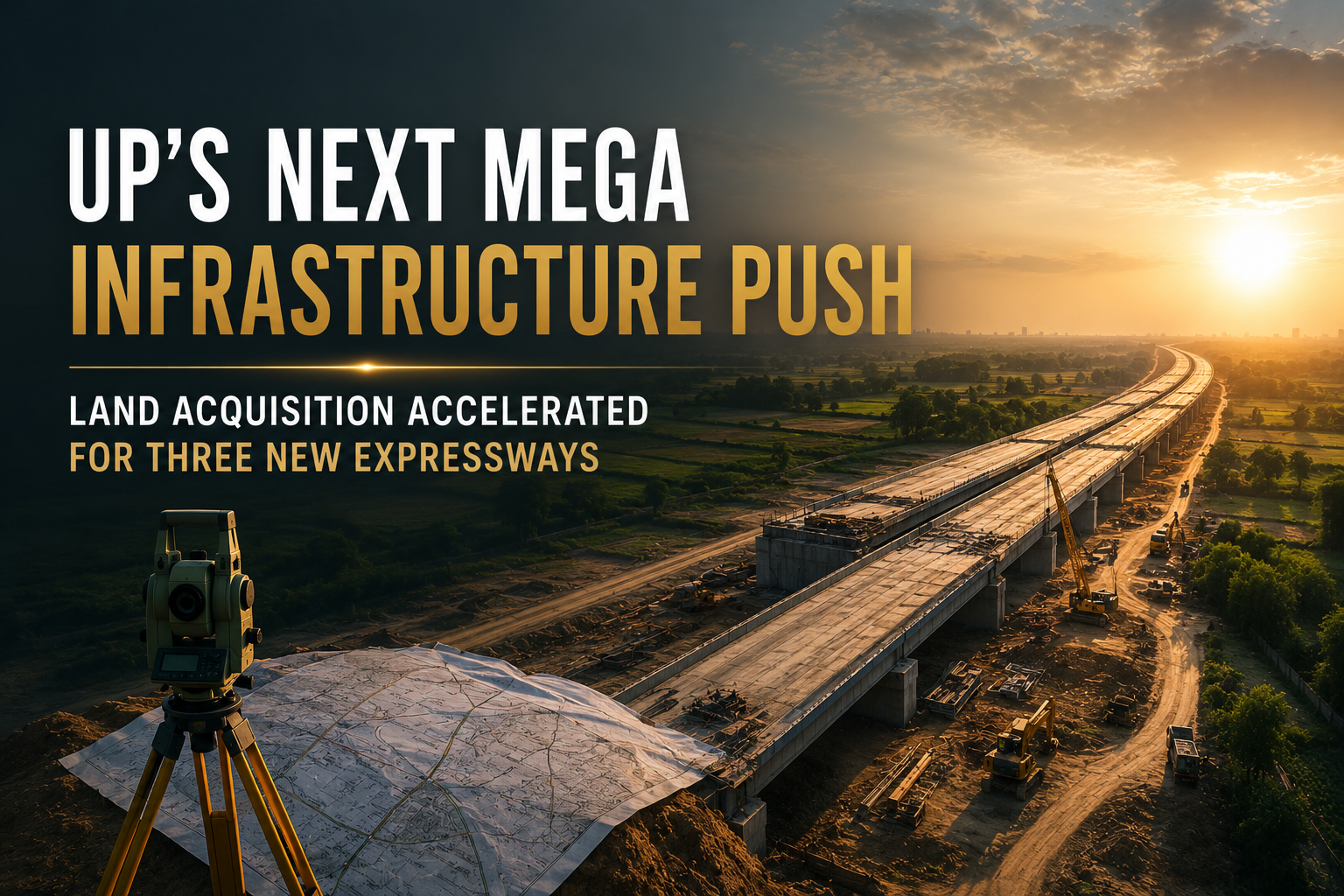
Uttar Pradesh is rapidly cementing its reputation as the expressway capital of India. Over the past few years, the state has witnessed a massive transformation in its road infrastructure, moving away from fragmented regional highways to seamless, access-controlled corridors. Now, the government is taking the next ambitious step in this journey. Authorities have officially accelerated the land acquisition process for three brand-new, game-changing corridors: the Meerut-Haridwar Expressway, the Vindhya Expressway, and the Vindhya-Purvanchal Link Expressway.
For those of us tracking the massive real estate boom along the Yamuna Expressway and the commercial developments around Jewar, this latest announcement signals a massive expansion of the state’s economic footprint. The focus is no longer just on western hubs or the immediate National Capital Region. Instead, the government is weaving a comprehensive web that connects the westernmost tips of the state to the eastern and southern borders, seamlessly linking them to neighboring states like Uttarakhand, Madhya Pradesh, Bihar, and Jharkhand.
This move is designed to slash travel times, supercharge industrial growth, and completely reshape the real estate landscape across dozens of districts. Here is a deep dive into the specifics of these three upcoming expressways, their proposed routes, the scale of land acquisition, and what they mean for the future of connectivity and investment.
Developing high-speed, multi-lane expressways requires meticulous planning, precise engineering, and, most importantly, large-scale land acquisition. The state government has learned from past infrastructure projects that securing the right of way early is the absolute key to preventing delays. To that end, official directives have been issued to district magistrates across the involved regions to begin matching land records, verifying village boundaries, and preparing for compensation payouts.
Together, these three projects will require the acquisition of nearly 9,400 hectares of land spread across hundreds of villages. Revenue department teams and local land accountants are already on the ground, conducting physical verifications to ensure that structures like houses, tube wells, and commercial shops on the designated alignments are properly documented and fairly compensated. By clearing these administrative hurdles upfront, the state aims to complete these massive road networks within the next three to four years, ensuring that construction can proceed without legal or logistical roadblocks.
Western Uttar Pradesh has always been a critical economic engine, but traffic bottlenecks heading north toward Uttarakhand have been a persistent challenge for both commuters and freight operators. The proposed Meerut-Haridwar Expressway is set to change that narrative completely. This approximately 150-kilometer-long corridor is designed to provide a direct, high-speed connection between the Delhi-Meerut region and the spiritual and tourist hub of Haridwar.
To make this a reality, authorities will acquire roughly 2,000 hectares of land spanning 185 villages across Amroha, Bijnor, and Haridwar districts. The most significant aspect of this project is its strategic integration with the massive, under-construction Ganga Expressway. Once completed, travelers coming from central or eastern UP on the Ganga Expressway will be able to seamlessly transition onto this new spur, bypassing crowded city roads entirely.
The economic implications for this route are staggering. Real estate observers note that cutting travel time from the National Capital Region to Haridwar to just a couple of hours will lead to a surge in demand for weekend homes, hospitality ventures, and wellness retreats along the corridor. Furthermore, it will drastically improve the logistics of moving industrial goods from the manufacturing belts of western UP directly to the consumption markets in Uttarakhand.
While the Meerut-Haridwar route focuses on the north, the Vindhya Expressway is an incredibly ambitious project aimed at unlocking the potential of the state's southeastern and central regions. Estimated to cost around ₹22,000 crore, this massive 320 to 330-kilometer network will connect Prayagraj directly to the resource-rich, heavy-industry district of Sonbhadra.
The land requirements for this corridor are immense. The government plans to acquire 4,600 hectares of land cutting through 341 villages across tehsils in Prayagraj, Bhadohi, Mirzapur, and Sonbhadra. Initial plans indicate that the highway will begin as a six-lane access-controlled road, with provisions built in to expand it to eight lanes in the future as traffic volumes grow. Vehicles will be permitted to travel at design speeds of up to 120 kilometers per hour.
What makes the Vindhya Expressway an engineering marvel is the planned infrastructure along its route. The project includes the construction of a major six-kilometer bridge over the Ganga River near Mirzapur, as well as complex tunnel networks through the challenging, hilly terrains of Sonbhadra.
Beyond its engineering feats, this expressway serves a critical strategic purpose. Sonbhadra shares borders with Madhya Pradesh, Chhattisgarh, Jharkhand, and Bihar. By creating a high-speed link to this district, the expressway effectively integrates the economies of these neighboring states with Uttar Pradesh. Travelers and freight operators heading from Rewa, Satna, and Sidhi in Madhya Pradesh will soon have direct, uninterrupted access to Prayagraj and, through connecting expressways, to the NCR in just eight to nine hours.
To ensure that the easternmost parts of the state are not left out of this connectivity boom, the government has conceptualized the Vindhya-Purvanchal Link Expressway. This crucial connector will span approximately 130 to 139 kilometers and will serve as the vital missing puzzle piece between the new Vindhya corridor and the fully operational Purvanchal Expressway.
Land acquisition for this segment targets 2,800 hectares across roughly 135 villages spanning Ghazipur, Chandauli, Varanasi, and Mirzapur. The route will culminate in Ghazipur, linking directly to the endpoint of the Purvanchal Expressway.
By tying these major arteries together, the state is creating a continuous, high-speed loop. A commercial truck originating in western UP can travel down the Ganga Expressway, switch to the Vindhya Expressway, and loop back up through the Purvanchal and Agra-Lucknow expressways without ever hitting a local traffic light. This seamless integration is exactly what large-scale logistics companies, e-commerce giants, and heavy manufacturers look for when deciding where to establish their massive warehousing hubs and distribution centers.
The initiation of ground surveys and land acquisition is typically the trigger point for a massive shift in local real estate dynamics. Historically, major infrastructure announcements in the state have led to immediate spikes in land valuations, and these three new corridors are following the exact same pattern.
Investors who have previously focused their attention on the booming industrial sectors in the west are now diversifying their portfolios across the state. The realization is setting in that the government is actively building out commercial and industrial nodes at the intersection points of these new expressways, spreading wealth generation far beyond the traditional metro borders.
The Vindhya region, in particular, is poised for a commercial renaissance. Areas like Mirzapur and Bhadohi, famous globally for their carpets and brassware, will now have the logistical backbone required to export their goods faster and cheaper. Sonbhadra, heavily reliant on mining and power generation, will see improved operational efficiencies as heavy freight movement becomes highly streamlined.
Market analysts anticipate a steady, long-term rise in the demand for commercial land parcels, especially near the planned interchanges, rest stops, and toll plazas of these new routes. Warehousing parks, cold storage facilities, and highway retail chains are expected to be the earliest adopters, moving in to secure prime land before the tarmac is even fully laid.
The sheer velocity at which these projects are moving from the initial drawing board to the physical land acquisition phase indicates a strong administrative will to overhaul the state's infrastructure permanently. While building hundreds of kilometers of multi-lane highways involves overcoming significant environmental, geographical, and legal challenges, the early deployment of revenue teams shows a highly proactive approach.
Once the Meerut-Haridwar, Vindhya, and Vindhya-Purvanchal expressways are operational, Uttar Pradesh will possess an unparalleled, world-class road network. The integration of these new routes with the Ganga, Purvanchal, and Bundelkhand expressways will create a robust grid that effectively shrinks the state, bringing remote, historically underserved districts directly into the national economic mainstream.
For the everyday commuter, this means much safer, faster, and more comfortable journeys. For regional industries and local farmers, it represents a massive reduction in transit times, less spoilage of goods, and lower freight costs, allowing them to remain highly competitive on a national scale. And for the broader real estate market, these expressways act as vast arteries of growth, continuously pumping value into the rural and semi-urban lands they traverse. The foundational work is currently happening on the ground, and the next few years will witness the physical manifestation of a master plan that promises to rewrite the economic geography of the entire region.
