Published On:
February 1, 2026
Updated On:
February 1, 2026
The Uttar Pradesh government has unveiled a transformative plan to establish 75 new industrial parks across all 75 districts by 2026, aimed at decentralizing growth. Under the PLEDGE scheme, the policy offers massive incentives, including up to 100% stamp duty exemption and land subsidies, creating a golden era for MSMEs and private developers in the state.
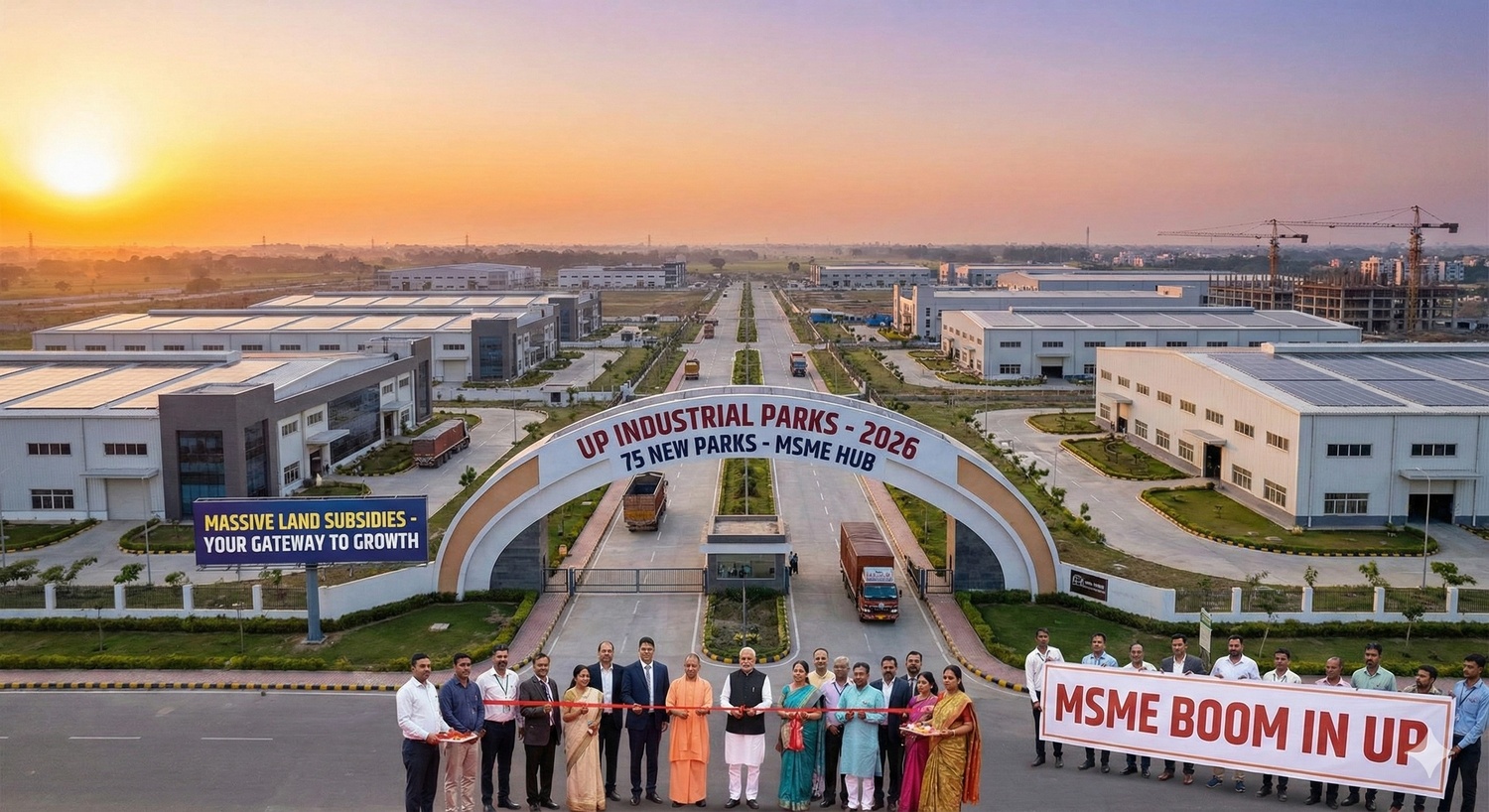
For decades, industrial growth in Uttar Pradesh was largely skewed toward the western belt—Noida, Ghaziabad, and Meerut. If you were an entrepreneur in Azamgarh or Banda, your options for world-class industrial infrastructure were limited. But the narrative is changing, and it is changing fast.
In a landmark decision that promises to redraw the economic map of the state, the Uttar Pradesh government has announced the establishment of 75 new industrial parks across all 75 districts by 2026. This move is not just about infrastructure; it is a direct invitation to the Micro, Small, and Medium Enterprises (MSME) sector to lead the state’s charge toward a trillion-dollar economy.
Whether you are a startup founder looking for affordable land or a private developer eyeing a high-yield project, the new policy framework—anchored by the PLEDGE Scheme—offers incentives that are too good to ignore. Here is a comprehensive breakdown of what this means for your business.
The core philosophy behind this initiative is decentralization. The government has moved away from the "cluster approach" where industry is concentrated in a few pockets. Instead, the goal is to ensure that every district, from the bustling lanes of Lucknow to the quiet hinterlands of Chitrakoot, has its own dedicated industrial engine.
Under this plan, approximately 100 acres of land are being earmarked in each district. This ensures that local raw materials (aligned with the ODOP - One District One Product scheme) can be processed locally, reducing logistics costs and creating jobs at the grassroots level. To fast-track this, land parcels in 14 districts have already been identified for immediate MSME allotment, signaling that the government is in execution mode.
The government knows it cannot build everything alone. Enter the PLEDGE (Promoting Leadership and Enterprise for Development of Growth Engines) scheme. This is a public-private partnership model designed to encourage private players to build these industrial parks.
If you have land (ranging from 10 to 50 acres), you can become a partner in this growth story. The incentives for developers are substantial:
For the business owner looking to set up a factory, the biggest barrier to entry is the cost of land. The 2026 roadmap slashes this cost through a tiered subsidy structure designed to favor the underdeveloped regions of Purvanchal and Bundelkhand.
The pricing model is strategic. To pull investment away from the saturated NCR region, the government offers:
This is where the savings really add up.
For larger players and foreign investors, the new FDI policy includes a "Front-End Land Subsidy." This allows eligible foreign firms to receive up to 80% reimbursement on land costs, a move designed to attract Fortune 500 companies to the state.
We have seen industrial policies before, so what makes the 2026 mission different? The answer lies in integration.
Previously, you might get land, but no road connectivity. Or you might get a shed, but no power. The new "Integrated Industrial Township" model ensures that these parks are "Plug-and-Play."
If you are planning to invest, aligning your business with the state’s focus sectors will maximize your chances of quick allotment and extra subsidies.
The 75-district industrial park plan is a clear signal that Uttar Pradesh is moving beyond the "Noida-centric" growth model. By subsidizing land and inviting private developers to build the infrastructure, the government has lowered the drawbridge for MSMEs.
For the entrepreneur, the window of opportunity is now. The land parcels are being identified, and the PLEDGE scheme applications are active. In the race to a trillion-dollar economy, the early movers who secure their spot in these new industrial hubs will be the biggest winners. The question is not if you should invest in UP, but where among the 75 districts you will plant your flag.
