Published On:
February 10, 2026
Updated On:
February 10, 2026
Uttar Pradesh is set to launch its first "Solar Expressway" by installing 550 MW of solar capacity along the 296-km Bundelkhand Expressway. This ambitious PPP project aims to power 1 lakh homes, support EV charging infrastructure, and generate significant revenue, marking a major leap in the state's green energy initiatives.
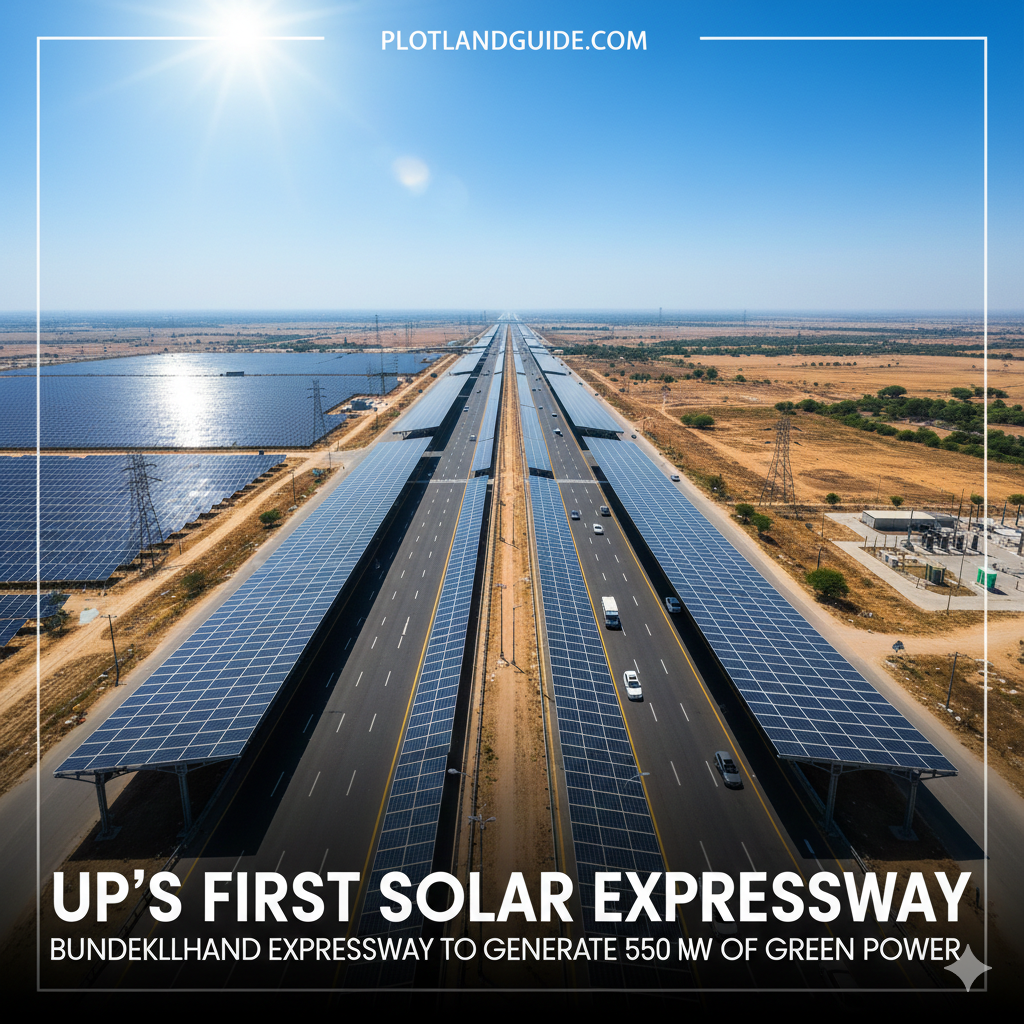
Uttar Pradesh has been on a massive infrastructure overdrive in recent years, stitching the state together with a network of world-class expressways. From the Yamuna Expressway to the Purvanchal Expressway, the focus has largely been on speed, connectivity, and industrial corridors. However, the state government is now adding a revolutionary new dimension to these concrete arteries: Sustainability.
In a move that blends infrastructure with renewable energy, the Uttar Pradesh government has announced plans to transform the Bundelkhand Expressway into the state’s first "Solar Expressway." This isn't just about planting trees along the highway; it is a high-tech initiative to turn the 296-kilometer stretch into a massive solar power plant.
Imagine driving down a highway where the road doesn't just transport you, but also powers the electric vehicle you are driving and lights up the villages you pass by. This vision is fast becoming a reality. The project, spearheaded by the Uttar Pradesh Expressways Industrial Development Authority (UPEIDA), is a pioneering step that could set a template for sustainable infrastructure across India.
The core concept is simple yet brilliant. Expressways occupy vast tracts of land, much of which remains unutilized. Specifically, there is a significant gap—often 15 to 20 meters wide—between the main carriageway and the service lanes, as well as vacant slopes and buffer zones. The Solar Expressway project aims to cover these strips with solar panels.
The Target: 550 MW of Clean EnergyThe scale of this project is massive. The government is targeting a total solar power generation capacity of 550 Megawatts (MW) along the Bundelkhand Expressway. To put this in perspective, 550 MW is enough to power approximately 1 lakh households daily.
By utilizing the 1,700 hectares of available land along the expressway, the state is effectively creating a solar park without the need to acquire new agricultural land—a common hurdle for renewable energy projects.
The choice of the Bundelkhand Expressway for this pilot project is strategic. The Bundelkhand region, known for its dry and arid climate, receives some of the highest solar irradiance in the state. Unlike other regions that might face heavy cloud cover or monsoon disruptions, Bundelkhand offers clear skies for a significant part of the year, making it an ideal location for solar power generation.
Furthermore, the region has historically been economically challenged. Transforming the expressway into an energy hub brings a new layer of economic activity to districts like Chitrakoot, Banda, Mahoba, Hamirpur, and Jalaun. It turns a "transit corridor" into a "production corridor."
Implementing a project of this magnitude requires capital and technical expertise. To ensure efficiency, the government has opted for the Public-Private Partnership (PPP) model.
The lease period is expected to be 25 years, ensuring a long-term commitment to green energy.
One of the most exciting aspects of the Solar Expressway is its synergy with Electric Vehicles (EVs). One of the biggest barriers to EV adoption in India is "range anxiety"—the fear of running out of charge on long highways.
The Solar Expressway solves this by creating a local ecosystem of power. The electricity generated by the panels can be directly fed into EV charging stations placed at regular intervals along the highway. This creates a self-sustaining loop: the sun powers the road infrastructure, and the road infrastructure powers the cars. It paves the way for a truly green commute, where both the vehicle and the fuel source are zero-emission.
The environmental benefits of this initiative cannot be overstated. By generating 550 MW of clean energy, the Bundelkhand Solar Expressway will offset thousands of tons of carbon dioxide emissions annually. It aligns perfectly with Uttar Pradesh’s Solar Energy Policy 2022, which targets 22,000 MW of solar capacity by 2027.
Moreover, the project includes provisions for:
The success of the Bundelkhand Solar Expressway is likely to trigger a domino effect. UPEIDA is already eyeing similar projects for other major corridors, including the Purvanchal Expressway, the Agra-Lucknow Expressway, and the Gorakhpur Link Expressway.
If replicated across the state's entire expressway network, Uttar Pradesh could potentially generate gigawatts of solar power just from its road infrastructure. This innovative land-use model—where infrastructure serves a dual purpose—is exactly the kind of out-of-the-box thinking needed to meet India's ambitious climate goals.
The Bundelkhand Solar Expressway is more than just an engineering feat; it is a statement of intent. It signals that Uttar Pradesh is ready to lead the charge in the transition to renewable energy. For the commuter, it promises a smoother, greener drive. For the investor, it opens up new avenues in the green economy. And for the planet, it is a breath of fresh air.
As the panels go up and the grid comes alive, the Bundelkhand Expressway will cease to be just a connection between two cities. It will become a bridge to a sustainable future.
