Published On:
March 28, 2026
Updated On:
March 30, 2026
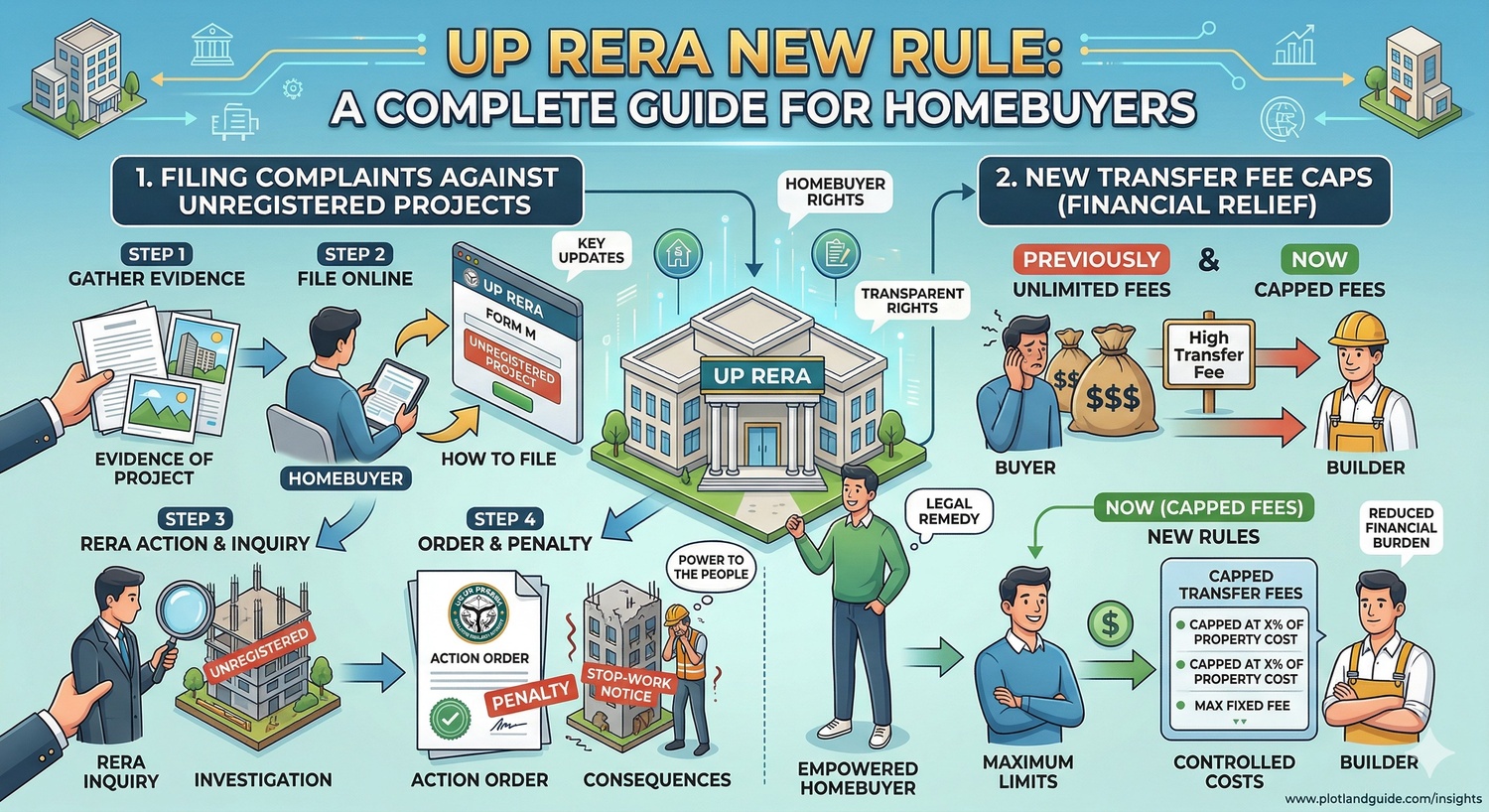
The Uttar Pradesh Real Estate Regulatory Authority has officially amended its rules to allow homebuyers to file grievances against unregistered projects, closing a major legal loophole. Additionally, the authority has introduced strict financial caps on property transfer charges, providing massive relief to property owners and heirs.
For years, the real estate sector in Uttar Pradesh has been a landscape of immense opportunity coupled with significant, sometimes devastating, risk. Investors and families pouring their life savings into the dream of homeownership often found themselves navigating a maze of legal ambiguities. One of the most glaring vulnerabilities in this system was the phenomenon of unregistered real estate projects. Buyers who unknowingly or trustingly invested in these unapproved developments frequently found themselves completely abandoned when construction stalled or promises were broken, seemingly without any legal avenue for redress.
Today, that narrative has been entirely rewritten. With the introduction of the latest sweeping amendments to its general regulations, the state’s real estate regulatory authority has fundamentally tipped the scales of justice back in favor of the consumer. This comprehensive regulatory overhaul not only brings rogue, off-the-grid projects firmly into the light of legal scrutiny but also dismantles the long-standing, exploitative practice of extortionate property transfer fees. This structural cleanup is poised to transform the property market, making it significantly safer, more transparent, and highly attractive for long-term investment.
To truly grasp the monumental nature of this regulatory shift, it is essential to understand the dark and frustrating era that preceded it. When comprehensive real estate regulations were initially rolled out across the country, the primary goal was to establish a standardized, transparent, and fast-track dispute resolution mechanism to protect everyday consumers. The law clearly mandated that any commercial or residential project exceeding a specific size threshold—typically land over 500 square meters or developments comprising eight or more apartments—had to be officially registered with the state authority before a single unit could be advertised or sold.
However, an insidious loophole quickly emerged. A subset of aggressive, fly-by-night developers deliberately chose to bypass the registration process entirely. They operated in the shadows, launching projects, collecting massive booking amounts, and issuing informal allotment letters without ever submitting their project blueprints or financial details to the regulatory portal.
When these unapproved projects inevitably ran into trouble—whether through deliberate fraud, diverted funds, or halted construction—the buyers were left completely stranded. Upon approaching the regulatory body for assistance, these aggrieved buyers hit a bureaucratic wall. Because the project did not technically exist on the official registry, the authority's legal jurisdiction to intervene was deeply ambiguous. The existing framework was meticulously designed to monitor and penalize projects that had willingly entered the system. For projects outside the system, the regulatory hands were seemingly tied. Buyers were routinely turned away and advised to take their grievances to traditional civil courts or consumer forums, a process infamous for its agonizing delays and mounting legal expenses. This created a perverse incentive where builders used the "unregistered" status as a literal shield against accountability, leaving early-stage investors, suburban plot buyers, and small-scale group housing participants exceptionally vulnerable.
The recent regulatory amendment decisively shatters this shield. The authority has officially clarified and expanded its operational jurisdiction, ensuring that unregistered projects are no longer immune to severe regulatory action. The legal ambiguity has been completely removed, paving the way for a highly robust, consumer-centric grievance redressal system.
Under this newly fortified framework, any individual who feels cheated, marginalized, or financially harmed by a developer can directly approach the regulatory bench, regardless of whether the specific building, housing society, or plotted township appears on the official online portal. The gates to justice have been thrown wide open.
The adjudication process for these specific cases has been meticulously structured to ensure both fairness and rigorous compliance. When a homebuyer files a formal grievance against an unregistered development, the regulatory bench does not automatically dismiss it due to a lack of backend data. Instead, the bench initiates a mandatory preliminary hearing. The sole objective of this initial phase is to determine whether the project in question legally qualified for mandatory registration in the first place. The bench meticulously examines the physical scale of the development, the geographical coordinates of the land, any available approved municipal maps, and the foundational parameters defined by the overarching real estate act.
If the evidence confirms that the developer was indeed legally obligated to register the project but deliberately evaded the responsibility, a powerful, two-pronged legal mechanism is instantly triggered. First, the bench immediately refers the matter to the authority’s executive wing to launch aggressive, punitive action against the promoter for brazenly violating registration laws. This action forcibly drags the project out of the unregulated shadows and mandates its integration into the official legal framework, complete with heavy financial penalties for the delay. Second, and most importantly for the consumer, once this registration mandate is firmly established, the bench proceeds to hear the homebuyer's original complaint on its sheer merits. The buyer is now eligible to receive the exact same relief, construction timelines, financial refunds, or compensation that they would have received had the project been fully compliant from day one.
Because these rogue developers actively avoid leaving a formal paper trail, the regulatory body historically lacked the crucial data required to issue binding legal notices. They had no official promoter addresses, no clearly demarcated project boundaries, and no registered escrow account details. To overcome this severe information deficit, the authority is aggressively leaning into digital crowdsourcing directly from the victims.
The official e-courts portal is being upgraded to accommodate these unique circumstances. Complainants will soon utilize a specialized digital form, designed specifically for unlisted and rogue developments. Through this interface, buyers are actively encouraged to submit any and all informal documentation they possess. This includes preliminary allotment letters, promotional brochures, email correspondences, payment receipts, and most crucially, personal bank statements reflecting financial transfers made directly to the builder’s accounts.
By aggregating this crowdsourced intelligence, the authority can rapidly construct a comprehensive, functional profile of the illegal project. This data empowers the regulatory body to track down elusive promoters, freeze unauthorized financial channels, and serve legally binding notices, ensuring that the developers can no longer hide behind a veil of administrative anonymity.
The strategic and economic implications of this regulatory expansion are profound, particularly within the state's most lucrative and rapidly expanding real estate corridors. Regions such as Noida, Greater Noida, and the massive Yamuna Expressway belt are currently experiencing an unprecedented influx of domestic and international investment. Driven by monumental, state-backed infrastructure projects, including the upcoming international aviation hub and dedicated industrial corridors, these micro-markets are witnessing explosive transaction volumes.
While the skyline is increasingly dominated by premium, fully compliant luxury high-rises, there is a massive, parallel market for raw land and plotted developments. Historically, for investors focusing specifically on land acquisitions within these newly carved-out sectors, the lack of mandatory registration by aggressive regional developers represented a massive, deal-breaking risk factor. Early-stage investments in unapproved plotted townships left buyers entirely exposed if the promoter failed to secure the necessary regional development authority clearances.
This specific, high-stakes investment risk has now been heavily neutralized. Investors targeting the high-growth suburban belts can deploy their capital with a profoundly renewed sense of security. They now operate with the absolute assurance that stringent regulatory oversight extends to their investments from the moment the first booking check is cleared, completely independent of the developer's internal regulatory status. If a promoter attempts to market and sell plots without the necessary regional approvals or regulatory registration, the buyer immediately possesses a powerful, direct legal recourse. This dramatically sanitizes the land acquisition market, ensuring that the incredible wealth being generated around these new economic epicenters is built on legally impenetrable, highly transparent foundations.
While the inclusion of unregistered projects represents a massive systemic victory, the regulatory amendments deliver a second, equally critical blow to long-standing developer malpractice. The authority has officially intervened to end the arbitrary, unregulated, and often extortionate administrative fees routinely charged by builders during the transfer of property allotments.
In the typical lifecycle of real estate investment, it is incredibly common for a property to change ownership before the final physical registry and handover are executed. An original investor might choose to sell their under-construction unit to liquidate their asset, or tragically, a property might need to be transferred to a legal heir following the sudden death of the primary allottee. Because the final government registry had not yet taken place, the developers acted as the ultimate, uncontested gatekeepers of the property records.
To simply update a name in their internal company ledger, builders routinely demanded exorbitant "transfer charges." There was absolutely no standardized, logical mathematical formula governing these fees. Charges were often calculated arbitrarily on a per-square-foot basis, resulting in buyers or grieving families being forced to pay hundreds of thousands of rupees simply to execute a basic administrative keystroke. It was a massive financial bottleneck that trapped capital, complicated secondary resale markets, and caused immense emotional distress to families already dealing with loss.
The new regulatory framework completely obliterates this exploitative practice by introducing strict, non-negotiable financial ceilings. Perhaps the most compassionate and necessary aspect of this entire ruling applies to family successions. In the unfortunate event of an original allottee's death, the crushing financial burden placed on the grieving family to secure their rightful, inherited asset has been practically eliminated.
If the un-registered property is being transferred to a direct family member who is the legally recognized successor, the promoter is now explicitly forbidden by law from charging anything more than a nominal processing fee of one thousand rupees. This token amount is strictly to cover the basic administrative stationary and effort. To successfully execute this transfer, the legal successor simply needs to provide standard, verifiable legal documentation. This typically includes the official death certificate of the original buyer, a valid succession certificate issued by a competent legal authority, and formal no-objection certificates from any other potential legal heirs within the family tree. Once these documents are submitted, the developer is legally bound to update the records immediately, without demanding a single rupee more.
The financial relief provided by these new rules extends far beyond family tragedies, directly impacting and revitalizing the broader secondary resale market. When an original allottee decides to sell their pre-registry unit to a third-party buyer—someone entirely outside their immediate family tree—the developer's historical ability to extract an unreasonable, profit-gouging cut of the transaction has been completely neutralized.
For any property transfer executed in favor of a general, non-family third party, the maximum allowable processing fee has been strictly capped at twenty-five thousand rupees. This represents a monumental paradigm shift for property investors. A routine administrative process that previously cost buyers massive, unpredictable sums based entirely on the whims and greed of individual developers is now fixed at a highly reasonable, universally standardized rate across the entire state.
Alongside these massive financial caps, the authority has taken decisive steps to streamline the legal paperwork involved in these property transfers. Previously, developers would frequently use the transfer process as an opportunity to force the new, incoming buyer to execute an entirely fresh sale or builder-buyer agreement. This seemingly innocent, redundant paperwork process actually opened a dangerous back door for builders. It allowed them to quietly alter original contract terms, push back promised possession dates, or insert new, highly one-sided clauses that heavily favored the construction company over the new consumer.
The recent amendment explicitly and permanently outlaws this predatory practice. The regulatory body has made it crystal clear that absolutely no fresh agreements need to be drafted, negotiated, or signed during a standard property transfer. Instead, the necessary details regarding the change of ownership will simply be recorded as an official, legally binding endorsement attached directly to the existing, original agreement. The promoter is then required to update their internal digital and physical records to reflect this specific endorsement. This elegant solution ensures that the new buyer inherits the exact same legal rights, consumer protections, financial penalties for builder delays, and construction timelines that were originally promised to the first allottee, perfectly preserving the integrity and intent of the initial contract.
The deeply comprehensive nature of these new regulations highlights a rapidly maturing real estate market that is actively pivoting away from opaque, builder-centric operations toward a highly balanced, radically consumer-first ecosystem.
For the everyday homebuyer and the retail investor, these amendments successfully remove the deepest, most persistent layers of anxiety traditionally associated with property investment. The lingering fear of being permanently abandoned in an illegal, off-the-books project with absolutely no legal recourse has been completely eradicated. Similarly, the financial dread of hidden, extortionate administrative costs draining one's savings during a routine property transfer or family succession has been permanently neutralized.
For the broader real estate industry, this represents a painful but absolutely necessary evolution. By aggressively squeezing out the regulatory loopholes that allowed unauthorized, substandard constructions to flourish, the state is effectively leveling the playing field. Ethical, compliant developers who invest heavily in acquiring proper approvals no longer have to unfairly compete against rogue operators who cut corners, evade regulatory costs, and artificially lower property prices. Furthermore, the mandatory standardizations of transfer fees will undoubtedly foster a much healthier, highly liquid secondary market. Investors can now confidently buy and sell under-construction properties without the severe friction of unpredictable, deal-breaking transfer penalties.
Ultimately, the sweeping decisions executed under this new regulatory amendment serve as a masterclass blueprint for how modern real estate should be governed. By aggressively expanding its legal jurisdiction to protect the absolute most vulnerable segments of buyers and forcefully standardizing hidden, predatory costs, the regulatory authority is doing much more than merely resolving past grievances; it is actively building an unbreakable foundation of consumer trust. As the state continues to attract massive waves of domestic and international investment, particularly within its booming industrial, technological, and aviation corridors, this fortified legal framework ensures that the ultimate dream of homeownership and the pursuit of strategic, wealth-building property investment remain safe, transparent, and legally secure for every single participant in the market.
