Published On:
October 19, 2025
Updated On:
April 2, 2026
Uttar Pradesh has formally launched its Bed and Breakfast and Homestay Policy 2025, bringing thousands of informal guest stays under state regulation for the first time — with a mandatory registration deadline of June 9, 2026.
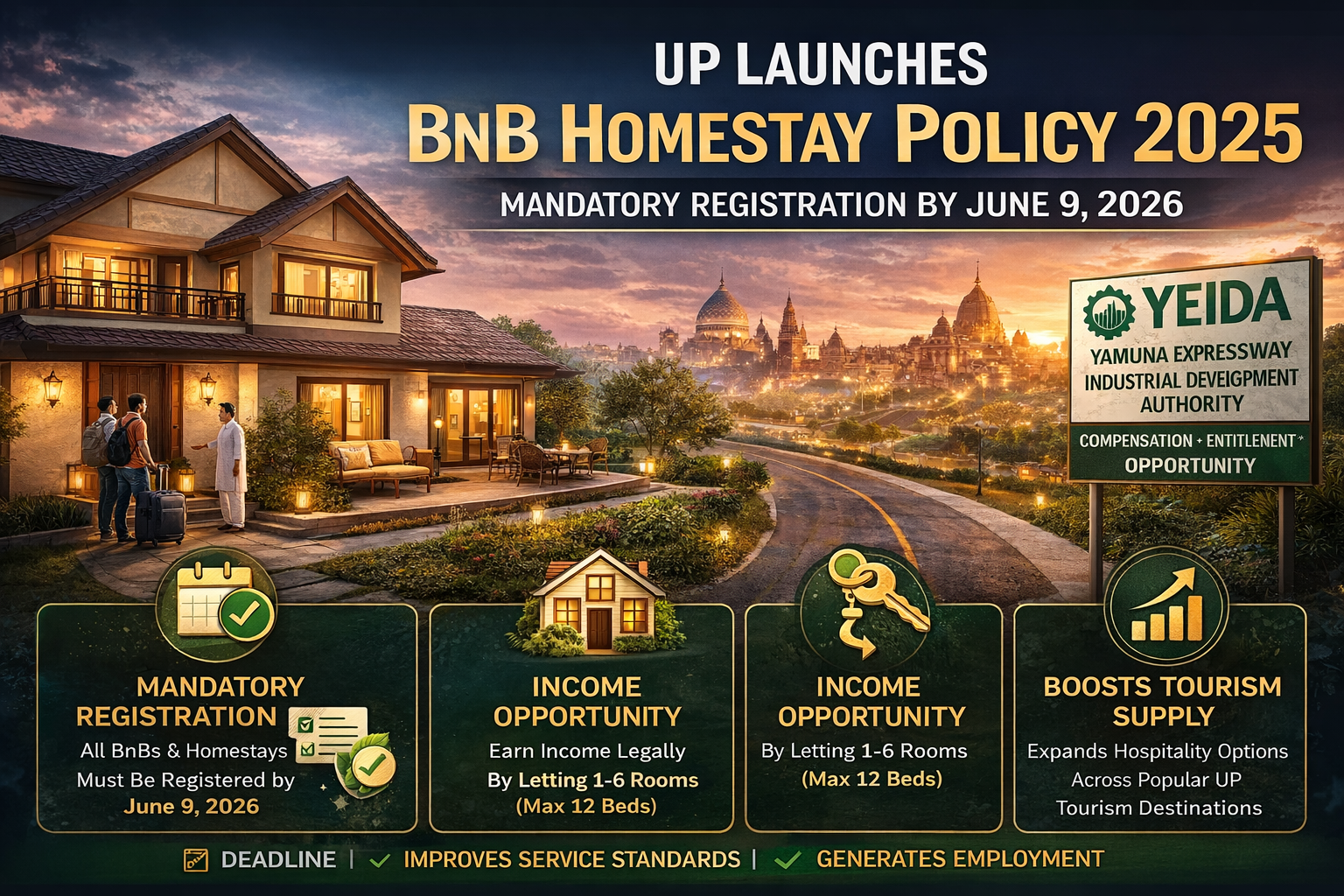
The Uttar Pradesh government has officially approved the Bed and Breakfast (BnB) and Homestay Policy 2025 — a long-overdue move to bring informal guest accommodation under a proper state-level framework.
Until now, thousands of homestays and BnB setups across UP operated either through central government registration on the NIDHI+ portal or simply without any formal state-level oversight at all. Operators in Varanasi, Agra, Ayodhya, Lucknow, and dozens of other tourist destinations ran their guest-facing businesses through platforms like Airbnb and Booking.com with no dedicated state policy to govern them.
That changes with this policy. Every existing and new BnB or homestay must register with the state tourism department by June 9, 2026. What that registration involves, who qualifies, what the fees are, and what happens if you don't comply — this blog covers all of it.
The answer is straightforward: UP has a massive accommodation gap.
Hotels near UP's major religious and tourist destinations — Varanasi, Ayodhya, Mathura, Vrindavan, Prayagraj — routinely fill up during peak seasons, pilgrimages, and major events. When hotels are full, visitors have limited options, many of them informal and unverified. The quality gap between verified hotels and informal paying guest arrangements has been a persistent complaint from both domestic and international tourists.
At the same time, hundreds of local residents near these destinations already informally host guests, and many would be willing to formalise their operations if the path to do so were clear and accessible. There was no state-level mechanism for that — operators defaulted to the central government's NIDHI+ portal, which many found cumbersome and insufficiently tailored to UP's specific tourism landscape.
The BnB and Homestay Policy 2025 is the state's answer to both problems: expand the accommodation supply by bringing private residences into the tourism ecosystem, while setting the quality and safety standards that make that expansion trustworthy for travelers.
The model isn't new nationally. Kerala, Himachal Pradesh, Uttarakhand, and Rajasthan have all run formal homestay frameworks for years. UP is among the last large tourism states to formalise this segment — but given the sheer scale of its religious and cultural tourism, the potential here is significant.
The policy draws a clear line between two types of units.
Bed and Breakfast (BnB) Units are typically located in urban or semi-urban settings. These are the more commercially-oriented end of the spectrum — homeowners in cities and town centres who want to offer standardised, paid accommodation to visitors alongside basic breakfast services.
Homestay Units are more common in rural and semi-rural areas — residences near temples, ghats, wildlife parks, Buddhist trails, or heritage zones where the visitor experience is as much about living with a local family as it is about the accommodation itself. Rural homestays are the policy's primary vehicle for creating grassroots tourism income and expanding UP's accommodation reach beyond its major cities.
Both categories are governed by the same core framework but have different fee structures and different classification levels, reflecting the different investment and operating contexts involved.
The policy is explicitly designed for homeowners — not commercial operators.
Hotels, guest houses, and purpose-built commercial lodging are not covered under this scheme. The intent is to bring private residences into the formal tourism fold, not to create a parallel commercial hospitality track.
The rules set clear parameters:
The 6-room and 12-bed cap is a deliberate design choice. It keeps these units genuinely residential in character rather than allowing them to scale into de facto guest houses. The moment a property starts operating beyond that threshold, it moves into a different regulatory category altogether.
Registered units under the policy are classified into two tiers — Gold and Silver — based on facilities, quality of amenities, and service standards.
Silver is the baseline classification, accessible to operators offering a clean, safe, and functional guest experience without necessarily having premium facilities. Gold is for units that meet a higher bar on infrastructure, service, and guest amenity standards.
The classification system serves two purposes. For tourists, it creates a quick shorthand for what level of experience to expect. For operators, it creates a defined pathway for upgrading — a Silver-category homestay owner who invests in better facilities has a clear target to aim for.
The government also plans to build a dedicated mobile application and tourism website where certified homestays and BnB units can be listed with photographs, reviews, and pricing — giving registered operators a digital presence that informal, unregistered operations simply won't have access to.
The registration process has been designed to be accessible, especially for rural operators who may have limited experience navigating government systems.
The primary step is obtaining a No Objection Certificate (NOC) from the relevant local authority. This NOC is the foundational document that confirms the property is legitimately used for residential purposes and that there are no local-body objections to it being used for tourist accommodation.
Once the NOC is in place, applications are submitted online through the state tourism department's official portal — up-tourismportal.in. The portal is already live and operational.
Registration fees by category:
These are deliberately nominal. The government's stated intent is to make entry into the formal system as frictionless as possible — particularly for rural residents who wouldn't have registered under any previous system simply because it was too cumbersome or costly.
Registration and approval are overseen by a five-member district-level committee headed by the District Magistrate, with the Superintendent of Police as a member. This structure ensures that safety and compliance checks are built into the approval process itself — not left as an afterthought.
For operators who were previously running informal paying guest arrangements or using older, pre-policy frameworks, a one-year transition period has been provided to migrate to the new system and complete registration.
Registration isn't just about compliance — the policy comes with concrete financial incentives for those who formalise.
Registered homestay owners are eligible for financial reimbursements to participate in tourism promotion events:
These incentives are aimed squarely at the problem of small, local operators having no route into broader markets. A homeowner in Kushinagar or Sarnath running a 4-room homestay has no natural mechanism to reach European Buddhist tourism circuits or Japanese pilgrimage travel agencies. Government-sponsored participation in international roadshows provides that bridge.
Beyond financial incentives, the state is also committing to training programs for host families — covering soft skills, hospitality standards, hygiene protocols, basic English communication, and local tourism knowledge. The intent is not just to increase the number of registered stays but to raise the baseline quality of the guest experience across all of them.
Registered units will also be integrated into official UP Tourism listings, giving them a level of institutional credibility that unregistered operators running through third-party platforms alone simply cannot match.
The mandatory registration cutoff is June 9, 2026. This applies to all existing BnB and homestay operators — not just new entrants.
Operators who continue running guest accommodation beyond that date without registration risk:
The policy also creates an accountability structure that didn't exist before. Registered units are subject to inspection by the district-level committee. Guest records must be maintained. Safety and hygiene standards must be demonstrably met. An unregistered operator running below those standards has no regulatory downside today — after June 2026, that changes.
For anyone currently operating informally — even through established platforms like Airbnb or Booking.com — the registration requirement applies regardless of how long you've been in operation or how many reviews you have.
The response since the policy's launch has been strong. Within the first month of the policy going live, more than 743 homestays and 30 agro-farm stays had already been registered across the state.
Geographically, the uptake has been concentrated — predictably — in UP's major religious and tourist corridors. Ayodhya Dham leads with 19 approved homestays, reflecting the enormous surge in visitor traffic the city has seen following the Ram Mandir consecration. Siddharthnagar, Maharajganj, Kushinagar, and Gorakhpur follow with 17 each — these districts sit on the Buddhist tourism circuit connecting Lumbini to Varanasi, and their homestay potential has been largely untapped until now.
Districts like Varanasi, Barabanki, Amethi, Sultanpur, and Bahraich have between 10 and 12 approved homestays each.
In Prayagraj alone, the state is targeting approximately 800 new registered homestay-cum-BnB units — a number that signals just how significant the accommodation gap is in a city that hosts one of the world's largest human gatherings every few years.
Under the scheme, 229 locations have been identified in rural areas across the state for priority homestay development. The state's tourism portal has already recorded over 16 lakh views since the policy's launch, reflecting genuine grassroots interest in registration.
Since April 2023, when early-stage applications were being processed even before the formal policy existed, over 2,269 applications have been received under the homestay program in various forms.
The BnB and Homestay Policy 2025 is not just a tourism initiative. It's an economic inclusion instrument — and the government has been explicit about that framing.
Women are expected to be primary beneficiaries. Managing a homestay is home-based, flexible, and directly monetises assets — a property and hospitality skills — that most host families already possess. The training programs the state is building are specifically structured to enable women to manage homestay operations independently, creating entrepreneurship pathways that don't require leaving home or accessing external capital.
The indirect employment created by a functioning homestay ecosystem is also meaningful. Every registered homestay that generates consistent bookings creates ancillary demand for local transport, laundry, catering, local guides, handicraft sales, and housekeeping services. In districts like Kushinagar or Gorakhpur — where formal employment options are limited — this knock-on effect is economically significant.
For the state government, formalising this sector also expands the tax base and creates a measurable data set on tourism accommodation capacity that UP has never had at the state level. That data directly informs infrastructure planning, tourism marketing, and future policy decisions.
UP's tourism numbers are already substantial. The Kashi Vishwanath Temple in Varanasi alone saw 9.5 million visitors in a single month in 2024. The Ram Mandir in Ayodhya has transformed the city's visitor profile almost overnight. The Mahakumbh in Prayagraj drew numbers at a scale that put global attention on the state's tourism infrastructure.
The formal hotel supply in UP simply cannot keep pace with that level of demand — not in the near term. The BnB and Homestay Policy 2025 is the government's recognition that the solution isn't to wait for enough hotels to be built; it's to mobilise the existing residential infrastructure that's already sitting adjacent to every major tourist destination in the state.
The policy achieves something else too: it shifts the competitive dynamic for informal operators. A registered, government-verified homestay in Varanasi now has a clear credibility edge over an unregistered one — both for domestic travelers making booking decisions and for international visitors who are more cautious about unverified accommodation. That credibility edge, over time, drives better pricing and occupancy for the operators who get compliant early.
The path is clear and the costs are low:
If you are currently listing on Airbnb, Booking.com, or any other platform and operating from a residential property in UP, this applies to you. The policy covers all residential-building-based guest facilities regardless of size, platform, or how long you've been operating.
The transition period is generous. The fees are nominal. The incentives for registered operators are real. There is no reason to wait.