Published On:
February 13, 2026
Updated On:
February 13, 2026
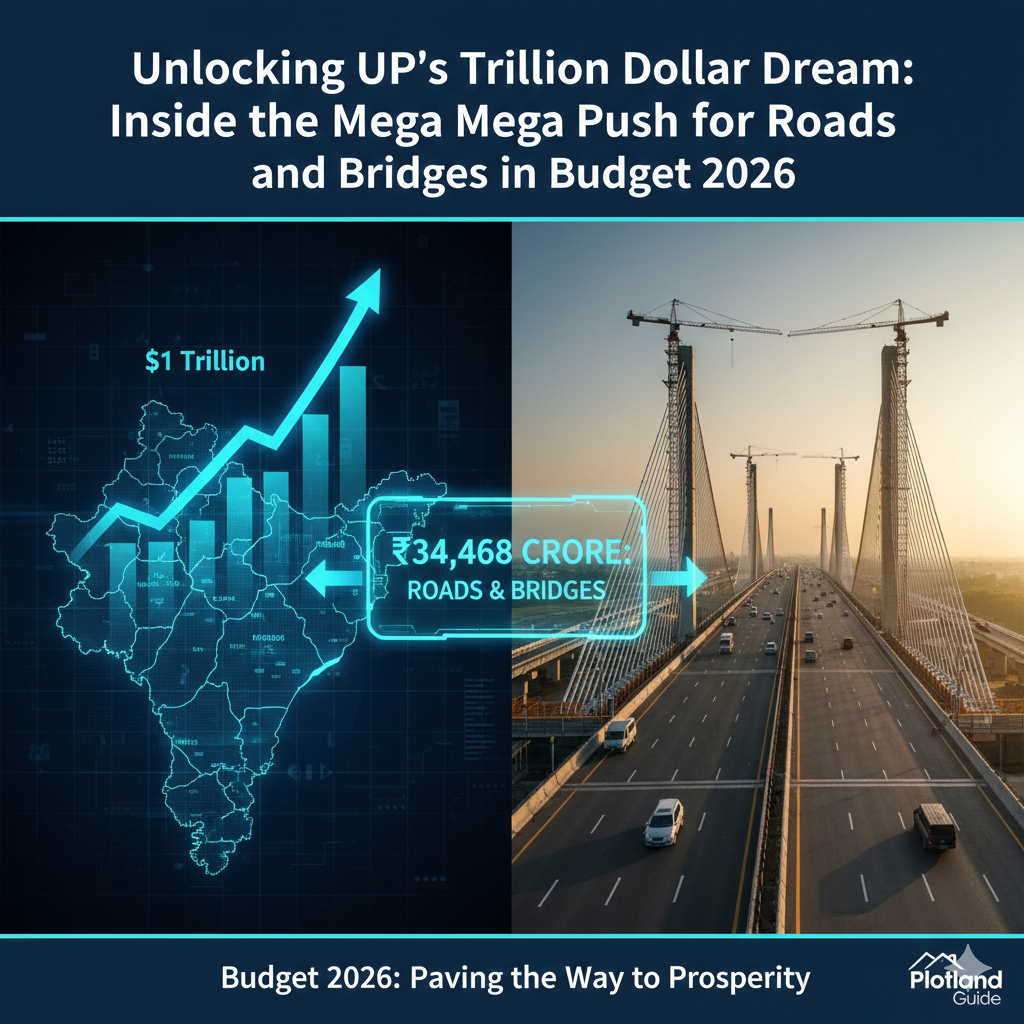
The Uttar Pradesh government’s historic Rs 9.12 lakh crore budget for 2026-27 dedicates a massive Rs 34,468 crore to completely overhaul the state's road and bridge network. This aggressive infrastructure push focuses on a new North-South corridor, urban ring roads, and specialized industrial connectivity, signaling a monumental boom for the local economy and regional real estate markets.
The narrative of Uttar Pradesh has undergone a dramatic transformation over the last decade. A state once scrutinized for its lack of basic infrastructure has aggressively rebranded itself as the "Expressway State" of India. However, building high-speed corridors connecting major metropolises was just the first phase of the master plan. The latest financial blueprint reveals that the government is now zooming in on deep-tier connectivity, ensuring that the economic momentum generated by these expressways actually penetrates the rural and semi-urban hinterlands.
The Uttar Pradesh government recently unveiled a record-breaking state budget of Rs 9.12 lakh crore for the 2026-27 financial year. While the staggering total volume of the budget made headlines, the most critical takeaway for urban planners, real estate investors, and the everyday commuter lies in the granular allocations. At the very core of this economic strategy is a massive provision of Rs 34,468 crore strictly earmarked for the Public Works Department (PWD) to construct, widen, and maintain roads, flyovers, and bridges.
This allocation is not merely about laying fresh asphalt. It represents a strategic shift from basic general connectivity to highly specialized engineering. By addressing chronic bottlenecks, prioritizing industrial freight movement, and opening up isolated land parcels, the Yogi government is laying the literal groundwork for its ambitious goal of transforming Uttar Pradesh into a one trillion-dollar economy.
Here is a comprehensive, deep-dive into how this Rs 34,468 crore infrastructure war chest is being distributed and what it means for the future of the state.
One of the most striking announcements in the UP Budget 2026 is the conceptualization and funding of the new North-South Corridor project. Geographically, Uttar Pradesh is a vast state, and historically, the heaviest infrastructure investments—like the Purvanchal and Agra-Lucknow expressways—have focused on East-West movement. This left a significant connectivity gap for districts aligned vertically across the state map.
To bridge this divide, the budget has allocated an initial seed fund of Rs 400 crore specifically to kickstart the widening, strengthening, and new construction required for the North-South Corridor.
Spanning an impressive 2,300 kilometers, this corridor will be developed across six major stretches, ultimately touching 20 different districts. These are areas that currently rely heavily on fragmented, narrow link roads to reach key commercial destinations. By creating a unified vertical spine, the state will drastically reduce transit times for agricultural and industrial freight moving from the northern borders down to the southern industrial belts.
From a real estate perspective, this is a massive green flag. Central UP districts that will fall along this new corridor are primed for a land value surge. As construction begins, we can expect to see agricultural land repurposed into transit towns, roadside commercial plazas, and large-scale warehousing hubs to support the increased truck traffic.
A highway is only as fast as its slowest bottleneck. For decades, the flow of traffic in Uttar Pradesh's rapidly expanding cities and sprawling rural districts has been choked by river crossings and railway lines. Waiting at a railway crossing for freight trains to pass is a daily, frustrating reality for millions of residents, causing immense economic loss in terms of wasted fuel and time.
The 2026-27 budget tackles this head-on with a massive capital injection. A staggering Rs 4,808 crore has been dedicated solely to the construction of new bridges across the state. Complementing this is another highly targeted allocation of Rs 1,700 crore specifically for Railway Over Bridges (RoBs) and underpasses.
This combined Rs 6,508 crore investment will fundamentally alter the daily commute. Eliminating railway crossings improves safety, reduces the carbon footprint of idling vehicles, and guarantees reliable transit times for emergency services.
For the property market, the impact of a new bridge or RoB cannot be overstated. Neighborhoods and villages that were previously considered "isolated" or "too far" simply because they were separated by a railway track or a river will suddenly become highly accessible. This immediate connectivity transforms undervalued, isolated land into prime real estate, sparking waves of new housing developments and local commercial markets.
As Uttar Pradesh transitions into an industrial powerhouse, its major cities are facing unprecedented inward migration. Cities like Lucknow, Kanpur, Varanasi, and Gorakhpur are expanding rapidly, leading to severe congestion in their historical city centers. Heavy transport vehicles passing through city limits add to the chaos, pollution, and degradation of urban roads.
To combat urban sprawl and direct heavy traffic away from city centers, the government has wheeled in an allocation of Rs 1,500 crore for the construction of bypasses, ring roads, and strategic urban flyovers.
Ring roads are the ultimate catalysts for urban expansion. By creating a high-speed circular perimeter around a city, they define the new boundaries for suburban growth. The "outskirts" of these major hubs will no longer feel disconnected. Instead, these ring road corridors will become the new hotspots for high-rise residential apartments, premium gated communities, and decentralized commercial IT parks. People want to live where the commute is seamless, and these bypasses will provide exactly that, pushing the real estate boom outward from the saturated city cores.
The push to make Uttar Pradesh a globally recognized manufacturing hub relies heavily on logistics. Companies will only set up factories if they can move their raw materials and finished products efficiently and cheaply. Acknowledging this, the budget has carved out a specialized fund of Rs 1,000 crore entirely dedicated to widening and strengthening roads that lead directly to industrial and logistics parks.
This is a clear indicator of the state's transition toward specialized engineering. Standard district roads are not built to withstand the relentless pounding of heavily loaded multi-axle trucks carrying steel, machinery, or export goods. Without high load-bearing capacities, standard roads quickly deteriorate, slowing down supply chains.
By heavily investing in heavy-duty industrial roads, the state government is directly subsidizing the operational costs of businesses. This proactive approach supports the broader 'Make in UP' initiative, attracting Fortune 500 companies and heavy industries. Naturally, industrial land prices adjacent to these upgraded corridors—especially those feeding into the Yamuna Expressway and the upcoming mega data center parks—are already beginning to climb in anticipation of this infrastructure upgrade.
Uttar Pradesh currently boasts one of the most impressive expressway networks in the country. However, an expressway is practically useless to a local farmer or a small-scale rural manufacturer if they cannot easily access it. The efficiency gap between high-speed toll roads and broken village roads has been a persistent challenge.
To ensure that the macroeconomic benefits of the state's expressways trickle down to the micro-level, the budget has allocated Rs 3,700 crore for the maintenance and upgrading of state highways, major district roads, and vital rural link roads.
This specific fund ensures that the smaller capillaries of the state's road network are robust enough to handle the traffic flowing into the main arterial expressways. When a village is seamlessly connected to an expressway via a well-paved district road, the local economy transforms. Farmers can transport perishable goods to larger city markets much faster, reducing spoilage and increasing profits. Simultaneously, farmland situated along these newly upgraded feeder roads becomes highly lucrative for commercial use, paving the way for roadside eateries, fuel stations, and regional cold-storage facilities.
Building new infrastructure is exciting and grabs headlines, but maintaining existing assets is what keeps an economy running smoothly. The UP Budget 2026 takes a highly pragmatic approach to asset preservation by allocating a massive Rs 6,000 crore to the State Road Fund, commonly referred to as the maintenance fund.
This corpus is expected to be split evenly, with half dedicated to the relentless repair and upkeep of older roads that suffer heavily during the monsoon seasons, and the other half supporting the rollout of new localized road sections.
Consistent maintenance is the unsung hero of real estate stability. Property values are intrinsically tied to neighborhood infrastructure. A well-maintained, pothole-free road network ensures that property investments retain their value over decades. By securing this Rs 6,000 crore fund, the government is guaranteeing that the state's vast road network will not fall into disrepair, providing confidence to both daily commuters and long-term investors.
When a government injects nearly Rs 35,000 crore into public works, the economic ripple effect is immediate and profound. Road construction is one of the most labor-intensive sectors in the economy. This budget allocation will directly generate millions of man-days of employment for skilled engineers, heavy machinery operators, and daily wage laborers across the state.
Furthermore, the demand for raw materials—cement, steel, bitumen, and heavy machinery—will provide a massive boost to the allied manufacturing sectors. The local MSME sector, which itself received a healthy Rs 3,822 crore allocation in the budget, will likely play a massive role in supplying the materials and secondary services required for these sprawling infrastructure projects.
The budget also highlights a disciplined fiscal approach. Despite the heavy capital expenditure, the state's finance department has managed to keep the debt-to-GSDP ratio in check, projecting a decline to 23.1% in 2026-27. This financial stability ensures that these mega-projects will not stall due to a lack of funds halfway through their execution.
The Uttar Pradesh Budget for 2026-27 is a definitive statement of intent. The Rs 34,468 crore allocated for roads and bridges proves that the state administration understands the critical link between world-class infrastructure and economic prosperity.
By balancing the creation of entirely new corridors with the urgent need for urban de-congestion and rural integration, the government is weaving a highly complex, highly efficient transit web. As the financial year rolls out and tenders are awarded, the landscape of Uttar Pradesh will once again transform. For the real estate sector, logistics companies, and the common citizen, these upcoming roads and bridges are more than just concrete and tar; they are the pathways to a trillion-dollar future.
