Published On:
January 29, 2026
Updated On:
January 30, 2026
As the Union Budget 2026-27 approaches, India's real estate sector is clamoring for a policy overhaul. Key demands include granting "industry status" to access cheaper credit, increasing tax deduction limits on home loans to boost demand, and creating a single-window clearance system to fast-track stalled projects and reduce costs.
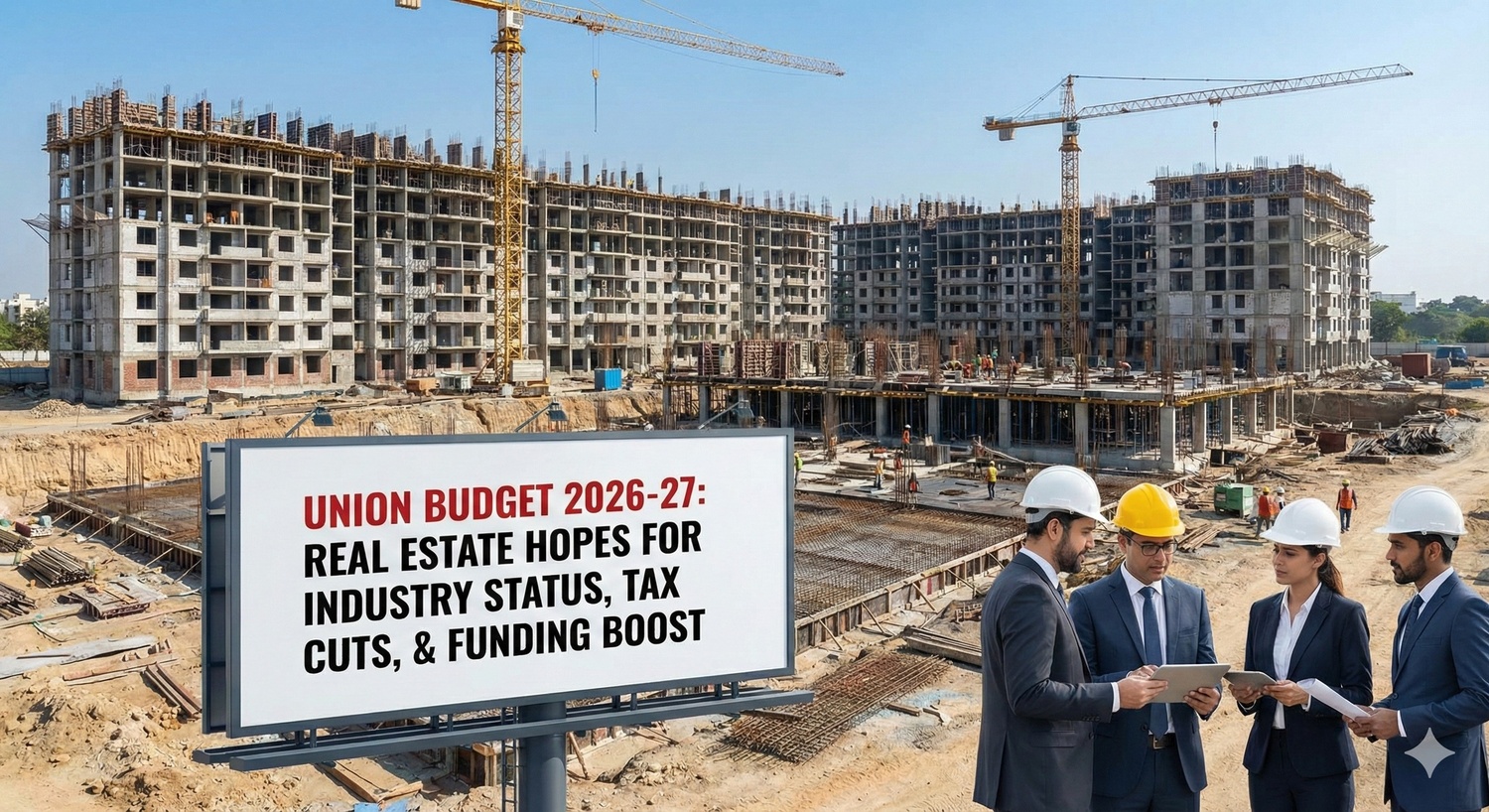
The countdown to February 1 is always filled with a mix of anxiety and anticipation for India’s economic stakeholders, but few sectors watch the Finance Minister’s briefcase as closely as real estate. As we approach the Union Budget 2026-27, the mood in the corridors of India’s property market is one of cautious optimism. After navigating a year of mixed signals—where luxury housing saw a meteoric rise while the affordable segment faced headwinds—the industry is collectively holding its breath for a policy overhaul that goes beyond token gestures.
Real estate is not just another vertical in the economy; it is a multiplier. It supports over 250 ancillary industries, from cement and steel to paints and furnishings, and is the second-largest employer in the country after agriculture. Therefore, the demands placed on the Finance Ministry’s table this year are not just about sector-specific relief; they are about greasing the wheels of a primary engine of India’s GDP.
For the average Indian middle-class family, the dream of homeownership has become increasingly expensive. While incomes have risen, they have often failed to keep pace with the sharp spike in property prices, especially in Tier-1 cities. Consequently, the primary demand this budget season focuses on putting more disposable income into the hands of the homebuyer.
The most vocal demand from taxpayers and industry bodies alike is the revision of Section 24(b) of the Income Tax Act. Currently, the deduction limit for interest payments on home loans is capped at ₹2 lakh per annum. This limit was set over a decade ago, in 2014. Since then, property prices in major hubs like Mumbai, Bengaluru, and Gurugram have nearly doubled, and interest rates have fluctuated, significantly increasing the EMI burden.
Financial planners argue that the ₹2 lakh limit is a "fiscal antique." For a homebuyer servicing a standard loan of ₹50 lakh at prevailing interest rates, the annual interest outgo easily exceeds ₹4 lakh in the initial years. The current cap means that half of their interest payment gets no tax relief. The expectation for Budget 2026 is a bold hike of this limit to at least ₹5 lakh. Such a move would not only lower the effective cost of borrowing for the common man but also reignite demand in the mid-segment housing market, which has seen sluggish growth compared to the luxury sector.
Another pain point for homebuyers is the overcrowding of Section 80C. Currently, the principal repayment of a home loan falls under the overall ₹1.5 lakh limit of Section 80C, which it shares with PF, PPF, life insurance premiums, and ELSS mutual funds. For most salaried professionals, mandatory PF and insurance premiums exhaust this limit, leaving no room to claim benefits on the home loan principal.
There is a strong consensus that the government should carve out a separate deduction specifically for home loan principal repayment, or arguably, increase the Section 80C limit to ₹3 lakh. This would incentivize long-term asset creation and provide genuine relief to borrowers who are currently paying off both principal and massive interest components without adequate tax efficiency.
One of the starkest disconnects between policy and ground reality lies in the definition of "affordable housing." According to the current government criteria, a residential unit is considered affordable only if it costs up to ₹45 lakh and does not exceed 60 square meters in carpet area (in metros).
In 2026, finding a livable two-bedroom apartment for ₹45 lakh in a city like Mumbai, Delhi, or even the IT corridors of Hyderabad and Pune is virtually impossible. This price cap effectively disqualifies a vast majority of middle-income projects from availing of the benefits linked to affordable housing, such as lower GST rates and subsidies.
The industry is strongly advocating for a location-based revision of this cap. The proposal is to increase the affordable housing threshold to ₹75-85 lakh for metro cities and ₹60-65 lakh for non-metros. By aligning the definition with actual market rates, the government can instantly bring thousands of under-construction units under the "affordable" umbrella, making them eligible for the 1% GST rate (versus 5% for standard housing). This single policy tweak could trigger a massive inventory clearance in the suburbs of major metros.
While demand-side reforms help the buyer, the real estate sector is equally desperate for supply-side interventions. The cost of building homes has escalated due to rising input material costs and the high cost of credit.
For decades, real estate developers have clamored for "Industry Status," and 2026 is no different. Currently, real estate does not enjoy the same borrowing privileges as infrastructure or manufacturing sectors. This forces developers to rely on high-cost lending from NBFCs or private equity, often at interest rates ranging from 12% to 18%.
Granting industry status would allow developers to access low-cost, long-term funds from banks and financial institutions. The logic is simple: if the developer borrows at a lower rate, the cost of construction drops, and ideally, these savings are passed on to the buyer, making homes cheaper. It would also enforce better transparency and governance standards, as institutional funding comes with stricter compliance norms.
The Special Window for Affordable and Mid-Income Housing (SWAMIH) fund has been a resounding success story in the last few years, reviving hundreds of stalled projects and handing over keys to thousands of homebuyers who had lost hope. However, the initial corpus is fully committed.
With thousands of units still stuck in legal and financial limbo across the NCR and MMR regions, there is a high expectation that the Finance Minister will announce "SWAMIH 2.0" with a fresh allocation of ₹15,000 to ₹20,000 crore. Reviving stalled projects is economically efficient—the infrastructure is already partially built, and completing them unlocks value faster than starting new greenfield projects.
Beyond the big-ticket items, there are several structural tax reforms that the sector is eyeing to streamline operations and boost investment.
The Goods and Services Tax (GST) regime for real estate has been a point of contention. While the rate was reduced to 5% for standard housing and 1% for affordable housing, the removal of the Input Tax Credit (ITC) came as a blow to developers. Without ITC, developers cannot claim a credit for the taxes paid on steel, cement, and services, which increases the overall project cost.
The industry is hoping for a restoration of ITC, or at least a rationalization where the tax on key raw materials (cement currently attracts 28% GST) is reduced. A lower tax burden on construction materials would directly aid in keeping property prices stable in an inflationary environment.
India has traditionally been a home-ownership market, but the dynamic is shifting with the gig economy and a mobile workforce. However, rental yields in residential property remain abysmal, hovering around 2-3%. To make "Build-to-Rent" a viable business model, the budget needs to offer tax holidays or specific incentives for rental income.
One specific proposal gaining traction is a 100% tax exemption for rental income up to ₹3 lakh per annum for properties valued under a certain threshold. This would encourage investors to buy affordable homes specifically for the rental market, addressing the housing shortage for the urban poor and migrants.
Finally, the "Ease of Doing Business" remains a work in progress for real estate. A typical housing project requires upwards of 50 approvals from various local, state, and central authorities, a process that can take 12 to 24 months. These delays add significantly to the project cost (interest costs pile up while land sits idle). A centralized, digitized Single Window Clearance system is a long-standing demand that, if implemented, could reduce project timelines and costs by 10-15%.
The Union Budget 2026 presents a pivotal opportunity for the government to acknowledge the structural shifts in the Indian real estate market. The sector has graduated from the recovery phase and is now poised for a growth phase, but it requires a supportive policy framework to sprint.
By addressing the twin challenges of affordability for buyers and liquidity for developers, the Finance Ministry can unleash the potential of this sector. A revitalized real estate market doesn't just mean more skyscrapers; it means more jobs, better infrastructure, and ultimately, the realization of the "Housing for All" dream. As the industry awaits the speech on February 1, the hope is that the policies will be as robust as the foundations they aim to build.
