Published On:
February 10, 2026
Updated On:
February 10, 2026
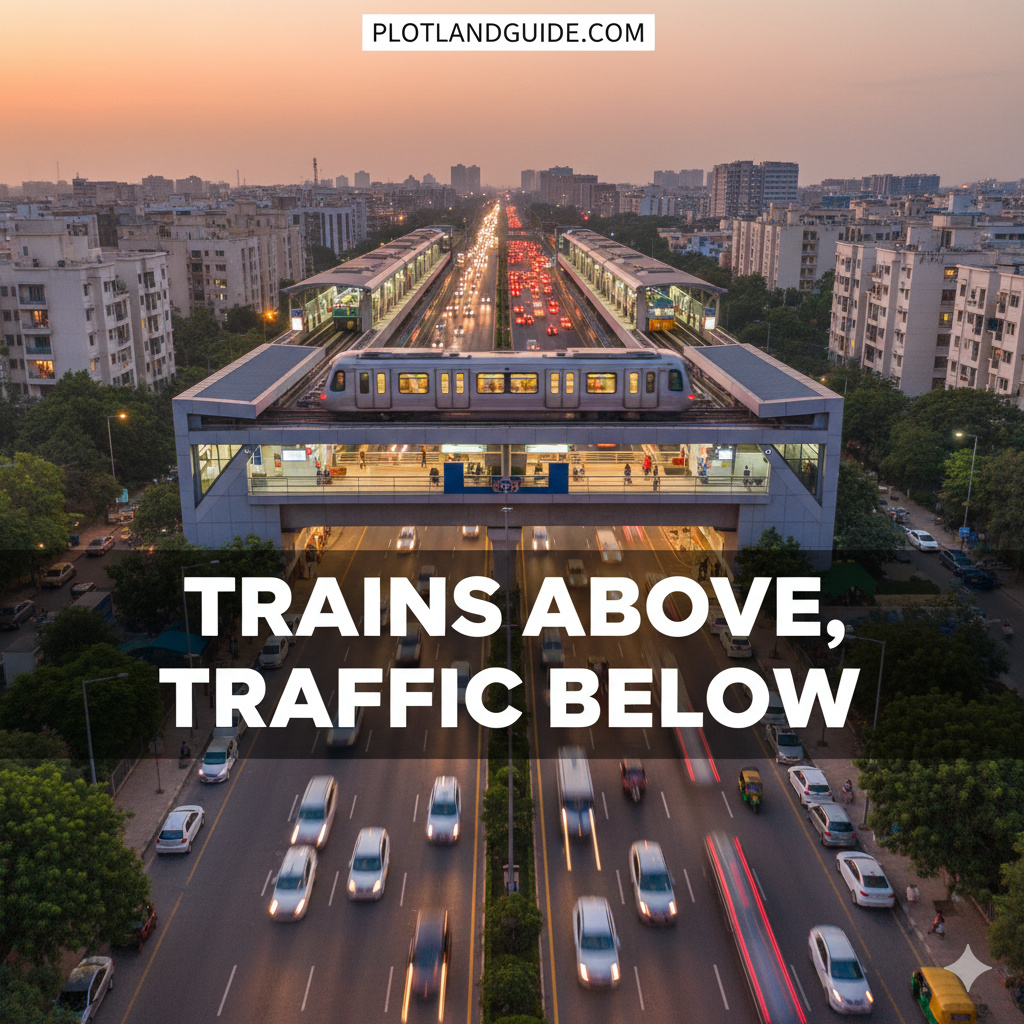
The Delhi Metro Rail Corporation (DMRC) is set to unveil its first-ever "double-decker" viaducts this year, featuring metro trains running on an upper deck and vehicular traffic on a lower flyover, all supported by a single set of pillars. This engineering marvel, part of the Phase 4 expansion, aims to resolve critical congestion in North-East and South Delhi by optimizing vertical space in densely populated corridors.
In a city as dynamic and densely packed as Delhi, space is the ultimate luxury. For decades, urban planners have wrestled with a simple geometric problem: how do you add more transport infrastructure—roads, rails, and walkways—when the ground level is already saturated? The answer, it seems, lies in looking up.
This year marks a watershed moment for the National Capital’s infrastructure. The Delhi Metro Rail Corporation (DMRC), a body already celebrated for revolutionizing public transport in India, is about to introduce a game-changing concept to the city’s skyline: the "double-decker" metro viaduct.
Imagine driving on a flyover to skip the chaotic local traffic, while a metro train whizzes past just a few meters above your car—all supported by the same pillar that holds up the road you are driving on. This is not a scene from a sci-fi movie but a reality that is nearing completion in North-East Delhi. As part of the ambitious Phase 4 expansion, these integrated structures promise to unclog some of the city's most notorious bottlenecks, proving that when you can't build out, you build up.
To understand the significance of this project, one must appreciate the engineering complexity behind it. traditionally, metro corridors and flyovers are built as separate entities. If they run along the same route, they usually require separate alignments, demanding double the land and creating a "concrete jungle" of pillars that can choke the road below.
The new double-decker system changes this paradigm completely. It employs a unified single-pillar structure that supports two distinct levels of transport:
This "stacking" effect reduces the land requirement significantly—a critical factor in Delhi’s crowded neighborhoods where acquiring land for infrastructure is often a litigious and prolonged nightmare. By utilizing the median of the existing road for a single row of pillars, the DMRC is minimizing disruption while maximizing utility.
The spotlight is currently on North-East Delhi, where the first of these double-decker marvels is nearing completion. Located on the Maujpur-Majlis Park corridor (an extension of the Pink Line), this 1.4-kilometer stretch connects Bhajanpura and Yamuna Vihar.
Residents of this area are all too familiar with the daily struggle of navigating the chaotic traffic at the Bhajanpura junction. The narrow roads, shared by buses, rickshaws, and private vehicles, often result in gridlocks that last for hours. The new structure addresses this head-on.
Status Report:According to recent updates, the upper deck—the metro viaduct—is already complete. The DMRC has successfully conducted trial runs, and the mandatory safety inspections by the Commissioner of Metro Rail Safety (CMRS) have been concluded. The trains are effectively ready to roll.
The lower deck, which serves as the road flyover, faced some delays due to pending permissions for tree cutting. However, with those regulatory hurdles now cleared, construction is in full swing. Authorities are optimistic that the road ramp will be completed and opened to the public within this year. Once operational, this integrated structure will allow commuters to zoom past the congested Bhajanpura signal, saving precious time and fuel.
While the Bhajanpura stretch is the first to cross the finish line, it is not the only one. The DMRC has planned similar double-decker structures in two other critical parts of the city, ensuring that the benefits of this design are distributed across the capital.
The second double-decker viaduct is taking shape in North Delhi, on the corridor connecting Janakpuri West to R.K. Ashram Marg. This 2.2-kilometer structure will run between the Azadpur and Ashok Vihar stations.
This area is a crucial transit hub, with Azadpur housing Asia’s largest wholesale fruit and vegetable market (Mandi) and serving as a gateway to North Delhi’s educational institutions. The traffic here is heavy, dominated by trucks and commercial vehicles. The new double-decker structure will segregate the local Mandi traffic from the through-traffic, while the metro extension will provide a direct link to West and Central Delhi. Currently, foundation works and girder erections for the flyover are progressing rapidly, with targets set for completion in the near future.
Perhaps the most ambitious of the trio is the 2.4-kilometer viaduct on the new Golden Line (formerly Silver Line), which connects Tughlakabad to Aerocity. Running between Sangam Vihar and Ambedkar Nagar, this structure is the longest of the three proposed double-decker corridors.
South Delhi’s Mehrauli-Badarpur Road is notorious for its peak-hour jams. The introduction of this double-decker system will be a lifeline for residents of Sangam Vihar and Khanpur. By lifting the metro and a significant portion of the road traffic into the air, the project aims to declutter one of South Delhi’s busiest arteries. Construction here is well underway, with integrated piers and viaduct spans becoming visible to daily commuters.
The primary allure of these projects is the promise of a "signal-free" commute. In traditional urban planning, every intersection is a point of friction. Traffic lights, while necessary for safety, act as dams that stop the flow of vehicles.
By elevating the through-traffic onto a flyover, these double-decker structures effectively remove the "friction" from the equation. A driver traveling from Yamuna Vihar to Majlis Park will no longer have to idle at the Bhajanpura signal. They can simply take the ramp, bypass the chaos, and descend only when they have cleared the bottleneck. Simultaneously, the metro riders above are completely immune to the road conditions below.
This dual-layer efficiency is expected to reduce travel times by up to 50% in these specific sectors. Moreover, the reduction in idling vehicles will have a direct positive impact on air quality—a perpetual concern for Delhi’s administration and residents alike.
Building a three-tier transport system in the middle of a bustling city is no small feat. The challenges faced by the engineers and planners are immense.
Despite these hurdles, the DMRC’s track record suggests they are up to the task. The successful completion of the trial runs on the Bhajanpura stretch is a testament to their execution capabilities.
Infrastructure is the lifeblood of real estate, and these new corridors are already influencing property dynamics.
1. Connectivity Premium: Areas like Yamuna Vihar, Bhajanpura, and Loni have historically been viewed as "disconnected" from the rapid pace of South or Central Delhi. The direct metro link to the Pink Line ring will integrate these neighborhoods into the core city network. Real estate experts predict a steady appreciation in capital values for residential properties in these zones.
2. Commercial Revival: The spaces beneath typical flyovers often become dead zones or parking lots. However, with the organized flow of traffic and the influx of metro commuters, the commercial catchments around the new stations (like Azadpur and Ambedkar Nagar) are likely to see a revival. Better accessibility usually translates to higher footfall for local businesses.
3. Rental Demand: With improved connectivity to employment hubs (via the Pink and Golden Lines), these affordable neighborhoods will become attractive options for the working population, potentially driving up rental yields.
As Delhi gears up to inaugurate its first double-decker metro viaduct this year, the implications extend far beyond just a few kilometers of concrete. This project serves as a pilot for the future of urban infrastructure in India.
It demonstrates that even in the most congested, land-locked environments, innovative engineering can create space where none seems to exist. It represents a shift from "conflict" (fighting for road space) to "coexistence" (stacking modes of transport).
For the commuter stuck in a jam at Bhajanpura today, the towering pillars nearby are a symbol of hope. They promise that very soon, the daily grind will get a little easier, the drive a little faster, and the city a little more connected. As the trains start rolling above and the cars speed up below, Delhi will once again prove its ability to reinvent itself for the modern age.
The wait is almost over. By the end of this year, the capital will officially enter the era of the double-decker commute.
