Published On:
February 6, 2026
Updated On:
February 6, 2026
India’s manufacturing sector is poised for a transformative leap, fueled by a slate of new trade agreements and global supply chain realignments. With zero-duty access to key European markets and tariff rationalizations with the US, "Make in India" is evolving from a policy slogan into a tangible engine of economic growth.
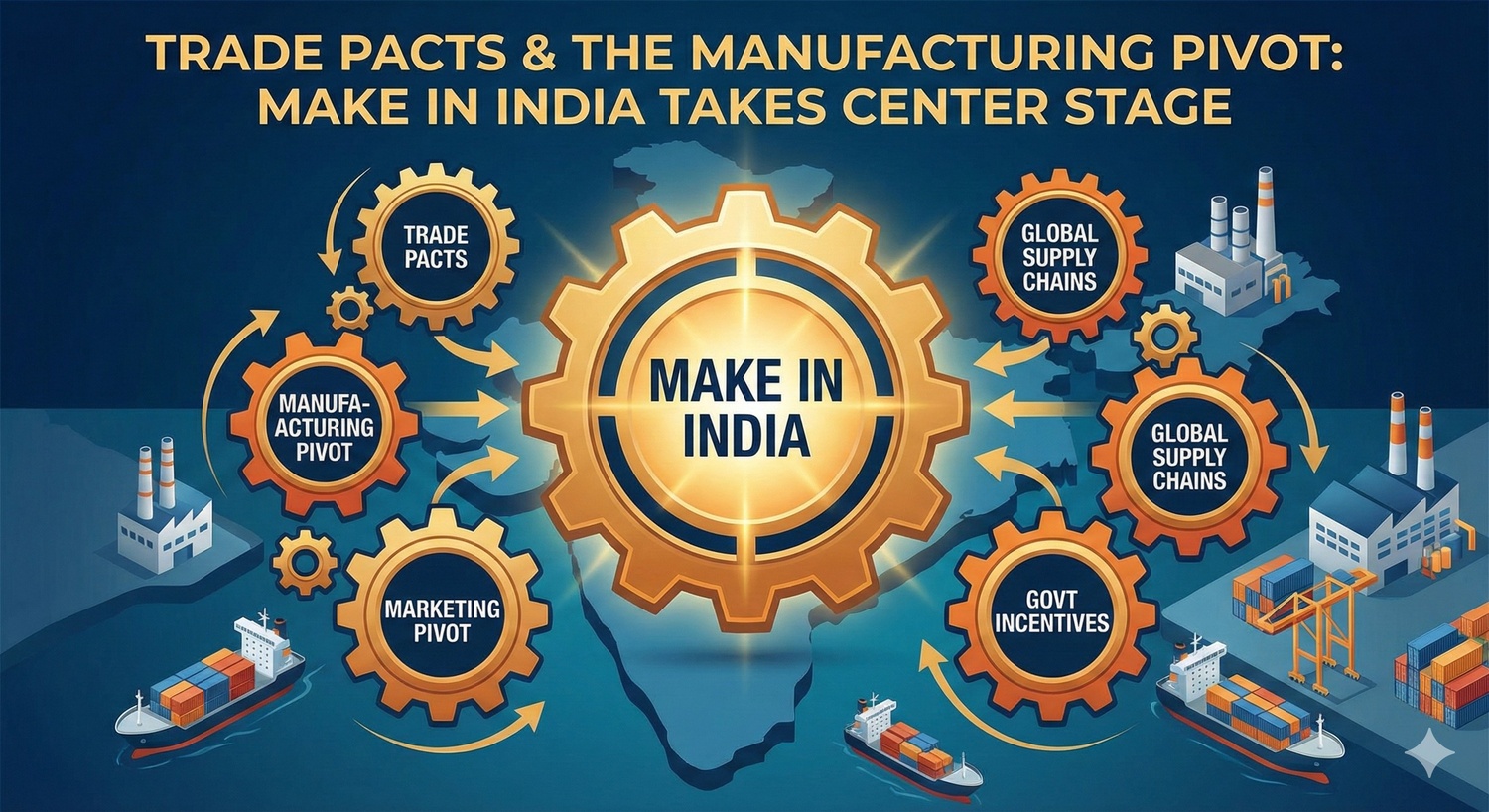
For decades, the Indian economic narrative has been dominated by its services sector. From IT giants in Bengaluru to financial hubs in Mumbai, services have been the primary engine of India's GDP growth. However, a significant structural shift is currently underway—one that promises to balance the economy and unleash a new wave of wealth creation.
The "Make in India" initiative, long viewed as a work in progress, is finding its strongest catalyst yet: a series of strategic Free Trade Agreements (FTAs) and economic pacts. With recent breakthroughs in negotiations with European nations and tariff rationalizations with major Western partners, India is shedding its historical hesitation toward trade liberalization. This shift is not merely about cheaper imports; it is about positioning India as a formidable alternative in the global manufacturing supply chain.
As market experts and fund managers increasingly turn their gaze toward industrial stocks, it is becoming clear that the next decade of growth will likely be written on the factory floor, not just in the server room.
The global economic landscape is fracturing, and in those cracks, India has found its foothold. The government’s aggressive push for trade deals—most notably with the European Free Trade Association (EFTA) and ongoing advancements with the EU and UK—signals a departure from past protectionism.
These agreements are designed with a specific goal: Reciprocity that favors manufacturing. Unlike earlier eras where India feared being flooded by foreign goods, the current confidence stems from a robust domestic industrial base bolstered by Production Linked Incentive (PLI) schemes.
The logic is straightforward. If Indian manufacturers can access high-income markets like Switzerland, Norway, or Australia with zero or reduced duties, their competitiveness skyrockets. This export potential acts as a force multiplier for domestic capacity expansion. We are no longer just making for India; we are making for the world.
The signing of the Trade and Economic Partnership Agreement (TEPA) with the EFTA nations (Switzerland, Iceland, Norway, and Liechtenstein) serves as a prime example of this new paradigm.
While the headline figure often focuses on the $100 billion investment commitment, the real game-changer lies in market access. The agreement offers Indian exporters duty-free access to nearly all industrial goods. For a country looking to boost its share of global manufacturing exports, this is vital. It allows Indian engineering firms, textile manufacturers, and chemical producers to compete on equal footing with established global players in some of the world's wealthiest markets.
This deal effectively signals to the world that Indian manufacturing standards have matured. It encourages domestic companies to upgrade their technology and quality processes, knowing that a premium market awaits their output.
The benefits of these trade pacts are not distributed evenly. Specific sectors stand out as the primary beneficiaries of this open-trade environment.
Perhaps the most dramatic turnaround has been in the defense sector. Once synonymous with heavy imports, India is aggressively pivoting toward indigenization. Trade pacts facilitate the flow of critical dual-use technologies and precision engineering components from advanced economies into India.
As foreign defense majors look to diversify their supply chains, Indian engineering firms are emerging as preferred partners. The reduction in trade barriers allows these firms to import advanced metallurgy and sub-systems more cheaply, value-add in India, and then export finished components globally.
The "China Plus One" strategy is no longer a theoretical concept; it is an operational reality for global giants. India’s PLI schemes in electronics have already jump-started the mobile manufacturing ecosystem. Trade agreements act as the second booster rocket. By securing duty-free access for Indian-made electronics in Western markets, these pacts ensure that the capacity being built today has a ready market tomorrow.
Traditional sectors like textiles and pharmaceuticals are receiving a fresh lease on life. In highly competitive markets like the EU and the US, even a small tariff advantage can be the difference between winning and losing a contract. New trade norms are helping Indian textile exporters regain ground lost to competitors like Bangladesh and Vietnam, while pharma companies are seeing streamlined regulatory pathways for their generic exports.
An often-overlooked metric in this manufacturing resurgence is the improvement in India’s Incremental Capital Output Ratio (ICOR). Simply put, India is becoming more efficient at generating GDP growth for every rupee of investment.
As infrastructure bottlenecks ease—thanks to better logistics, new freight corridors, and digital public infrastructure—the cost of manufacturing in India is coming down. When this domestic efficiency is coupled with the market access provided by trade deals, the Return on Equity (ROE) for manufacturing companies improves significantly. This creates a virtuous cycle: higher profits lead to higher capex, which leads to more capacity and economies of scale.
For investors, the implications of this shift are profound. The "value" in the Indian market is increasingly being found in the manufacturing space rather than the traditional defensive sectors.
Market veterans are noting that while consumption stocks (FMCG, retail) are facing headwinds due to saturation and inflation, the industrial and manufacturing themes are just beginning their structural upcycle. The trade pacts provide the long-term visibility that these capital-intensive sectors need to plan for the next decade.
India is standing at a unique geopolitical intersection. The West is looking for reliable partners, and India is looking for markets. The convergence of these needs has birthed a new era of trade diplomacy that places "Make in India" at its core.
The trade pacts being signed today are not just legal documents; they are the highways upon which India’s manufacturing ambitions will travel. For the economy, this means a more robust job market and a healthier trade balance. For the investor, it suggests that the time to bet on Indian industry is now. The factory gates are open, and the world is waiting.
