Published On:
September 23, 2026
Updated On:
September 23, 2026
Eleven emerging Tier-2 cities in India have recorded a staggering 63% surge in residential property prices over the last five years, far outpacing the traditional metropolitan hubs. Driven by robust infrastructure, aggressive job creation, and a retail boom, these smaller urban centres are rapidly becoming the focal point of India's future real estate growth.
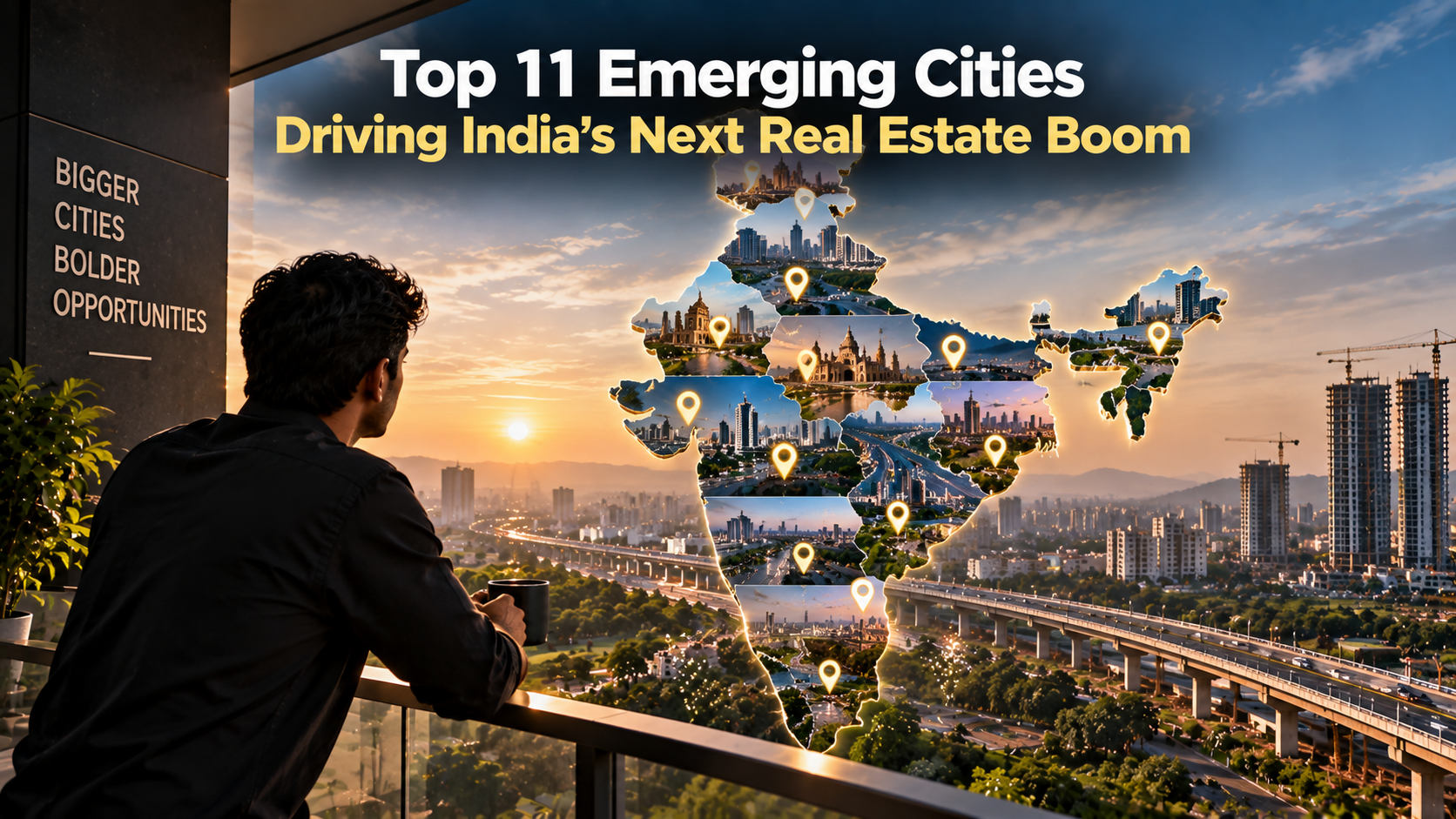
For decades, the Indian real estate narrative was entirely monopolised by a handful of metropolitan giants. Mumbai, Delhi-NCR, Bengaluru, and Pune were the undisputed magnets for talent, corporate capital, and large-scale property development. If you wanted strong capital appreciation and premium rental yields, these top-tier cities were deemed the only logical choices. However, the urban landscape is currently undergoing a profound structural transformation. The economic narrative is actively shifting away from the saturated, overpriced, and heavily congested mega-cities, pivoting towards a dynamic new breed of economic engines: India’s emerging Tier-2 and Tier-3 cities.
Recent comprehensive industry analyses have pinpointed eleven specific smaller cities that are fundamentally rewriting the rules of property investment. These regional centres are no longer just affordable retirement destinations or quiet peripheral towns; they are rapidly evolving into independent, self-sustaining real estate powerhouses. For homebuyers tired of compromising on living space in expensive metros, and for institutional investors looking for the next massive growth wave, understanding the mechanics of this regional boom is absolutely critical.
The shift of economic momentum towards smaller cities is not just a theoretical concept; it is backed by formidable market data. Over the past five years, between 2021 and 2026, residential property prices across these 11 identified emerging markets skyrocketed by a phenomenal 63 percent. To fully grasp the sheer magnitude of this growth, one must compare it against the country's top eight metropolitan areas, which managed a comparatively modest 42 percent growth during the exact same timeframe.
When we stretch the timeline to examine the past decade, spanning from 2016 to 2026, the contrast becomes even sharper. The residential property segment in these smaller markets recorded a Compound Annual Growth Rate of 8 percent. In stark contrast, the top eight metros recorded just half of that, averaging a 4 percent growth rate over the decade. This widening gap conclusively proves that capital appreciation is no longer confined to traditional urban borders. The real estate market in these regional hubs is responding aggressively to localized economic activity, proving that wealth creation and land appreciation are spreading organically across the country.
The cities driving this unprecedented boom are geographically diverse and possess highly unique economic drivers. The 11 markets identified as India's next real estate hotspots are Bhopal, Bhubaneswar, Chandigarh Tricity, Goa, Indore, Jaipur, Kochi, Lucknow, Nagpur, Visakhapatnam, and Coimbatore. However, treating all these cities as a single, homogenous block of affordable alternatives would be a massive strategic error for any investor. Their housing markets are developing at entirely different paces, catering to vastly different demographics.
At the highly affordable end of the spectrum, cities like Nagpur and Visakhapatnam offer incredibly attractive entry points, with average residential prices hovering between Rs 4,500 and Rs 6,500 per square foot. These markets are perfect for first-time homebuyers and long-term investors looking for massive upside potential as industrial and port-led development accelerates.
Moving slightly up the value chain, cities such as Bhopal, Indore, Lucknow, and Coimbatore present a robust mid-segment market, with quoted property rates generally ranging from Rs 5,000 to Rs 9,000 per square foot. These cities are experiencing heavy influxes of corporate investments, the expansion of Global Capability Centres, and massive IT sector growth, which is driving solid demand for quality formal housing. Jaipur and Kochi occupy a similar bracket, often commanding between Rs 7,000 and Rs 9,000 per square foot, fueled by a unique mix of tourism, local enterprise, and strong expatriate investments.
At the premium end of these emerging markets sits the Chandigarh Tricity area, where prices range from Rs 7,500 to Rs 10,500 per square foot. Finally, Goa leads the pack with the highest quoted residential rates among the 11 cities, ranging from Rs 11,500 to Rs 13,500 per square foot. Goa's distinct position as a premier luxury second-home and vacation rental destination heavily skews its property dynamics, constantly attracting high-net-worth individuals from across the globe.
It is tempting to look at these surging property prices and assume it is merely a speculative bubble. However, the underlying economic fundamentals suggest a highly sustainable, long-term growth trajectory. The foundational pillar of this real estate boom is an aggressive push in public infrastructure spending. Over the last decade, the government has heavily prioritized regional connectivity. Infrastructure investment, as a share of aggregate government capital investment, jumped from 39 percent in the financial year 2015 to a massive 55 percent by 2026.
This capital is actively being deployed to construct massive expressways, modernize regional airports, expand coastal maritime routes, and develop intra-city metro networks. Mega-projects like the Delhi-Mumbai Expressway are directly boosting the economic prospects of cities like Jaipur, while the Samruddhi Mahamarg is acting as a massive catalyst for the Nagpur and Indore corridors.
Yet, physical infrastructure alone does not guarantee a lasting real estate boom. A new highway or airport can undoubtedly improve accessibility, but long-term property appreciation requires people to actually move to, and stay in, these cities. The defining characteristic of these 11 markets is their unique ability to convert improved connectivity into sustained economic activity. They are successfully attracting heavy industries, fostering local enterprises, and most importantly, generating vast pools of local white-collar and blue-collar employment. When businesses set up shop and high-quality jobs are created locally, it triggers a massive wave of housing demand, effectively turning a quiet regional city into a vibrant, high-growth economic hub.
The residential property boom in these Tier-2 cities is not happening in a vacuum; it is intricately linked to an explosive expansion in commercial, retail, and industrial real estate. You cannot have a thriving residential market without the supporting urban ecosystem that provides goods, services, and local employment to the residents.
The logistics and warehousing sector serves as a perfect barometer for this spreading economic activity. As e-commerce penetration deepens and quick-commerce models expand across the country, corporate supply chains are rapidly decentralizing. In 2025, Tier-2 markets recorded a staggering 11.2 million square feet of warehousing leasing transactions. Just six of our identified emerging markets—Lucknow, Jaipur, Nagpur, Indore, Coimbatore, and Bhubaneswar—accounted for an impressive 5.3 million square feet of those highly lucrative commercial leases. This massive industrial footprint means thousands of new localized jobs, ranging from warehouse operators to high-level logistics managers, all of whom require formal residential housing.
Simultaneously, the retail landscape is undergoing a massive regional transformation. Consumer aspirations in smaller cities have rapidly caught up with metropolitan standards, and organized retail brands are rushing in to capitalize on this rising disposable income. By 2025, India possessed 134 million square feet of organized shopping-centre space, out of which a highly significant 36 million square feet was located exclusively across Tier-2 cities. Fascinatingly, ten of the eleven identified growth cities accounted for nearly 60 percent of this entire Tier-2 shopping centre stock. For the residents of these cities, this translates to enjoying the premium metropolitan experience of high-end dining, modern multiplexes, and global fashion brands without ever having to relocate to a major metro.
To understand why this real estate trend will continue for decades, one must look at the shifting demographic projections of the country. India is currently undergoing one of the most massive waves of urbanization in human history. The nation's urban population is projected to reach an astounding 740 million by the year 2050.
Crucially, this urban influx will not be entirely absorbed by the existing megacities. The civic infrastructure of cities like Mumbai and Bengaluru is already stretched to the absolute breaking point. Consequently, the bulk of future urbanization will be forcefully directed towards regional centres. Projections indicate that the number of Indian cities with populations exceeding one million will rise significantly in the coming years. More importantly, cities outside the top eight metros are expected to record a staggering population growth of over 28 percent in the coming decades. In stark contrast, the population growth in the top eight megacities is projected to severely slow down to around 8.7 percent. This massive demographic divergence guarantees a relentless, long-term demand for residential housing, commercial office space, and urban infrastructure in these 11 emerging markets.
The broader economic implications of this regional shift are absolutely phenomenal. Macroeconomic projections suggest that the overall output of the Indian real estate sector is firmly on track to hit an incredible USD 5.8 trillion by the year 2047. Within this massive economic pie, Tier-2 and Tier-3 cities are no longer going to be minor, peripheral contributors. They are projected to command anywhere between 25 percent to 30 percent of the total sector output, translating to a colossal monetary value of USD 1.4 trillion to USD 1.7 trillion.
Unlocking this immense economic potential, however, will require continued focus and highly disciplined urban planning. It is not enough to just build sprawling residential complexes; these cities must actively prioritize the creation of dedicated business activity zones, ensure the steady supply of serviced land, streamline their bureaucratic building approval processes, and aggressively upgrade their local utilities like water supply and power distribution. The future winners in the real estate space will undoubtedly be the cities that successfully manage to balance rapid infrastructural expansion with sustainable urban livability.
For the average homebuyer, the dramatic rise of these 11 cities offers a profound sense of relief. Watching property prices in Tier-1 cities steadily slip out of reach has been a highly frustrating experience for the Indian middle class. These emerging markets provide a highly viable, attractive alternative, offering much larger, better-quality homes at significantly lower entry prices, without forcing buyers to compromise on urban amenities, lifestyle quality, or career growth.
For property investors, the overarching strategy must now evolve. Blindly parking capital in a major metro and waiting for guaranteed, high-margin returns is a rapidly outdated playbook. The superior price acceleration currently lies hidden within the secondary markets. However, this lucrative opportunity comes with its own set of critical nuances. Investors must look far beyond the initial low cost of a property. A cheap home in a city with stagnant job growth and poor municipal planning will ultimately yield terrible returns. The key to successful investment in these Tier-2 markets lies in identifying the specific micro-markets that sit precisely at the intersection of heavy government infrastructure development and active corporate enterprise expansion.
The real estate landscape of the country is being completely redrawn from the ground up. The absolute monopoly of the megacity is officially over, and the era of the regional economic hub has definitively arrived. As wealth, talent, and physical infrastructure continue to flow into places like Indore, Lucknow, Bhubaneswar, and Coimbatore, these eleven cities are not just the next frontier for property investment; they are the very foundation of India's future urban economy.
