Published On:
May 3, 2026
Updated On:
May 3, 2026
With thousands of towering high-rises and rapid urban expansion, the fire safety infrastructure in Noida and Ghaziabad is buckling under immense pressure. Faced with severe equipment shortages, limited manpower, and blatant builder non-compliance, the region urgently needs the recently sanctioned financial upgrades to protect its residents from catastrophic vertical fire hazards.
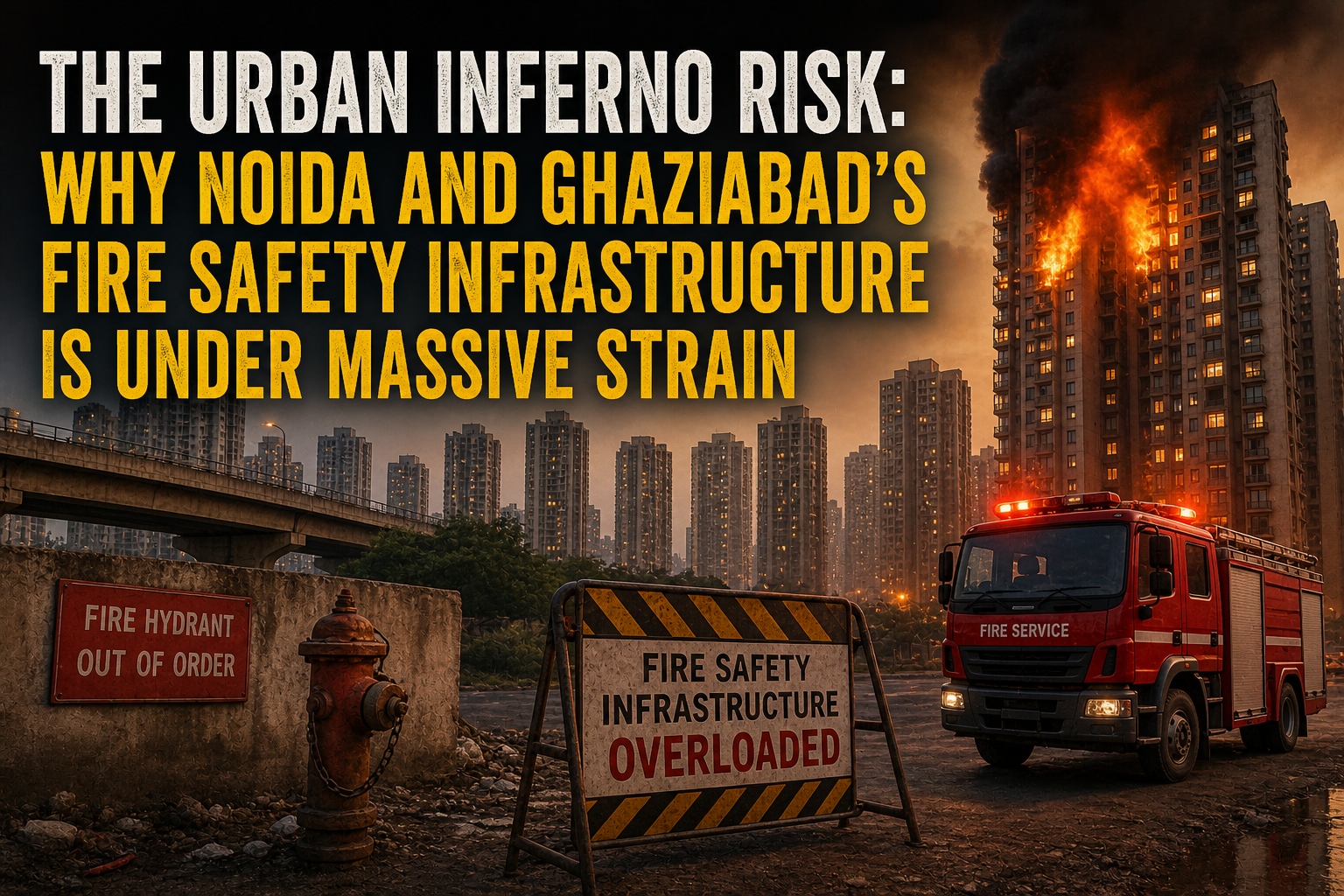
The National Capital Region has undergone a spectacular vertical transformation over the last two decades. What were once sprawling agricultural lands and low-slung industrial outposts have rapidly evolved into glittering metropolises. Today, Noida and Ghaziabad boast skylines that rival major global financial hubs, characterized by massive integrated townships, sprawling commercial IT parks, and luxury residential towers that pierce the clouds. For millions of residents, these high-rises represent upward mobility, offering premium amenities, panoramic city views, and a modern urban lifestyle. However, behind the glossy glass facades and manicured podium gardens lies a deeply concerning, potentially catastrophic vulnerability.
As the cities have aggressively expanded toward the sky, the critical civic infrastructure required to protect these towering concrete ecosystems has failed to keep pace. The Noida Ghaziabad fire safety network is currently operating under unimaginable strain, forced to protect a rapidly multiplying, highly dense population with dangerously outdated resources. Recent spikes in urban fire incidents, particularly during the grueling summer months, have violently exposed the gaping holes in the region's emergency preparedness. For residents living on the upper floors of these modern condominiums, the stark reality is chilling: if a major fire breaks out today, the local emergency responders simply do not have the adequate tools, manpower, or structural support to reach them in time.
To truly comprehend the severity of the crisis, one must look closely at the heavily disproportionate ratio of fire safety infrastructure to the sheer volume of urban development. Noida and Greater Noida are currently home to an astounding number of high-rise buildings, with conservative estimates placing the figure at well over 4,000 structures exceeding the standard 15-meter height classification. To protect this massive concrete jungle, alongside dozens of highly populated urban villages and sprawling industrial sectors, the district fire department operates a meager nine fire stations.
The vehicular fleet is equally stretched to its absolute breaking point. Across the entirety of Gautam Budh Nagar, there are only twenty-eight active fire engines of varying capacities—less than half of the formally assessed minimum requirement of fifty-four. The situation across the border in Ghaziabad mirrors this severe deficit. Tasked with securing over 400 highly dense residential high-rises, Ghaziabad operates just five fire stations equipped with twenty-two fire engines, falling noticeably short of its required thirty.
The human element of this crisis is perhaps the most concerning. Firefighting is an incredibly grueling, physically demanding profession that requires peak endurance and sharp tactical focus. Yet, the personnel tasked with securing these massive districts are severely overworked. In Noida, there are currently around 160 active firefighters deployed across the district, barely clearing half of the absolute minimum requirement of 300 personnel. This chronic manpower shortage means that the first responders are constantly operating in a state of deep fatigue, bouncing frantically from one emergency call to the next without adequate recovery time, which inherently compromises operational efficiency during complex, multi-level rescue missions.
In the realm of fire safety, time is the ultimate currency. A minor spark can escalate into an uncontrollable, lethal inferno in a matter of minutes. Global best practices and international fire safety norms strictly dictate that modern cities should feature a fully operational fire station at least every five kilometers. This geographical spread is precisely calculated to ensure that a fully manned fire tender can navigate through local traffic and reach the exact site of an emergency within a strict three-minute window.
In the current reality of Noida and Ghaziabad, achieving this three-minute response time is an absolute logistical impossibility. The sprawling geography of the region, combined with the explosive growth of newer micro-markets like Greater Noida West and the Yamuna Expressway corridors, means that fire engines often have to travel massive distances to reach distress calls. When you factor in the notoriously congested arterial roads, narrow approach lanes frequently blocked by illegal parking, and heavy peak-hour traffic, the response times inevitably stretch far beyond the critical golden window of survival.
The most glaring and terrifying limitation of the current fire department fleet becomes obvious when you look upward. High-rises are the dominant residential model in the NCR, with average building heights easily exceeding fifty meters. Some of the most ambitious mixed-use architectural projects in Noida, such as the massive towers in Sector 94 and Sector 74, reach staggering heights ranging from 250 to 300 meters, comprising upwards of sixty to eighty floors.
Despite this aggressive vertical reality, the fire departments in both Noida and Ghaziabad are fundamentally grounded. The maximum reach of the hydraulic platforms and aerial ladders currently active in the district fleets maxes out at a mere 42 meters. In practical terms, this means that external rescue operations and direct water-hosing capabilities abruptly end at the 14th floor. If an aggressive blaze breaks out on the 30th or 40th floor of a residential tower, the standard fire engines parked on the street are essentially helpless.
This severe physical limitation was on full public display during a recent, highly publicized blaze at a massive residential complex in the Indirapuram area. The fire rapidly gutted multiple apartments, spreading aggressively from the eighth floor all the way up to the thirteenth. Witnesses and residents watched in horror as the high-pressure water jets mounted on the arriving fire engines struggled and initially failed to push water high enough to combat the flames effectively. While hydraulic cranes were eventually deployed, their limited reach and the inherent 15-to-20-minute setup time highlighted exactly how vulnerable higher-floor residents truly are.
Recognizing that hoses and ground-based ladders are no longer sufficient to secure a modern skyline, there is a desperate, frantic push to overhaul the heavy machinery profile of the regional emergency services. Authorities are finally moving to bridge the massive height disparity by initiating the procurement of significantly taller hydraulic platforms. Specialized machines capable of reaching 72 meters, 92 meters, and even up to 112 meters are currently in the acquisition pipeline. These advanced platforms are critical for executing high-altitude evacuations and delivering suppressed, high-pressure water streams directly into the heart of elevated fires.
Furthermore, the sheer height and density of the newest super-structures have prompted senior emergency officials and architectural experts to formally request the induction of specialized firefighting helicopters. In scenarios where towering buildings are completely inaccessible from the ground due to massive structural heights or intensely blocked, narrow access roads, aerial intervention remains the absolute last line of defense for rooftop evacuations and targeted fire retardant drops.
While the residential skyscrapers dominate the visual skyline and public concern, Noida and Ghaziabad are also massive, globally significant industrial and manufacturing hubs. The region is packed with thousands of factories, chemical processing plants, textile mills, and massive electronic assembly units. Industrial fires present an entirely different, vastly more complex set of operational challenges compared to standard residential blazes.
Many of these factories house highly volatile chemicals, massive fuel reserves, and heavy industrial machinery. When a fire breaks out in these environments, attempting to douse it with standard municipal water is not only ineffective but can frequently trigger massive, deadly chemical reactions or catastrophic explosions. To combat these specific, high-intensity industrial infernos, the fire departments are in desperate need of massive stockpiles of specialized firefighting foam and advanced chemical suppressants. The ongoing procurement efforts are actively targeting these specialized materials, acknowledging that protecting the region's economic engines requires completely different tactical resources than protecting its homes.
Because external firefighting equipment physically cannot reach the upper echelons of modern skyscrapers, the absolute burden of safety shifts heavily inward. For any building rising above a certain height, robust internal fire safety systems—including automated sprinklers, pressurized smoke-free staircases, dedicated fire-hydrant shafts, heavy smoke extraction fans, and massive underground emergency water reserves—are not merely regulatory checkboxes; they are the sole, critical lifelines for the residents.
Tragically, this internal safety net is frequently compromised by severe developer apathy and rampant non-compliance. In the rush to complete massive projects and minimize operational overheads, many builders either install substandard firefighting equipment or completely fail to maintain the complex systems once the building is handed over. Recent aggressive inspection drives launched by the fire department have exposed a shocking culture of negligence.
In Ghaziabad alone, dozens of prominent residential high-rises are currently facing severe legal action and active court cases for blatantly violating mandatory fire safety norms. Inspections frequently reveal that mandatory No Objection Certificates have been left unrenewed for years, automated sprinkler systems are disconnected to save on maintenance costs, and vital emergency exit stairwells are illegally blocked by debris or locked entirely. While the authorities are actively issuing strict legal notices and attempting to enforce massive penalties, holding powerful, well-connected real estate developers legally accountable remains an incredibly slow, highly challenging legal battle.
The responsibility also frequently falls into a gray area during the transition phase between the builder and the Resident Welfare Associations. Once the developer exits the project, the heavy financial burden of maintaining these complex, highly expensive internal safety grids falls squarely onto the residents. Without proper funding, regular mock evacuation drills, and strict community awareness, even the most advanced internal firefighting systems quickly fall into dangerous disrepair.
The mounting public pressure and the undeniable physical reality of the resource deficit have finally triggered a massive financial response from the state government. In a bid to rapidly strengthen the failing infrastructure, local development authorities across Noida and Greater Noida have formally sanctioned massive operational budgets, recently approving hundreds of crores specifically dedicated to overhauling the district's fire-fighting capabilities.
These heavy financial injections are currently actively moving through the state-level procurement processes, designed to rapidly fund the acquisition of the desperately needed 100-meter hydraulic platforms, the advanced chemical firefighting foams, and the construction of critically needed new fire stations in the most rapidly expanding, high-risk micro-markets.
Beyond just financial capital, there is a growing consensus among safety experts and retired emergency officials that the very institutional structure of the fire department needs a fundamental overhaul. Currently operating under the broader umbrella of the state police force, experts argue that the fire department must be carved out as a completely independent, autonomous body, similar to the operational structure seen in Delhi. An independent agency possesses the singular, dedicated focus required to manage massive procurement budgets, enforce strict municipal safety compliance, and develop highly specialized, localized tactical strategies without having to navigate the complex bureaucracy of broader police administration. Furthermore, ensuring that each rapidly growing NCR city is entirely self-sufficient prevents the dangerous current practice of cities cannibalizing each other's limited resources during overlapping emergency events.
The current strain on the fire safety infrastructure in Noida and Ghaziabad serves as a massive, urgent wake-up call for modern urban planning across the entire country. Building smarter, taller, and faster simply cannot come at the uncompromising cost of fundamental human safety.
Resolving this deep-rooted crisis requires a highly aggressive, multi-pronged approach. The government must drastically accelerate its bureaucratic procurement processes, ensuring that the sanctioned funds instantly translate into physical, modern trucks on the road and highly trained personnel in the stations. Real estate developers must be held to an ironclad, unyielding standard of compliance, facing immediate, severe criminal repercussions for treating internal safety systems as optional financial line items. Most importantly, residents and community associations must actively transition from passive consumers of real estate into highly vigilant, proactive stakeholders who relentlessly demand and maintain flawless safety standards within their own high-rises.
As the skylines of the National Capital Region continue their inevitable, aggressive push toward the clouds, the infrastructure keeping those buildings safe must rise to meet them. Without immediate, massive structural upgrades, the vertical dream of modern urban living remains terrifyingly close to a catastrophic nightmare.
