Published On:
March 2, 2026
Updated On:
March 2, 2026
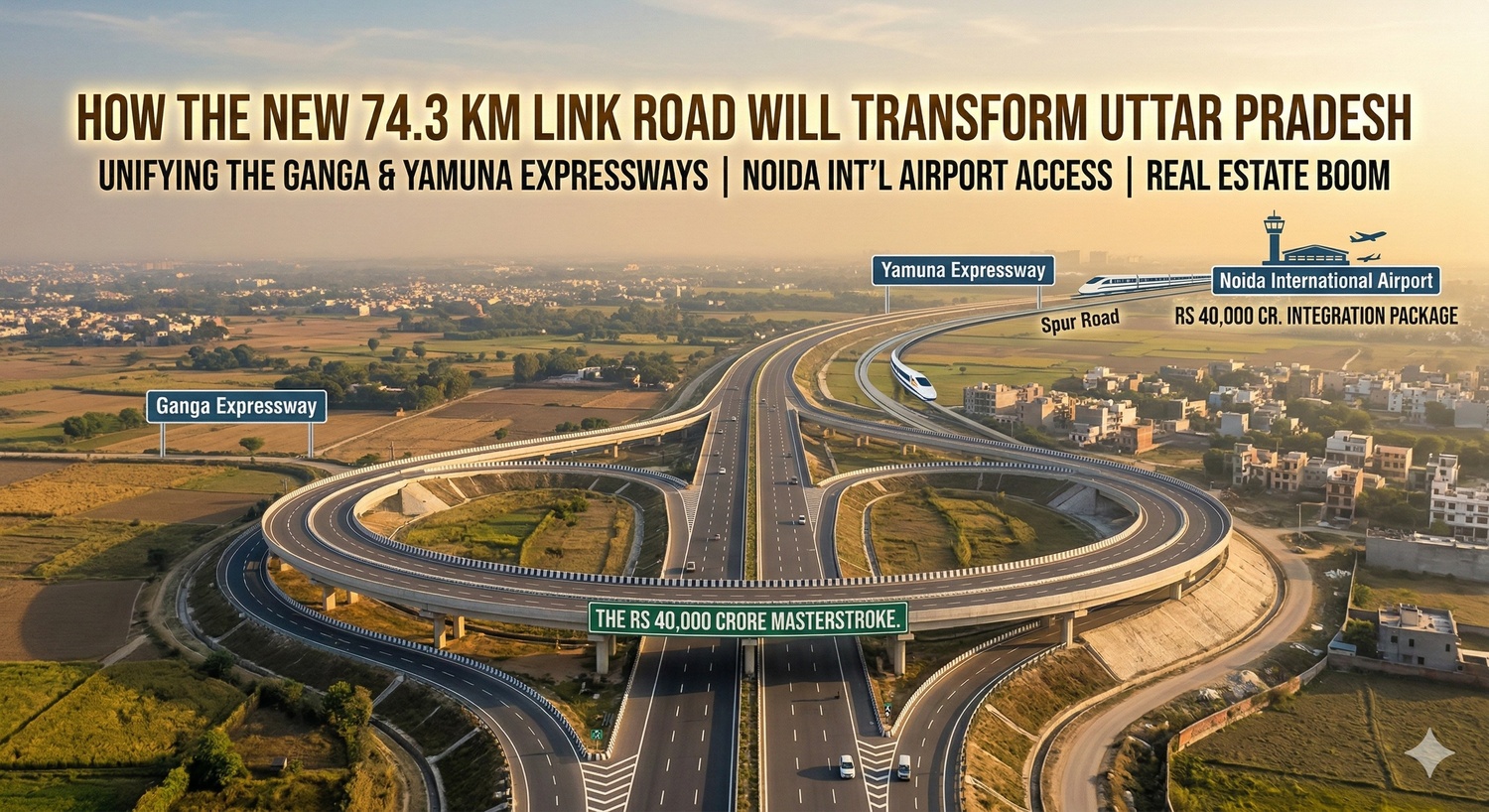
Uttar Pradesh has approved a massive Rs 40,000 crore infrastructure integration package, highlighted by a new 74.3-kilometre greenfield link road connecting the Ganga and Yamuna Expressways. This strategic corridor will bypass heavy local traffic, cut the Meerut-to-Jewar travel time to just 45 minutes, and provide seamless, high-speed access to the upcoming Noida International Airport, triggering a massive boom in regional real estate and logistics.
The physical and economic landscape of Northern India is undergoing a structural overhaul at an unprecedented pace. For decades, the narrative surrounding the state of Uttar Pradesh was heavily dominated by its vast population and agricultural output, but often plagued by disconnected transit networks and heavily congested state highways. Today, that narrative has completely flipped. The state is actively executing a master plan designed to elevate its status to a trillion-dollar economy, and at the absolute core of this vision is a massive, relentless push toward world-class mobility.
In a landmark decision that is sending ripples through the logistics, aviation, and real estate sectors, the state administration has greenlit an overarching Rs 40,000 crore infrastructure integration initiative. The crown jewel of this massive capital injection is the highly anticipated 74.3-kilometre greenfield link road. Officially categorized as the Bulandshahr Link Expressway, this new corridor is engineered to seamlessly bridge the two most critical transit arteries in the state: the Ganga Expressway and the Yamuna Expressway.
More importantly, it serves as the ultimate high-speed conduit to the upcoming Noida International Airport at Jewar. This is not just a road construction project; it is the creation of a massive "Golden Triangle" of connectivity that will permanently alter how people, goods, and global investments move through Northern India.
To truly understand the magnitude of this 74.3-kilometre link road, one must look at the map of Uttar Pradesh’s existing highway network. On the eastern front, you have the monumental 594-kilometre Ganga Expressway rapidly nearing completion, designed to connect Meerut all the way to Prayagraj. On the western front lies the operational 165-kilometre Yamuna Expressway, which links Greater Noida to Agra. Historically, these two massive corridors operated independently. If a commuter or a freight truck needed to cross from the eastern districts of the state to the western industrial hubs, they were forced into navigating highly congested, secondary state routes or dealing with the notorious traffic bottlenecks of the National Capital Region.
The new 74.3-kilometre Bulandshahr Link Expressway completely eliminates this massive geographical hurdle. The alignment is brilliantly simple yet incredibly effective. The greenfield road will kick off near the town of Siyana in the Bulandshahr district, branching directly off the Ganga Expressway. From there, it will cut a straight, high-speed path westward, officially terminating at a massive interchange near Sector 21 on the Yamuna Expressway, directly adjacent to the highly publicized upcoming Film City.
By physically bridging these two colossal highways, the state is effectively integrating the agricultural and traditional markets of Eastern and Central Uttar Pradesh with the ultra-modern, export-driven corporate hubs of the National Capital Region.
The absolute driving force behind the accelerated approval and massive funding for this link road is the Noida International Airport at Jewar. Billed to be one of the largest aviation hubs in Asia, the airport is preparing for its phased operational launch. However, a world-class airport is completely useless if it is geographically isolated or choked by local suburban traffic.
Currently, travelers heading from districts like Meerut, Hapur, Moradabad, or even further east toward Prayagraj face a grueling journey to reach the Jewar site. They have to rely on the heavily saturated Delhi-Meerut Expressway or navigate the unpredictable traffic of Ghaziabad and Greater Noida.
The new 74.3-kilometre expressway is the ultimate bypass solution. Because it connects the Ganga Expressway directly to the Yamuna Expressway right at the doorstep of the airport, travelers from across the state can enjoy a completely frictionless drive. The impact on travel times is nothing short of revolutionary. Once this link road is fully operational, a journey from Meerut to the Noida International Airport, which currently takes anywhere from two and a half to three hours depending on traffic, will be compressed into a lightning-fast 45-minute drive. For domestic passengers, international tourists, and massive cargo operators, this time saving is an absolute game-changer.
When dealing with an infrastructure budget of this magnitude, the focus is entirely on future-proofing the transit network. The Bulandshahr Link Expressway is not a standard highway upgrade; it is being built entirely from scratch as a greenfield project, allowing urban planners to implement the absolute highest standards of modern road engineering.
The corridor is being developed with an extraordinarily wide 130-metre right-of-way, drawing heavy inspiration from the highly successful Noida-Greater Noida Expressway model. The main carriageway will initially feature six wide lanes, completely access-controlled, and structurally engineered to support cruising speeds of 120 kilometres per hour. Furthermore, the foundational earthworks and bridges are being designed to easily accommodate an expansion to eight lanes as traffic volumes inevitably surge over the next decade.
Understanding that high-speed expressways can sometimes disrupt local rural mobility, the engineers have incorporated smart neighborhood integrations. The project includes 25-metre-wide dedicated service roads on both sides of the main highway, ensuring that local village traffic, tractors, and two-wheelers can move safely without ever interfering with the high-speed airport transit. Additionally, the route features a highly complex 9-kilometre elevated section to seamlessly bypass the more densely populated residential belts, preventing the displacement of local communities while keeping the expressway traffic completely uninterrupted. Smart underpasses and railway overbridges, particularly near crucial junctions like Chola, guarantee a smooth, signal-free drive from start to finish.
A major hurdle for any infrastructure mega-project in India is the acquisition of land. Historically, bureaucratic delays and disputes over compensation have stalled vital highways for years. However, the state administration is approaching the 74.3-kilometre link road with an aggressive, proactive strategy to ensure it meets its tight deadlines and aligns with the airport's expansion phases.
The project requires the acquisition of land across 56 villages—48 located within the Bulandshahr district and 8 situated in Gautam Buddha Nagar. To expedite this massive undertaking, the state government immediately released a massive initial land budget exceeding Rs 1,200 crore. Rather than engaging in lengthy disputes, the authorities are offering a highly attractive 25 percent premium on the prevailing market rates to the roughly 8,700 farmers whose lands fall along the alignment.
This swift, financially rewarding approach has turned potential resistance into widespread local support. The target is to completely finalize all land possession by the end of March 2026, allowing heavy civil construction to commence by the middle of the year. By ensuring the rural stakeholders are handsomely compensated, the government is facilitating a smooth transition of agricultural plots into a high-value transit corridor. Furthermore, the local farming communities stand to gain immensely. Instead of relying on slow, treacherous village roads to transport their perishable crops to local mandis, farmers will now have immediate access to a global cargo hub, entirely reshaping the agricultural economics of Western Uttar Pradesh.
Roads are the arteries of commerce, and the integration of the Ganga and Yamuna Expressways is set to trigger an industrial boom of unprecedented proportions. By creating the shortest, most efficient route between the expansive Delhi-Mumbai Expressway network, the Noida Airport, and the Eastern UP corridor, this 74.3-kilometre stretch is rapidly becoming the most coveted logistics real estate in the country.
Large-scale manufacturing and warehousing companies operate on razor-thin margins where every minute spent in transit eats into profitability. The ability to manufacture goods in the rural heartlands of the state, load them onto a truck, speed down the Ganga Expressway, cross the new link road, and immediately load them onto an international cargo flight at Jewar is an incredibly attractive proposition for multinational corporations.
Because of this promised connectivity, the Yamuna Expressway Industrial Development Authority region is witnessing a massive influx of specialized corporate investments. The areas surrounding the new expressway interchanges are being aggressively developed into targeted industrial zones. We are already seeing the rapid mobilization of a massive Medical Device Park, a highly specialized Apparel Park, and a dedicated Toy City. Additionally, the new link road will feed directly into the sectors earmarked for semiconductor manufacturing and international fintech hubs. This isn't just about making travel convenient; it is about creating millions of localized jobs and turning the district into the absolute manufacturing powerhouse of Northern India.
Wherever high-speed infrastructure goes, a real estate boom inevitably follows. The sheer announcement and subsequent rapid funding of the Bulandshahr Link Expressway have completely energized the property markets across Gautam Buddha Nagar and Bulandshahr. Investors and end-users alike are scrambling to secure land and property before the heavy machinery even hits the ground.
The primary beneficiaries of this infrastructure integration are the specific residential and commercial sectors located along the Yamuna Expressway, particularly Sectors 22D, 28, 29, 32, and 33. Over the past twelve months, property valuations in these specific micro-markets have witnessed staggering surges, often appreciating by 30 to 40 percent. The logic driving this property rush is incredibly sound. Once the airport is fully functional and the link road is active, this region will host a massive workforce of aviation executives, logistics managers, and multinational corporate employees, all of whom will require high-quality, modern housing.
Developers are keenly aware of this shifting demographic. The areas around Tappal, Jewar, and Greater Noida West are transitioning from speculative land markets into highly organized residential hubs. We are seeing a massive surge in the launch of luxury high-rise apartments, gated villa communities, and premium plotted developments. For the modern homebuyer, the appeal is undeniable. They are investing in a region that offers massive, sprawling green spaces, ultra-modern amenities, and the unique guarantee that they can access a global international airport or drive out to the eastern corners of the state without ever hitting a single traffic light.
Simultaneously, commercial real estate is seeing a massive uptick. Investors are highly focused on acquiring parcels near the proposed interchanges for the development of transit hotels, premium retail plazas, and massive warehousing facilities. The rental yields projected for these upcoming commercial spaces are among the highest in the National Capital Region.
The Rs 40,000 crore infrastructure boost and the definitive approval of the 74.3-kilometre link road represent a masterclass in forward-thinking urban and regional planning. For far too long, infrastructure development in the region was reactive, building roads only after traffic had reached a breaking point. This project breaks that cycle entirely. It is a proactive, highly strategic move designed to lay the groundwork for decades of sustained economic prosperity.
By decisively connecting the Ganga Expressway with the Yamuna Expressway and the Noida International Airport, the state is effectively erasing the old geographical boundaries that separated the rural agricultural belts from the ultra-modern corporate hubs. It is a unifying project that brings the entire state under one highly efficient, high-speed transit umbrella.
As the final phases of land acquisition conclude and the foundation is laid over the coming months, the excitement across the logistics, real estate, and corporate sectors is entirely justified. This 74.3-kilometre stretch of tarmac is going to do much more than just cut down driving hours. It will attract global capital, generate vast employment opportunities, elevate the standard of living for millions of residents, and firmly establish Uttar Pradesh as the undisputed logistics and transit capital of modern India.
