Published On:
May 3, 2026
Updated On:
May 3, 2026
The real estate sector is undergoing a massive structural transformation, moving away from intuition-based investments toward a highly analytical, quantified property market where big data, predictive algorithms, and structured intelligence dictate smarter, risk-averse decisions.
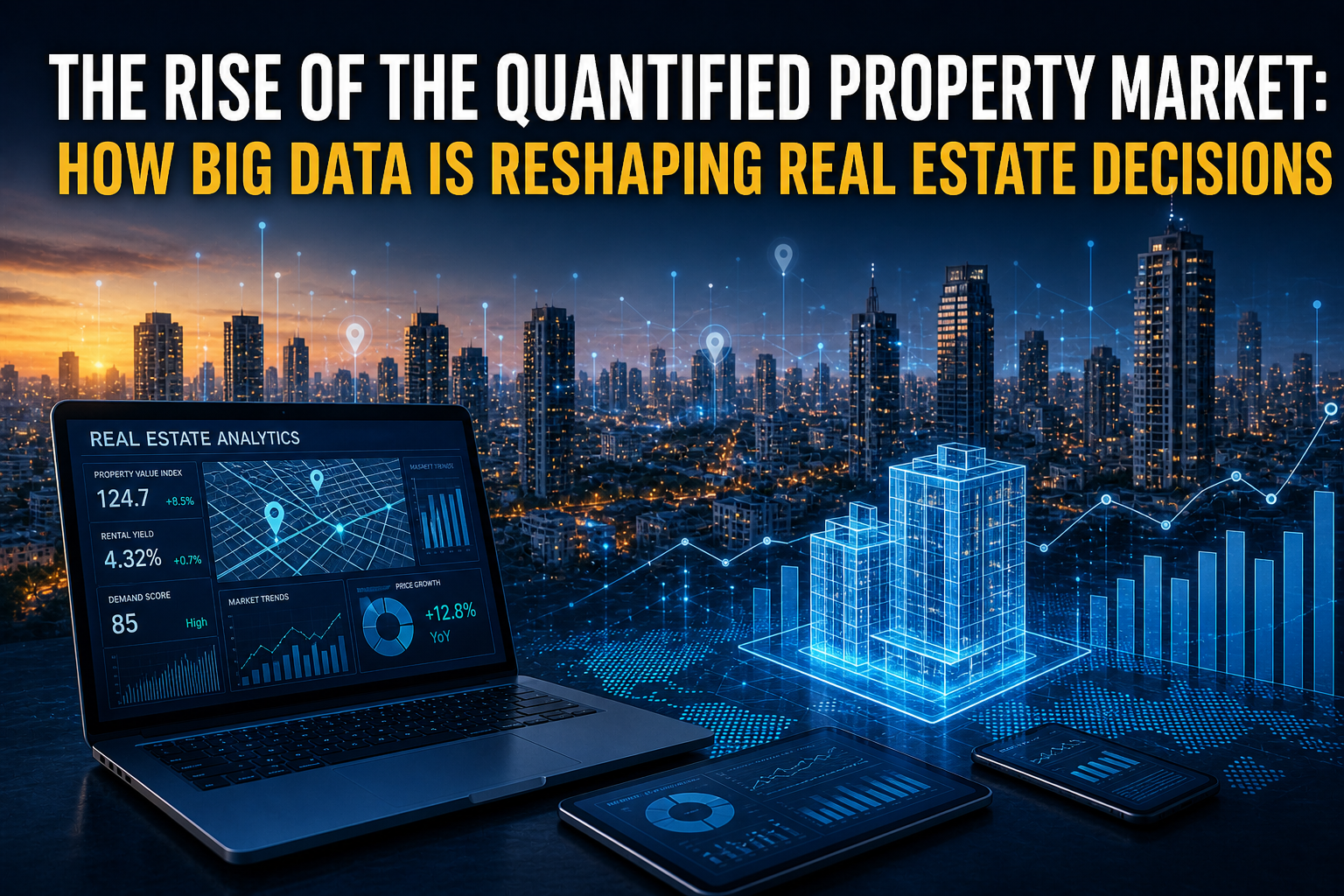
For generations, the real estate industry operated on a potent mixture of localized intuition, historical anecdotes, and professional networking. Investors, developers, and homebuyers largely relied on gut feelings, limited comparative market analyses, and the exclusive knowledge held tightly by industry insiders to make massive financial commitments. Property acquisition was historically viewed as a narrative-driven asset class, heavily swayed by a compelling pitch, the sheer visual appeal of a physical structure, or speculative rumors about a neighborhood's future. Today, that traditional paradigm is being violently disrupted. We have entered the era of the quantified property market, where every square foot of land, every demographic shift, and every infrastructural development is meticulously tracked, measured, and analyzed.
Data-driven real estate decisions have effectively replaced guesswork. By harnessing vast amounts of structured and unstructured information, the property sector is rapidly transforming into a highly precise, analytical discipline. This evolution goes far beyond simply having access to more information; it is entirely about how that information is aggregated, interpreted, and deployed to forecast market trends, mitigate investment risks, and unlock hidden value in an increasingly competitive global landscape. As we examine the modern property ecosystem, it becomes undeniably clear that big data is no longer a niche, experimental tool reserved for elite financial institutions. It is the absolute foundational bedrock upon which the future of real estate is being built, permanently altering how we buy, sell, manage, and value physical spaces.
To understand the sheer magnitude of this shift, one must first recognize how fragmented real estate information used to be. A single property transaction historically required piecing together a massive puzzle. The county clerk held the tax records, the local municipality held the zoning laws and infrastructure blueprints, the broker possessed the historical sales comps, and the property manager understood the localized rental yields. None of these systems spoke to one another. Gathering a comprehensive picture of a single asset took weeks of manual labor, making agile, informed decision-making nearly impossible.
The rise of advanced real estate analytics and PropTech platforms has completely eradicated this fragmentation. Modern data ecosystems are designed to aggregate massive, disparate datasets into unified, highly visual, and easily digestible platforms. Today, an investor sitting in a corporate office in New York can pull up a commercial asset in Austin, Texas, and instantly view a comprehensive dashboard. This dashboard simultaneously displays the property’s historical price appreciation, the surrounding area's crime rates, median household income trajectories, municipal infrastructure plans, and real-time comparable sales.
This transition from siloed data to structured intelligence enables true comparative decision-making. Investors are no longer forced to evaluate properties in isolation or rely on localized biases. They can objectively compare the expected yield, tenant profile, and long-term appreciation potential of a warehouse in the Midwest directly against a multi-family complex in the Sun Belt, using identical, standardized metrics. This massive increase in market transparency is actively building unprecedented investor confidence, drawing new streams of institutional capital into regions that were previously considered too opaque to touch.
One of the most profound impacts big data in real estate has introduced is the ability to analyze geographical locations on a micro-level. Previously, market reports would profile entire cities or massive zip codes homogeneously. An analyst might declare that the broader Seattle market is cooling, or that the Miami market is overheating. While these macro-level insights are helpful for general economic overviews, they are entirely insufficient for executing highly profitable, targeted real estate investments.
The quantified property market thrives on hyper-local segmentation. Advanced analytics allow developers and investors to pinpoint crucial differences between individual city blocks. A broader neighborhood might be experiencing stagnant property values, but real-time data can reveal that a specific four-block radius within that neighborhood is showing a massive spike in online search queries for residential leases.
Furthermore, the industry is increasingly relying on alternative data sources to gain an edge. Analysts are no longer just looking at official tax assessments or mortgage rates; they are looking at the digital footprint of a neighborhood. A sudden influx of highly-rated coffee shops appearing on business review platforms, a sustained increase in ride-share drop-offs during evening hours, or changing mobile signal patterns indicating increased daytime foot traffic can all signal impending gentrification long before those trends reflect in official property sales data. By capturing these subtle, real-time indicators, data-driven real estate decisions allow early movers to secure undervalued assets right before a neighborhood officially booms.
The traditional method of pricing a home or a commercial building relies heavily on the past. Appraisers look at comparable properties—affectionately known as "comps"—that have sold within the last six months to determine what a current property is worth. The fatal flaw in this retroactive methodology is that the real estate market is highly dynamic. What a house sold for three months ago does not accurately account for the subtle economic shifts happening today, nor does it forecast what the property will be worth tomorrow.
Predictive analytics completely flips this methodology on its head. Instead of merely looking backward, modern Automated Valuation Models utilize artificial intelligence and machine learning to look forward. These complex algorithms ingest thousands of dynamic data points simultaneously. They analyze the structural condition of the property, the exact geographical location, current macroeconomic indicators, shifting interest rates, and the localized purchasing power of the surrounding demographic.
By identifying deep mathematical patterns within this massive ocean of information, predictive algorithms can forecast future price movements with startling accuracy. They can predict rent increases based on shifting local employment sectors, estimate the exact month a local housing supply will dry up, and accurately project the future valuation of an entire commercial portfolio. For retail buyers and sellers, this means properties can be priced with absolute precision to maximize returns and minimize the time spent languishing on the market. For institutional investors, it means capital can be allocated based on strict, mathematical foresight rather than optimistic speculation.
The power of real estate analytics does not dissipate the moment a purchase contract is signed. In fact, some of the most lucrative applications of big data are currently being deployed in the realm of property management and daily operations. Managing a massive commercial building or a sprawling multi-family residential complex was historically a reactive business. Property managers waited for a pipe to burst, an HVAC unit to fail, or a tenant to submit a complaint before taking action.
The integration of the Internet of Things (IoT) and big data has ushered in a highly proactive era of smart property management. Modern buildings are increasingly equipped with interconnected sensors that continuously monitor energy consumption, ambient temperature, water pressure, and the mechanical health of critical infrastructure. This continuous stream of data empowers management teams to utilize predictive maintenance. An algorithm can analyze the subtle changes in the vibration of an elevator motor and dispatch a repair technician weeks before the motor actually fails, completely preventing costly emergency repairs and massive tenant disruptions.
Moreover, data analytics heavily optimizes the financial side of property management. Landlords can track real-time vacancy rates across their portfolios and cross-reference them with regional market averages. If an algorithm detects a seasonal dip in local housing demand, it can automatically suggest highly targeted, temporary rent concessions to keep occupancy rates at maximum capacity. This granular, continuous optimization ensures that real estate assets operate at peak financial efficiency throughout their entire lifecycle.
Investing in real estate carries inherent, massive financial risks. Markets can crash, natural disasters can strike, and supply chains can abruptly halt. Historically, mitigating these risks relied on broad, generalized insurance policies and conservative financial padding. Today, data is the ultimate shield against market volatility.
Geographic Information Systems (GIS) and big data allow investors and insurance actuaries to assess environmental and structural risks with pinpoint precision. Before breaking ground on a new development, a firm can analyze decades of localized climate data, flood plain shifts, and soil stability reports to determine the exact environmental vulnerability of a specific plot of land. This allows developers to adjust their architectural engineering long before construction begins, building resilient structures that natively withstand localized threats.
Similarly, insurance companies are utilizing big data to completely restructure how premiums are calculated. Instead of relying on broad regional averages, insurers can analyze the specific structural data, automated maintenance records, and predictive risk factors of an individual building to craft highly personalized, fair insurance policies. For the investor, this means completely avoiding assets that hide invisible, catastrophic risks, and securing highly optimized insurance overheads that protect the bottom line.
As data becomes increasingly democratized, a profound shift is occurring within the professional real estate ecosystem. In the past, real estate agents, commercial brokers, and investment advisors derived a massive portion of their professional value from simply acting as gatekeepers to exclusive information. If you wanted to know what a property was worth or what was available on the market, you had to hire an intermediary.
Information is no longer scarce. Retail homebuyers can pull up complex market trends on their smartphones, and institutional investors have their own massive in-house data terminals. Because access to raw information is no longer a distinct competitive advantage, the role of the traditional real estate intermediary is evolving rapidly.
The most successful professionals in the industry are transitioning away from being mere transaction facilitators and are rebranding themselves as strategic data interpreters. A client no longer pays a broker simply to find a building; they pay the broker to contextualize the massive volume of data surrounding that building. The modern real estate professional must be highly adept at analyzing predictive models, translating complex neighborhood demographic shifts into actionable business advice, and aligning the raw data with the client's highly specific, long-term financial objectives. The emphasis has fundamentally shifted from providing access to providing insight.
While the rise of the quantified property market is undeniably reshaping the global landscape, it is highly critical to acknowledge the inherent limitations of pure data. Real estate is ultimately a physical asset class that exists within a highly complex human society. Algorithms are exceptionally powerful at identifying historical correlations and projecting mathematical trajectories, but they frequently struggle to account for the unpredictable nuances of human behavior and sudden cultural shifts.
A predictive model might easily identify a neighborhood with affordable housing and excellent transit links, mathematically flagging it as a prime target for investment. However, that same model might fail to account for a sudden, highly aggressive shift in local municipal zoning politics, or a grassroots community movement actively resisting commercial gentrification. Furthermore, data cannot inherently evaluate the subjective, emotional appeal of a property—the unique architectural charm of a heritage building or the precise angle of a sunset reflecting off a waterfront property—factors that still drive massive premium valuations in the luxury market.
Therefore, the most successful, highly lucrative real estate strategies of the future will not completely abandon human intuition in favor of the machine. Instead, they will seamlessly fuse the two. The quantified property market provides an incredibly strong, unbreakable foundation of objective truth, completely stripping away the dangerous biases and speculative gambling that historically plagued the industry. It empowers investors to approach physical property with the exact same level of precision and analytical rigor traditionally reserved for complex stock market equities.
We are witnessing a permanent, structural maturation of the property sector. As digital infrastructure continues to advance, the volume of data will only multiply, and the algorithms will only grow sharper. For those willing to adapt, the shift toward data-driven real estate decisions represents an unprecedented opportunity to eliminate inefficiency, maximize long-term yields, and navigate the built environment with absolute clarity. The future of real estate does not belong to those who can spin the best narrative; it belongs entirely to those who can interpret the deepest data.
