Published On:
February 27, 2026
Updated On:
February 27, 2026
The Kanpur Master Plan 2031 is set to transform the historic industrial town into a sprawling metropolis, bringing 80 villages into its fold to create "Greater Kanpur" with a skyline of skyscrapers, robust expressways, and dedicated economic hubs. This massive urban expansion aims to alleviate legacy congestion, retain local talent, and position the city as a highly lucrative, modern real estate destination.
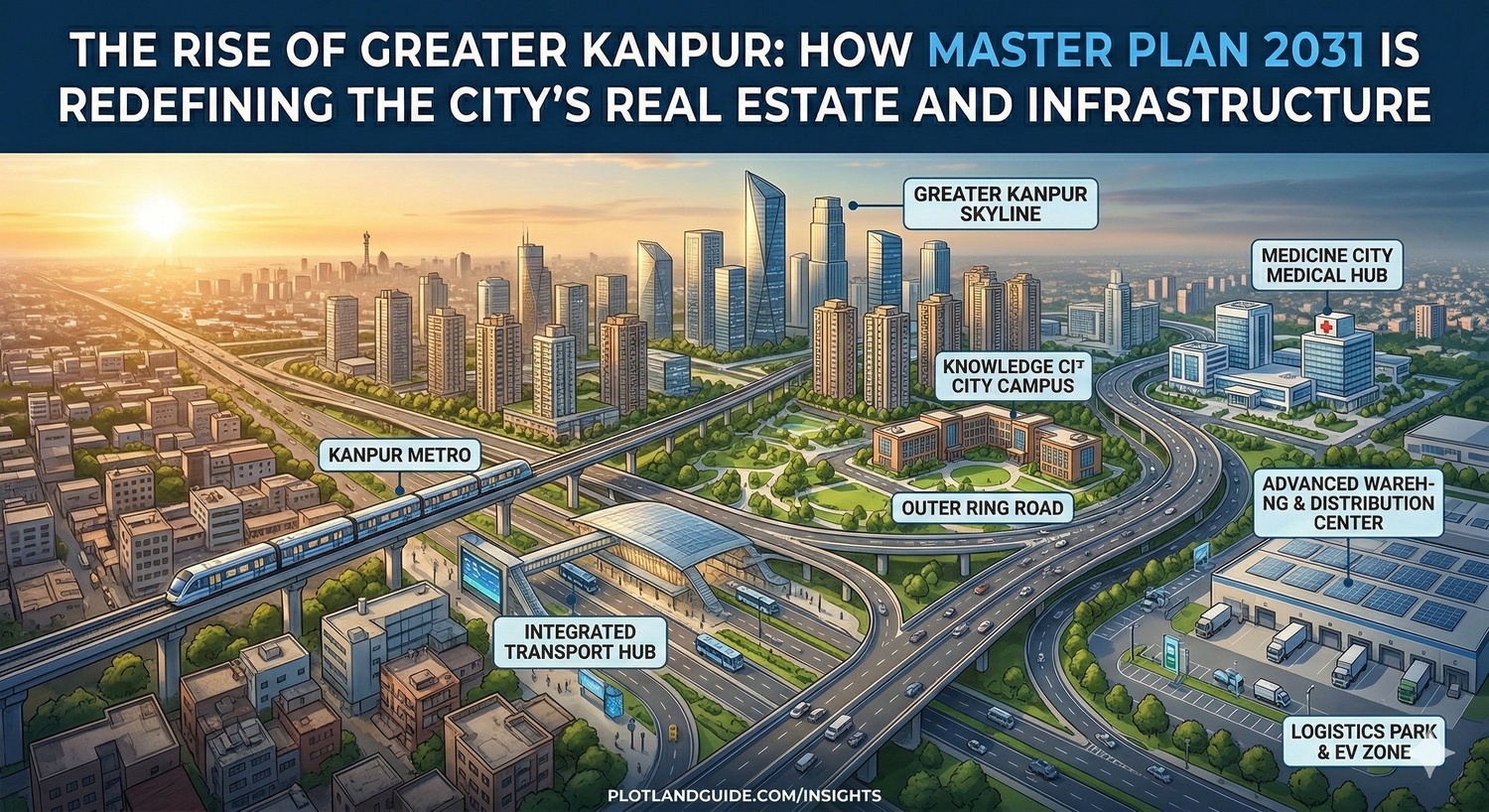
For decades, Kanpur has carried the weight of its historical legacy as the "Manchester of the East." While its industrial prowess in textiles and leather put it on the global map, the city’s urban infrastructure struggled to keep pace with its booming population. Unplanned expansion, narrow streets, and severe traffic congestion became the defining characteristics of its core areas like Parade, Naveen Market, and the older industrial belts. However, a monumental shift is currently underway. The Kanpur Development Authority has officially received the green light for the ambitious Kanpur Master Plan 2031, a comprehensive blueprint designed to completely overhaul the city's urban landscape.
This is not a minor civic upgrade or a routine beautification drive. The master plan is a highly structured, aggressive strategy aimed at transitioning Kanpur from a congested legacy town into a 21st-century metropolitan powerhouse. By focusing heavily on strategic land acquisition, vertical real estate growth, and the establishment of dedicated economic corridors, the administration is effectively hitting the reset button on how the city functions. The vision is to build a structured, self-sustaining ecosystem that mirrors the planned precision of modern hubs like Noida, drawing in massive private investments and fundamentally altering the local property market dynamics.
The most aggressive and transformative aspect of the 2031 blueprint is the sheer scale of its geographical expansion. To fix the severe density issues suffocating the inner city, the development authority is looking outward, formally absorbing 80 villages spanning across Kanpur Nagar and Kanpur Dehat into the official city limits. This massive acquisition drive is unlocking thousands of acres of previously agricultural land for structured urban development, laying down the physical foundation for what is now being officially termed "Greater Kanpur."
By pulling these peripheral areas into the urban fold, the city is securing roughly 5,000 to 10,000 acres of fresh land to be developed under a pure 'Satellite Town' model. Unlike the older parts of the city that grew organically and chaotically, these new sectors are being meticulously planned from scratch before a single brick is laid. Urban planners are prioritizing wide arterial roads, dedicated green belts, scientifically mapped zoning for residential and commercial spaces, and robust underground drainage and sewage systems.
For the residents currently navigating the cramped, heavily populated pockets of the old city, this expansion serves as the ultimate exit plan. Families seeking a higher standard of living without leaving their hometown are already shifting their focus toward these newly designated zones. The overarching vibe of Greater Kanpur is deliberately designed to emulate the spacious, organized feel of the National Capital Region's premium sectors. Smart buyers and seasoned real estate investors are aggressively scouting for early-bird opportunities, knowing that property values in these transitioning villages are poised to skyrocket as agricultural land converts into premium residential plots.
Historically, the residential preference in Kanpur heavily favored independent houses, bungalows, and low-rise apartments. However, as the city expands and the cost of prime land escalates, the old model of horizontal growth is no longer economically viable or sustainable. The Kanpur Master Plan 2031 introduces a radical shift in the city’s architectural philosophy: why go wide when you can build high?
To maximize land utility and accommodate a population expected to cross the 55 lakh mark, the development authority is heavily incentivizing vertical growth. The city is preparing to welcome a completely new skyline dominated by 20 to 30-story residential skyscrapers. These high-rises will predominantly emerge in the newly acquired sectors where large, unencumbered land parcels are readily available, replacing what used to be vast open fields with modern concrete marvels.
This vertical shift brings an entirely new lifestyle segment to the local real estate market. These upcoming high-rise projects are not just about stacking apartments; they are designed as comprehensive, gated communities. Buyers can expect world-class amenities that were previously rare in the local market, including multi-tier security systems, 100% power backup, sprawling clubhouses, temperature-controlled swimming pools, and integrated shopping plazas.
For property investors, this represents a massive, untapped market. The demand for premium, secure, and amenity-rich living spaces among the city's affluent business class and growing corporate workforce is immense. Securing a unit in these high-growth vertical zones during the early launch phases is widely considered a highly lucrative play, as the visual transformation of the skyline over the next few years will inevitably drive heavy capital appreciation.
A metropolitan expansion of this magnitude cannot survive without a logistical backbone to support it. Recognizing that severe traffic bottlenecks have been the city’s biggest deterrent to growth, the master plan places an unprecedented emphasis on connectivity and road infrastructure. The crown jewel of this transit overhaul is the construction of a massive Outer Ring Road.
Designed to act as a giant geographical loop around the expanding city borders, the Ring Road serves a critical dual purpose. First, it completely diverts heavy commercial trucks and inter-state freight traffic away from the city center, immediately drastically reducing congestion and pollution in the core residential and commercial areas. Second, it provides high-speed connectivity between the newly integrated villages, ensuring that residents of Greater Kanpur can traverse the city without ever navigating the old, narrow lanes.
Complementing the Ring Road is a highly structured internal grid. The newly planned village sectors will be linked by massive 45-meter-wide arterial roads, ensuring smooth traffic flow within the satellite towns. Furthermore, the broader regional connectivity is receiving a massive boost. The highly anticipated Kanpur-Lucknow Expressway is set to drastically reduce travel time between the two major cities to a mere 35 to 45 minutes. This high-speed corridor not only makes daily commuting viable but also effectively merges the economies of the two cities, making Kanpur an equally attractive base for businesses currently operating out of the state capital.
Add to this the rapid advancement of the Kanpur Metro Rail Project, which is aggressively expanding its routes to cover southern neighborhoods, and the city is looking at a completely modernized, multi-modal transit network that drastically elevates its real estate appeal.
The true genius of the Kanpur Master Plan 2031 lies in its understanding that residential expansion must be supported by aggressive job creation. For years, the city witnessed a massive brain drain, with its brightest engineers from institutions like IIT Kanpur, along with medical professionals and corporate executives, migrating to tech hubs like Bangalore, Pune, or Delhi NCR in search of better career opportunities and modern lifestyles. The new master plan is explicitly designed to halt this migration by building dedicated, high-yield economic zones right at home.
The development authority has mapped out vast tracts of land for specialized commercial and industrial hubs. Among the most ambitious projects is the establishment of a dedicated Knowledge City near the IIT Kanpur campus. Spanning hundreds of acres, this zone is designed to host research facilities, higher education institutions, and innovation centers, creating a localized tech and academic ecosystem.
Simultaneously, the administration is pushing forward with a Medicine City to centralize advanced healthcare and pharmaceutical research, alongside a massive, dedicated EV (Electric Vehicle) Park aimed at capturing the booming green mobility manufacturing sector. The ongoing development of the Defence Industrial Corridor is already attracting massive private investments from aerospace and defense manufacturing firms, generating thousands of high-paying technical jobs. Additionally, the new Aero City project near the Chakeri Airport is blending commercial, residential, and hospitality spaces to serve as an economic anchor for the region.
By creating these massive employment hubs within the city limits, the government is ensuring a steady, long-term demand for the surrounding real estate. When high-income jobs are generated locally, the demand for premium housing, retail spaces, and entertainment venues naturally follows, creating a self-sustaining cycle of urban prosperity.
For anyone closely monitoring the real estate landscape in Northern India, Kanpur currently represents one of the most compelling ground-floor investment opportunities. The Master Plan 2031 is a gutsy, aggressive move that actively corrects decades of disjointed growth. By heavily regulating the newly acquired 80 villages and mandating strict zoning laws, the government is effectively killing the chaotic spread of unauthorized colonies and replacing them with a highly structured, RERA-compliant property market.
For end-users, this transition means access to modern housing that actually supports a high quality of life. The upcoming sectors will offer a stark contrast to the existing city, providing breathable spaces, reliable civic amenities, and the kind of lifestyle previously reserved for top-tier metros.
For investors, the math is incredibly straightforward. The aggressive land acquisition by the state sets a baseline for structured growth, while the incoming economic hubs guarantee a future influx of corporate tenants and affluent buyers. Properties located along the new Ring Road, the Lucknow-Kanpur Expressway corridor, and the immediate vicinity of the Knowledge and EV parks are perfectly positioned for massive price escalations.
The transformation from an aging industrial town into a vertical, expressway-linked smart city will undoubtedly take time, and navigating the early phases of construction and development will require patience. However, the blueprint is legally solid, the infrastructure funding is actively being deployed, and the administrative will is visibly present. The Kanpur Master Plan 2031 has officially laid the groundwork, and the city is now undeniably catching up to the 21st century, offering immense rewards for those who choose to invest in its future today.
