Published On:
February 24, 2026
Updated On:
February 24, 2026
Discover how artificial intelligence, blockchain, and virtual reality are rapidly shifting Indian real estate from sluggish paper-based processes into a dynamic, data-driven ecosystem of smart buildings and connected cities.
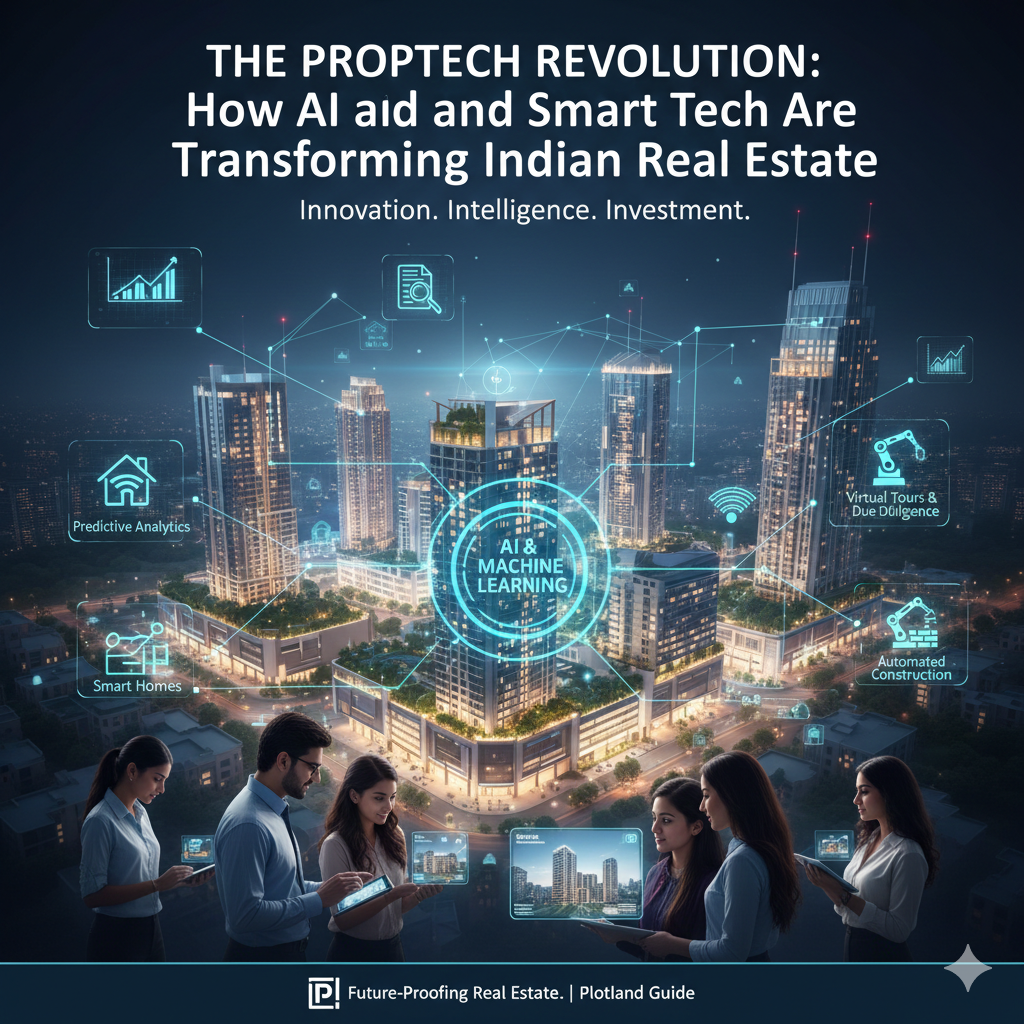
For decades, the Indian real estate market was synonymous with towering stacks of physical paperwork, endless visits to government registry offices, and an over-reliance on the subjective intuition of local property brokers. Buying a home, leasing a commercial space, or securing project approvals required navigating a maze of manual, time-consuming processes. However, a monumental shift is currently underway. Entering 2026, the sector is experiencing a complete digital overhaul, powered aggressively by Artificial Intelligence (AI) and Property Technology (PropTech).
A recent joint report by KPMG and NAREDCO, titled “Real Estate in Viksit Bharat @2047,” perfectly highlights this trajectory. It outlines how technology is no longer just a luxury or a backend support function; it is fundamentally reshaping every single touchpoint of the property lifecycle. From the initial stages of construction and government approvals to modern leasing and complex property management, manual systems are being rapidly replaced by high-speed, data-driven frameworks. For developers, institutional investors, landlords, and everyday homebuyers, adopting digital governance, AI workflows, and modern construction tech has transitioned from being an optional upgrade to an absolute operational necessity.
Historically, one of the most frustrating pain points in the Indian property market has been the sluggish pace of documentation. Reviewing commercial leases, verifying tenant credentials, and checking massive real estate contracts could easily consume weeks of valuable time. Today, AI-powered tools are completely eliminating these bottlenecks. Advanced algorithms can scan hundred-page legal contracts in a matter of minutes, instantly extracting key clauses, spotting hidden financial risks, and flagging unusual terms that require human review.
The tenant screening process is also getting a much-needed intelligence upgrade. In the past, landlords and property managers relied heavily on subjective judgments, basic reference checks, and a leap of faith when handing over the keys. Now, the industry is pivoting toward highly sophisticated, data-driven scoring models. These AI systems dive deep into a prospective tenant's digital footprint, analyzing their historical payment behaviors, income consistency, and credit patterns. By replacing human bias with cold, hard data, property owners are successfully identifying highly reliable tenants and drastically reducing the risk of rental defaults.
On the consumer side, the property search experience has been completely revolutionized. Gone are the days of scrolling endlessly through irrelevant listings. Modern real estate portals are deploying machine learning algorithms to study a user’s behavior, track their past transaction history, and analyze localized price trends in real-time. Whether a buyer is looking for a luxury high-rise in Gurugram or exploring the emerging 7% farmer quota plots in the YEIDA region, the platform instantly curates personalized recommendations. This hyper-targeted approach ensures that buyers only see properties that perfectly align with their specific budget and lifestyle preferences, cutting the exhausting search time in half.
The physical site visit has always been the golden rule of real estate. However, commuting across sprawling metropolitan areas or traveling interstate to view under-construction projects is often highly impractical. Augmented Reality (AR) and Virtual Reality (VR) technologies are entirely changing how people visualize and interact with properties.
Instead of staring at a flat, two-dimensional floor plan and trying to imagine the final product, buyers can now simply put on a VR headset in their living room and take a highly immersive 3D walkthrough of a flat that has not even been built yet. They can check the spatial flow of the layouts, look out the virtual windows to gauge the future view, and inspect the planned amenities in stunning high definition.
This technology is proving particularly transformative for investors focusing on rapidly expanding peripheral markets. An NRI investor sitting in Dubai, or a professional based in South Delhi, can actively explore massive upcoming township developments along the Yamuna Expressway without having to schedule multiple weekend site visits. By providing a realistic sense of space and scale, AR and VR tools are building massive buyer confidence and accelerating sales cycles for developers across the country.
Perhaps the most ambitious and highly anticipated technological shift in Indian real estate is the integration of blockchain technology. Land disputes, fraudulent property sales, and tampered registry documents have historically plagued the market, trapping billions of dollars in endless litigation. Blockchain offers a permanent, highly secure solution to this systemic issue.
Pilot projects are already aggressively underway in states like Maharashtra and Telangana, testing the implementation of tamper-proof digital registries. Because a blockchain is a decentralized and immutable ledger, once a property title is verified and recorded on the network, it cannot be secretly altered, forged, or deleted by bad actors.
Furthermore, the industry is beginning to experiment with smart contracts. These are self-executing digital agreements where the terms of the sale or lease are written directly into lines of code. When a buyer transfers the funds into a digital escrow, the smart contract automatically verifies the receipt and instantaneously triggers the transfer of ownership to the buyer. By removing the need for multiple middlemen and eliminating the possibility of human error, supporters firmly believe that blockchain will eventually eradicate property fraud and dramatically reduce land disputes over the coming decades.
The concept of a building has evolved from a static structure of bricks and cement into a living, breathing digital entity. New-generation commercial towers and premium residential complexes are being heavily wired with IoT (Internet of Things) sensors and AI-based environmental control systems.
These "smart assets" constantly monitor their own performance. They can automatically adjust interior lighting, regulate central cooling, and manage heating based entirely on real-time occupancy levels and external weather conditions. This level of automation not only drastically lowers massive energy bills but also significantly improves the physical comfort and well-being of the occupants.
On the daily operations side, PropTech platforms have completely taken over property management. The days of chasing tenants for rent checks or dealing with manual maintenance registers are over. Landlords and facility managers now operate through intuitive digital dashboards that provide real-time updates on overdue payments, pending repair requests, and monthly utility consumption patterns. Conversely, tenants can effortlessly raise service tickets for plumbing or electrical issues and pay their rent seamlessly through dedicated mobile applications, completely removing the traditional friction between property owners and occupants.
The impact of PropTech is not confined to individual buildings; it is scaling up to govern entire urban ecosystems. According to industry analyses, technology is finally breaking down the notorious bureaucratic walls surrounding government project approvals. By implementing online dashboards and standardized digital workflows, municipal corporations are creating a highly transparent clearance process. Digital file movement and real-time status tracking are drastically reducing the costly delays and eliminating the uncertainty that has long plagued major construction projects.
At the macro level, the data generated by real estate tech is feeding directly into centralized smart city control rooms. Authorities are pulling diverse data streams from traffic cameras, municipal utilities, pollution monitors, and commercial buildings into a single analytical engine. This holistic view allows urban planners to manage essential city services much more efficiently. They can optimize traffic light grids during rush hours, route waste management trucks based on sensor data from bins, and precisely plan future infrastructure developments to prevent the gridlock that suffocates older metropolitan hubs.
This city-scale integration is particularly visible in newly planned urban centers and industrial corridors, such as the massive developments surrounding Greater Noida, where planners are building digital-first infrastructure from the ground up rather than trying to retrofit old, chaotic city grids.
While the momentum behind PropTech is undeniable, the transition is not entirely without friction. A significant portion of the Indian real estate sector is still highly fragmented, populated by thousands of small-scale developers and independent local brokers who severely lack basic digital skills. Pushing this massive, unorganized workforce to adopt complex AI tools and digital workflows requires extensive training and a massive cultural shift.
Furthermore, the fundamental fuel for AI is data, and the Indian property market currently suffers from highly inconsistent data standards. Property valuations, rental yields, and historical transaction records are often recorded differently from state to state, or even from district to district. Until a unified, national standard for real estate data is established, the accuracy and reliability of AI-driven pricing models and predictive analytics will remain somewhat limited.
Finally, as buildings become fully digitized and connected to the internet, the threat of cyberattacks becomes a very real and rising concern. Securing sensitive tenant data, protecting financial transaction portals, and ensuring that a building's core operating systems cannot be hacked are massive challenges that developers and tech firms must actively solve in the coming years.
Despite these transitional hurdles, the consensus among industry leaders, developers, and institutional investors is absolute: the direction of the market is set in stone. The era of the paper file is ending, making way for a highly transparent, efficient, and user-centric ecosystem.
From algorithms that price properties with pinpoint accuracy and smart contracts that execute flawless transactions, to virtual headsets that allow buyers to walk through unbuilt homes, digital tools are completely rewriting the rules of the game. The Indian real estate sector is moving rapidly toward a future defined by connectivity, speed, and intelligence, fundamentally transforming how our homes and cities are built, sold, and experienced.
