Published On:
March 12, 2026
Updated On:
March 12, 2026
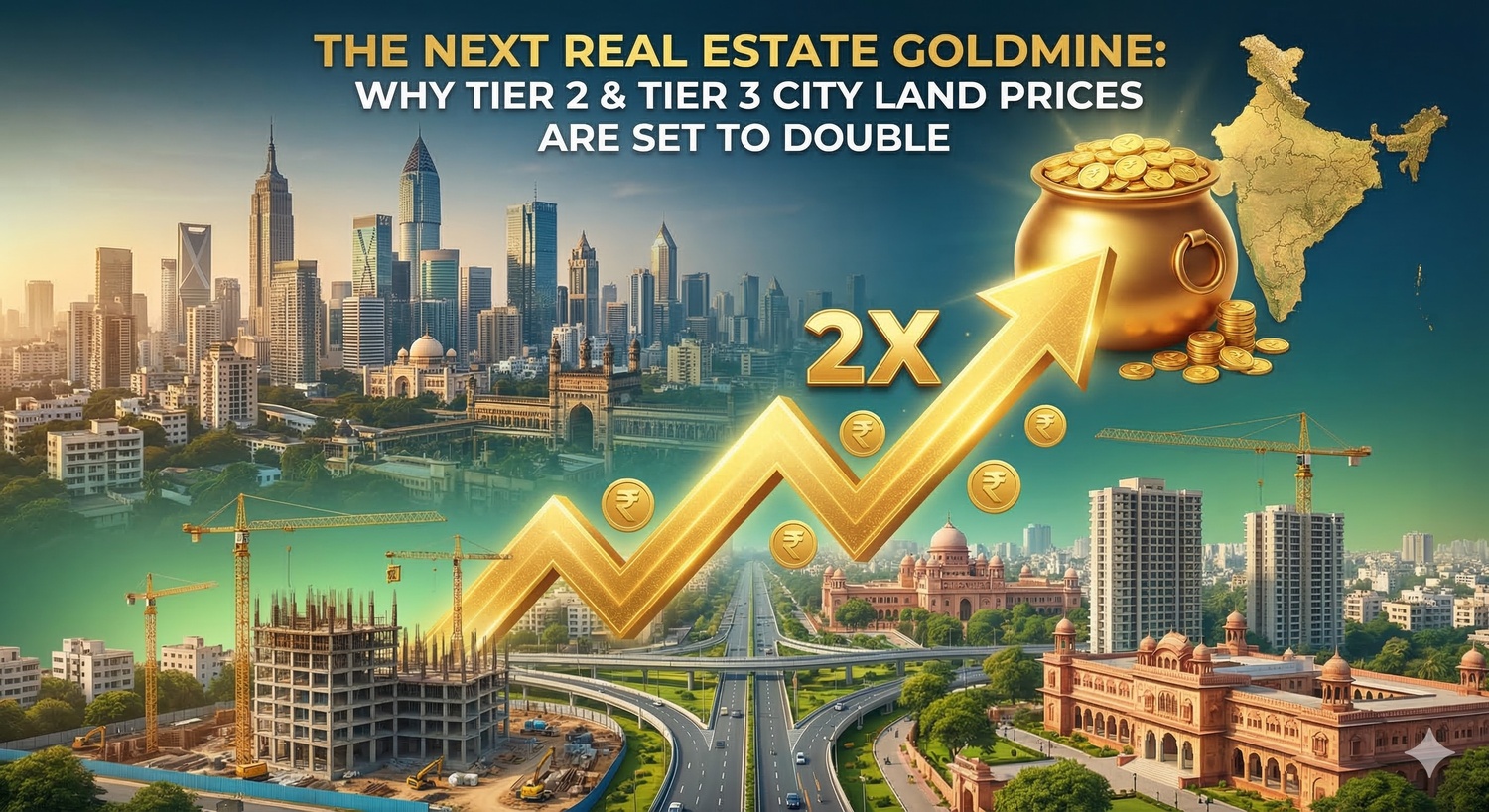
Driven by a massive ₹12.2 lakh crore national infrastructure push and targeted regional development policies, land prices in India's Tier-2 and Tier-3 cities are projected to soar by 25% to 100% over the next two to four years. As Tier-1 markets reach saturation, emerging cities are transforming from speculative outposts into highly lucrative, employment-backed real estate goldmines.
For the better part of the last two decades, the Indian real estate narrative has been overwhelmingly dominated by a handful of massive metropolitan centers. The towering skylines of Mumbai, the sprawling IT corridors of Bengaluru, and the rapid commercial expansions across the National Capital Region absorbed the vast majority of institutional capital, developer focus, and retail investment. However, as we move deeper into 2026, the structural dynamics of the Indian property market are undergoing a profound and permanent recalibration.
The traditional Tier-1 urban centers are increasingly grappling with high saturation levels, severe infrastructural bottlenecks, and astronomical entry barriers for the average homebuyer. In stark contrast, a quiet revolution is taking place across the country's heartland. A confluence of aggressive government policy, unprecedented capital expenditure, and a fundamental shift in corporate expansion strategies is shining a massive spotlight on emerging regional markets. Real estate in Tier-2 and Tier-3 cities is no longer just a retirement plan or a highly speculative play; it is actively positioning itself as the primary growth engine for the next decade of Indian wealth creation.
Recent comprehensive market analyses project that land prices in select corridors across these emerging cities could witness a staggering appreciation of 25% to 100% over the next two to four years. This is not a temporary bubble fueled by artificial liquidity; it is a highly structural, deeply rooted expansion driven by tangible physical infrastructure and organic employment generation.
To understand the sheer magnitude of the impending price surge in Tier-2 and Tier-3 real estate, one must first look at the macroeconomic foundation being laid down at the federal level. The Indian real estate market is transitioning into a structurally driven cycle anchored entirely by infrastructure expansion. The central government has committed an astonishing ₹12.2 lakh crore in planned public capital expenditure, effectively redrawing the economic map of the country.
The recent Union Budget has served as the ultimate catalyst for this regional pivot. Moving away from the concentrated metropolitan focus, the government has introduced a highly targeted approach to regional urban development through the creation of City Economic Regions (CERs). By allocating ₹5,000 crore per region over a five-year period—to be implemented through an aggressive, performance-based 'challenge mode'—the policy clearly signals a deliberate intention to decentralize economic power.
When large-scale capital is deployed to build high-speed expressways, regional rapid transit systems, and modern greenfield airports, the economic realities of the surrounding geography change instantly. Infrastructure essentially eradicates the distance barrier, folding previously isolated towns into the broader national supply chain and commuter networks. As these public projects move from paper announcements to active construction sites, they bring with them a massive influx of contractors, heavy industry, and ancillary businesses, instantly creating localized micro-economies that demand organized real estate.
The projected 25% to 100% appreciation in land values is not a blanket guarantee across every small town in India. It is highly specific to the type of infrastructure being developed and the asset class in question. Historically, land markets react much more sharply and aggressively to infrastructural triggers than stabilized, ready-to-move-in housing segments. When analyzing how this wealth will be generated over the next two to four years, market experts point to a distinct appreciation matrix based on proximity to physical development.
Transit-oriented development is currently the most reliable predictor of localized real estate wealth. Properties and land parcels located within a tight 500-meter to one-kilometer radius of upcoming metro corridors typically command an immediate premium of 8% to 25% just upon the project's announcement. Once the transit system becomes fully operational and the friction of daily commuting is removed, these specific corridor-level properties routinely see a further value appreciation of around 15% to 40%.
However, the truly exponential gains are tied to massive, macro-level infrastructure projects. The development of new regional airports and multi-lane expressways acts as a supercharger for surrounding land values. In the direct influence zones of these mega-projects, prices often surge by 30% to 70% from the initial announcement stage through to completion.
Furthermore, the highest potential for multi-year wealth creation lies in high-growth peripheral micro-markets, specifically within plotted developments and raw land parcels. As newly constructed highways unlock previously inaccessible acreage, the development potential of these plots skyrockets. In these specific scenarios, it is entirely common to see land values double, achieving well over 80% to 100% appreciation as developers rush in to acquire land banks for future integrated townships. Similarly, regions designated for industrial corridors and logistics hubs, heavily supported by active employment centers, are firmly expected to drive foundational land value growth ranging from 20% to 60%.
As the national economic footprint actively expands beyond traditional metropolitan borders, several specific cities have been identified by industry analysts as the premier markets likely to spearhead this next growth cycle. These are cities that seamlessly combine strong cultural heritage, growing educational infrastructure, and aggressive state-backed industrial policies.
Bhubaneswar and Cuttack are rapidly emerging as the twin engines of eastern India's real estate boom. With an intense focus on IT infrastructure, smart city initiatives, and excellent coastal connectivity, property rates here are currently hovering between ₹4,000 to ₹8,000 per square foot for Bhubaneswar, and ₹2,000 to ₹7,000 for Cuttack. These entry points offer massive upside potential for early investors as the state continues to attract heavy industrial and technology investments.
In the south, Erode is transitioning from a traditional textile and agricultural hub into a modernized logistics and manufacturing center, with real estate values currently sitting in a highly accessible bracket of ₹1,600 to ₹6,000 per square foot. Meanwhile, Visakhapatnam is leveraging its massive port infrastructure and executive capital status to attract high-net-worth investments, with prime real estate moving between ₹3,000 and ₹8,000 per square foot.
Religious tourism and cultural heritage are also proving to be monumental drivers of real estate value. Cities like Varanasi and Puri are undergoing complete urban transformations. Supported by massive state funding to upgrade civic amenities, widen approach roads, and build world-class transit hubs, these cities are experiencing a massive influx of hospitality brands, retail chains, and second-home buyers. Property values in Varanasi currently range from ₹4,000 to ₹8,000 per square foot, while Puri commands a slight premium at ₹5,500 to ₹10,500 due to its highly restricted coastal land availability and booming hospitality sector.
One of the most encouraging and structurally sound aspects of this impending boom is the underlying nature of the buyer demographic. In previous market cycles, rapid price escalations in smaller cities were often the dangerous result of blind speculation by absentee investors looking to flip land parcels for quick, untaxed profits. Today, the market has matured significantly.
Industry data clearly indicates that the current residential expansion in Tier-2 and Tier-3 markets is overwhelmingly driven by salaried end-users. Improved macroeconomic stability, formalization of the economy, and a recent moderation in baseline repo rates have collectively enhanced mortgage affordability across the country. Homeownership is now highly accessible for India's growing provincial middle class.
The demand is highly segmented and deeply practical. The ₹30 lakh to ₹60 lakh price bracket is currently dominating the market, attracting a massive wave of first-time homebuyers who are utilizing stable corporate salaries and accessible home loans to exit the rental market. Moving slightly up the ladder, the ₹60 lakh to ₹1 crore segment caters heavily to core mid-segment buyers looking for premium community living, gated security, and modern amenities that were previously exclusive to Tier-1 cities. For the affluent business class and highly paid professionals, the ₹1 crore to ₹1.5 crore segment is seeing strong traction, particularly for luxury apartments and independent villas. Additionally, structured plotted developments within secure, branded townships remain incredibly popular for buyers looking to build customized homes while benefiting from managed community infrastructure.
A booming real estate market cannot survive purely on the promise of good roads and affordable mortgages; it absolutely requires a permanent, localized economic engine. The defining characteristic of this current Tier-2 and Tier-3 expansion is that residential demand is strictly following employment creation.
The government’s aggressive push to revive over 200 legacy industrial clusters across the country is breathing new life into dormant regional economies. Furthermore, forward-looking initiatives like Semiconductor Mission 2.0, coupled with massive localized expansions in electronics manufacturing, specialty chemicals, and advanced defense manufacturing, are generating large-scale, high-paying employment far away from the traditional IT capitals.
As these massive industrial and technological facilities set up base in emerging cities, they require a vast ecosystem to support them. This inevitably drives an aggressive, sustained demand for commercial real estate, including Grade-A office spaces for regional headquarters, massive logistics hubs, and modern warehousing facilities. Consequently, the tens of thousands of professionals migrating to these cities to fill these new roles require quality housing, retail centers, schools, and hospitals. This creates a highly sustainable, self-reinforcing loop of economic growth, where commercial expansion directly fuels residential absorption, creating a perfectly balanced urban ecosystem.
The Indian real estate market has officially entered a new era of decentralized growth. As large-scale investments like the Urban Challenge Fund actively unlock the commercial and industrial prospects of the country's interior regions, the massive dependency on saturated Tier-1 cities is finally breaking. The infrastructure being laid down today is permanently altering the economic gravity of the nation, turning peripheral towns into powerful, self-sustaining economic hubs.
For homebuyers and institutional investors alike, the current landscape presents a rare, generational window of opportunity. The foundation has been poured, the policies are actively in motion, and the corporate expansion is already underway. Getting positioned in these emerging markets before the physical infrastructure is fully completed offers the highest possible margin for wealth creation. Over the next two to four years, as these Tier-2 and Tier-3 cities fully integrate into the national economic engine, the projected doubling of land values will transition from a bold market forecast into undeniable reality. The next great real estate gold rush is not happening in the crowded metropolitan centers; it is happening right now in the rapidly rising cities of tomorrow.
