Published On:
April 27, 2026
Updated On:
April 27, 2026
Haryana is setting the stage for the National Capital Region's next massive growth phase by developing five Singapore-inspired, master-planned cities along the 135-km Kundli-Manesar-Palwal Expressway, creating a new epicenter for industrial and residential real estate.
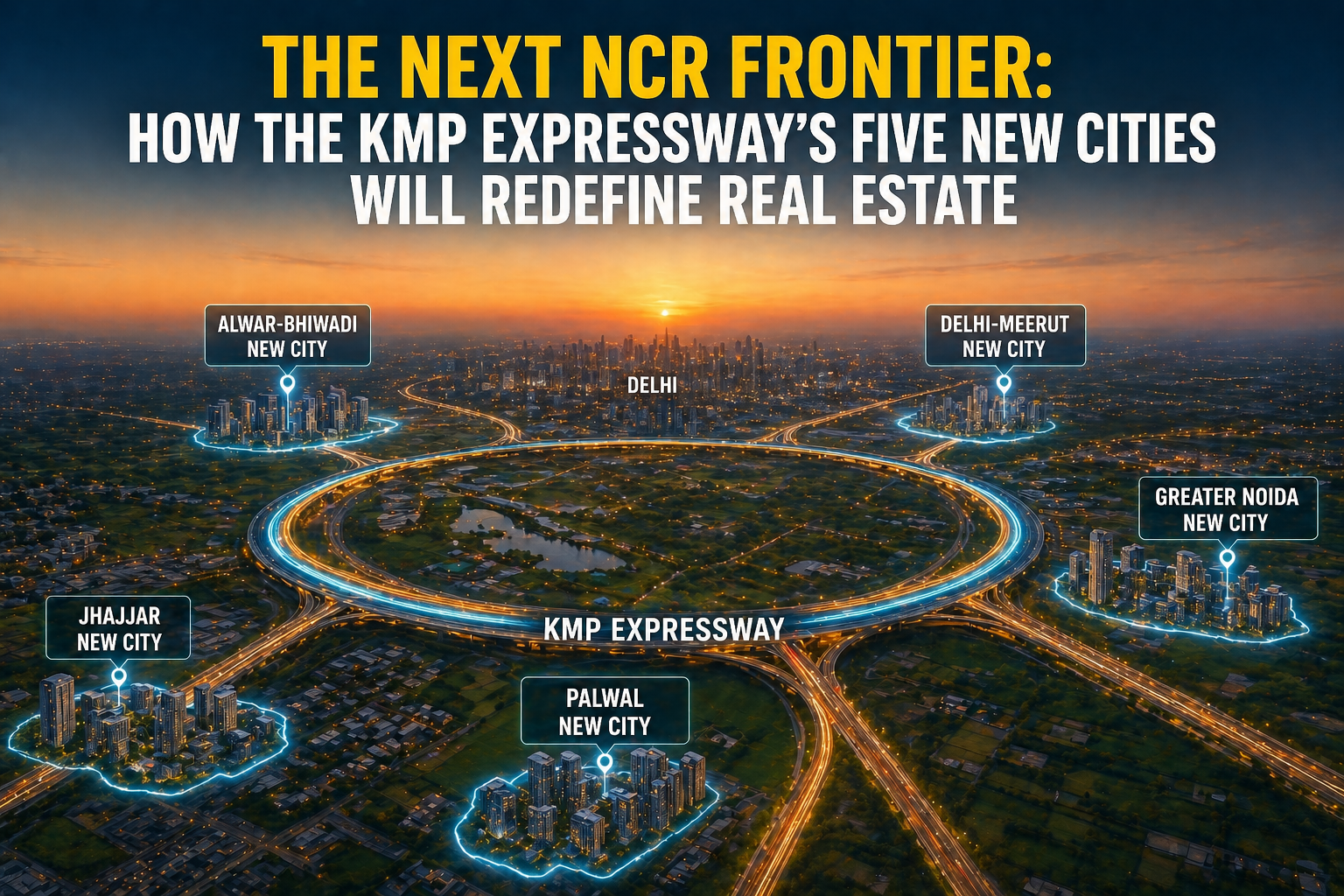
The National Capital Region has historically been a story of explosive, often unbridled expansion. For decades, the narrative of urban growth was dominated by the meteoric rise of Gurugram and the massive infrastructural sprawl of Noida. These satellite cities absorbed the intense demographic and economic pressure spilling over from New Delhi, transforming from quiet suburbs into towering global business districts. However, as these established hubs approach their saturation points—grappling with soaring property valuations, traffic bottlenecks, and infrastructural strain—the spotlight is inevitably shifting. The burning question for urban planners, corporate giants, and real estate investors has been: where is the next big growth corridor?
The answer is rapidly materializing along the periphery of the capital. The Haryana government has unveiled a highly ambitious, long-term master plan to develop five entirely new cities along the Kundli-Manesar-Palwal Expressway. Also known as the Western Peripheral Expressway, this massive transit corridor is no longer just a bypass route meant to divert heavy commercial trucks away from Delhi's internal roads. It is actively being reimagined as the foundational artery for the next chapter of the region's urban evolution. This is not a standard suburban housing extension; it is a fundamental geographic pivot designed to reshape the economic geography of Northern India.
What separates this upcoming developmental wave from previous real estate cycles is the underlying philosophy of urban planning. Historically, city growth in the region often followed a reactionary model: residential developments would sprout up first, followed years later by desperate attempts to retrofit roads, sewage systems, and commercial zones to support the booming population.
The strategy for the five new cities along the expressway completely inverts this outdated model. Drawing heavy inspiration from the meticulous urban planning frameworks seen in Singapore, the authorities are adopting a proactive, integrated approach. The core objective is to build comprehensive urban ecosystems from the ground up, where employment hubs, residential neighborhoods, transit networks, and daily lifestyle amenities are conceptualized and constructed in unison.
Instead of building bedroom communities that force residents into grueling daily commutes back into Delhi or Gurugram, these new urban centers are designed to be entirely self-sustaining. The idea is to create environments where people can live within walking distance or a short, seamless transit ride from their workplaces. By prioritizing high-capacity road networks, robust public transportation grids, and massive green belts from day one, planners are aiming to bypass the growing pains that have historically plagued rapid urbanization in the subcontinent.
To truly understand the scale of this undertaking, one must look at the sheer geographical footprint of the expressway. Stretching across a massive one hundred and thirty-five kilometers, the corridor forms a massive semi-circle around the western border of the national capital. The development of the five new cities will be strategically anchored along distinct nodes of this transit belt, specifically targeting the Kundli, Manesar, and Palwal zones.
The Kundli node, situated toward the Sonipat side, is already demonstrating significant early-stage momentum. Capitalizing on its proximity to the northern borders of Delhi, this area is witnessing a steady influx of industrial investments and early-mover real estate developers establishing large-scale residential townships. It serves as the vital northern gateway for this new growth corridor.
Moving southward, the Manesar belt represents the most mature and economically potent segment of the expressway. Manesar is already recognized as a formidable industrial and automotive manufacturing hub. The new developmental blueprint aims to drastically expand this existing infrastructure, transforming it from a purely industrial zone into a dynamic, mixed-use metropolis. By adding premium residential and commercial layers to its robust industrial foundation, Manesar is poised to rival Gurugram in terms of economic output and livability.
Finally, the Palwal stretch anchors the southern end of the corridor. While currently in the most nascent stages of development compared to its northern counterparts, Palwal holds immense long-term potential. It offers vast tracts of contiguous land, making it an ideal canvas for large-scale, master-planned townships. Furthermore, its geographic positioning provides excellent connectivity to the southern parts of the capital and seamlessly links with the broader highway networks pushing toward Agra and central India.
Executing a multi-city urban development project across a hundred and thirty-five kilometers requires an unprecedented level of administrative focus and regulatory control. Recognizing the complexities involved, the state government established a dedicated statutory body to oversee the entire operation: the Panchgram Development Authority.
This specialized agency operates with a singular, long-term mandate. Its primary responsibility is to meticulously design the master layouts for each of the five cities, ensuring strict adherence to the Singapore-style infrastructure guidelines. But the authority's role goes far beyond simple zoning. It is heavily engaged in predictive demographic modeling, calculating the projected population influx up to the year 2031 and beyond.
By accurately estimating future housing, water, power, and transit requirements, the authority is ensuring that the physical infrastructure is laid down well before the population density peaks. This forward-thinking governance model is designed to prevent the unauthorized construction, land encroachment, and haphazard zoning that typically occur when infrastructure trails behind demand. The existence of a dedicated authority also provides a massive boost of confidence to institutional investors, signaling that the state is committed to maintaining strict regulatory standards and ensuring a transparent, structured growth environment.
In the realm of real estate, housing demand is rarely a standalone phenomenon; it is almost entirely driven by employment generation. The authorities behind the expressway cities acutely understand this fundamental economic principle. Consequently, the entire urban expansion plan is heavily tethered to a massive, state-backed industrial push.
The strategy is clear: bring the factories, corporate parks, and logistics centers first, and the residential demand will naturally follow. To execute this, the state has rolled out an aggressive plan centered around Industrial Model Townships. The blueprint is staggering in its scope, with ten mega industrial townships officially announced along the corridor. Groundwork is already actively progressing on five of these approved townships, while three more are specifically planned to fall within the immediate boundaries of the National Capital Region.
This industrial explosion is not happening by accident. The state has fundamentally overhauled its industrial policies, rolling out the red carpet for domestic conglomerates and multinational corporations. By streamlining bureaucratic approvals, offering attractive tax incentives, and guaranteeing world-class industrial infrastructure, the region is rapidly becoming a magnet for capital.
To financially back this vision, the government implemented a massive one hundred and twenty-five percent increase in its industrial budget during the previous fiscal year, with expectations of continued aggressive funding. As these industrial townships become operational, they will generate hundreds of thousands of direct and indirect employment opportunities. This massive influx of a diverse workforce—ranging from blue-collar factory workers to white-collar corporate executives—will serve as the primary engine driving the demand for housing, retail, and commercial real estate across the five new cities.
The true genius of developing these cities along the western peripheral route lies in the unmatched logistical and geographical advantages the corridor offers. Real estate is ultimately a game of connectivity, and this one hundred and thirty-five-kilometer belt is arguably the most strategically positioned landmass in Northern India.
First and foremost, the expressway acts as a perfect outer ring, connecting to New Delhi on three separate sides without forcing commuters to navigate the capital's heavily congested internal traffic. Whether a business needs to transport goods to the northern states of Punjab and Himachal Pradesh or move cargo south toward the ports of Mumbai, the highway provides instant, high-speed access to the country's broader national highway network.
Furthermore, the aviation connectivity is unparalleled. The corridor offers rapid, signal-free access to the Indira Gandhi International Airport. Looking toward the future, the cities on the southern end of the expressway will also benefit immensely from their relatively close proximity to the upcoming mega-airport in Jewar. Having immediate access to two of the largest international aviation hubs in South Asia makes this belt incredibly attractive for global logistics companies, export-oriented manufacturing units, and multinational corporate headquarters.
For the savvy real estate investor, the announcement of these five new cities represents a generational wealth-creation opportunity, bearing striking similarities to the early days of Gurugram's expansion. However, navigating this emerging market requires a nuanced understanding of the current landscape and a realistic timeline.
Currently, the property market along the expressway belt is still in its infancy compared to the highly saturated markets of central Gurugram or Noida. This early-stage positioning is the biggest factor working in favor of prospective investors. Land valuations and entry-level property prices are relatively accessible, offering an exceptional runway for capital appreciation.
Investors who secure strategic land parcels, commercial plots, or early-stage residential assets now are essentially buying into the ground floor of a massive, state-backed economic transformation. Because the growth is being tightly managed by a dedicated development authority, investors also benefit from a highly structured, predictable zoning environment. The massive industrial zones being built guarantee long-term tenant demand, ensuring robust rental yields for commercial and warehousing assets.
Despite the overwhelming optimism, it is crucial to approach this growth corridor with a dose of pragmatism. Building five full-scale cities from scratch is a monumental task that spans decades, not months.
The biggest caveat for anyone entering this market is the necessity of patience. The physical realization of the Singapore-style infrastructure, the completion of the massive industrial townships, and the subsequent migration of the population will take considerable time. Real estate investments in this belt are not designed for quick flipping or immediate, short-term gains. They require strong holding capacity and a long-term investment horizon.
Furthermore, executing projects of this magnitude inevitably involves bureaucratic hurdles and potential timeline adjustments. Delays in land acquisition, environmental clearances, or shifts in macroeconomic conditions can briefly slow the pace of development. However, the sheer political will and financial capital being poured into the region suggest that the overall trajectory remains firmly upward.
The decision to build five master-planned cities along the Kundli-Manesar-Palwal Expressway is arguably the most significant urban planning initiative the region has seen in the twenty-first century. It represents a mature, forward-thinking approach to population management and economic expansion.
By decentralizing growth and moving it away from the choking centers of the existing metropolitan areas, the state is creating a pressure valve for the entire National Capital Region. If executed according to the ambitious blueprints, this corridor will do much more than just provide affordable housing and new factory spaces. It will establish a new gold standard for urban living in the subcontinent, characterized by seamless connectivity, abundant green spaces, and integrated economic hubs.
For those watching the real estate landscape, the message is clear. The days of hyper-concentrated growth in a single satellite city are ending. The future of the region is decentralized, meticulously planned, and firmly anchored along the sweeping curves of the western peripheral expressway. As the foundational infrastructure takes root, this one hundred and thirty-five-kilometer belt is quietly transitioning from a high-speed bypass into the undeniable economic powerhouse of tomorrow.
