Published On:
May 3, 2026
Updated On:
May 3, 2026
Commercial real estate is rapidly becoming a cornerstone of modern investment portfolios as buyers shift their focus toward stable, recurring income, driven by the massive e-commerce boom and the democratization of the market through fractional ownership and structured investment platforms.
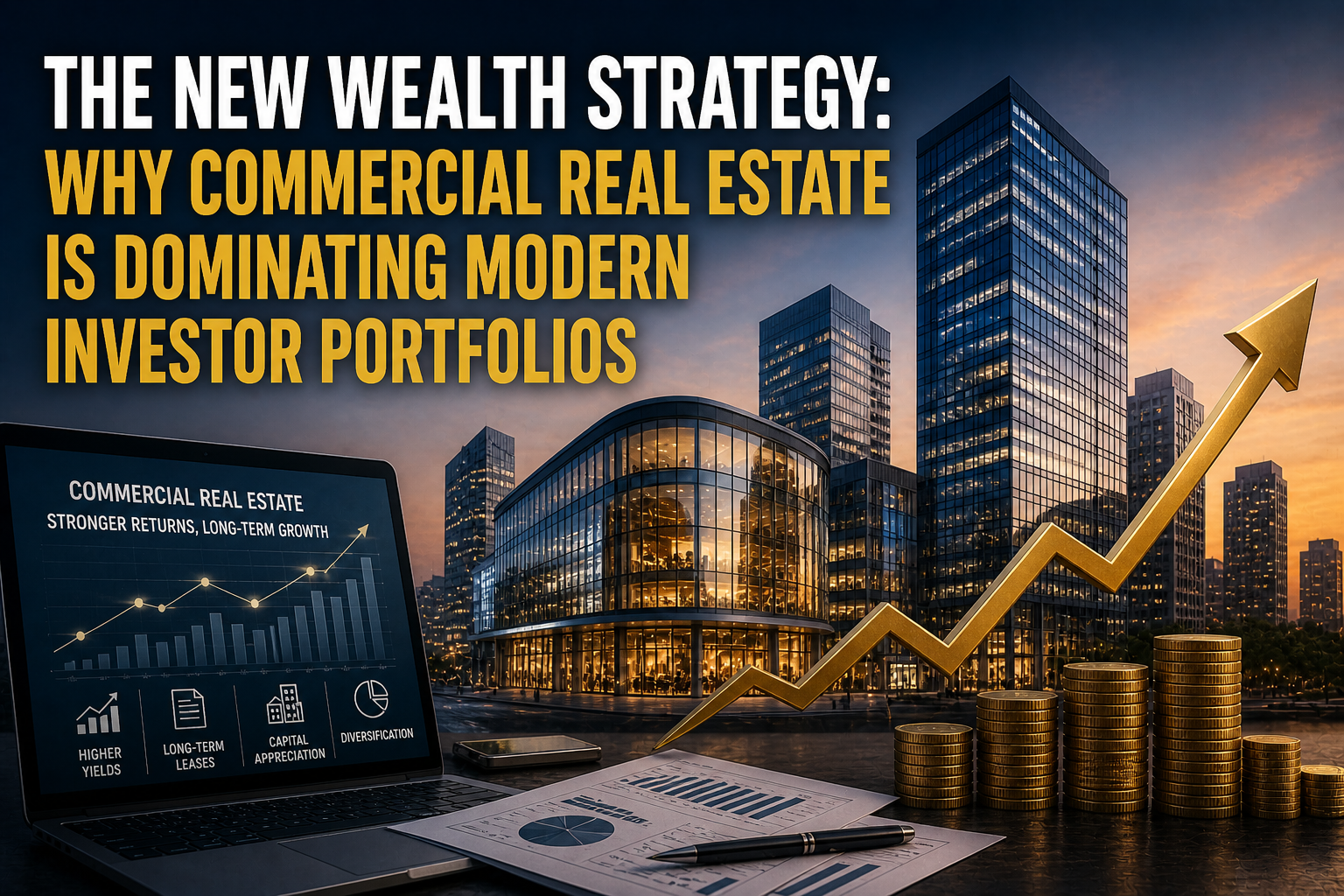
Historically, building a robust real estate portfolio was almost universally synonymous with acquiring residential property. The traditional dream was straightforward and deeply culturally ingrained: purchase a house or an apartment, hold onto it for decades while it slowly appreciates in value, and perhaps lease it out to a family for a modest, albeit sometimes inconsistent, monthly rent. However, the global and domestic investment landscape is currently undergoing a massive, structural paradigm shift. Investors are no longer satisfied with merely parking their hard-earned capital in a static asset and crossing their fingers for long-term appreciation.
Today, there is a highly calculated, aggressive pivot toward commercial real estate. This transition represents a fundamental maturation of how wealth is built, managed, and diversified in the twenty-first-century economy. From gleaming, tech-enabled corporate office parks in major metropolitan hubs to sprawling, highly automated logistics centers positioned on the outskirts of expanding cities, commercial assets are rapidly proving to be dynamic, high-yielding financial instruments. Investors are actively awakening to the reality that real estate can operate as a powerful engine for active, recurring revenue, permanently altering the composition of the modern investment portfolio.
One of the absolute strongest catalysts driving capital toward the commercial sector is the unparalleled visibility of income. When managing a residential property, landlords frequently grapple with the stressful realities of high tenant turnover, sudden unexpected vacancies, and relatively short lease agreements that typically span just eleven months to a year. Conversely, commercial real estate operates on an entirely different, highly institutionalized timeline.
Corporate entities, multinational branded retail chains, and global logistics operators do not want to constantly relocate their business operations. Therefore, they routinely commit to robust, multi-year lease agreements. These commercial contracts frequently span anywhere from five to fifteen years, and crucially, they feature built-in, pre-negotiated rent escalations that serve as an incredible natural hedge against rising inflation.
Furthermore, the caliber of the tenant is vastly different. Institutional and corporate tenants bring a level of professional payment discipline and operational stability that is virtually unmatched in the residential consumer market. Businesses view rent as a non-negotiable operational expense, ensuring that payments are prompt and reliable. For the modern investor—whether that is a seasoned professional meticulously planning for an early retirement or a younger wealth creator aggressively seeking passive income to supplement their primary salary—this level of income predictability is incredibly attractive. Commercial real estate is increasingly being viewed not just as a physical structure made of brick, glass, and mortar, but as a high-performing, income-producing financial asset that reliably delivers steady, recurring cash flows month after month, year after year.
The growing appeal of commercial assets is heavily fortified by broader, undeniable structural changes sweeping through the global and domestic economy. The most prominent and aggressive of these changes is the exponential rise of the e-commerce sector. The digital retail boom has fundamentally altered the mechanics of the global supply chain, triggering a massive, insatiable demand for Grade-A warehousing, ultra-efficient fulfillment centers, and advanced logistics infrastructure.
As modern consumers increasingly demand rapid, sometimes same-day or ten-minute deliveries, businesses are being forced to aggressively optimize their supply chains to meet these towering expectations. This has led to the proliferation of the highly efficient hub-and-spoke logistics model, driving immense demand for massive regional distribution centers and smaller, hyper-localized distribution nodes situated deep within urban neighborhoods.
Consequently, well-located industrial and storage assets situated near major transit corridors and peripheral highways have become some of the most valuable, highly sought-after properties on the open market. Investors who strategically secure a stake in these logistics hubs are essentially capitalizing on the irreversible, permanent shift in global shopping habits. The underlying land value and the lucrative rental yields of these massive industrial spaces are directly, inextricably tied to the relentless, ongoing expansion of the digital economy.
While the global pandemic undoubtedly transformed the traditional office landscape through the widespread introduction of remote and hybrid work models, the predicted death of the physical corporate office was greatly exaggerated. Instead of entirely eliminating their workspace needs, top-tier companies are currently completely rethinking the quality and purpose of their physical environments.
There is a massive, highly visible "flight to quality" currently underway in the commercial sector. Premium corporate offices that boast strong physical and digital connectivity, impeccable sustainability credentials such as advanced energy efficiency certifications, and world-class employee amenities continue to attract massive, high-paying institutional demand. Modern corporations acutely understand that a high-quality, deeply collaborative physical office is now a critical, non-negotiable tool for retaining top-tier talent and fostering in-person innovation.
Simultaneously, the retail real estate sector is undergoing its own spectacular, highly dynamic renaissance. Modern consumers are no longer satisfied with standard, purely transactional shopping trips; they can easily accomplish that online from the comfort of their homes. Instead, they are increasingly drawn to immersive, highly experiential physical spaces. High-street retail destinations and modern, expansive shopping malls that seamlessly combine luxury retail therapy with fine dining, live entertainment, and dynamic social engagement are currently thriving. This evolution supports a massive, sustained demand for highly organized, professionally managed retail destinations in prime urban centers, offering incredibly lucrative, long-term opportunities for investors who back these mixed-use commercial hubs.
Historically, the single most significant deterrent preventing everyday retail investors from entering the lucrative commercial real estate market was the sheer, prohibitive cost of entry. Purchasing an entire corporate office floor or a sprawling retail showroom required an immense, often multi-crore outlay of liquid capital. This immense financial barrier effectively kept the commercial sector tightly locked behind closed doors, accessible only to massive institutional funds, private equity firms, and ultra-high-net-worth individuals.
Today, thanks to sweeping regulatory changes and rapid technological innovation, that financial ceiling has been completely shattered. The rapid advent of structured investment models, Real Estate Investment Trusts, and cutting-edge digital fractional ownership platforms has completely democratized access to the commercial sector. Investors can now seamlessly purchase fractional shares of premium, heavily vetted commercial assets with significantly smaller ticket sizes.
A formalized real estate trust operates much like a mutual fund for property, allowing investors to buy shares of a massive commercial portfolio directly on the stock market, providing unprecedented liquidity to an asset class that was historically highly illiquid. This technological and financial shift has opened the floodgates for first-generation wealth creators, salaried professionals, and younger, highly tech-savvy investors who previously would never have possessed the capital required to consider adding commercial real estate to their portfolios. Through these platforms, everyday investors can now directly reap the massive benefits of high rental yields and long-term capital appreciation without bearing the heavy burden of sole ownership and day-to-day property management.
The surging interest in commercial real estate also deeply reflects a much more mature, sophisticated understanding of modern portfolio diversification. While residential assets undeniably continue to hold immense value—particularly for self-use, legacy building, and emotional security—relying solely on housing for total real estate exposure can lead to a highly unbalanced, vulnerable investment strategy.
The distinction between the underlying economic drivers of the two sectors is highly critical. Residential demand is typically heavily influenced by household affordability, personal consumption decisions, localized job markets, and fluctuating retail mortgage rates. Commercial demand, on the other hand, is intrinsically tied to broad macroeconomic expansion, aggressive corporate growth, organized retail consumption, and global supply chain needs.
Because the fundamental drivers of these two distinct asset classes differ so wildly, commercial properties often behave entirely differently from residential real estate during various economic cycles. They essentially possess a lower correlation to residential market dips. By actively adding commercial exposure to their holdings, investors introduce a highly effective financial buffer against market volatility. This creates a beautifully balanced, highly resilient investment mix where the robust, recurring monthly income from commercial assets acts as a perfect, strategic complement to the slow, long-term capital appreciation of traditional residential holdings.
Another major, highly influential factor accelerating this shift toward commercial property is the profound evolution of investor psychology and expectations. Today’s property buyers are highly data-aware, relentlessly performance-conscious, and extremely financially literate. They actively and meticulously compare real estate returns against other competitive asset classes, such as equities, government debt instruments, mutual funds, and fixed deposits. They demand absolute visibility on projected returns, highly transparent legal and tax structures, and strict, uncompromising professionalism in ongoing asset management.
Commercial real estate, particularly when accessed through formalized platforms or institutional structures, perfectly aligns with these modern, highly analytical expectations. Digital platforms and institutional fund managers now provide instantaneous access to critical data points. Investors can review intricate lease tenures, read detailed tenant quality reports, analyze localized asset performance metrics, and track highly accurate projected income streams right from their personal devices. In the modern era, real estate is increasingly expected to mathematically justify its presence in a portfolio based on hard, verifiable outcomes rather than the speculative, hopeful assumptions that defined the market in previous decades.
As the global economy continues to evolve rapidly, commercial real estate is highly unlikely to ever fully replace residential property in the hearts and minds of investors; housing will always retain its unique, irreplaceable practical and emotional significance. However, the rapidly growing, undeniable appeal of income-generating commercial assets signals a massive, permanent broadening of the traditional investment perspective.
Property is finally being recognized for its unique ability to play multiple, highly diverse roles within a portfolio: serving as essential shelter, driving long-term capital appreciation, generating high-yield recurring income, and providing critical, stabilizing portfolio diversification. As digital access continues to drastically improve and the broader market formalizes, commercial real estate is no longer viewed as an intimidating, alternative asset class reserved only for the elite. Instead, it is firmly taking its rightful place as an essential, completely non-negotiable pillar of a truly modern, resilient, and comprehensive wealth-generating strategy.
