Published On:
July 19, 2026
Updated On:
July 19, 2026
Discover why many residential high-rises skip the 13th floor and how arbitrary floor numbering by developers can lead to severe legal, financial, and resale complications for homebuyers under strict real estate regulations.
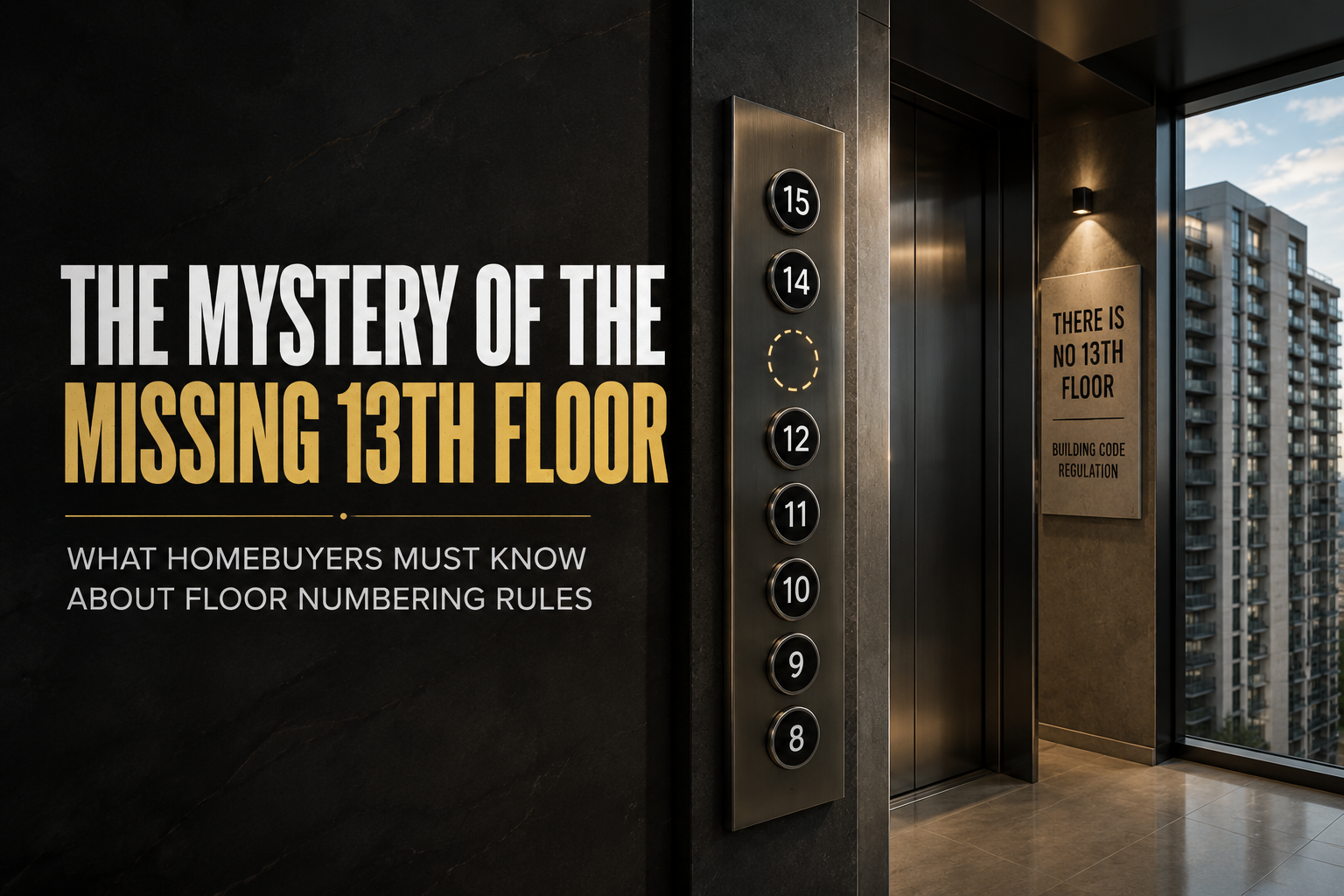
Walk into almost any modern high-rise apartment building, step into the elevator, and take a close look at the button panel. You will likely notice a very specific, almost universally accepted quirk: the numbers jump straight from 12 to 14. Sometimes, the space between is filled by a creatively named 12A or 12B, but the number 13 is completely absent. For decades, this practice has been brushed off as a harmless nod to ancient superstitions, a minor psychological comfort provided by builders to ensure their inventory sells without a hitch.
However, the real estate landscape has evolved, and regulatory frameworks have tightened significantly. What was once considered a harmless marketing tactic has now become a complex compliance issue. Regulatory authorities are increasingly scrutinizing the mismatch between what is approved on official government documents and what is physically painted on the walls of residential towers. For a homebuyer, purchasing a property on a renumbered floor is no longer just a matter of personal belief or preference. It is a decision that can trigger a domino effect of administrative headaches, financing hurdles, and legal roadblocks.
Understanding the mechanics behind floor numbering, the psychology that drives it, and the strict regulatory rules governing it is absolutely essential for anyone looking to invest in a high-rise apartment today.
To understand why a multi-million dollar real estate project would alter its engineering layout for a mere number, one has to look at the deep-seated cultural phobias surrounding the number 13. The fear of this number, known formally as triskaidekaphobia, has strong Western origins. It is deeply tied to historical and religious narratives, most notably the Last Supper, where the 13th guest was the betrayer. Over centuries, literature, cinema, and urban legends amplified this fear, embedding it so deeply into the public consciousness that it began dictating architectural choices across the globe.
Interestingly, this fear does not naturally align with local Indian traditions. In Hindu mythology, the number 13 is actually considered highly auspicious. The 13th day of the lunar fortnight, known as Trayodashi, is dedicated to Lord Shiva, and fasting or worshipping on this day is believed to bring immense prosperity, health, and happiness. Furthermore, traditional Vastu Shastra does not assign any negative attributes to the 13th floor or the number 13 itself.
Despite these local beliefs, the Indian real estate market adopted the practice of skipping the 13th floor largely to cater to a globalised audience. As metropolitan cities saw a boom in luxury high-rises, developers sought to attract Non-Resident Indians (NRIs), multinational corporate tenants, and international investors who might carry these Western superstitions. Builders operate on the principle of minimal resistance. Since a property is an incredibly high-value transaction driven heavily by emotion, developers prefer to eliminate any potential factor that might make a buyer hesitate. Changing a floor number from 13 to 14 costs absolutely nothing during the marketing phase, but failing to sell an entire floor of apartments because of a superstition could cost a developer millions. Consequently, nearly all major builders have historically chosen to simply erase the number from their projects.
While the marketing and sales departments of real estate firms prefer the psychological comfort of skipping the number 13, the legal and town planning departments deal in absolute facts. When a developer submits blueprints to municipal corporations and town planning authorities for approval, those plans must reflect physical reality. Structural engineers design buildings with sequential floors. The government approves a 13th floor, sanctions structural safety for a 13th floor, and assesses environmental impact based on the exact sequential height of the building.
The introduction of the Real Estate (Regulation and Development) Act (RERA) fundamentally changed how developers must handle these approved plans. Under the strict guidelines of RERA, developers are legally bound to adhere exactly to the building plans sanctioned by the competent authorities.
Regulatory bodies have recently made it explicitly clear that developers cannot arbitrarily change floor or flat numbers after obtaining these government approvals. If a sanctioned blueprint shows a 13th floor, the developer cannot legally rebrand it as the 14th floor on the site merely because they fear buyers will not purchase the units. Doing so creates a direct contradiction between the statutory public records and the physical building.
Legal experts heavily emphasize that if a developer wishes to avoid the number 13, they must make that decision at the very inception of the project. During the architectural drafting phase, before any government approvals are sought, the developer can purposefully design the 13th level to house non-residential amenities. They can dedicate the floor to a gymnasium, an indoor clubhouse, open terraces, or, most commonly, the mandatory fire refuge area. By officially designating the floor for common use in the original blueprints, the developer successfully avoids assigning the number 13 to any specific homebuyer's residential unit without violating any legal statutes. Altering the numbers after the plans have been stamped and approved, however, is a direct violation of compliance norms.
For a homebuyer, the consequences of buying an apartment with a disputed floor number can be severely frustrating. The entire real estate transaction process in India relies on a delicate chain of documents, and a single discrepancy can break that chain.
The property registration process requires absolute precision. When you arrive at the sub-registrar's office to register your sale agreement, the government officials cross-reference the details in your deed with the master sanctioned plan provided by the municipal authority. If your sale agreement proudly lists your apartment as Flat 1402 on the 14th floor, but the government's official blueprint states that the physical slab is the 13th floor, the registration can be immediately halted. Government records do not accommodate superstitions. Fixing this discrepancy often requires the developer to issue official rectifications, causing significant delays in legally establishing your ownership.
Banks and housing finance companies are incredibly meticulous when it comes to disbursing funds. Before a bank approves a home loan, it sends two distinct teams to evaluate the property: a legal team and a technical valuation team.
The legal team verifies the title and ensures that the sale agreement perfectly matches the RERA-approved documents. The technical team physically visits the construction site to assess the property's structural stage and value. If the technical evaluator walks up the stairs, counts 13 physical slabs, and finds a door marked 1401, they will flag the property in their system. Financial institutions view these discrepancies as unauthorized deviations from the approved layout. Even a minor numbering mismatch can cause the bank's underwriting department to freeze the loan application, demanding written clarifications from the developer and local municipal bodies before they release a single rupee.
Once you take possession of your home, your relationship with the local municipal corporation begins through the payment of property taxes. Property tax assessments are generated based on the official town planning records. If you reside in an apartment that the builder calls the 14th floor, but the municipal database records it as the 13th floor, your tax bills will forever reflect a unit that technically does not match your registered address. This creates a bureaucratic nightmare when applying for address proofs, updating government IDs, or trying to rectify municipal billing errors.
Electricity boards, piped gas companies, and municipal water departments allocate meters based on the sanctioned floor plans. A mismatch in the floor numbering can lead to utility meters being incorrectly tagged. In large housing societies, this often results in residents receiving electricity bills for the wrong apartment or facing unnecessary bureaucratic hurdles when trying to transfer the utility connections into their own names after taking possession.
The true weight of a floor numbering discrepancy is often felt years down the line when the original homeowner decides to sell the property. In the secondary resale market, the new buyer will appoint their own legal counsel to conduct strict due diligence.
During this vetting process, the new buyer's lawyer will inevitably discover the mismatch between the physical flat number, the registered sale deed, and the original RERA-sanctioned plan. In the eyes of a meticulous lawyer, this is not a harmless quirk; it is a clear title defect. The new buyer's bank will raise the exact same financing hurdles that the original buyer might have barely managed to bypass.
As a result, the resale transaction can easily fall through, or the seller might be forced to lower their asking price to compensate the new buyer for taking on a legally ambiguous property. What started as a developer's attempt to avoid bad luck ultimately transforms into a very real financial misfortune for the homeowner trying to liquidate their asset.
Beyond the paperwork, arbitrary floor numbering can intersect dangerously with building safety codes. High-rise buildings are legally mandated to have designated refuge areas—open spaces where residents can safely gather in the event of a fire or emergency. These refuge areas are strictly mapped out in the sanctioned blueprints and are heavily relied upon by the local fire department.
Sometimes, developers attempt to resolve the 13th-floor dilemma by declaring it a refuge floor on paper, but later try to partially convert the space into saleable units or shuffle the refuge areas around to make the numbering look better to prospective buyers. Compromising or relocating fire safety zones without official re-sanctioning is a severe structural and legal violation. Emergency responders operate based on the approved structural plans. If a fire breaks out, rescue teams will navigate the building based on the official floor count, not the arbitrary numbers pasted next to the elevator doors. Ensuring that your building's numbering aligns with the safety blueprints is quite literally a matter of life and death.
Real estate investments require vigilance. If you are considering purchasing an apartment in a high-rise, especially on the floors immediately above the 12th level, there are several steps you must take to safeguard your financial and legal interests.
First, do not rely on the developer's marketing brochures or the building's elevator panel. Visit the official RERA portal for your respective state and search for the project's registration number. From there, you can download the actual government-sanctioned building plans. Cross-reference the floor layout in these official documents with the exact apartment number you are being offered.
Second, conduct a physical verification if the building is under construction or nearing completion. Walk up the stairwell and physically count the structural slabs from the ground floor upward. Ensure that the physical slab you are standing on corresponds perfectly with the floor number printed on your allotment letter.
Third, pay close attention to the documentation. Your Sale Agreement, the RERA-approved plan, your future property tax receipts, and the housing society records must all tell the exact same story. There is absolutely no room for creative numbering in legal contracts.
Finally, if you find yourself purchasing a unit where the numbering skips the 13th floor, instruct your legal counsel to draft a strict indemnity clause into the sale agreement. This clause must explicitly state that the developer takes full legal and financial responsibility for rectifying any future disputes, tax defects, or registration complications that may arise due to the mismatch between the sanctioned plans and the adopted numbering scheme. Regulatory authorities have noted that it is the promoter's duty to rectify such defects, but having it clearly outlined in your personal agreement provides an immediate legal shield.
Investing in real estate is about securing a tangible, structurally sound asset backed by bulletproof paperwork. While cultural beliefs and superstitions will always play a role in human decision-making, they should never be allowed to overwrite statutory laws. A home with flawless legal compliance will always offer more peace of mind—and a better return on investment—than a legally flawed apartment masquerading under a lucky number.
