Published On:
March 2, 2026
Updated On:
March 2, 2026
While a swimming pool is marketed as the ultimate symbol of luxury in modern gated communities, it often becomes an underutilized financial drain for homeowners. Buyers end up paying a hefty upfront premium for pool-facing views and significantly higher lifetime maintenance costs for an amenity driven more by aspiration than actual daily usage.
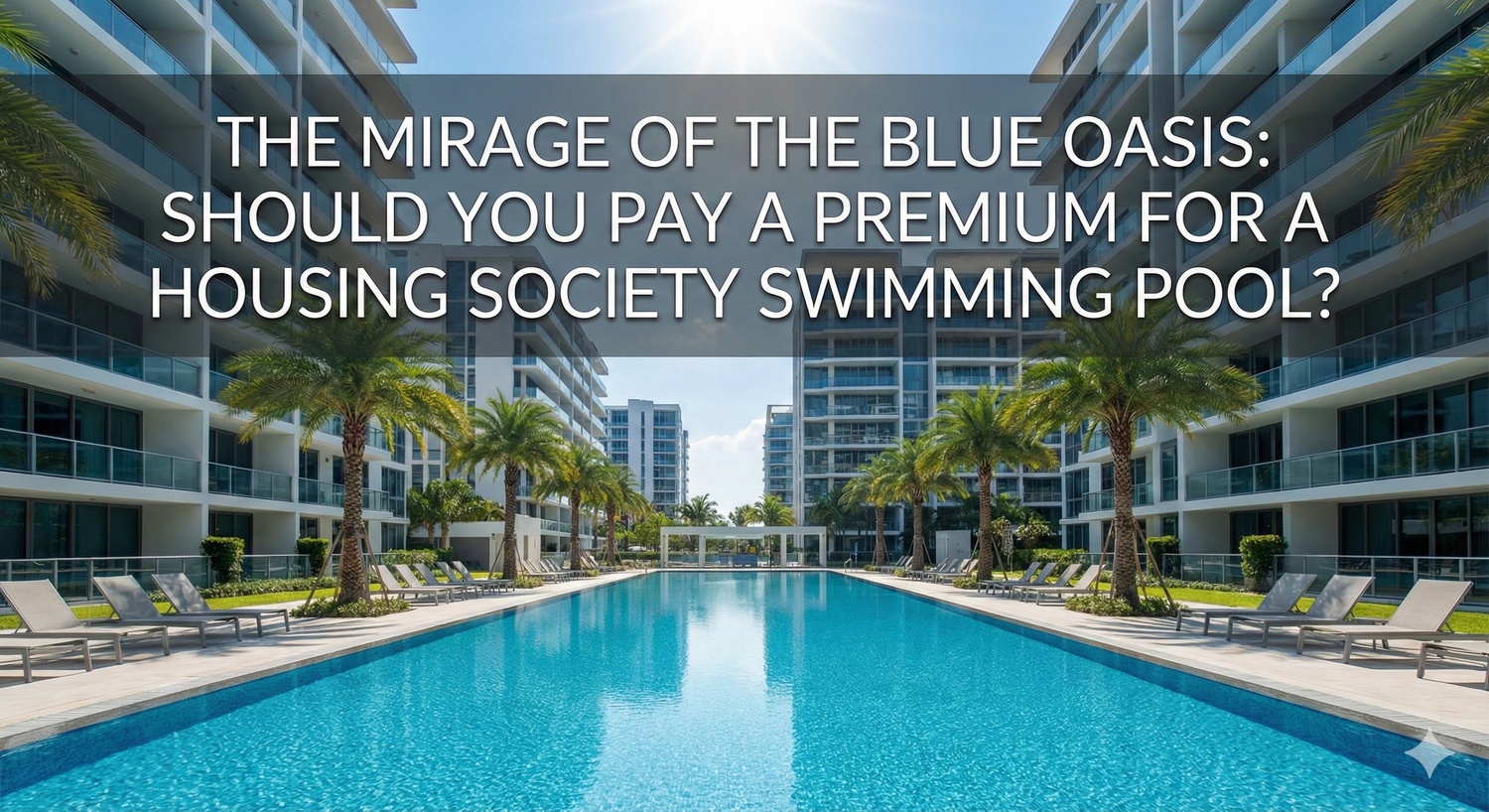
Flip through any real estate brochure today, and you will inevitably be greeted by the exact same image. A sparkling, crystal-clear swimming pool, captured from a sweeping aerial angle, perfectly framed by sleek sun loungers, mood lighting, and lush landscaping. It is the ultimate visual shorthand for arrival. It tells the prospective buyer that they are not just purchasing an apartment; they are buying into an exclusive, upgraded lifestyle.
But as the Indian real estate market matures and buyers become more financially astute, a very grounded, practical conversation is beginning to surface. People are starting to look past the glossy marketing materials and ask a hard-hitting question: if every premium housing society promises a resort-style pool, why do so many of them sit completely empty just a few months after the residents move in?
The reality of gated community living often starkly contrasts with the dream sold during the site visit. Buying a home with high-end amenities requires a deep dive into behavioral psychology, financial planning, and the long-term realities of property management. It is time to unpack whether paying a massive premium for a swimming pool is a sound real estate investment, or simply an expensive trap fueled by aspiration.
To understand why swimming pools are so ubiquitous in modern residential projects, you have to understand the psychology of the urban homebuyer. In India, access to a private or semi-private swimming pool has historically been associated with extreme exclusivity, usually restricted to elite clubs, five-star luxury hotels, or ultra-high-net-worth standalone villas. By placing a pool in the center of a high-rise development, builders are democratizing that feeling of wealth and upward mobility.
In highly competitive micro-markets where multiple developers are offering similar floor plans, identical carpet areas, and the same geographic advantages, a swimming pool becomes the ultimate differentiator. It enhances the perceived value of the property immensely during a site visit.
There is also a deeply ingrained behavioral phenomenon at play here. When people buy a new home, they are often purchasing a vision of their idealized future selves. They envision waking up at dawn, doing an hour of laps, and starting their workday energized and exceptionally fit. The pool represents health, leisure, and family bonding. Furthermore, in the age of social media, the aesthetic value cannot be ignored. The presence of a beautifully lit pool elevates the status of the entire society, providing a perfect backdrop for entertaining guests and sharing lifestyle updates online.
However, the gap between aspiration and habit is massive. The harsh reality of urban living—long commutes, demanding corporate jobs, and exhausting daily routines—quickly sets in. The grand plans of daily swimming usually devolve into a vague promise to start next weekend, which eventually turns into never. Within a year of project handover, a massive body of water meant to serve hundreds of families is often utilized by a mere fraction of the residents.
The financial impact of a swimming pool hits the buyer's wallet long before they ever dip a toe in the water. Developers monetize this amenity aggressively right from the primary sales phase through something known as Preferential Location Charges.
If you have ever negotiated for an apartment in a premium high-rise, you know that not all flats are priced equally, even if they share the exact same square footage and layout. Apartments that offer an unobstructed view of the central courtyard and the swimming pool command a massive price premium over units facing the outer boundary wall, the main road, or a neighboring building.
Market data from major tech and corporate hubs like Bengaluru, Gurugram, and Pune illustrates this starkly. In many premium projects, a standard road-facing unit might be priced at a baseline of roughly ₹1.1 crore. However, the exact same unit, situated on the same floor but facing the internal swimming pool, can easily be priced at ₹1.25 crore to ₹1.3 crore.
This represents an immediate, upfront premium of nearly ten to fifteen percent purely for the view and the perceived lifestyle appeal. Buyers eagerly take on larger home loans, paying higher interest over twenty years, simply to look down at an amenity they may rarely use. From an investment standpoint, you are effectively paying a luxury tax on your capital before the property has even had a chance to appreciate.
The true cost of a housing society swimming pool is not the upfront premium; it is the relentless, recurring maintenance bill. A pool is an active, demanding piece of infrastructure. It is not like a jogging track or a badminton court that requires occasional sweeping and a fresh coat of paint every few years.
Maintaining a large, commercial-grade pool requires running heavy-duty filtration plants daily, purchasing expensive chemicals to balance the water's pH levels, regular deep cleaning, and hiring certified lifeguards and dedicated facility staff. When you buy into a society with these amenities, you are signing a legally binding contract to subsidize these operational costs for as long as you own the property, regardless of whether you ever step foot in the water.
Real estate management data shows that the presence of a swimming pool and an adjoining high-end clubhouse typically inflates the overall maintenance charges of a society by a staggering 15 to 20 percent. Depending on the city and the exact nature of the project, maintenance is usually calculated on a per-square-foot basis, ranging anywhere from ₹3 to over ₹10 per square foot per month in premium complexes. For a spacious 2,000 square foot apartment, a resident could easily be paying upwards of ₹10,000 to ₹15,000 every single month just in maintenance dues.
Furthermore, there is a hidden tax implication that catches many first-time buyers off guard. Under current tax regulations, if your monthly housing society maintenance bill exceeds ₹7,500, the entire amount becomes subject to an 18 percent Goods and Services Tax. Because water-heavy amenities push base maintenance costs incredibly high, residents often find themselves breaching this ₹7,500 threshold, instantly triggering an additional 18 percent tax burden on their monthly household budget. This transforms an aspirational luxury into a significant, perpetual financial drain.
The financial strain of maintaining a pool inevitably leads to complex operational challenges once the builder hands over the project to the Resident Welfare Association. When a society is brand new, the builder usually maintains the facilities to drive remaining sales. The water is pristine, the lighting is perfect, and the lifeguards are attentive.
However, once the residents take over the financial reins, the dynamics change entirely. An RWA operates on the collective funds of the homeowners. When the annual general body meetings take place, budgets are scrutinized. If only ten percent of the residents are actively using the pool, the other ninety percent will eventually object to the massive chunk of the maintenance budget being diverted to water filtration and chemical treatments.
This creates a dangerous cycle of neglect. To cut costs and keep monthly maintenance fees from skyrocketing, management committees often begin to compromise. They might reduce the hours the filtration plant runs, switch to cheaper, lower-quality cleaning chemicals, or let go of the full-time lifeguard.
The moment the upkeep drops, the pool becomes a liability. Poorly maintained pools are notorious breeding grounds for bacteria, leading to severe hygiene concerns, waterborne illnesses, and skin infections. As the water quality deteriorates, even the few dedicated swimmers stop using it. The amenity essentially becomes an expensive, stagnant pond that nobody wants to pay for, yet nobody can legally fill in or remove.
For buyers looking at real estate purely from an investment and rental yield perspective, heavy amenities require a very careful mathematical calculation.
It is absolutely true that premium amenities attract a specific demographic of high-paying tenants, particularly young corporate professionals, expatriates, and double-income families who want a resort-like lifestyle without the burden of ownership. A flat in a fully loaded society will almost always rent out faster than a standalone building.
However, high rental demand does not automatically equal high profitability. As an investor, your net rental yield is your annual rent minus your expenses. If you are paying exorbitant monthly maintenance charges—which are almost entirely driven by the upkeep of the pool, the gym, and the clubhouse—those costs eat directly into your rental income. If the market experiences a downturn or a tech industry layoff wave forces tenants to seek cheaper housing, you might have to lower your rent to keep the flat occupied. But the RWA will never lower the maintenance bill. In many cases, investors find that the capital appreciation of pool-facing flats eventually plateaus, and the high carrying costs make the asset incredibly inefficient.
Interestingly, the broader real estate market is slowly beginning to wake up to this reality. While ultra-luxury projects will always feature massive aquatic zones, the mid-to-premium segment is witnessing a subtle shift in what buyers prioritize.
Savvy homebuyers and progressive developers are starting to pivot toward amenities that offer massive lifestyle value but require a fraction of the upkeep. There is a growing emphasis on space efficiency and sustainable community living. For instance, developers are increasingly repurposing awkward leftover spaces or podium levels to build multi-purpose sports courts.
Activities that require minimal infrastructure, low water usage, and virtually zero daily operational costs are taking precedence. We are seeing a rise in dedicated yoga pavilions, extensive, well-lit walking tracks, open-air calisthenics parks, and beautifully landscaped community gardens. These features cater to the everyday, practical wellness routines of the vast majority of residents without burying the RWA under crippling utility bills.
When you are standing on the balcony of a sample flat, looking down at a beautifully rendered concept of a swimming pool, it is incredibly easy to let emotion override financial logic. But buying a home is a decades-long commitment, and it requires brutal honesty about your own lifestyle.
Before paying a premium for an amenity-heavy project, ask yourself a few grounding questions. Do you currently swim on a regular basis? If you don't do it now, simply having a pool in your basement is unlikely to permanently alter your behavior. Are you comfortable with the fact that your monthly maintenance bill will steadily increase every year due to inflation, labor costs, and the inevitable wear and tear of aquatic equipment?
More importantly, demand complete transparency from the developer regarding the maintenance calculations. Ask for the exact per-square-foot charges, clarify whether the quoted amount includes or excludes GST, and understand exactly what percentage of that fee is allocated to the clubhouse and pool.
Owning a home in a premium society is a fantastic achievement that should bring peace of mind, not financial anxiety. By separating the glossy marketing illusions from the practical realities of urban living, you can ensure that your hard-earned capital is invested in a property that actually serves your daily needs, protects your long-term wealth, and doesn't leave you paying a lifetime premium for a luxury you will never use.
