Published On:
May 3, 2026
Updated On:
May 3, 2026
By July 2026, the strategic linkages connecting the massive Ganga Expressway to both the Delhi-Mumbai Expressway and the holy city of Haridwar will fundamentally transform North India's transit landscape, drastically cutting travel times and triggering an unprecedented real estate surge across the Noida Extension, Yamuna Expressway, and Meerut corridors.
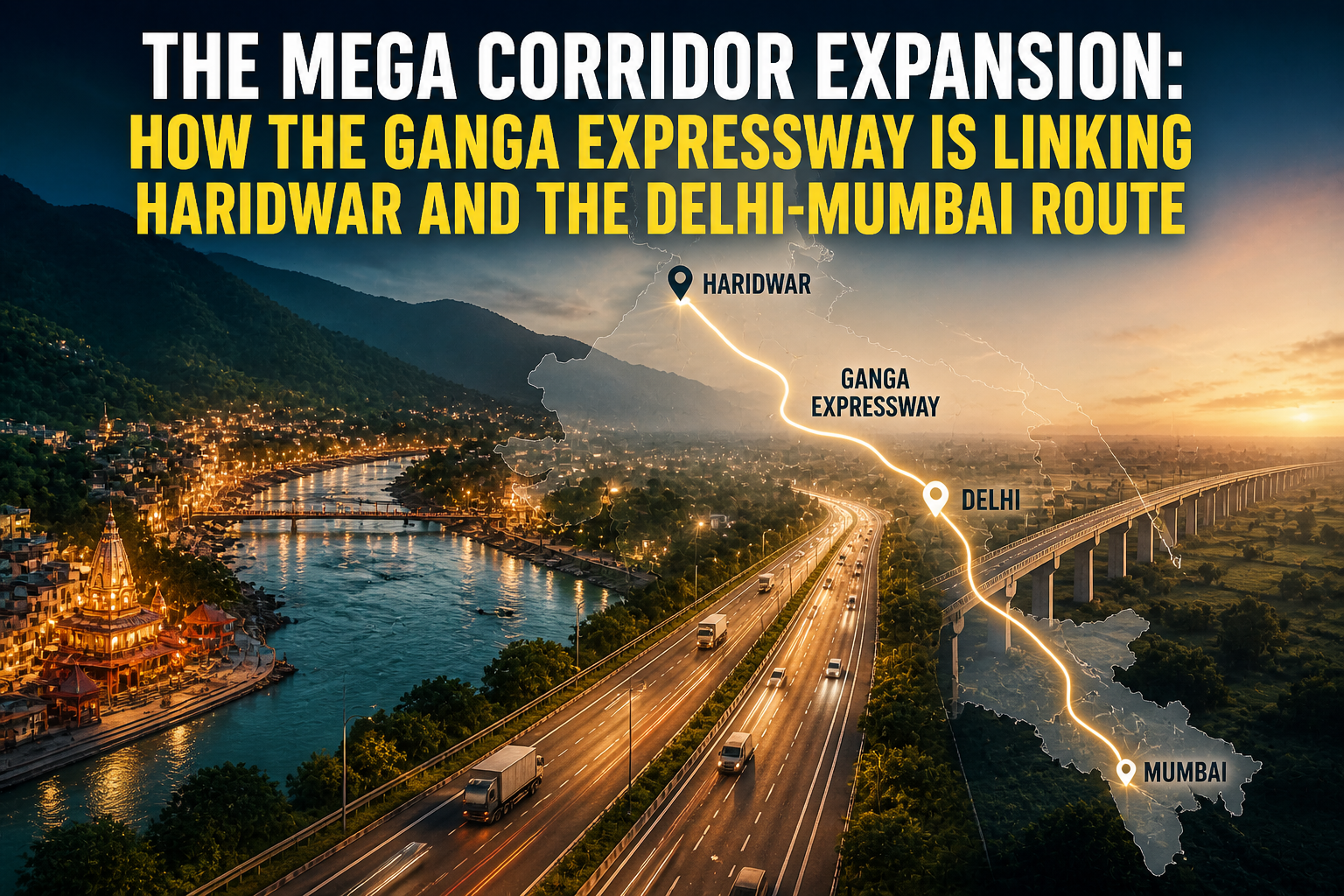
The geographic and economic map of North India is currently undergoing a structural makeover of unprecedented scale. Following the recent and highly anticipated inauguration of the massive 594-kilometer Phase-1 of the Ganga Expressway connecting Meerut to Prayagraj, the infrastructure focus has immediately pivoted toward an even more ambitious expansion. Slated for crucial completions by July 2026, the National Highways Authority of India and state regulatory bodies are rapidly finalizing critical linkages that will seamlessly connect this giant six-lane greenfield highway directly to the Delhi-Mumbai Expressway in the south and the holy city of Haridwar in the north.
For decades, navigating the sprawling heartland of Uttar Pradesh to reach the western coastal ports or the mountainous religious retreats of Uttarakhand involved enduring heavily congested state highways, endless toll plazas, and navigating through the notorious traffic choke points of the National Capital Region. This upcoming, multi-directional connectivity matrix entirely eliminates these historical bottlenecks. By creating high-speed, access-controlled bypasses, the state is not merely building roads; it is engineering a highly fluid economic zone that will redefine commercial logistics, supercharge regional tourism, and trigger massive capital appreciation across targeted real estate micro-markets.
The most economically significant component of this expansive infrastructure web is the highly engineered, multi-kilometer bridge and link-road network designed to fuse the Ganga Expressway with the Delhi-Mumbai corridor. At the heart of this integration lies the planned 74.3-kilometer Ganga-Yamuna Expressway, a critical spur extending from Siyana near Bulandshahr directly to the bustling Pari Chowk interchange in Greater Noida. This specific spur is an absolute masterstroke of regional transit planning, as it provides seamless, high-speed connectivity straight into the Yamuna Expressway, the rapidly developing Noida International Airport at Jewar, the Eastern Peripheral Expressway, and ultimately, the massive Delhi-Mumbai Expressway.
Why is this specific linkage so critical to the national economy? Currently, heavy freight transporters and long-distance commercial commuters traveling from the agrarian and manufacturing hubs of central and eastern Uttar Pradesh must violently reduce their speed and crawl through the saturated traffic ecosystems of Delhi or the Gurgaon toll borders to reach the western logistics corridors. The new linkage acts as a massive, high-speed bypass loop. Commercial traffic can now transition seamlessly from the UP heartland directly onto the Mumbai-bound corridor without ever touching the congested capital center. Once this route fully opens in July 2026, the flow of raw materials, manufactured goods, and cold-storage agricultural yields to the massive ports in Maharashtra and Gujarat will be exponentially faster, drastically reducing supply chain overheads and commercial vehicle turnaround times.
Simultaneously, the northern trajectory of the project is set to completely revolutionize one of the most heavily trafficked pilgrimage routes in the country. Under the banner of the Upper Ganges Canal Expressway, an eight-lane extension is actively carving its way from the Bulandshahr and Meerut junctions straight into Haridwar, Uttarakhand. For the millions of domestic and international devotees who undertake the journey to the sacred river ghats every year, the historical nightmare of navigating narrow, tractor-choked village roads is rapidly coming to an end.
To ensure an absolutely frictionless transit experience, structural engineers have constructed massive elevated sections specifically around the Meerut junction. By physically elevating the expressway over local village intersections and regional district roads, the highway removes the need for travelers to constantly slow down for localized, rural traffic. The ultimate goal of this northern spur is to transform the arduous, half-day struggle of reaching the Uttarakhand border into a smooth, highly predictable two-hour cruise. This dramatic reduction in travel fatigue is expected to trigger a massive, year-round surge in religious and wellness tourism, heavily benefiting the hospitality and retail sectors in and around Haridwar and Roorkee.
While the massive elevated corridors and expansive multi-lane stretches dominate the visual landscape, some of the most impressive engineering feats of this project are completely hidden from the public eye. Recognizing the inherent risks associated with sustained, 120-kilometer-per-hour travel across vast, isolated stretches of northern India, authorities have integrated highly advanced, specialized safety infrastructure directly into the highway's design.
Along the new link roads connecting to the Mumbai corridor, engineers have meticulously constructed six entirely unmarked exits. These distinct ramps are completely restricted from public use and will not appear on standard consumer GPS navigation systems. Instead, they serve as dedicated, high-tech access points exclusively for state-operated mobile emergency hospitals and specialized trauma vans. In the event of a severe vehicular collision, this hidden safety network ensures that advanced medical support can bypass all standard traffic and enter the expressway to reach any accident site within a strict, eight-minute response window. It is a brilliant, invisible layer of civic infrastructure that prioritizes the preservation of human life without disrupting the high-speed flow of the main commercial arteries. Furthermore, the inclusion of a 3.5-kilometer emergency landing airstrip in the Shahjahanpur district adds a profound layer of national security and disaster response capability to the route.
It is an established economic law that large-scale, functional infrastructure invariably turns the surrounding land into highly lucrative real estate. The impending July 2026 completion of these specific linkages is already sending massive shockwaves through the regional property markets, fundamentally altering where institutional capital and retail homebuyers are choosing to invest their wealth.
Nowhere is this hyper-growth more apparent than in the Noida Extension and Greater Noida micro-markets. Because the newly proposed linkages funnel massive traffic flows directly into Pari Chowk, these specific zones are rapidly transforming into the absolute zero point for northern highway connectivity. If a commercial enterprise or a residential homebuyer secures a property in this exact radius, they are instantly, physically connected to everywhere—from the financial capital in the west to the religious centers in the north, and the manufacturing heartlands in the east. Consequently, the demand for premium plotted developments, luxury high-rises, and commercial retail spaces in Greater Noida is experiencing an unprecedented, highly aggressive surge.
Similarly, the western terminus of Meerut is shedding its historical status as a massive, congested satellite town and is rapidly emerging as a highly organized, premium residential anchor. As the physical starting point for both the Prayagraj stretch and the Haridwar spur, the demand for property in Meerut has completely skyrocketed. Savvy real estate investors and large-scale developers are actively acquiring massive land parcels on the city's outskirts, recognizing that these new roads are the permanent, unshakeable economic lifelines of the state. The ability to live in a highly affordable, rapidly modernizing Meerut township while maintaining an incredibly fast, stress-free commute to an NCR-based corporate office or the Jewar Airport is an incredibly attractive proposition for the modern Indian workforce.
The linkage at Pari Chowk does more than just connect two asphalt roads; it entirely revitalizes the Yamuna Expressway Industrial Development Authority region. The entire YEIDA zone was already gaining immense global traction due to the ongoing construction of the Noida International Airport, but the ability for the Ganga Expressway to feed direct, uninterrupted traffic into this zone acts as an ultimate force multiplier.
Investors who have carefully tracked the trajectory of plot lands and commercial acquisitions in the YEIDA sectors understand that this is a massive wealth-creation event. As massive streams of commercial vehicles and high-net-worth travelers transition from the eastern UP heartland into the Greater Noida grid, the necessity for high-end hospitality, retail avenues, and expansive corporate parks along the Yamuna Expressway becomes an absolute certainty. The strategic advantage of holding assets in a region perfectly sandwiched between the largest aviation hub in the country and the most expansive highway network in the state simply cannot be overstated.
Beyond the immediate residential boom, the fusion of the Ganga Expressway with the Delhi-Mumbai route is aggressively supercharging the commercial warehousing and logistics sectors. Historically, massive corporate distribution centers were forced to cluster tightly around the immediate borders of Delhi or Gurgaon, leading to hyper-inflated land costs and severe operational congestion. The new connectivity paradigm entirely disrupts this outdated model, actively promoting a highly decentralized, corridor-based approach to industrial growth.
State development authorities have explicitly designated vast tracts of land along the expressway alignment for the creation of massive Integrated Manufacturing and Logistics Corridors. Over 2,600 hectares have been formally earmarked across the route, specifically targeting the establishment of Grade-A warehousing facilities, highly advanced cold-storage networks, and specialized agro-processing units. Because the new highway linkages seamlessly connect these deep-state agricultural belts directly to the rapid freight corridors heading toward Mumbai, farmers and regional manufacturers can export their highly perishable yields to global markets exponentially faster. This direct, frictionless access ensures far better price realization for local agricultural outputs and significantly lowers the crippling logistical costs that have historically hampered the northern industrial sector.
Beyond the vast amounts of concrete and the massive capital investments, the entire Ganga Expressway and its upcoming linkages are being constructed with a heavy, uncompromising emphasis on ecological sustainability and smart highway management systems. As a pure greenfield corridor—meaning it is built entirely from scratch on previously undeveloped land rather than merely widening an old, existing road—civil engineers were given a blank canvas to implement the highest global standards of environmental preservation.
The route features extensive, continuous green belts, with millions of native saplings actively being planted along the massive median and the broad highway shoulders to actively mitigate vehicular emissions and reduce the overall carbon footprint of the massive projected traffic volume. Furthermore, the entire stretch connecting Meerut to Prayagraj, and the subsequent spurs to the Delhi-Mumbai Expressway and Haridwar, are strictly governed by advanced, state-of-the-art traffic management systems. High-definition surveillance cameras, automated speed detection radars, and electronic toll collection grids are deeply integrated into the sophisticated fiber-optic network running right beneath the asphalt. This ensures that the 120-kilometer-per-hour design speed is safely regulated, regional traffic flow is continuously monitored from central command stations, and any vehicular breakdowns or accidents are instantly flagged for the hidden emergency response teams.
The upcoming completion of the Haridwar and Delhi-Mumbai linkages to the massive Ganga Expressway represents a true watershed moment in Indian infrastructure development. It is a definitive transition away from localized, fragmented road building toward the creation of a massive, highly integrated, and deeply intelligent continental grid.
By drastically reducing regional transit times, implementing world-class hidden safety protocols, and providing direct, high-speed access to the country's most critical economic corridors, this mega-project is actively laying the permanent groundwork for a modernized, unstoppable northern economy. For the millions of travelers heading to the spiritual centers of Uttarakhand, the massive fleets of commercial trucks supplying the western ports, and the thousands of real estate investors securing plots in Greater Noida, YEIDA, and Meerut, the message is overwhelmingly clear. The geographic friction that once defined travel and commerce in Uttar Pradesh is rapidly dissolving, making way for a highly connected, fiercely competitive, and exceptionally prosperous economic future.
