Published On:
March 2, 2026
Updated On:
March 2, 2026
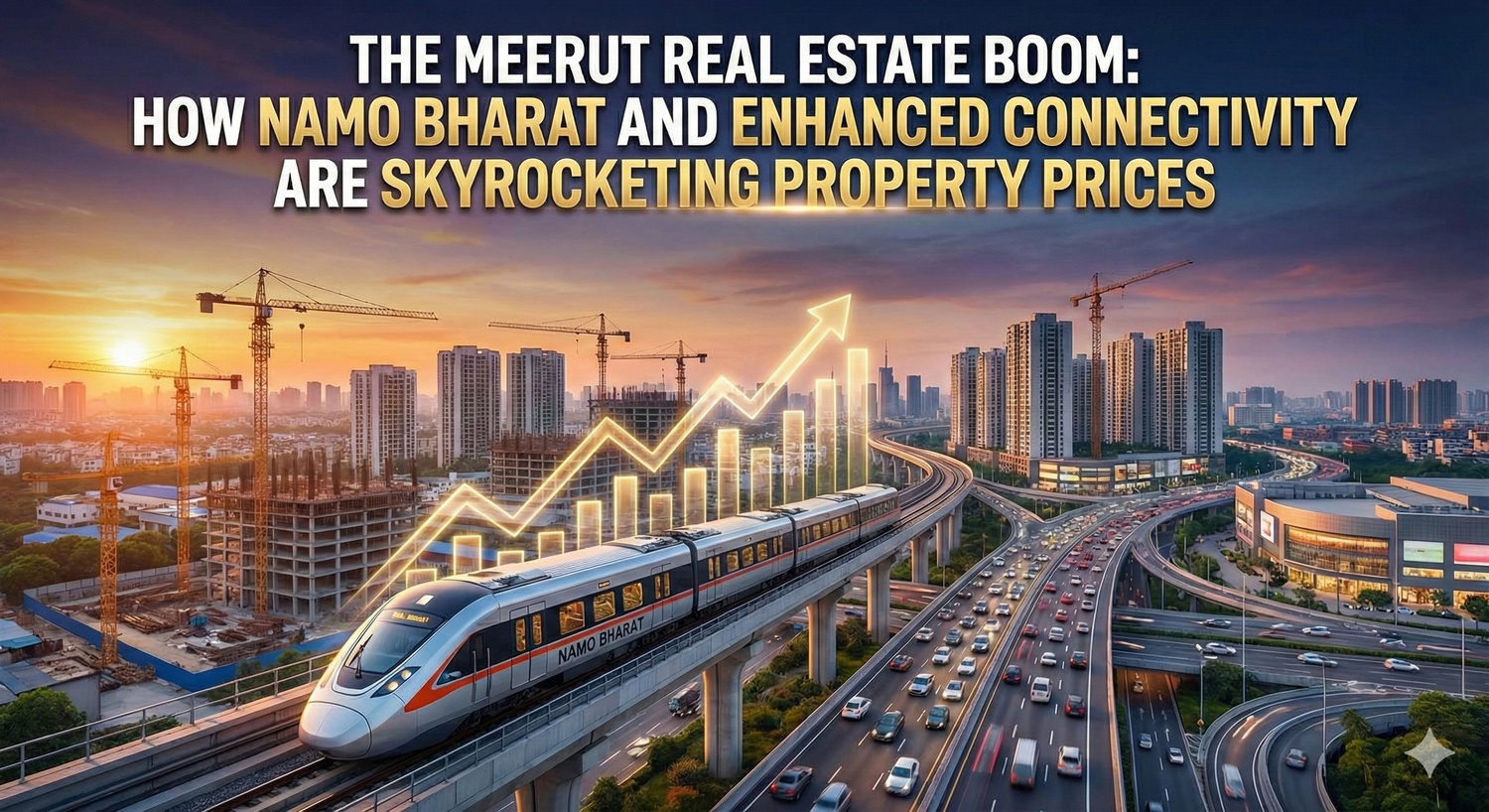
The full operationalization of the Namo Bharat RRTS and the Delhi-Meerut Expressway has ignited an unprecedented real estate boom in Meerut, driving property values up by as much as 67 percent. By slashing travel times to the National Capital to under an hour, these monumental infrastructure projects are transforming Meerut from a distant Tier-2 city into a premier, high-growth investment hub driven by transit-oriented development.
For decades, the real estate narrative of the National Capital Region was heavily monopolized by the rapid, towering expansions of Gurugram and Noida. These financial and technological hubs absorbed the lion's share of corporate investments and residential demand, pushing peripheral cities further into the background. Meerut, despite its historical significance and vast land banks, was largely considered a distant Tier-2 city. It was a place burdened by notoriously congested highways and grueling commute times, making it entirely impractical for the modern professional working in central Delhi or the broader NCR to consider as a primary residence.
However, the year 2026 has completely rewritten this geographical and economic narrative. A monumental shift is underway in western Uttar Pradesh, driven by a series of aggressive, large-scale infrastructural milestones. The city is currently experiencing an unprecedented real estate renaissance, transitioning from a sleepy suburban outlier into a high-octane investment destination. This transformation is not the result of speculative trading or temporary market exuberance; it is a structural, permanent revaluation of the land driven by physical connectivity. The geographical divide between the national capital and Meerut has been bridged, and the local property market is reacting with explosive upward momentum.
To understand the sheer magnitude of the property boom in Meerut, one must look at the twin infrastructural engines powering it. The first major catalyst was the operationalization of the Delhi-Meerut Expressway. This sprawling, multi-lane greenfield project fundamentally altered road travel in the region. By bypassing the historically choked urban bottlenecks of Ghaziabad and Modinagar, the expressway slashed what used to be an unpredictable three-hour nightmare into a smooth, seamless forty-five-minute drive. For the first time, seamless logistical movement between Meerut and Delhi became a tangible reality.
Yet, it is the recent, full operationalization of the Namo Bharat Regional Rapid Transit System (RRTS) that has truly set the real estate market on fire. Spanning over eighty-two kilometers, this high-speed, state-of-the-art rail network is an engineering marvel designed to redefine regional mobility. Operating at staggering speeds, the Namo Bharat trains allow commuters to traverse the distance between Delhi's Sarai Kale Khan and Meerut's Modipuram in under an hour. Furthermore, the integration of the local twenty-three-kilometer Meerut Metro—which shares infrastructure with the RRTS—ensures that internal city mobility is just as efficient.
This is no longer just about building faster trains; it is about altering the foundational "distance versus time" equation that governs real estate valuations. When travel time is reduced so drastically, geographical distance becomes irrelevant. Meerut has effectively been absorbed into the viable commuter belt of the National Capital, and the financial markets are aggressively pricing in this new reality.
The financial impact of this connectivity on Meerut's ground-level real estate has been nothing short of staggering. Over the past two to three years, the property market has witnessed a parabolic rise in valuations, leaving many early investors sitting on massive equity gains. Recent e-auctions conducted by state housing development councils serve as the perfect barometer for this soaring demand. In several instances, residential and commercial land parcels have witnessed record-breaking bids, with final sale prices completely obliterating the initial reserve rates. Plots that were reserved at roughly thirty-five lakhs have been fiercely contested and sold for upwards of sixty-five lakhs. In the most highly sought-after transit zones, land bids have crossed the astonishing threshold of one and a half lakh rupees per square meter.
Looking at the broader market metrics, the baseline land rates in Meerut have undergone a complete repricing. Just a few years ago, premium land in the city was trading anywhere between eight thousand to twelve thousand rupees per square yard. Today, those same parcels are commanding prices ranging from twelve thousand to well over twenty thousand rupees per square yard, with specific micro-markets experiencing even higher premiums.
The appreciation is particularly aggressive within the immediate vicinity of the new transit hubs. Properties located within a two-kilometer radius of Namo Bharat stations have recorded a value appreciation of anywhere between thirty percent to sixty-seven percent. This hyper-localized surge is a textbook example of infrastructure-led demand, where proximity to high-speed transit directly correlates with exponential capital growth.
While the entire city is benefiting from the infrastructural uplift, the capital is heavily concentrating on five specific real estate zones that are poised to become the modern hubs of Meerut.
Modipuram stands at the absolute forefront of Meerut’s real estate revolution. Its designation as the terminal point for the Delhi-Meerut RRTS has instantly transformed it into the city's most influential and highly tracked property market. Modipuram is transitioning rapidly from an industrial and educational pocket into a high-density residential and commercial powerhouse. The area is witnessing heavy inquiries from national-level developers looking to aggregate land for luxury high-rises and integrated commercial centers.
Strategically located close to national highways, Pallavpuram is soaking up the demand for well-planned, mid-to-high density residential housing. Its direct road connectivity to central Meerut and Ghaziabad makes it a highly practical choice for growing families. Furthermore, the established presence of recognized educational institutions and healthcare facilities provides the necessary social infrastructure that long-term homebuyers demand, ensuring steady property appreciation without the volatility of purely speculative markets.
For buyers seeking regulatory safety and structured living, Ganga Nagar has emerged as a premium destination. Governed strictly by the local development authority, this township zone boasts clearly demarcated residential, institutional, and commercial sectors. Its wide, well-planned road networks, abundance of public parks, and readily available civic amenities make it the perfect environment for families looking to escape the congested neighborhoods of older city centers.
Unlike the emerging peripheral zones, Shastri Nagar represents Meerut’s mature, developed urban core. While it may not offer the massive land parcels required for sprawling new townships, it retains immense value due to its established ecosystem. The heavy presence of government hospitals, premier educational centers, and administrative offices ensures that Shastri Nagar remains a highly coveted address for those who prioritize immediate access to top-tier civic infrastructure and long-term neighborhood stability.
The Meerut Bypass and the NH-58 corridor represent the future of large-scale, highway-led urban development. This stretch is a natural magnet for massive capital deployment. The sheer availability of land allows developers to conceptualize and execute massive integrated townships, specialized logistics hubs, and mixed-use commercial projects. With excellent feeder connectivity to the RRTS stations, the NH-58 corridor is widely considered the most future-ready investment zone for those looking at a ten-to-fifteen-year wealth creation horizon.
The driving philosophy behind Meerut’s rapid modernization is Transit-Oriented Development, a globally proven urban planning model that maximizes the amount of residential, business, and leisure space within walking distance of public transport. The local development authorities have recognized the transformative power of the Namo Bharat project and have proactively aligned their master plans to support it.
Over three thousand hectares of land have been specifically earmarked for TOD in the city's long-term master plan. This allows developers to utilize a much higher Floor Area Ratio, enabling the construction of taller residential towers and denser commercial complexes right next to the transit nodes. By actively promoting mixed-use zoning, the city is moving away from the outdated model of separated residential and commercial districts. Instead, it is fostering vibrant, self-sustaining communities where residents can live, work, and socialize without heavily relying on personal vehicles. This integrated approach not only boosts local micro-economies but also ensures that property values remain highly resilient against broader market downturns.
Perhaps the most fascinating socio-economic trend emerging from this infrastructure boom is the phenomenon of reverse migration. For decades, the migration pattern was strictly unidirectional: ambitious professionals and students left Meerut to settle in the cramped, expensive neighborhoods of Delhi, Gurugram, and Noida. Today, the high-speed connectivity provided by the Namo Bharat RRTS is reversing that flow.
Professionals are realizing that the exorbitant rent they pay for a tiny apartment in the national capital can easily cover their travel costs while allowing them to live in a spacious, premium home in Meerut. The appeal of the "bedroom community" is stronger than ever. Homebuyers are actively trading the congestion and high cost of living in Delhi for larger floor plans, private gardens, and premium clubhouses available in Meerut’s new gated communities. This demographic shift is bringing a highly educated, high-earning workforce back to the city, which in turn elevates the local consumption economy, driving demand for upscale retail, fine dining, and premium healthcare services.
While residential property often dominates the headlines, the impact of enhanced connectivity on Meerut’s commercial real estate sector is equally profound. The reduction in travel time has made Meerut a highly viable destination for corporate satellite offices, co-working spaces, and back-end IT operations. Companies that previously found the city too logistically challenging are now re-evaluating its potential as a cost-effective alternative to the heavily saturated commercial markets of the central NCR.
Furthermore, the region's traditional industries, including sports goods manufacturing, textiles, and sugar production, are experiencing a logistical renaissance. Faster transit times and dedicated freight corridors mean that local products can reach national and international markets with unprecedented efficiency. This industrial boom is triggering massive demand for modern warehousing, cold storage facilities, and organized logistics parks along the expressways and bypass corridors. Real estate developers with a national footprint are heavily acquiring land to build these large-scale commercial assets, recognizing that industrial real estate offers some of the most stable and lucrative rental yields in the current market environment.
As we look toward the future, the trajectory for Meerut’s real estate market appears exceptionally robust. The current surge in property prices is not an artificial bubble built on empty promises; it is a rational market adjustment based on the delivery of world-class, multi-billion-dollar infrastructure. The successful integration of the Delhi-Meerut Expressway, the Namo Bharat RRTS, and the local Meerut Metro has permanently elevated the city's economic baseline.
For investors and homebuyers alike, the window of opportunity is evolving. The initial phase of massive, across-the-board land appreciation may eventually stabilize, but the transition into structured, premium developments is just beginning. As major national developers continue to launch upscale gated communities, integrated townships, and state-of-the-art commercial hubs, Meerut is cementing its position not just as a suburb of Delhi, but as a powerful, self-sustaining economic engine in its own right.
The realization of the one-hour commute has effectively erased the borders of the National Capital Region, proving that when infrastructure leads, economic prosperity and real estate growth inevitably follow. For those seeking high-yield investments, capital preservation, and an elevated quality of life, the new Meerut offers a compelling proposition that is increasingly impossible to ignore.
