Published On:
July 26, 2026
Updated On:
July 26, 2026
As developers load real estate projects with exhaustive amenity lists, homebuyers are increasingly questioning whether features like outdoor chess boards and amphitheatres add genuine value or are simply clever marketing tools. Understanding the real utility of these spaces—and separating practical lifestyle upgrades from purely decorative installations—is crucial for buyers looking to make smart, long-term property investments without paying a premium for unused facilities.
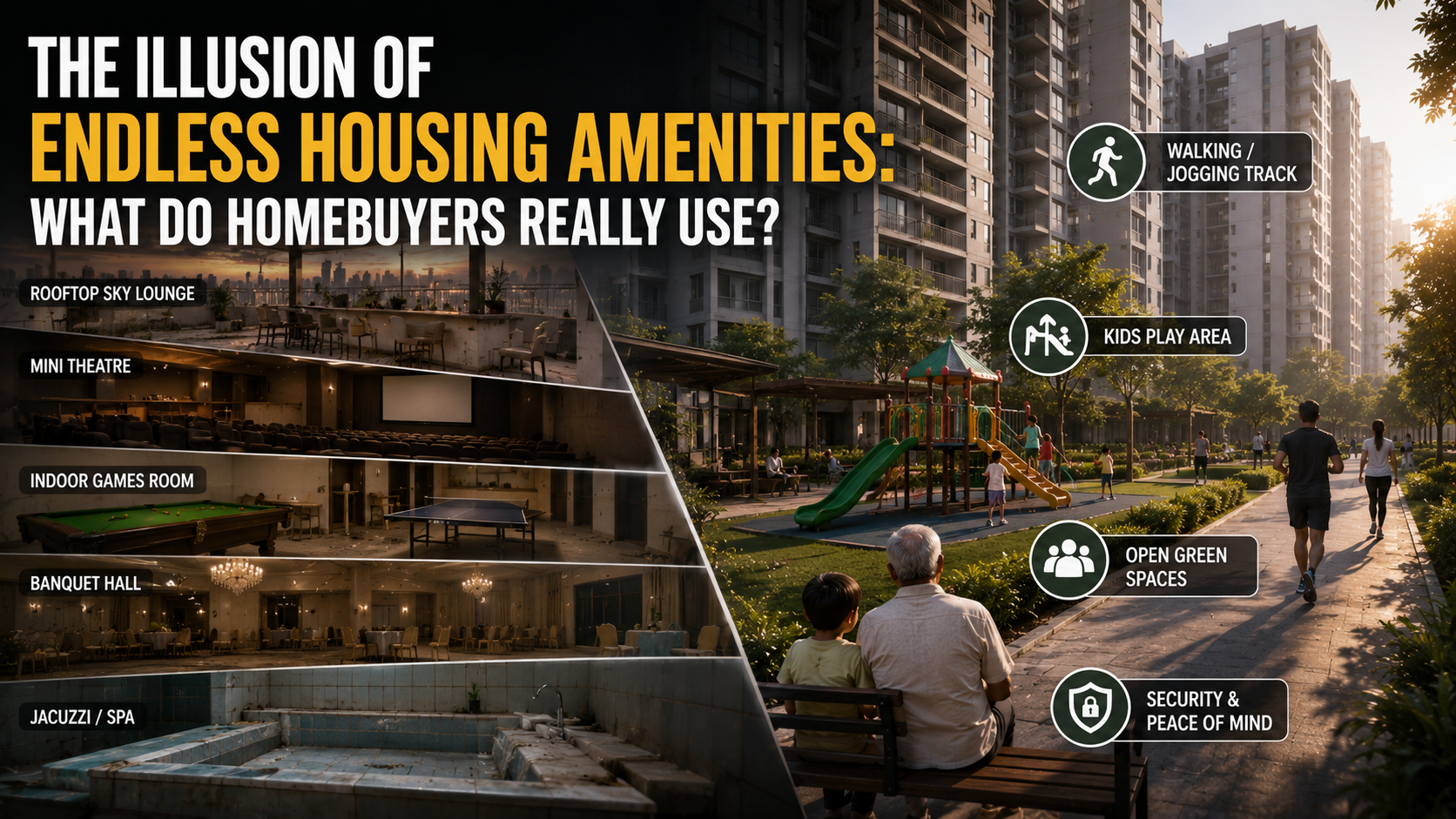
Walking into a real estate sales office today is often an overwhelming experience. Glossy brochures and high-definition virtual tours highlight an endless, staggering list of features promised to prospective buyers. It has become an industry standard for new residential projects to advertise anywhere from thirty to over a hundred distinct housing amenities. From temperature-controlled infinity pools and private cinema screening rooms to stargazing decks and acupressure pathways, developers are fiercely competing to offer the most exhaustive list of lifestyle facilities.
However, a recent and highly relatable social media debate has struck a nerve among homeowners and prospective buyers alike, reigniting a crucial conversation about real estate marketing. The core of the debate is simple but profound: how many of these heavily advertised clubhouse amenities and outdoor installations do residents actually use once the novelty wears off?
As property prices continue to climb across major urban hubs, buyers are paying a significant premium for these shared spaces, both in their initial purchase price and through recurring monthly maintenance charges. It is becoming increasingly apparent that many of these features are inexpensive to construct and serve primarily as marketing padding, helping developers artificially inflate their amenity count. To make an informed real estate decision, today’s homebuyer must look past the glossy brochures and evaluate which facilities truly enhance daily living and which ones are destined to gather dust.
To understand why residential projects are suddenly flooded with obscure amenities, one must look at the intense competition within the real estate market. When developers are working with limited land parcels, especially in dense urban environments, differentiating their project from the one being built right next door becomes a massive challenge. If two projects share the same neighborhood, offer similar square footage, and sit at a comparable price point, the developer needs a unique selling proposition to capture the buyer's attention.
This is where the numbers game begins. Marketing a project with "15 premium amenities" sounds far less impressive than marketing one with "75+ world-class lifestyle features." To hit these high numbers without drastically increasing construction costs, developers have started breaking down standard areas into highly specific, micro-amenities. A standard landscaped garden is no longer just a garden; it is subdivided into a meditation zone, a senior citizen seating area, a reflexology path, and a butterfly garden.
While this strategy looks incredibly impressive on a billboard, the reality on the ground post-possession is often starkly different. Homebuyers are slowly realizing that a long list of unused amenities in residential projects does not equate to a better quality of life. In fact, maintaining vast, underutilized spaces can become a financial burden for the housing society's maintenance fund over the years.
The viral discussion surrounding housing amenities highlighted several specific features that consistently fail to live up to their marketing hype. Industry observers and residents alike have pointed out that these installations often look fantastic during the initial site visit but quickly transition into decorative background elements once everyday life takes over.
Often heavily prominently featured in project brochures, the outdoor amphitheatre is frequently described as a vibrant hub for cultural performances, community talent shows, and society gatherings. However, critics correctly point out that in the vast majority of housing societies, these spaces end up as little more than a series of stepped concrete benches. Without a dedicated community management team to constantly organize events, the amphitheatre remains entirely unused for months at a time, occasionally serving as a makeshift seating area for children playing in the evenings. Given the massive footprint it requires, many buyers feel this space could be better utilized for practical sports courts.
Pebble-lined reflexology paths are a staple in the wellness section of any real estate brochure. Promoted as a holistic health feature designed to stimulate pressure points on the feet, these narrow walkways are incredibly cheap for a developer to construct. While they sound highly appealing to health-conscious buyers during a sales pitch, the practical reality is that very few residents incorporate a painful walk on sharp stones into their daily routine. Within a year of project completion, these pathways are typically ignored, gathering moss and requiring upkeep without delivering any real lifestyle value.
Oversized outdoor chess boards featuring massive, knee-high plastic pieces are visually striking and generate a lot of curiosity during the first few months after possession. They serve as great photo opportunities for new residents. However, the novelty wears off incredibly fast. The logistics of standing outdoors in the heat or rain to play a lengthy game of chess means that these boards eventually become purely decorative installations, offering almost zero practical utility for the community.
The inclusion of a jacuzzi is often a clever workaround for developers who lack the physical space or structural permissions to build a full-sized, functional swimming pool. While a private jacuzzi is a luxurious addition to a home, a shared jacuzzi in a common clubhouse presents significant challenges. Many residents are inherently uncomfortable sharing such an intimate, small water body with dozens of neighbors due to hygiene and privacy concerns. Consequently, these facilities often sit empty, draining maintenance funds for water heating and filtration without serving the community.
Marketed as tranquil escapes from the chaos of city life, meditation zones typically consist of a simple wooden pergola or gazebo surrounded by some landscaping. While the idea of a quiet outdoor space is appealing, the execution often fails. Placed in the middle of a bustling apartment complex, surrounded by the noise of playing children, traffic, and daily society operations, these zones rarely offer the peace required for actual meditation. They usually end up completely unused for the majority of the day.
While it is easy to dismiss certain features as mere marketing gimmicks, it is important to acknowledge that the usefulness of any real estate amenity is highly subjective. What one family considers a total waste of space might be the exact feature that convinced another family to purchase their home. The true variable that dictates the success of these shared spaces is the community itself.
An active, highly engaged housing society can completely transform the narrative around so-called useless amenities. For example, an amphitheatre might look like a waste of concrete in a passive society, but in a vibrant community, it can double as a highly effective space for morning yoga sessions, weekend roller-skating classes for children, and festival celebrations.
Similarly, dedicated senior-citizen corners might seem like wasted space to a young, single professional, but for elderly residents who need a safe, quiet place to socialize without the risk of being knocked over by running children, these designated seating areas are an absolute necessity. Rock-climbing walls, often criticized as overly niche, frequently remain a massive hit among the younger demographics of a building.
Real estate consultants frequently emphasize that there is no universal, objective list of good or bad amenities. The utility of a residential project is entirely dependent on the age profile, lifestyle preferences, and collective engagement of the people living there. A proactive residents' welfare association can breathe life into almost any space, turning a static gazebo into a thriving community library or a meeting spot for local hobby clubs.
The intense debate over fake amenities points to a much larger shift in real estate trends. The modern homebuyer is far more educated and discerning than they were a decade ago. Rising disposable incomes, the lasting impact of the pandemic on our relationship with our homes, and the permanence of hybrid work models have fundamentally altered what people look for in a property.
Surveys and market research consistently show that buyers are moving away from purely decorative, flashy features and heavily prioritizing practical, lifestyle-oriented additions that support their daily routines.
While grand clubhouses are nice, the demand for private outdoor space has skyrocketed. A vast majority of prospective buyers now explicitly prefer homes with large, functional balconies. The desire for a personal sense of openness and private ventilation has eclipsed the appeal of shared, heavily crowded community gardens. Buyers want a space where they can enjoy their morning coffee or cultivate a small private garden without leaving their apartment.
As hybrid and remote work become permanent fixtures of the modern economy, the requirement for professional infrastructure within residential complexes has surged. A significant percentage of buyers actively seek homes that offer a dedicated study room or home office layout. For developers, substituting a poorly utilized meditation gazebo with a fully equipped, Wi-Fi-enabled co-working space or a soundproof meeting room within the clubhouse is a guaranteed way to attract working professionals.
Pet ownership has seen a massive rise in urban centers, yet many traditional housing societies are remarkably hostile toward animals. Developers who recognize this demographic shift are replacing obscure, unused amenities with dedicated, securely fenced pet parks. Providing a safe space for pets to exercise and socialize not only delights pet owners but also keeps the main manicured lawns clean and free for other residents, solving a major point of friction in community living.
With the rapid adoption of electric vehicles, future-proofing a residential complex is no longer optional. Buyers are increasingly investigating the electrical load capacity of a building and demanding dedicated EV charging stations in the parking levels. An outdoor chess board adds no monetary value to a property, but robust, accessible EV infrastructure significantly boosts the long-term desirability and resale value of an apartment.
Above all else, modern buyers are demanding better foundational construction quality over an inflated amenity list. Homebuyers are perfectly willing to sacrifice an acupressure pathway or an open-air gym if it means the developer invests those funds into superior waterproofing, better sound insulation between walls, high-speed branded elevators, and robust security systems.
When evaluating housing amenities, buyers must look beyond the initial excitement of the brochure and consider the long-term financial implications. Amenities directly impact how a property ages and performs in the resale and rental markets over the decades.
Properties that offer practical, well-maintained facilities—such as a large, temperature-controlled swimming pool, a fully equipped indoor fitness center, and expansive, uncluttered walking tracks—consistently experience faster rental occupancy and command better yields. Tenants and future buyers are willing to pay a premium for residential communities that reduce their dependency on external gym memberships and public parks.
Conversely, housing societies burdened with highly specific, difficult-to-maintain novelties often struggle. When features like artificial water bodies, jacuzzis, and complex landscaping fall into disrepair due to a lack of use and high maintenance costs, they become visual eyesores that drag down the overall aesthetic and perceived value of the entire property. In the real estate market, a poorly maintained amenity is actually worse than having no amenity at all.
Navigating the modern real estate landscape requires a healthy dose of skepticism. When touring a new project or reviewing marketing materials, prospective buyers must actively question the utility of every advertised feature.
Instead of being blinded by a list boasting eighty different amenities, take a moment to visualize your actual daily routine. Ask yourself if you will genuinely use that open-air gym in the middle of a humid summer, or if you will realistically find peace in a meditation pavilion located right next to a busy children's play area.
Focus your investment on projects that prioritize robust structural quality, practical shared spaces that align with your family's actual habits, and well-designed private living areas. By looking past the marketing fluff and prioritizing genuine functionality, you can ensure that the premium you pay translates into a tangible, long-lasting enhancement to your everyday lifestyle.
