Published On:
March 23, 2026
Updated On:
March 23, 2026
Property prices often surge well before infrastructure projects like metros or expressways are completed, driven by early speculation and anticipated connectivity. Savvy buyers and investors push demand up during the announcement and construction phases, locking in gains before the final price appreciation hits.
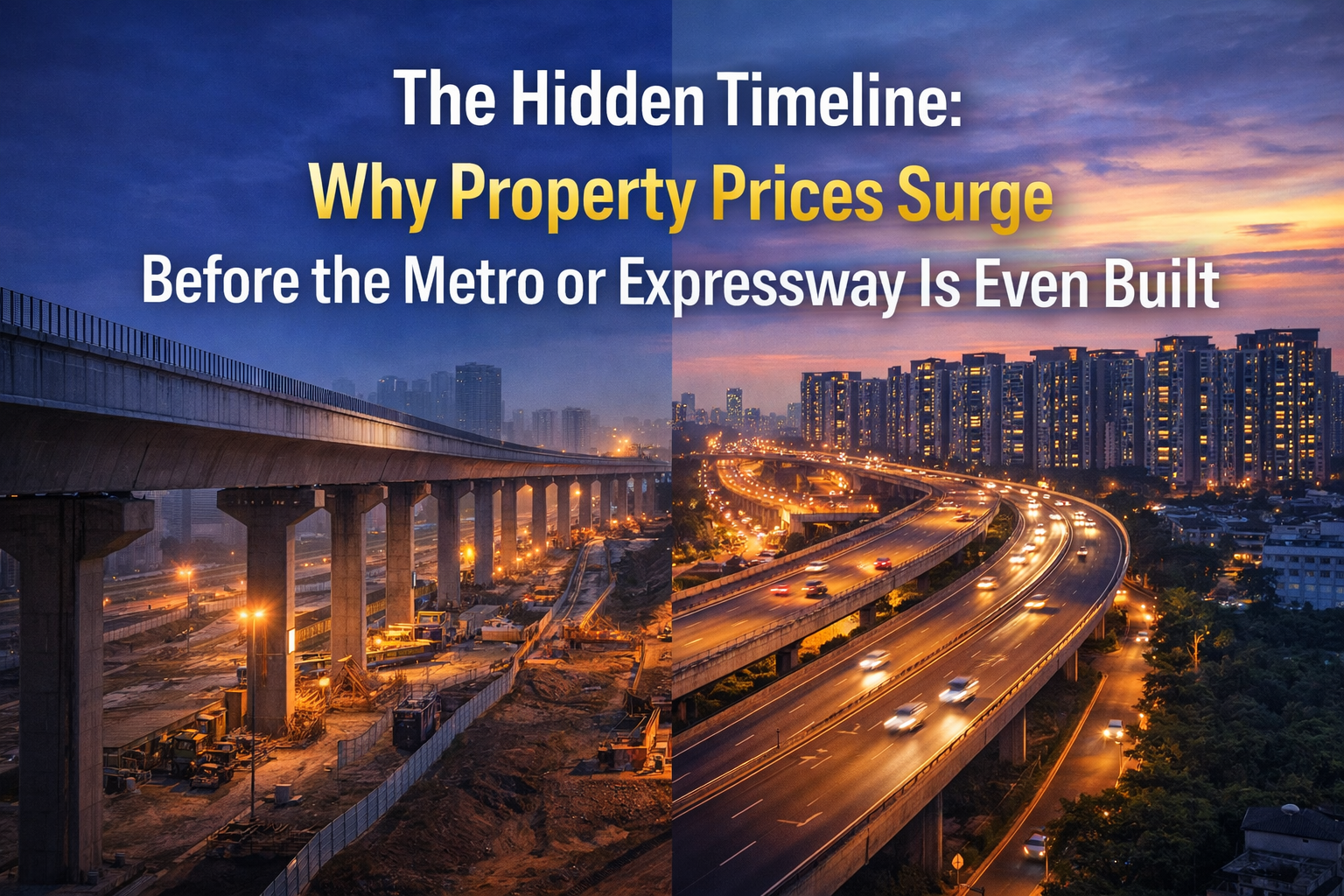
Have you ever noticed how a sleepy, affordable neighborhood on the outskirts of the city suddenly becomes the hottest real estate ticket in town? You might look around and see the same dusty roads, the same aging buildings, and the same empty plots of land. Yet, somehow, the price of a standard 2BHK flat has jumped by 20% or 30% in just a few months.
Many buyers are left scratching their heads, wondering what justifies this sudden spike in property prices. The buildings haven't changed, and the local amenities are exactly the same as they were last year. The invisible force driving this rapid appreciation is the promise of future infrastructure. Whether it is a proposed metro line, an upcoming expressway, or a planned international airport, the mere announcement of improved connectivity is enough to set the real estate market on fire.
Understanding this timeline is crucial for anyone looking to invest in real estate or buy a home. If you wait for the metro trains to actually start running or the expressway toll booths to open, you have likely already missed out on the most significant wave of price appreciation.
Most average homebuyers operate under the logical assumption that a property’s value increases only after the surrounding area is fully developed. They want to see the paved roads, ride the new metro, and see the commercial hubs buzzing with activity before they commit their hard-earned money.
However, the real estate market is fundamentally forward-looking. It does not price in what is happening today; it prices in what is guaranteed to happen tomorrow. The lifecycle of property appreciation tied to infrastructure generally follows a very specific, multi-stage pattern.
The first major shift happens right at the announcement phase. When the government officially sanctions a new expressway or a major transit corridor, the smart money moves in immediately. Large-scale developers start quietly acquiring land parcels along the proposed route, and seasoned investors begin booking early-stage residential flats and commercial spaces.
The next jump occurs when early construction work actually begins. Once the barricades go up and the earthmovers arrive, the general public realizes the project is not just an empty political promise. Builders begin aggressively marketing their new projects, highlighting the future connectivity. At this stage, buyers who previously thought the location was too far away suddenly start showing serious interest, pushing prices up gradually but consistently.
By the time the project is fully operational, the final, steep price hike has already been baked in. The demand is at its peak because the convenience is now tangible, but the opportunity for massive capital gains has mostly passed to the early adopters.
When evaluating different types of infrastructure, expressways tend to have the most immediate and profound impact on local property markets. The reason is simple: expressways drastically alter how we perceive distance and travel time.
Consider a professional working in a central business district. A location situated 40 kilometers away might seem impossible for a daily commute if it involves navigating heavily congested city traffic. But if a new, signal-free expressway cuts that travel time down to a smooth 30-minute drive, that distant location suddenly becomes highly viable.
This reduction in travel time fundamentally expands the livable radius of a city. People who were previously confined to cramped, expensive apartments in the city center realize they can purchase larger homes, villas, or even independent plots of land on the periphery for the same budget. Expressways bring the suburbs into the mainstream, and as that psychological barrier of distance breaks down, property prices in those newly connected areas naturally shoot up. We have seen this exact scenario play out perfectly along major corridors like the Dwarka Expressway in the National Capital Region (NCR), where property values essentially doubled over a few short years solely on the back of improving road networks.
While expressways open up new geographic frontiers, metro networks excel at densifying and hyper-connecting existing urban and suburban spaces. The impact of a new metro line on property prices is incredibly localized and highly potent.
A metro station transforms a neighborhood by making the daily commute predictable, affordable, and immune to road traffic. For the massive working population that relies on public transport, living within walking distance or a short auto ride from a metro station is the ultimate convenience.
This creates a massive surge in both buyer demand and rental demand. Landlords know they can command a premium for flats located near transit hubs, which in turn drives up the capital value of those assets. Even a single proposed metro station can entirely revitalize the real estate prospects of a sluggish neighborhood, making it a hotspot for young professionals and small families.
Unlike roads and metro lines, which offer immediate daily utility to residents, the development of a new airport is a massive, slow-burning economic engine. Airports do not just change how people commute; they change the entire economic landscape of a region.
The timeline for airport-linked real estate appreciation is much longer, but the ceiling for growth is arguably the highest. Take, for example, the massive developments currently unfolding around the Noida International Airport in Jewar. A few years ago, this region was largely ignored by mainstream homebuyers who considered it too remote and underdeveloped.
However, as the airport project moved from the planning stages to active construction, the narrative completely shifted. The anticipation of better road connectivity, the influx of massive logistics hubs, and the promise of future commercial and corporate zones have completely transformed the area. Today, the demand for residential plots and flats near the Yamuna Expressway and the upcoming airport is unprecedented. Prices have surged significantly, not because the airport is flying planes today, but because buyers clearly see the massive business and employment ecosystem that will inevitably surround it in the coming decade.
This phenomenon of pre-development price hikes is largely driven by a major shift in buyer psychology. Today’s homebuyers and investors are significantly more educated and forward-thinking than previous generations. They have access to master plans, infrastructure updates, and historical market data at their fingertips.
They are no longer just looking at what a neighborhood offers right now; they are actively calculating what it will become in three to five years. This speculative foresight is exactly why locations tied to upcoming expressways, metro lines, or aviation hubs are receiving so much attention and capital. Buyers understand that purchasing a property in a fully developed, saturated market offers stability, but buying into a developing corridor offers the chance for transformative wealth creation.
That Rs. 40 lakh flat on the outskirts didn't physically improve overnight to become worth Rs. 55 lakh. What changed was the collective vision of the market. Once the majority of buyers agree that an area’s connectivity is going to improve and major commercial development will inevitably follow, the demand curve shifts permanently upward.
While buying into an area before the infrastructure is complete is a proven strategy for securing lower prices and higher returns, it is not without its risks. Not every announced project moves at the speed of light, and some never materialize at all.
The most critical factor to evaluate before investing is the reality of the infrastructure project itself. Announcements and political promises are not enough. Savvy buyers must verify if the land acquisition has actually been completed, if the necessary environmental and financial approvals are in place, and most importantly, if physical construction work has commenced on the ground.
Furthermore, relying on a single upcoming project can be risky. The most resilient real estate investments are located in areas that boast multiple, overlapping connectivity options—such as a region that is getting a new expressway link as well as a proposed metro extension.
The intricate dance between infrastructure development and real estate prices is one of the most reliable wealth-building engines in the modern economy. A single major project—be it a sprawling expressway, a high-speed metro line, or an international airport—has the power to completely rewrite the financial destiny of an entire region.
We are witnessing this play out right now across various parts of the country, particularly in rapidly expanding zones like the NCR. The pattern is incredibly predictable. The smart money moves in during the announcement phase, the aggressive investors jump in during the early construction phase, and the general public arrives only after the ribbon is cut and the prices have already peaked.
The key to maximizing your real estate returns is learning to spot these paths of progress early. By understanding that property prices move on future expectations rather than current realities, you can position yourself ahead of the curve, securing premium assets before the rest of the market catches on. The landscape of our cities will continue to evolve, and the only constant is that where the roads and rails go, massive real estate appreciation will always follow.
