Published On:
April 14, 2026
Updated On:
April 14, 2026
The true cost of owning an apartment extends far beyond the initial purchase price, as ongoing expenses like maintenance, GST, and corpus funds act as a permanent financial commitment. This comprehensive guide breaks down the hidden lifetime costs of real estate to help buyers accurately calculate their long-term affordability and make informed investment decisions.
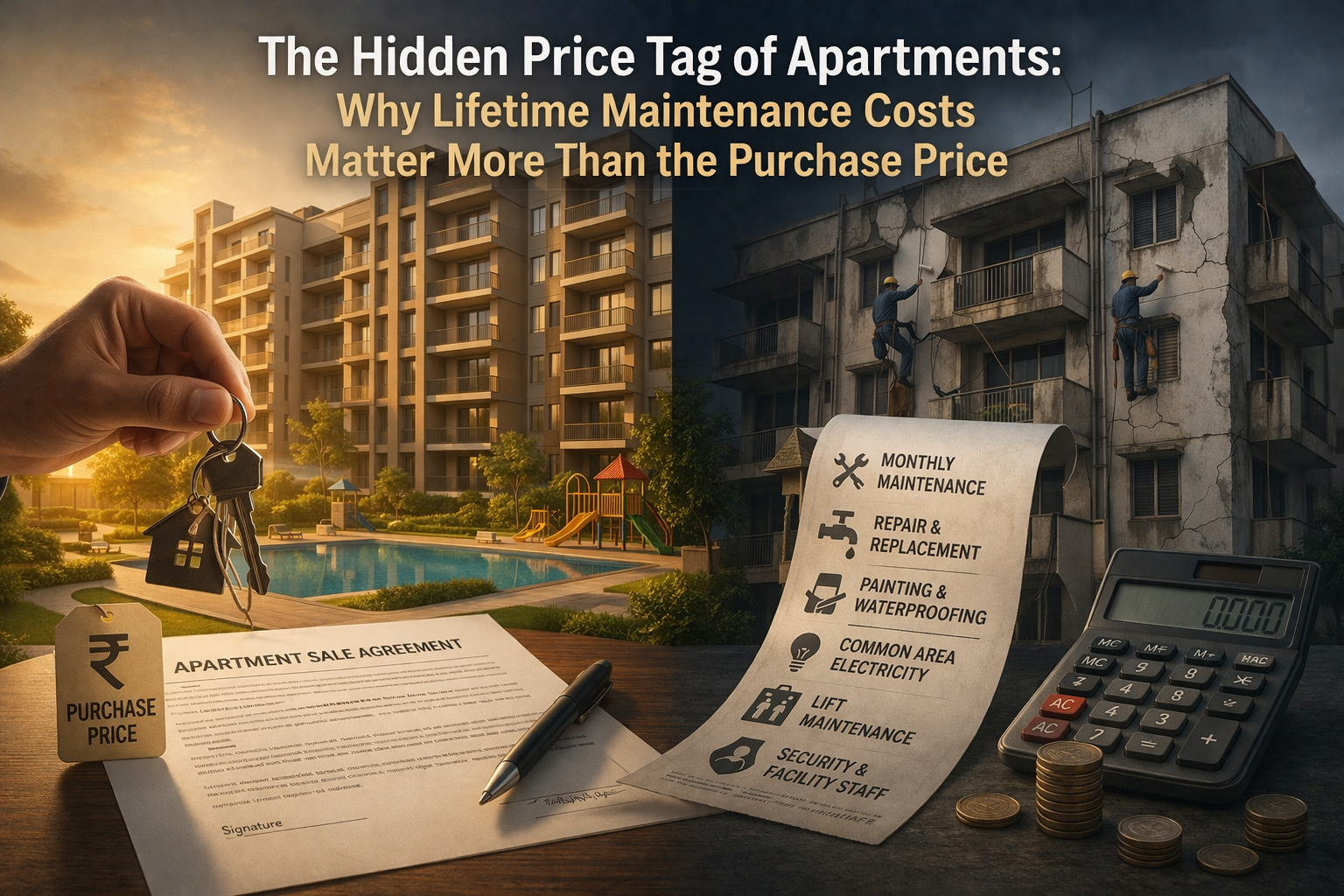
When buying an apartment, the primary focus naturally falls on the base price. Buyers spend months negotiating the per-square-foot rate, comparing home loan interest rates, and saving up for the down payment. Securing the property feels like the finish line. However, the purchase price is merely the entry ticket into the world of homeownership. The actual financial commitment is an ongoing, lifetime obligation driven by maintenance costs, taxes, and hidden fees that most buyers fail to adequately calculate.
For many property buyers, especially those looking at premium gated communities in rapidly developing corridors like Noida, Greater Noida, and the Yamuna Expressway, the appeal of luxury amenities is strong. Swimming pools, 24/7 security, landscaped gardens, and modern clubhouses are major selling points. But these amenities require constant upkeep, and that financial burden falls squarely on the residents. Relying solely on the initial brochure price creates a false sense of affordability. To understand the true financial impact of real estate, buyers must shift their perspective from the initial acquisition cost to the lifetime cost of ownership.
Treating an apartment purchase as a one-time transaction is a fundamental error in financial planning. Real estate experts increasingly view maintenance as a quasi-capital cost. A helpful industry rule of thumb illustrates this perfectly: every single rupee per square foot spent on monthly maintenance translates to roughly one thousand rupees per square foot in implied capital cost over the holding period of the property.
When you buy an apartment, you are committing to a recurring cash outflow that will never go away. Unlike a home loan EMI, which eventually ends after fifteen or twenty years, maintenance bills continue for as long as you own the property. Furthermore, these costs are not static. Due to inflation, rising labour wages, and the increasing cost of materials, maintenance charges escalate every year. Buyers who lock in an apartment based strictly on their current loan eligibility often find themselves financially stretched a few years down the line when the maintenance fees inevitably rise.
To understand why these costs add up so quickly, it is important to look at what Common Area Maintenance (CAM) actually covers. When you purchase an apartment, you are not just buying your private living space; you are buying an undivided share of the common land and the shared facilities.
Your monthly maintenance bill funds a massive, ongoing operational machine. It pays for the salaries of the security personnel, the facility managers, and the housekeeping staff. It covers the electricity required to keep the common areas lit and the elevators running twenty-four hours a day. It includes the annual maintenance contracts (AMCs) for complex machinery like diesel generators, water pumps, fire safety systems, and elevator shafts. Landscaping, pest control, garbage disposal, and clubhouse upkeep are all bundled into this monthly fee.
In large, efficient townships, a slightly higher maintenance fee might actually be justified by the sheer volume and quality of the services provided. The cost is spread across hundreds or thousands of residents, creating economies of scale. However, in smaller boutique projects, high maintenance costs can quickly become unsustainable because there are fewer homeowners to absorb the expenses.
Buyers should also be highly sceptical of initially low maintenance charges advertised by developers during the sales phase. It is a common practice for builders to subsidise maintenance costs for the first year or two to attract buyers. Once the project is fully handed over to the Residents' Welfare Association (RWA), the true operational costs surface, and the monthly charges often witness a sharp, unexpected hike.
One of the most overlooked hidden costs of buying an apartment in India is the impact of the Goods and Services Tax (GST) on maintenance charges. Many buyers are completely unaware that their monthly society bills can attract heavy taxation.
According to government regulations, GST is applicable on housing society maintenance if two specific conditions are met simultaneously. First, the housing society's total annual turnover must exceed twenty lakh rupees. Second, the monthly maintenance charge per member must exceed seven thousand five hundred rupees. If both these criteria are met, an eighteen percent GST is levied on the entire maintenance amount.
This tax rule significantly impacts buyers of premium or spacious apartments. For instance, if you purchase a large 3BHK or 4BHK apartment in a mid-range to premium society in Delhi-NCR, your monthly maintenance will likely easily cross the seven thousand five hundred rupee mark. If your base maintenance is eight thousand rupees, the eighteen percent GST adds an extra one thousand four hundred and forty rupees to your bill, bringing the total to nine thousand four hundred and forty rupees every single month. Over the span of a decade, this tax component alone results in a massive financial outflow. If the bill stays strictly at seven thousand four hundred rupees, the GST is zero. This steep cliff makes crossing the threshold a painful financial reality for homeowners.
The recurring monthly bills are only part of the maintenance equation. When you take possession of a new apartment, the developer will require you to pay several upfront charges. One of the largest is advance maintenance, usually collected for the first twelve to twenty-four months.
Alongside this, buyers must pay an Interest-Free Maintenance Security (IFMS) and contribute to a sinking fund or corpus fund. The corpus fund is a large pool of money collected from all residents and kept in reserve. It is not meant for daily operational expenses. Instead, it acts as an emergency and long-term repair fund.
Buildings age, and concrete structures require heavy capital infusion over time. Ten or fifteen years after construction, the entire exterior of the building will need repainting and waterproofing. Elevator motors will need replacement, and the terrace may require structural repairs to prevent seepage. The sinking fund is designed to cover these massive, inevitable expenses without forcing the RWA to demand sudden, massive lump-sum payments from the residents. While this fund is practically necessary for the health of the building, it adds a significant sum—often running into lakhs of rupees—to the immediate acquisition cost of the apartment.
Understanding the lifetime cost of ownership inevitably leads to the comparison between apartment maintenance costs and independent house real estate investments. For buyers evaluating options, perhaps comparing a flat in a high-rise to a plot or villa in emerging areas like the YEIDA region, the maintenance dynamics are entirely different.
In an apartment, maintenance is a mandatory, centralised, and highly predictable cost. You pay a fixed amount per square foot regardless of whether you personally use the clubhouse, the swimming pool, or the tennis courts. You are outsourcing the headache of daily management to the RWA. If a common pipe bursts or the elevator breaks down, you simply call the facility manager.
An independent house provides a completely different financial structure. There are no mandatory monthly CAM charges or 18% GST on society bills. You have complete autonomy over your expenses. If the exterior needs painting, you decide when to do it and what materials to use. However, this autonomy comes with total responsibility. You must independently handle the security, power backup, and regular upkeep.
Financially, the maintenance of an independent house is sporadic but can be heavily concentrated. You might spend very little for five years, but a major roof leak or plumbing failure will require a massive, immediate out-of-pocket expense. Furthermore, from an investment standpoint, independent houses and plots tend to appreciate primarily due to the land value, while the physical structure depreciates. In contrast, apartment owners hold a very small undivided share of the land, meaning the long-term appreciation is often slower, yet the maintenance costs remain relentlessly high.
While lifetime maintenance forms the bulk of the ongoing financial commitment, the initial purchase phase is also riddled with hidden costs that completely alter the budget. Buyers must strictly account for these before signing any agreements.
Stamp duty and registration charges are the most prominent. Depending on the state, these mandatory government levies can add anywhere from five to eight percent to the total property value. On a one crore rupee apartment, that is an immediate additional burden of up to eight lakh rupees.
Then come the builder-imposed premiums. Preferential Location Charges (PLC) are added if your apartment faces the park, the swimming pool, or the main road. Floor rise charges are applied in high-rises, where the per-square-foot rate increases for every floor you go up. Car parking is rarely included in the base price anymore; developers typically charge anywhere from two to five lakh rupees for a single covered parking spot.
Finally, there are the legal and administrative fees. Skipping professional title verification to save a few thousand rupees is a dangerous move. Buyers must hire competent legal professionals to trace the property’s title history, ensure there are no encumbrances, and execute the sale deed safely. Add in home loan processing fees and the cost of basic interior work like modular kitchens and wardrobes, and the actual cost of stepping into an apartment is often fifteen to twenty percent higher than the advertised price.
The most severe consequence of ignoring lifetime maintenance costs hits homeowners during their retirement years or during periods of sudden unemployment. When a buyer is in their thirties or forties with a dual-income household, paying ten thousand rupees a month for maintenance feels manageable. It easily fits into the monthly cash flow.
However, buyers must project these costs into the future. Real estate is a long-term play. If maintenance costs inflate at an average of five to seven percent annually, that ten thousand rupee bill will double in a decade. Fast forward to retirement, when active income is replaced by a fixed pension or savings drawdowns. The EMI might be fully paid off, but the maintenance bill will be at its absolute highest.
Many retired individuals living in premium gated communities find themselves entirely priced out of their own homes because the monthly upkeep and associated GST become an unsustainable drain on their fixed retirement corpus. A property that was meant to be a secure asset suddenly transforms into a severe financial liability.
To avoid these financial traps, buyers must change how they calculate affordability. Looking at bank loan eligibility is the wrong approach. Banks calculate your loan capability based on your current gross income and the EMI amount. They do not factor in the society maintenance, the property taxes, the GST, or the future inflation of these costs.
A genuine affordability check requires treating the total maintenance outgo over a defined holding period—such as ten years—as a core component of the property price. You must take the home loan EMI, add the estimated monthly maintenance, add the applicable GST, and build in a ten percent buffer for annual escalation.
Compare properties based on this total lifetime cost. You will often find that a slightly more expensive apartment in a well-managed, energy-efficient building with solar panels and water recycling systems has a much lower running cost than a cheaper apartment in an inefficient building. The property with the lower lifetime operational cost is always the more cost-effective and financially secure investment.
Buying real estate is a monumental milestone, but it demands cold, hard calculations. By factoring in every single hidden charge, understanding the exact nature of the corpus funds, and planning for decades of mandatory maintenance and taxes, you can ensure that your dream home remains a comfortable haven rather than a lifelong financial burden.
