Published On:
March 19, 2026
Updated On:
March 19, 2026
Overshadowing occurs when a new development severely restricts natural sunlight from reaching neighboring properties, leading to degraded living conditions, reduced solar panel efficiency, and complex legal disputes. By leveraging advanced shadow mapping software and strategic architectural setbacks, property developers can maximize urban density while protecting the essential right to light for surrounding communities.
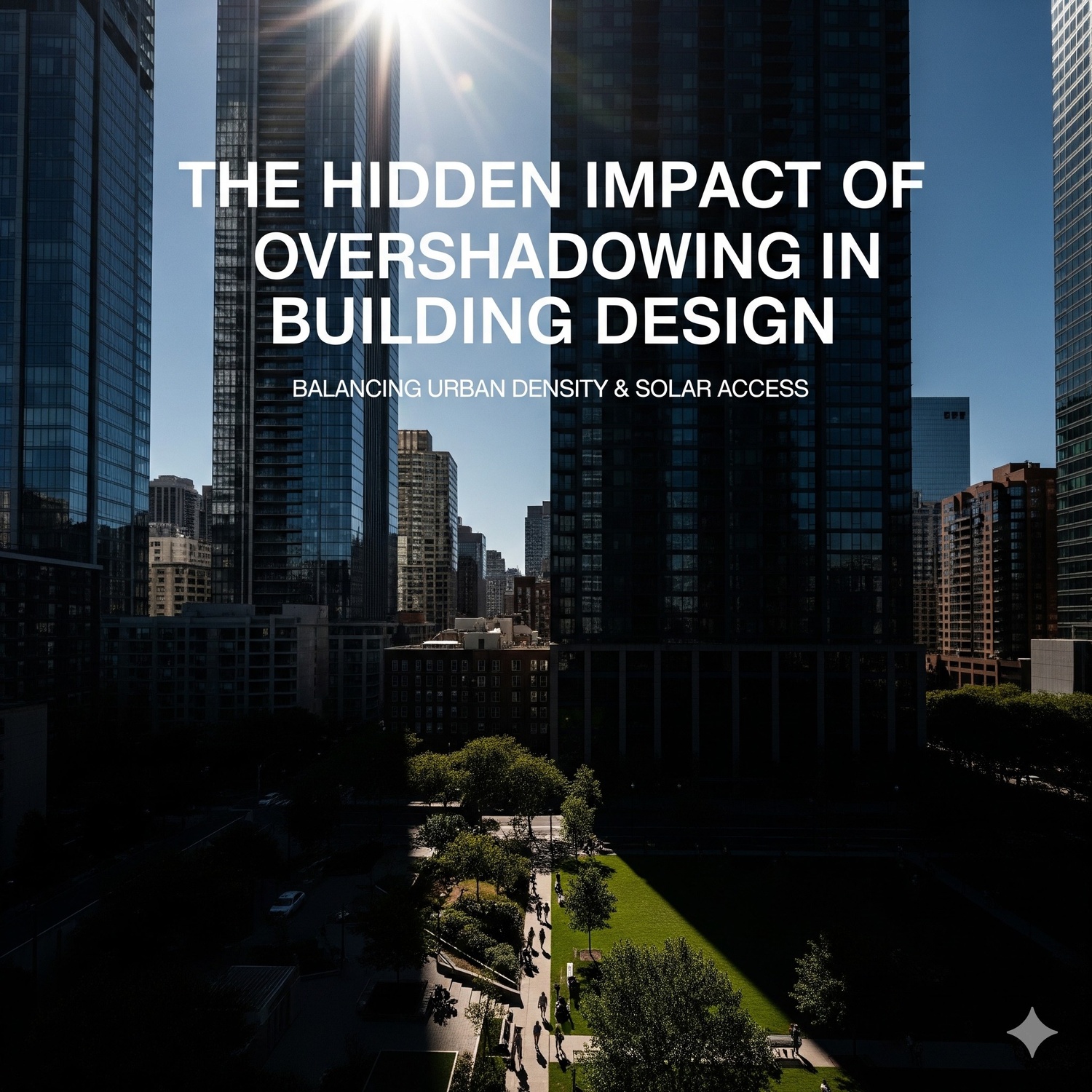
Imagine purchasing a home with a beautifully sunlit garden and a roof perfectly angled for a brand-new solar array, only for a massive multi-story development to go up right next door a year later. Suddenly, your garden is plunged into perpetual gloom, the house feels significantly colder during the winter months, and your expensive solar investment is essentially rendered useless. This frustrating scenario is the exact reality of overshadowing, a critical environmental phenomenon that heavily dictates how modern urban spaces are planned, regulated, and experienced.
As cities expand and the demand for housing pushes our skylines higher, the competition for natural daylight intensifies. Sunlight is no longer viewed merely as a pleasant environmental perk; it is a highly valuable, highly regulated resource that affects property valuations, sustainability targets, and the fundamental livability of our neighborhoods. For property developers, architects, and urban planners, understanding how to intelligently manage the shadows cast by new structures is absolutely essential. Failing to account for this dynamic can lead to rejected planning applications, angry communities, and poorly performing buildings that drain energy.
At its core, overshadowing refers to the physical shadow cast by a building or property onto nearby structures, private open spaces, and public domains. While the concept sounds straightforward, the geometry behind it is incredibly dynamic. The length, direction, and intensity of a shadow constantly shift based on the time of day, the changing seasons, and the specific geographic location of the construction site.
When a new high-rise or bulky extension blocks the sun from a neighboring property, it fundamentally alters the microclimate of that immediate area. Depending on the level of obstruction, overshadowing strips surrounding homes of direct sunlight and ambient daylight. Authorities reviewing building permits look closely at specific impact zones. They analyze whether a proposed building will plunge neighboring backyards into darkness, block the windows of habitable rooms like bedrooms and living spaces, or severely compromise communal areas like public parks and street-level courtyards.
The presence of natural daylight is deeply tied to human health and psychological comfort. Decades of environmental psychology research consistently show that access to sunlight regulates our circadian rhythms, boosts mood, and improves overall daytime productivity. When a poorly placed building heavily overshadows an existing home, the residents inside suffer a tangible drop in their daily quality of life.
Living in a constantly shaded, dim environment forces occupants to rely heavily on artificial lighting, even during peak daytime hours. Beyond the interior spaces, outdoor amenity areas bear the brunt of the impact. A garden or a courtyard that receives no direct sunlight quickly becomes damp, cold, and entirely unusable for recreation or planting. Over time, the chronic lack of solar access makes the overshadowed property feel oppressive and claustrophobic, which ultimately drives down its market desirability and resale value. Buyers inherently gravitate toward bright, airy spaces, and properties trapped in the shadow of a neighboring tower often struggle to command premium prices.
The financial and environmental implications of overshadowing extend far beyond the annoyance of needing to flip on a light switch at noon. Modern and traditional buildings alike rely heavily on passive solar gain—the natural heat generated by sunlight entering through glass windows—to maintain comfortable indoor temperatures during cooler months.
When a neighboring structure completely blocks that sunlight, the overshadowed building loses its primary source of free, renewable heat. This drastically increases the property's estimated heating load, which is the total amount of energy required to keep the indoor temperature at a comfortable baseline. Residents are forced to run their central heating systems much longer and at much higher outputs, leading to inflated utility bills and a significantly larger carbon footprint.
Interestingly, the relationship between shadows and ambient temperature is a delicate balancing act. In extremely hot climates, a certain degree of shade provided by adjacent buildings can actually be highly beneficial, as it reduces the cooling load required to keep a house from overheating during the brutal summer months. Finding the perfect sweet spot—where a building layout allows for crucial winter solar gain while providing slight relief from harsh summer exposure—is one of the greatest challenges in contemporary urban planning.
One of the most heavily scrutinized aspects of modern building design is how new developments impact existing renewable energy infrastructure. Millions of homes now feature rooftop photovoltaic systems. When a new building casts a shadow over a neighbor's solar panels, the drop in energy production is rarely proportional to the size of the shadow.
To understand why this happens, you have to look at how standard solar arrays are wired. Most traditional solar panels consist of multiple individual cells connected in a series circuit. If a new high-rise casts a shadow that covers just ten percent of a solar panel, it does not mean the panel simply loses ten percent of its output. Instead, that single shaded cell acts as a resistor, bottlenecking the flow of electricity for the entire panel. This is often referred to in the industry as the Christmas light effect, named after older strings of holiday lights where one single broken bulb would cause the entire string to go dark.
A relatively small shadow from a new chimney, an elevated roofline, or a parapet wall can cause an output loss of fifty to eighty percent for the affected panel. For homeowners relying on that energy to offset their utility bills or feed power back into the grid, this represents a massive financial loss. Because of this severe vulnerability, many modern planning regulations heavily protect existing solar infrastructure, requiring new developments to step back or alter their rooflines to ensure neighboring panels remain entirely unshaded during peak generation hours.
Because the impacts of overshadowing are so severe, local councils and urban planning bodies enforce strict solar access regulations. However, developers must navigate two entirely separate hurdles: the local planning process and the civil legal framework. Understanding the distinction between a standard daylight assessment and the legal right to light is vital for anyone involved in property development.
A daylight and sunlight assessment is a standard administrative planning requirement. It evaluates whether a proposed building will allow sufficient natural light into its own interior spaces and whether it will reasonably maintain the light levels of surrounding properties. Authorities use highly technical guidelines to measure this. A common benchmark is testing the shadows on the Winter Solstice. As the shortest day of the year when the sun sits at its lowest angle in the sky, the Winter Solstice represents the absolute worst-case scenario for shadow length. Another common metric is the forty-five-degree rule, where planners draw an imaginary line at a forty-five-degree angle from the center of a neighbor's window to see if the new extension intersects it.
The right to light, however, is a completely different, highly potent legal concept. It is a civil matter based on property law rather than a simple municipal planning guideline. In many legal jurisdictions, if a specific window has received uninterrupted daylight for a certain number of years—often twenty years or more—that window acquires a legally protected status. If a developer secures planning permission but their new building significantly darkens a protected window, the affected homeowner can launch a civil lawsuit. They can seek a court injunction to halt the construction project entirely, or sue the developer for massive financial compensation. Developers must conduct exhaustive due diligence long before breaking ground to identify any protected apertures on neighboring properties, as failing to do so can result in catastrophic project delays and legal fees.
Preventing severe overshadowing is rarely about stopping development altogether; rather, it is about designing intelligently. Architects and property developers have a robust variety of tools and spatial strategies at their disposal to maximize building footprints without creating dark, oppressive urban canyons.
The absolute most effective way to handle overshadowing is to visualize it before the first brick is ever laid. Generating highly accurate shadow diagrams is a non-negotiable step in the modern design process. These specialized 3D models simulate the exact path of the sun across a specific geographic site, mapping out precisely where shadows will fall during different hours of the day and across different seasons. By utilizing generative design software during the initial concept phase, developers can spot potential compliance issues early and adjust their designs before committing to expensive structural engineering plans.
How a building's mass is distributed across a site plays a massive role in the shadows it casts. A solid, unbroken block of a building will cast a massive, uniform shadow that engulfs everything behind it. To mitigate this, architects frequently employ stepped facades or tiered rooflines. By pulling the upper levels of a building further back from the property boundary, the bulk of the shadow is significantly reduced, allowing sunlight to slip past the structure and reach the ground level of neighboring lots.
Strategic breaks in the building massing can also be used to create solar corridors. Instead of building one long, continuous wall, splitting a development into two slightly smaller towers can allow a generous shaft of sunlight to pass through the middle, illuminating public courtyards or nearby homes that would have otherwise been completely blocked.
Site layout must fundamentally respond to the path of the sun, and the rules change depending on where you are in the world. In the Northern Hemisphere, for example, placing the tallest elements of a development on the northern edge of the site is a standard best practice. Because the sun sits predominantly in the southern sky, the shadows from those tall northern elements will fall primarily on the development's own property or onto adjacent roads, rather than heavily impacting residential neighbors to the south. Properly spacing buildings is also crucial; maintaining a distance of at least one to one-and-a-half times the building's height between structures generally ensures that year-round sun paths remain unobstructed for the maximum number of dwellings.
Urban environments require high density to function efficiently and accommodate growing populations, but that density cannot come at the steep expense of human comfort and environmental sustainability. Managing the shadows cast by our built environment requires a delicate, highly calculated balancing act.
Building designs must inevitably cast shadows, and in some contexts—such as providing much-needed relief in hot public squares—that shade is highly desirable. Yet, the unchecked blockage of natural light creates unhealthy living spaces, drives up energy consumption, and stifles the efficiency of renewable energy technologies. By respecting local solar access policies, understanding the severe legal risks of blocking protected light, leveraging advanced 3D modeling software, and prioritizing thoughtful site layouts, property developers can continue to build upward while ensuring that our cities remain bright, warm, and highly livable for everyone.
