Published On:
April 19, 2026
Updated On:
April 19, 2026
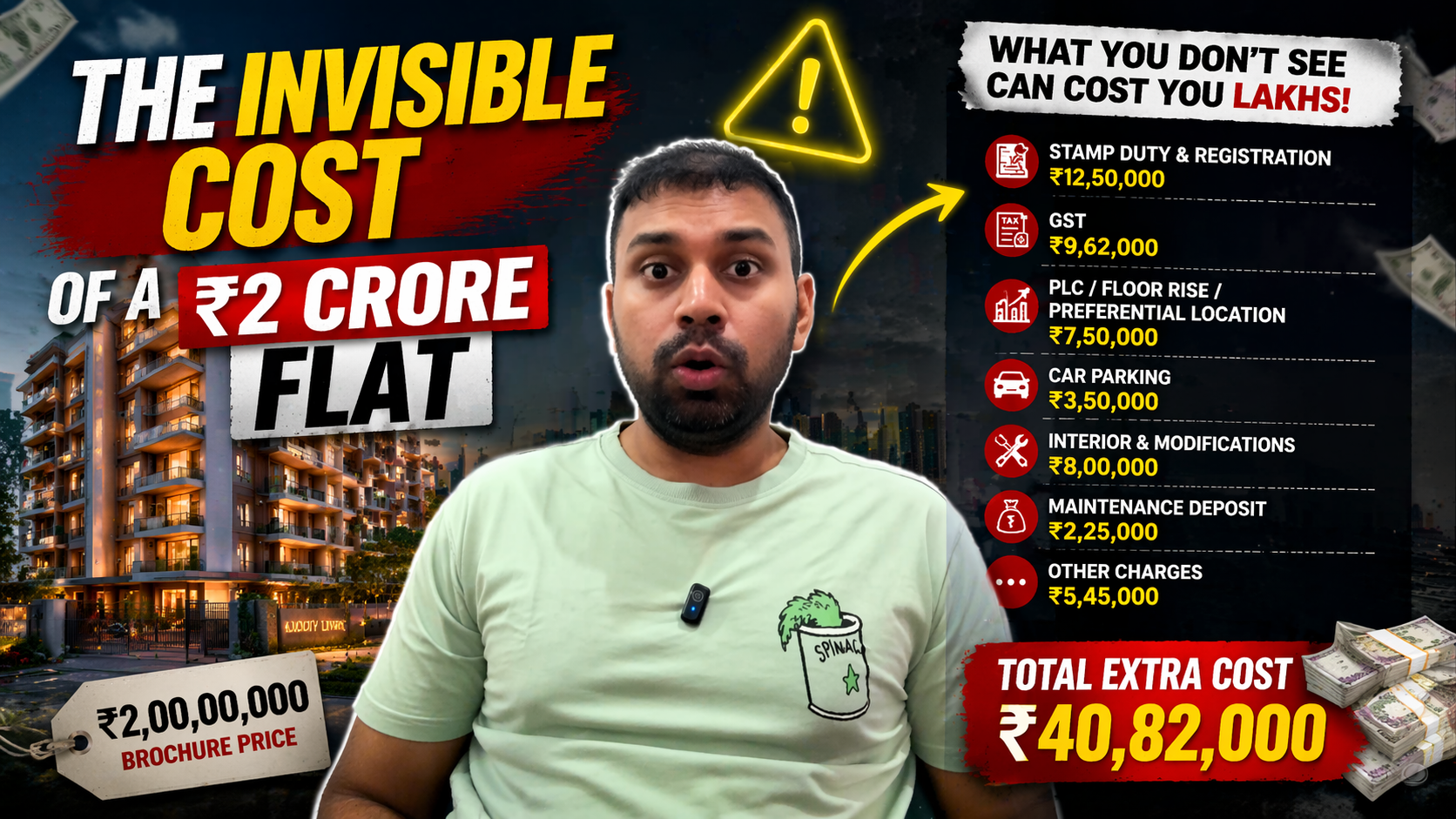
Buying a ₹2 Crore apartment in Noida comes with a massive financial shock, often carrying over ₹40 Lakhs in hidden taxes, mandatory developer fees, and transaction costs. This comprehensive guide breaks down the invisible 21% premium attached to high-rise flats and explores why strategic land investments offer a far superior, cost-effective route to generational wealth.
Stepping into a glossy, air-conditioned real estate sales pavilion in Delhi NCR is designed to be an emotional and highly aspirational experience. You are presented with a breathtaking scale model of a towering residential complex, complete with miniature landscaped gardens, sparkling infinity pools, and the promise of an elevated lifestyle. The sales representative hands you a brochure with an attractive base price—let’s say ₹2 Crore for a premium apartment in Noida. For a highly successful professional ready to secure their family’s future, this number feels like a substantial but manageable milestone.
However, the moment you transition from the initial booking phase to the final execution of the documents, the financial reality of the Indian real estate market violently shatters that initial expectation. What most buyers absolutely fail to realize is that the advertised base price of a high-rise flat is merely the starting line. Beneath that top-line number lies a deep, complex, and highly expensive labyrinth of invisible costs. By the time the final registry is executed and the keys are handed over, that ₹2 Crore flat has quietly bloated into a ₹2.40 Crore financial burden.
Understanding exactly how and where this massive 21% markup is generated is absolutely critical for anyone navigating the property market today. It is the difference between making a calculated, wealth-generating investment and falling into a depreciating financial sinkhole. Let us systematically break down the mind-boggling mathematics and hidden charges that developers and authorities extract from apartment buyers, leaving them financially stretched and entirely unprepared.
The very first financial penalty an apartment buyer absorbs is not a direct out-of-pocket fee, but a massive loss of intrinsic value. When a developer quotes you a rate of approximately ₹11,000 per square foot for an 1,800 square foot apartment, it sounds like a straightforward transaction. However, the real estate industry overwhelmingly prices apartments based on the "Super Built-Up Area."
This metric is a masterclass in creative accounting. The super area includes the physical interior of your home, but it also forces you to pay proportionally for the common corridors, the elevator shafts, the grand reception lobby, the staircase, and the clubhouse foundation. When you finally unlock your front door and measure the actual "Carpet Area"—the physical space where you can actually lay down a rug and place your furniture—you quickly realize it constitutes only 55 to 60 percent of the total area you paid for. You are essentially paying top-tier residential rates for massive concrete voids that you will never exclusively own or utilize. This discrepancy represents the first major invisible bleed of your capital.
Just like buying a base-model luxury car that comes without air conditioning or a stereo system, the ₹2 Crore base price of an apartment gets you the absolute bare minimum: a concrete box located on an undesirable floor, likely facing a blank boundary wall. The moment you express a desire for an enhanced living experience, the developer introduces Preferential Location Charges.
If you want to live higher up the tower to escape the relentless ground-level dust and vehicular noise, you are hit with a floor rise premium. That simple preference easily adds ₹2.5 Lakhs to your bill. If you want your balcony to face the landscaped central park rather than the adjacent construction site, or if you prefer a well-ventilated corner unit, the developer immediately tacks on another ₹1.5 Lakhs. Without adding a single square inch of usable space to your home, your baseline cost has already swollen to ₹2.04 Crore. In the ultra-luxury segment, these location premiums are significantly steeper, drastically altering your initial budget before a single brick is even laid.
Once the developer has established the inflated base price, the state and local authorities step in to claim their substantial share. Government levies are entirely non-negotiable and must be paid upfront in heavy, liquid cash.
The most significant blow comes from Stamp Duty. In Uttar Pradesh, the standard stamp duty rate stands at a staggering 7 percent for male buyers and 6 percent for female buyers. On a ₹2.04 Crore valuation, a male buyer is suddenly forced to generate roughly ₹14.28 Lakhs just to satisfy the state tax department. This is immediately followed by a mandatory 1 percent property Registration Fee, completely draining another ₹2.04 Lakhs from your savings.
Furthermore, the Noida real estate market operates on a highly unique structural model. Unlike other cities where property is freehold, all land in Noida is technically owned by the local development authority and handed out on long-term leases. Because of this, apartment buyers are subjected to a mandatory One-Time Lease Rent fee payable directly to the Noida Authority. For a standard premium apartment, this quietly adds an additional ₹1.75 Lakhs to the total.
Adding another layer of financial complexity is the Goods and Services Tax. If you make the highly common decision to invest in an under-construction property to secure a slightly lower entry price, the government imposes a strict 5 percent GST on the agreement value. This single tax can effortlessly add another ₹10 Lakhs to your overall burden. While ready-to-move-in flats equipped with an official Occupancy Certificate are exempt from GST, they typically command a much higher baseline market premium, ensuring you pay heavily regardless of the route you choose. Excluding GST, the basic stamp and lease taxes alone easily cross the ₹18 Lakh threshold.
You might assume that paying over ₹2 Crore for a luxury flat inherently includes basic lifestyle necessities. You would be entirely wrong. Developers have mastered the art of unbundling essential services to drastically artificially lower the advertised base price, only to force you to buy them back as mandatory add-ons.
Consider your vehicle. Bringing your car into your new residential complex requires purchasing a parking spot. A standard, covered parking space in a premium basement facility is never complimentary; it will set you back an average of ₹6 Lakhs. Next comes the highly controversial mandatory Club Membership fee. Whether you actively intend to use the community gym, the swimming pool, or the party hall is completely irrelevant. The developer forces a mandatory lifetime access fee of around ₹2 Lakhs onto your final invoice.
Then there is the concept of Interest-Free Maintenance Security. This is a massive, pooled cash reserve collected from every single buyer, ostensibly used to fund the society's initial heavy infrastructure, such as installing the primary elevators, securing massive backup generators, and establishing the common landscaping. While developers technically claim this money is refundable, the harsh reality is that it remains locked away for decades, functioning as a massive, zero-interest loan from the buyers to the builder.
Finally, simply getting the lights to turn on requires heavy capital. The mandatory electricity meter installation, which is a deposit forwarded to the state electricity board, costs approximately ₹75,000. Because grid power is highly unreliable, the builder forces you to pay a Power Backup installation charge of roughly ₹1.5 Lakhs just to connect your home to the central diesel generators. It is crucial to note that this massive upfront fee does not cover your actual electricity usage; whenever the grid fails, you will still be billed an exorbitant ₹8 to ₹15 per unit for the backup power consumed. Combined, these mandatory developer extractions easily strip another ₹11.75 Lakhs from your bank account.
The financial bleeding does not stop when the building structure is complete. Before the developer officially hands over the keys, they ensure the newly formed society is heavily capitalized for the foreseeable future.
Builders are acutely aware that collecting monthly maintenance dues from hundreds of diverse residents is a logistical nightmare. To entirely bypass this friction, they mandate an Advance Maintenance Deposit. Buyers are typically forced to pay their maintenance fees 24 months in advance. Assuming a highly conservative monthly maintenance fee of ₹5,000, that is an immediate upfront payment of ₹1.2 Lakhs.
To formally establish the Residents Welfare Association that will eventually govern the complex, you are charged a Society Formation fee of roughly ₹25,000. Additionally, securing your essential civic utilities requires paying a Water and Sewer Connection fee of another ₹50,000. These final, pre-possession hurdles quietly add another ₹2 Lakhs to the ballooning grand total.
Navigating a high-value real estate transaction is impossible without a supporting cast of professionals, and none of them work for free. The vast majority of premium property sales in Delhi NCR are facilitated by real estate brokers. The industry standard brokerage fee hovers between 1 and 2 percent of the transaction value. On a ₹2 Crore base, your broker’s commission effortlessly swallows another ₹4 Lakhs.
If you are leveraging institutional finance to fund this acquisition, the banks will extract their pound of flesh. Standard home loan processing fees typically range around half a percent of the total loan amount, adding approximately ₹80,000 to your overall cost. Finally, the intricate process of executing a title search, drafting the complex builder-buyer agreements, stamping the loan documents, and securing the Memorandum of Deposit requires professional legal documentation, adding another ₹25,000 to the transaction pile. This final layer of transactional friction accounts for over ₹5 Lakhs in dead capital.
When you finally step back and tally the brutal mathematics of this transaction, the true picture is staggering. The floor premiums, the heavy government stamp duties, the lease rents, the mandatory parking, the club fees, the massive utility deposits, the advance maintenance, and the brokerage completely shatter the initial budget. That advertised ₹2 Crore flat has a real-world, all-in cost of over ₹2,40,82,000.
You are paying a massive, invisible premium of nearly ₹41 Lakhs. This represents an astonishing 21 percent markup over the base price—capital that vanishes entirely into taxes, administrative fees, and non-appreciating developer infrastructure.
When you evaluate this reality through the lens of long-term wealth generation, the economics of buying an apartment become highly questionable. You are locking a massive amount of capital into a depreciating concrete structure suspended in the sky, burdened by exorbitant, perpetual maintenance fees and a staggering 21 percent entry tax that offers absolutely zero resale value.
This financial reality highlights exactly why seasoned, highly strategic investors consistently pivot away from high-rise apartments and funnel their capital heavily into independent plots and raw land. The historical blueprint for true generational wealth creation is incredibly clear. Consider the investors who entirely bypassed the temptation of vertical housing to acquire raw land parcels in the rapidly developing sectors of Noida back around 2007. They did not pay massive floor-rise premiums. They were not forced to buy unwanted club memberships or fund a developer's massive generator sets.
They simply bought the finite, indestructible earth. While apartment values eventually stagnate as the physical buildings age and society maintenance issues compound, raw land appreciates exponentially based purely on the organic expansion of regional infrastructure and urban density. Owning a plot grants you absolute autonomy over your asset, complete freedom from restrictive housing societies, and the ultimate ability to custom-build a legacy property on your own timeline.
If you are preparing to enter the real estate market in Noida or the broader Delhi NCR region, you must thoroughly understand the mechanics of these hidden charges. Budgeting strictly for the advertised base price is a guaranteed recipe for severe financial distress. Whether you ultimately choose to absorb the heavy 21 percent premium of high-rise living or strategically pivot toward the unmatched appreciation potential of independent land ownership, you must make that decision with absolute financial clarity, fully prepared for the invisible costs that define the modern property landscape.
