Published On:
May 21, 2026
Updated On:
May 21, 2026
While housing societies offering a mix of 1, 2, 3, and 4 BHK apartments cater to a diverse range of buyers, the differing financial capacities of residents often lead to sharp class divisions, disputes over costly aesthetic upgrades, and unequal access to premium amenities. Balancing the lifestyle expectations of wealthy large-flat owners with the financial realities of smaller-apartment residents has become a critical challenge in modern real estate.
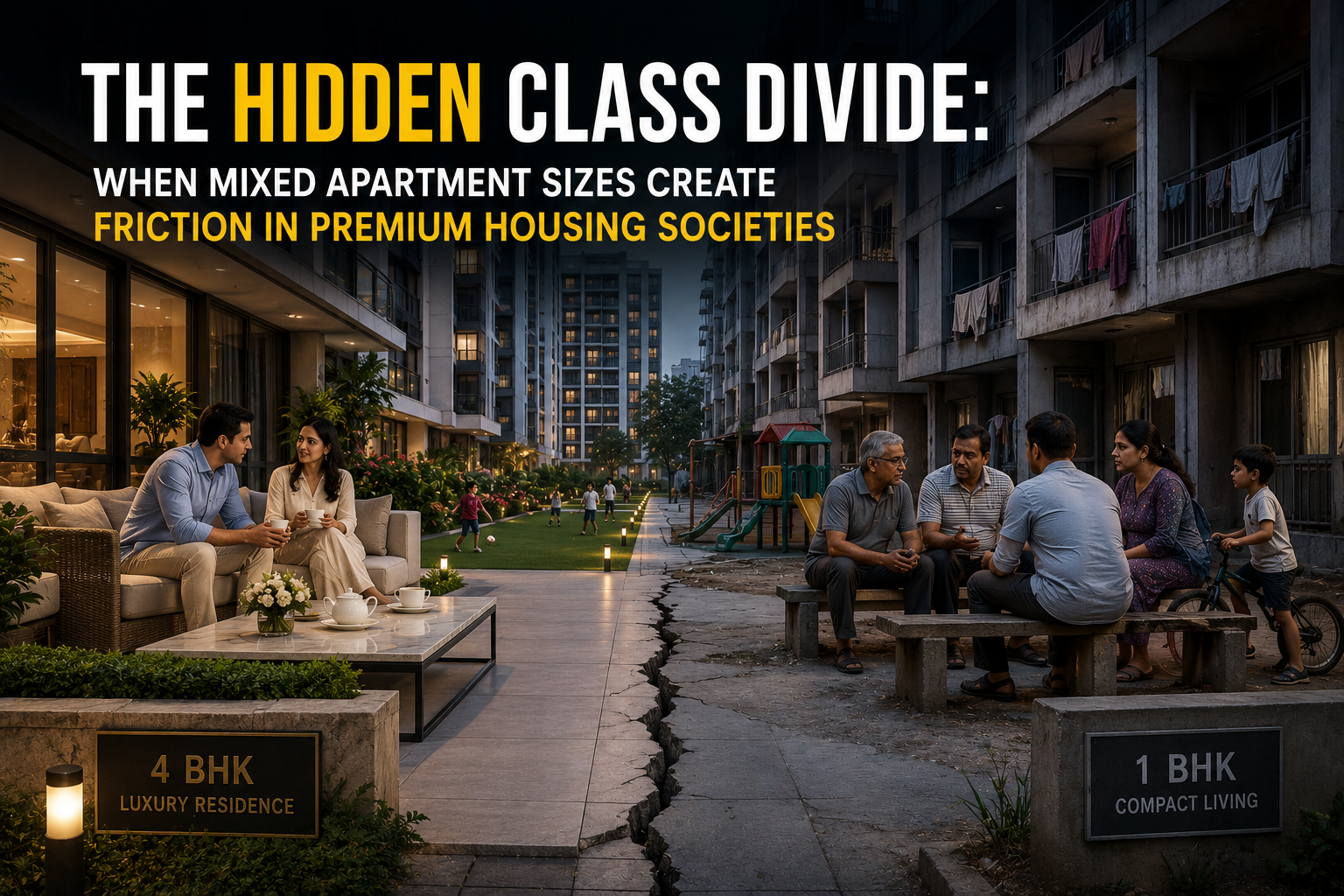
Purchasing a home in a premium gated community is widely regarded as a significant life milestone. The allure of manicured lawns, state-of-the-art clubhouses, and a secure, upscale environment drives countless homebuyers to stretch their financial limits just to secure an aspirational address. To cater to a broad spectrum of buyers, many modern developers construct sprawling luxury township projects that feature a vast product mix, offering everything from compact 1 and 2 BHK flats to sprawling 4 and 5 BHK penthouses within the exact same complex.
On paper, this diverse configuration looks like a masterclass in inclusive urban planning. It allows young professionals, small families, and wealthy business owners to share a secure, premium living space. However, as these mixed configuration housing societies mature and everyday operations take over, a completely different reality often sets in. The vast financial disparity between the occupants of the smallest apartments and those residing in massive luxury units is increasingly becoming a major pain point, triggering deep-seated friction over maintenance charges, parking allocation, and discretionary spending.
The core issue stems from a fundamental mismatch in spending power and lifestyle expectations. When a developer places 1, 2, 3, and 4 BHKs in one housing complex, they are essentially merging distinct socioeconomic brackets behind a single security gate.
Consider a mid-level corporate employee who has heavily leveraged their income to buy a modest 2 BHK or 3 BHK apartment in a premium project located on the city's outskirts. For this homebuyer, acquiring the property required immense financial discipline. A massive portion of their monthly income is likely committed to a hefty home loan EMI, leaving just enough to cover standard household and lifestyle expenses. Their primary expectation from the housing society is efficient, predictable, and budget-friendly basic maintenance.
In stark contrast, the residents occupying the 4 and 5 BHK apartments or sprawling penthouses in the same building often belong to a much higher wealth echelon. For these ultra-high-net-worth individuals, the monthly maintenance fee is a trivial expense. Their expectations lean heavily toward maintaining a pristine, luxurious, and constantly evolving living environment that mirrors a five-star hotel. When these two opposing financial realities collide in society board meetings, the fallout is inevitable.
The friction in mixed apartment sizes rarely revolves around essential utilities like water supply or basic security. The true battleground is discretionary spending. In premium housing societies, wealthy residents frequently drive the push for costly aesthetic and functional upgrades.
A classic scenario involves a group of residents deciding that the existing building lobby feels outdated and pushing for a complete interior redesign featuring imported marble, expensive lighting, and luxury seating. Alternatively, there might be a proposal to completely overhaul the clubhouse, host lavish, high-budget festival celebrations, or install premium electric vehicle charging stations across the premises.
To fund these ambitious projects, the managing committee usually demands out-of-pocket contributions from all homeowners. For the wealthy residents driving the initiative, writing a check for an unexpected society upgrade is completely effortless. However, for the buyer of the smaller apartment who is already living paycheck to paycheck due to a staggering EMI burden, these sudden demands create an immense financial and psychological strain.
The homeowner of the smaller unit suddenly feels trapped and financially boxed in. They stretched their resources to secure a premium lifestyle, only to find that sustaining the ongoing, ever-increasing lifestyle expectations of their wealthier neighbors is completely unviable. The inability or reluctance to contribute to these luxury upgrades often leads to social alienation, where smaller flat owners are unfairly viewed as obstacles to the community's progress.
The financial divide sometimes morphs into outright social segregation, leading to deeply controversial policies regarding amenity usage. The tension between different apartment tiers was perfectly highlighted in a recent viral social media discussion originating from a housing society in Karnataka.
In that particular complex, the managing committee reportedly introduced a discriminatory rule that barred the residents of 1 BHK and 1 RK (room kitchen) apartments from accessing premium amenities like the swimming pool and the gymnasium. The justification often given in such scenarios is that smaller apartments are frequently rented out to bachelors or short-term tenants, which allegedly leads to overcrowding and accelerated wear and tear of the facilities.
However, this practice creates a massive ethical and legal dilemma, as the occupants of these smaller units are still forced to pay their share of the common area maintenance charges. Being locked out of the very facilities they are paying to maintain triggers immense resentment. It shifts the atmosphere of the housing complex from a welcoming community to a highly divided, class-conscious environment where access is dictated by the square footage of one's home. Such discriminatory practices frequently lead to bitter legal disputes, drawing the attention of real estate regulators and consumer courts.
Beyond aesthetic upgrades and clubhouse access, the day-to-day operational logistics of mixed configuration housing societies present a logistical nightmare, particularly concerning maintenance calculation and parking allocation.
The method used to calculate monthly maintenance is a perpetual source of conflict. If a society adopts a flat-rate maintenance model, where every apartment pays the same amount regardless of size, the owners of 1 and 2 BHK flats are severely penalized, effectively subsidizing the upkeep of the larger units. Conversely, if the society uses a strict per-square-foot calculation, the owners of 4 and 5 BHK units end up shouldering the vast majority of the financial burden. The wealthier residents often argue that since everyone uses the same swimming pool, elevators, and gardens, the maintenance burden should be shared equally, leading to endless debates during annual general meetings.
Parking is another highly contentious issue. In premium projects, developers often allocate multiple covered parking spots to the buyers of luxury 4 and 5 BHK apartments, leaving limited parking inventory for the smaller units. As the families in 2 and 3 BHK apartments grow and acquire secondary vehicles, they find themselves entirely out of space, forced to park outside the complex or enter into daily disputes over visitor parking slots. The visual of luxury cars taking up expansive multi-car bays while smaller apartment owners fight over a single cramped spot visually reinforces the socioeconomic divide every single day.
Sinking funds, which are collected for future structural repairs, also become a point of contention. Wealthier residents generally prefer building a massive reserve fund to ensure top-tier repairs in the future, while stretched homeowners prefer keeping monthly collections as low as legally permissible.
The prevalence of mixed apartment sizes heavily depends on the geographic location and the availability of land. Real estate developers do not blindly mix configurations; their product mix is a highly calculated response to local market demand, land scarcity, and floor space index efficiency.
In sprawling metropolitan regions like Pune and Bengaluru, massive luxury township projects are incredibly common. These cities have the geographical space to support vast developments spanning hundreds of acres. In these townships, developers deliberately include a wide spectrum of 1, 2, 3, and 4 BHK apartments, sometimes placing different configurations in entirely separate towers within the same gated community. This allows them to capture a massive target audience, from young IT professionals buying their first starter home to senior executives seeking luxury penthouses.
However, the real estate landscape in Mumbai operates on an entirely different logic. Due to severe land constraints and exorbitant acquisition costs, developers in Mumbai rarely mix drastically different apartment sizes within a single building. Instead, they prefer a highly targeted, razor-sharp product mix to ensure commercial viability and avoid social friction. A Mumbai project will typically exclusively offer 1 and 2 BHKs targeted at mid-income buyers, or it will be positioned as an ultra-luxury tower offering only 3, 4, and 5 BHKs.
By separating the target demographics, Mumbai developers inadvertently prevent the financial clashes that plague mixed societies. Homebuyers are surrounded by neighbors with relatively similar financial capacities, ensuring that everyone is on the exact same page when it comes to standard upkeep, discretionary spending, and lifestyle expectations.
For existing mixed configuration housing societies, finding a sustainable middle ground requires a high degree of empathy, transparent communication, and structured financial planning. The managing committee must recognize that a one-size-fits-all approach is doomed to fail when the residents have wildly different disposable incomes.
A practical solution to the discretionary spending problem is the implementation of an opt-in model for luxury upgrades. If the wealthier residents wish to completely overhaul the clubhouse or install expensive lobby art, the funding should be sourced through voluntary contributions rather than mandatory special assessments. This allows the affluent residents to enjoy the upgraded lifestyle they desire without forcing financial distress upon their neighbors.
Regarding maintenance charges, a hybrid model often works best. Fixed costs that apply to everyone equally, such as security personnel and elevator maintenance, can be divided evenly. Meanwhile, property-tax-related expenses and sinking funds should strictly follow a per-square-foot calculation.
Furthermore, strict bylaws must be established and enforced to prevent discriminatory practices. Access to all common amenities must remain fundamentally equal for every resident who pays their maintenance dues, regardless of their apartment size or whether they are a property owner or a tenant.
The trend of placing 1, 2, 3, and 4 BHKs in one housing complex has undeniably exposed the fragile social dynamics of modern urban living. While developers will continue to experiment with varied product mixes to maximize their sales reach, the long-term success of these communities rests entirely on the shoulders of the residents.
Homebuyers must look beyond the glossy brochures and the allure of an upscale address. Before committing a massive portion of their future income to a premium housing society, it is crucial to assess the ongoing, hidden costs of sustaining that specific lifestyle. An aspirational address quickly loses its charm if the monthly financial pressure and the resulting social friction make everyday living a stressful ordeal. A sustainable, harmonious living environment ultimately requires a community where neighbors respect each other's financial boundaries, ensuring that the luxury of the few does not become a penalty for the rest.
