Published On:
August 10, 2026
Updated On:
August 10, 2026
Forget stagnant high-rises and hidden builder fees—strategic agricultural land in YEIDA is the ultimate NCR real estate gold rush. This definitive masterclass reveals the exact paperwork checks, investment timelines, and insider strategies you need to safely multiply your wealth near the Noida International Airport.
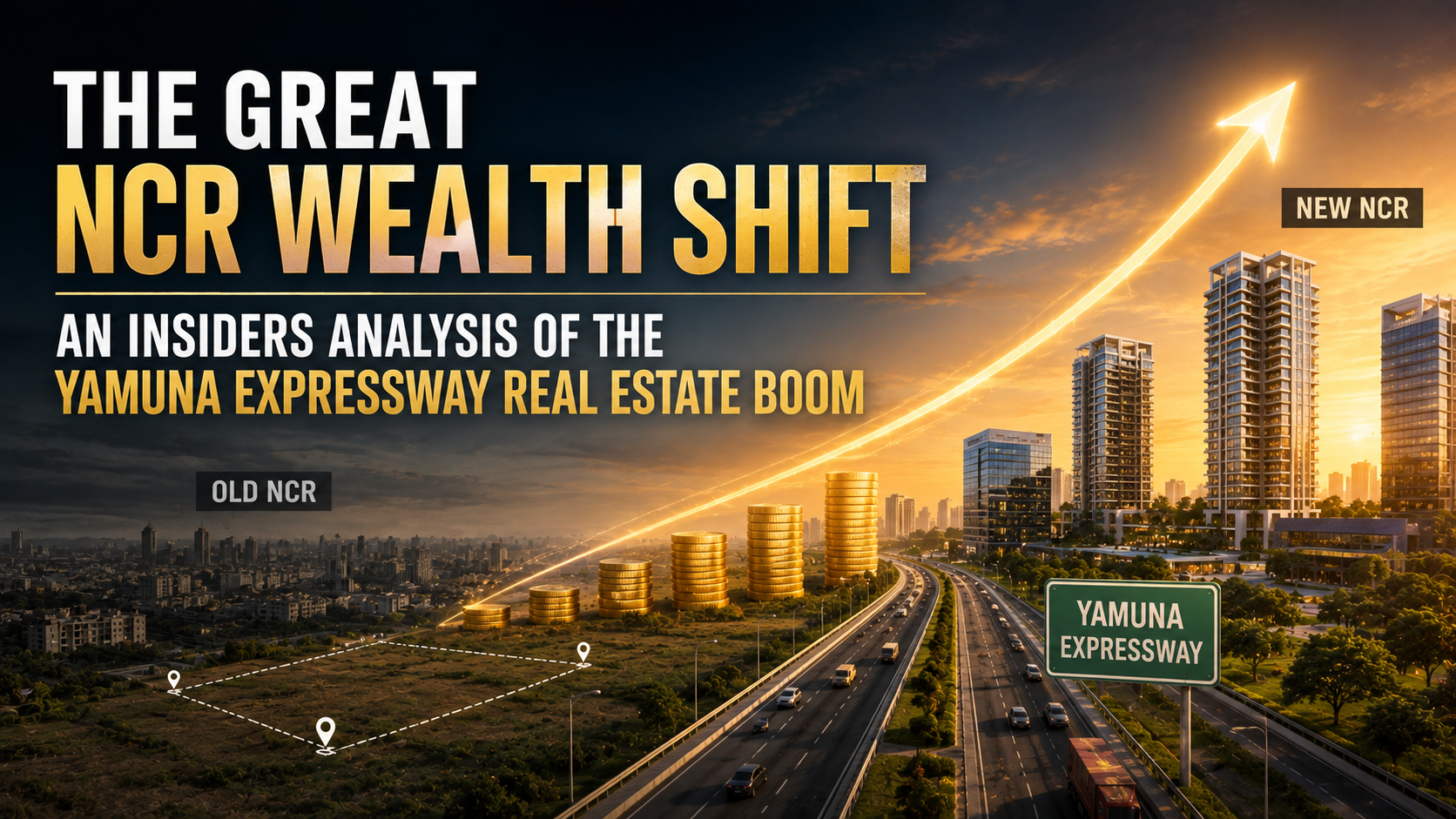
The real estate landscape of the National Capital Region (NCR), particularly along the Yamuna Expressway Industrial Development Authority (YEIDA) corridor and the upcoming Noida International Airport in Jewar, represents one of the most explosive wealth-building opportunities in the country. Driven by massive state-backed infrastructure projects, property values are surging. However, the market is intensely fragmented. Investors looking to capitalize on this boom are frequently torn between chasing the hype of new urban centers, navigating the murky waters of rural land acquisitions, or falling back into the familiar but financially stagnant trap of high-rise builder flats.
Understanding the deep mechanics of this market—from the historical trajectory of land appreciation to the hidden legal pitfalls of agricultural paperwork—is the only way to secure generational wealth. This comprehensive guide breaks down the exact strategies, risks, and regional dynamics required to successfully invest in the NCR’s ultimate real estate frontier.
To understand the trajectory of the Yamuna Expressway today, one must look at the historical evolution of Noida. A deep dive into the real estate dynamics of the mid-1990s reveals a market that perfectly mirrors the current state of the outer YEIDA regions. In 1996, agricultural land in peripheral Noida villages like Sadarpur was available for roughly ₹50,000 per bigha (effectively ₹50 per square yard).
For early investors, the primary fear was the safety of their hard-earned capital in undeveloped, rural territories. However, this fear was mitigated by partnering with highly trusted, ethical local consultants who navigated the complex village dynamics. The patience paid off spectacularly. By the early 2000s, government acquisitions yielded compensation that was six times the initial investment. Back then, outside investors were not entitled to the highly lucrative 7% developed alternative plots—a policy that only changed after significant court rulings post-2014, making modern land investment exponentially more profitable.
By 2001, the announcement of an international airport in Jewar shifted the focus further down the corridor. Between 2004 and 2005, land around Jewar was available for ₹75,000 to ₹1 Lakh per bigha. At the time, reaching Jewar from Noida was a grueling three-hour journey. There was no local broker network, and navigating the area required immense groundwork. Early attempts often led to mistakes, such as purchasing cheap 'Khadar' (flood-prone riverbed) land before realizing the necessity of strictly buying 'Bangar' (solid, elevated agricultural) land. Fast forward to the present day, and those exact Jewar land parcels are commanding astronomical rates of ₹1.5 Crore per bigha and beyond.
As the Jewar airport nears operational status, a critical shift is occurring in the investment landscape. When land in a specific hyper-growth node like Jewar becomes exorbitantly expensive, a dangerous market dynamic emerges. The highly desirable, dispute-free land is quickly absorbed by institutional buyers and wealthy locals. Consequently, approximately 70% of the remaining inventory floating in the open market consists of flawed, rejected, or legally disputed properties.
To find clean, high-growth inventory, strategic capital is now moving further down the 165-kilometer expressway toward Tappal and the Bajna Cut. This southern migration is heavily supported by the YEIDA master plan, which is executing development in three distinct phases. Phase 1 centered entirely on Jewar. Phase 2 encompasses the Tappal, Bajna, and Mant regions. Phase 3 extends further south into Mathura, Hathras, and Agra.
The Bajna Cut and Mant regions currently represent the sweet spot for investment. A few years ago, land here hovered around ₹3 Lakh per bigha. Today, driven by the reinvestment of airport compensation funds by local farmers, rates have climbed to ₹15 Lakh to ₹20 Lakh per bigha. The master plan for this specific corridor includes massive infrastructural upgrades, including the Raya Heritage City, the Vrindavan Heritage City, and sprawling logistics hubs. The ideal investment window for securing affordable land in this specific corridor is narrowing rapidly, with major price escalations expected within the next six to eight months. The most lucrative parcels are those situated within a one to two-kilometer radius of the highway, featuring clear, accessible 'Chak' (village) roads.
One of the most critical questions new investors ask is why certain land parcels are offered at prices significantly below the prevailing market rate. In the agricultural land sector, an unusually cheap price tag is an immediate red flag. Good land does not float around at a discount; it is absorbed instantly.
The primary reason for heavily discounted land is a total disconnect between the paperwork and physical possession. A property might have flawless registry and mutation documents, but the original farmer may have migrated years ago, allowing distant relatives or local strongmen to encroach upon the physical plot. Unethical dealers frequently attempt to sell this encroached land by physically taking the buyer to a completely different, clean parcel of land during the site visit, while processing the paperwork for the disputed plot.
Another massive hidden danger lies in the exact categorization of the land. Investors must differentiate between 'Dada Lai' (ancestral property tracing back to the 1359 Fasli year records) and 'Patta' (land originally leased by the government to landless farmers). While ancestral land is generally safe, Patta land is a legal minefield. Government leases granted for specific purposes—such as grazing lands (Gauchar), forest buffers, or village ponds—do not qualify for monetary compensation during authority acquisition. Only 'Banjar' (barren land) Pattas are eligible for acquisition payouts. Verifying these intricate details through 41/45 revenue records is the only way to avoid buying legally worthless land.
Furthermore, investors frequently question why certain land parcels directly adjacent to highly developed areas, like YEIDA Sector 22D, remain unacquired and surprisingly cheap. The answer lies in the timeline of the master plans. Authorities acquire land in strictly controlled phases based on immediate zoning requirements (industrial vs. residential) and available treasury funds. Land that falls under the future 2041 master plan might be geographically close to current developments but will not be acquired for another 10 to 15 years, drastically delaying the investor's exit strategy and ROI.
A common dilemma is whether an investor should bypass consultancy fees and purchase land directly from the village farmers. While this is legally permissible, it is fraught with operational hazards.
The rural real estate ecosystem operates on a complex web of local relationships. While the vast majority of farmers are honest, the transaction mechanics are often handled by local middlemen who may withhold payments from the farmer to maximize their own margins. When a farmer does not receive their full payment on time, they naturally refuse to hand over physical possession of the land to the end buyer, resulting in a bitter, prolonged dispute.
A professional, ethical consultant acts as a vital shield against these hazards. The nominal fee paid to a consultant is not just for brokering a deal; it is the cost of leveraging decades of experience to verify 40 years of revenue records, ensuring the physical GPS coordinates match the paperwork, managing the financial escrow to ensure the farmer is paid in full simultaneously with the registry, and securing immediate, undisputed physical possession. Attempting to save a minimal percentage on consultation fees frequently results in the total loss of the principal investment.
When evaluating agricultural land for future government acquisition, investors often obsess over the physical shape of the parcel, preferring perfect squares or rectangles and avoiding L-shaped plots. In reality, the shape of the land is entirely irrelevant to the core investment strategy. Government authorities calculate acquisition compensation strictly on a per-square-meter basis, regardless of the geometric layout of the boundaries.
The true focus must be on immediate post-purchase security. The exact protocol dictates that the moment the registry is complete, the investor must assert absolute physical dominance over the property. This involves evicting the previous farming arrangement and immediately installing concrete pillars and barbed wire fencing.
Following the fencing, the land should be formally handed over to a trusted local associate or a neighboring tractor owner for continuous cultivation under a new agreement. For a nominal annual maintenance fee of roughly ₹5,000 to ₹10,000, local security personnel can be retained to visit the site weekly. In the current administrative climate of Uttar Pradesh, supported by stringent anti-land-mafia government portals, illegal encroachment is exceedingly rare unless a property is completely abandoned and ignored by the owner for periods exceeding five to ten years.
The real estate market is highly susceptible to hype, the most recent being the "New Noida" project slated for the Bulandshahr and Dadri regions across the railway lines. While the concept sounds promising, strategic analysis suggests extreme caution.
Currently, the New Noida region lacks a fully operational administrative office, a concrete timeline for mass acquisition, and critical clarity regarding whether investors will be entitled to the highly lucrative 7% developed alternative plots. Despite this massive administrative ambiguity, speculative hype has already driven ground-level prices to an exorbitant ₹60 Lakh per bigha. Investing heavy capital into an unproven, overpriced zone with no clear exit strategy is a high-risk gamble compared to the guaranteed, rapidly executing master plans of the YEIDA and Jewar corridors.
Investors also frequently question the stark price disparity between Uttar Pradesh and neighboring Haryana, wondering why UP land remains comparatively affordable. The root cause is historical legislation. Uttar Pradesh implemented strict land ceiling acts decades ago, preventing the consolidation of massive, monopolistic land banks. This resulted in a highly fragmented ownership structure with thousands of small-holding farmers. When these farmers face major life events—such as funding a child's marriage or launching a business—they are forced to liquidate portions of their land, creating a continuous, competitively priced supply that keeps the market accessible.
A critical error many investors make is attempting to build wealth through high-rise builder flats or commercial office spaces instead of raw land. Analyzing decades of real estate performance reveals that builder properties are a notoriously poor investment vehicle.
Real-world examples paint a grim picture. An investor purchasing a premium commercial office space might wait 15 years through endless construction delays, legal battles, and regulatory appeals just to receive physical possession. Once operational, the financial reality is bleak: the property might generate a rental income of ₹18,000 per month, but the builder will enforce mandatory, inescapable maintenance charges of ₹10,000 per month.
Builders maintain a permanent, monopolistic grip on their projects. They levy exorbitant hidden fees for electricity load upgrades, parking allocations, and unadvertised club memberships. Most destructively, when an investor attempts to sell the property to realize their capital gains, the builder will impose massive transfer charges, essentially siphoning off the majority of the profit. Flats and commercial spaces offer minimal capital appreciation and function more as leveraged liabilities than wealth-generating assets.
This disparity is also evident when comparing saturated metropolitan capitals to expanding peripheries. Investors heavily concentrated in central Delhi neighborhoods have seen their property values grow perhaps tenfold over a span of 30 years. In stark contrast, those who stepped out of their comfort zones and invested in the raw, peripheral lands of early Noida saw their capital multiply by an astonishing 150 times over the exact same period. True generational wealth is consistently forged on the expanding fringes of infrastructure, never in the fully saturated centers.
The agricultural land market offers distinct entry points tailored to varying levels of capital. For young professionals in their late twenties with modest annual savings of ₹10 Lakh to ₹12 Lakh, the strategy requires patience and precision. Rather than locking inadequate funds into a depreciating apartment EMI, the optimal move is to accumulate savings for an additional six to eight months to reach a ₹15 Lakh to ₹20 Lakh threshold. This capital is sufficient to purchase a smaller, one-bigha parcel in the high-growth Bajna corridor, successfully initiating their real estate portfolio without crippling debt.
For High-Net-Worth Individuals (HNIs) possessing liquid capital between ₹1 Crore and ₹3 Crores, the strategy shifts toward consolidation. Rather than scattering funds across dozens of micro-investments, the focus should be on acquiring massive, consolidated land parcels. Large, contiguous land banks are significantly easier to manage, fence, and secure, and they offer immense leverage during the final government acquisition process.
The ultimate blueprint for financial independence is the multi-year rolling investment strategy, a methodology that perfectly mirrors how local NCR farmers became extraordinarily wealthy.
The system operates on a continuous loop. An investor commits to purchasing one parcel of land every single year from 2026 through 2032. By the time 2033 arrives, the land purchased in 2026 will have matured, likely having undergone acquisition and massive appreciation. The investor then sells or liquidates the 2026 asset. A portion of these massive profits is extracted to fund major life milestones—building a primary residence, funding higher education, or launching a business—while the original principal is rolled forward into a new land purchase.
Executing this strategy creates a perpetual, self-sustaining wealth machine. It entirely eliminates the financial anxieties associated with corporate salary dependence or business downturns. This exact model of holding raw land until infrastructure arrives is why a significant portion of NCR farmers currently possess more liquid wealth, larger mansions, and higher commercial rental incomes than the highest-paid urban corporate executives.
The greatest threat to a modern investor is the digital comfort zone. Today's youth are heavily conditioned to restrict their investments to screen-based assets—mutual funds, SIPs, and digital gold—while entirely ignoring the massive, tangible wealth being generated in the offline real estate sector.
This hesitation manifests as severe analysis paralysis, leading to highly unrealistic market expectations. Novice buyers frequently enter the market demanding land situated directly next to the operational Jewar Airport, but aggressively insist on paying the heavily discounted prices found 50 kilometers away in Mant. When confronted with the reality of premium pricing, they question the seller's motives, wondering why a farmer would sell land if the airport is truly driving up prices. The reality is that rural economies require liquidity; farmers sell high-value parcels near the airport to purchase exponentially larger tracts of cheaper land further out, multiplying their own holdings.
Waiting for the perfect, risk-free, heavily discounted deal in a booming infrastructure corridor is a mathematical impossibility. As the old real estate adage dictates: "Cheap makes you cry repeatedly; expensive makes you cry once." Refusing to pay the fair market premium for clean, verified, high-growth land simply results in being permanently priced out of the market. The investors who hesitated to buy Noida land twenty years ago are the same individuals currently hesitating to buy Jewar land today, and they will be the exact same people regretting their failure to invest in Bajna ten years from now.
To succeed in the NCR land market, investors must adopt a twenty-year operational horizon, partner with deeply experienced verification consultants, and decisively execute their purchases before the infrastructure physically materializes.
